Interactive Brand Bibles: Turning Style Guides into Questas Adventures Your Team Will Actually Use


Most brand teams have a familiar pain: you pour months into a beautiful brand book… and then watch people ignore it.
Designers hunt for the “right” logo in random Slack threads. Sales decks show up in off-brand gradients. New hires get a 60-page PDF in onboarding, skim the first five, and never open it again.
You’re not alone. Surveys suggest that while the vast majority of companies have some form of brand guidelines, only a minority actively enforce or consistently follow them. One recent roundup put it bluntly: 95% of companies report having brand guidelines, but only about a quarter say they’re actually enforced. That gap between having a brand bible and living it is where consistency, trust, and growth quietly leak away.
So what if your brand bible wasn’t a static artifact at all?
What if it behaved more like a game tutorial or a playable story—something people experience instead of merely reference?
That’s where turning your style guide into an interactive adventure built with Questas comes in.
Why Static Brand Bibles Fail (And What You’re Losing)
Before we talk about interactive brand bibles, it’s worth naming why the old model breaks down.
1. PDFs are built for reference, not behavior change
Static guidelines are great as a legal and design reference. They are terrible at:
- Teaching judgment (“Is this almost on-tone, or way off?”)
- Modeling tradeoffs (“If I break this rule, what happens?”)
- Showing consequences (“This is how a slightly off-color palette feels across a whole campaign.”)
They tell you what the rules are, but not how it feels to use them.
2. People learn by doing, not reading
There’s a reason gamified learning keeps showing up in corporate training and education research: when learners make choices, see feedback, and get pulled through a story, engagement and retention jump significantly compared to passive formats.
Your brand bible is, at its core, a learning problem:
- New hires need to absorb your story, values, and visuals quickly.
- Partners and agencies need to internalize the boundaries of your world.
- Internal teams need to practice making brand calls before they’re shipping work to thousands of customers.
Reading a PDF once doesn’t build that kind of muscle.
3. Guidelines are often hard to find and easy to ignore
Even when a company has great guidelines, common friction points show up:
- The “real” latest version lives in someone’s Google Drive.
- People bookmark a link, then the file gets updated elsewhere.
- Teams outside marketing don’t even know where to look.
The result: rogue decks, improvised one-pagers, and a lot of “close enough” execution.
Meet the Interactive Brand Bible
An interactive brand bible is a choose-your-own-adventure training experience where employees and partners play through your brand instead of just reading about it.
Built with a no-code platform like Questas, it becomes a branching story that:
- Drops people into realistic scenarios ("You’re a sales rep building a deck for a skeptical enterprise buyer.")
- Presents choices that mirror real decisions ("Do you lead with product features, customer story, or mission?")
- Shows immediate consequences through narrative, visuals, and outcomes ("The customer reacts this way…" or "Design flags your deck as off-brand.")
Instead of a static “do this, don’t do that” document, your brand bible becomes:
- Playable onboarding for new hires
- Ongoing practice ground for marketers, sales, and support
- A living hub you can update and expand over time
If you’ve read our piece on turning briefing documents into playable experiences—“From Brief to Branches: Agencies Using Questas to Pitch Campaign Concepts as Playable Stories”—this is the same idea, pointed inward at your own team.

Why Turn Your Style Guide into an Adventure?
Let’s ground this in concrete benefits.
1. Better brand consistency, less policing
When people feel what on-brand vs. off-brand looks like across a story, they:
- Make fewer “close enough” design and tone calls.
- Catch their own mistakes before they ship.
- Need fewer review cycles with brand guardians.
You move from enforcement to shared intuition.
2. Faster, more memorable onboarding
Instead of dropping new hires into a folder of PDFs, you:
- Give them a playable journey through your brand’s origin story.
- Let them role-play as a marketer, sales rep, or support agent.
- Embed your mission and values into narrative choices that matter.
They’re more likely to remember the story they played than the deck they skimmed.
If you’re curious how this logic plays out in learning design, our post on interactive course materials—“AI, Interactivity, and the Death of the Static Syllabus: The Future of Course Design in 2030”—dives deeper into why static documents underperform.
3. Safer practice for tricky brand decisions
Some of the hardest brand calls are gray areas:
- How edgy can we be on social without breaking trust?
- How do we respond to a public complaint while staying on-tone?
- How far can a regional team localize a campaign before it stops feeling like us?
Interactive stories give your team a risk-free sandbox to try options, see outcomes, and debrief. It’s the same principle we explore in “Office Politics, But Make It Playable: Using Questas to Rehearse Feedback, 1:1s, and Promotion Conversations”: when stakes are simulated, people experiment more and learn faster.
4. A living system, not a frozen artifact
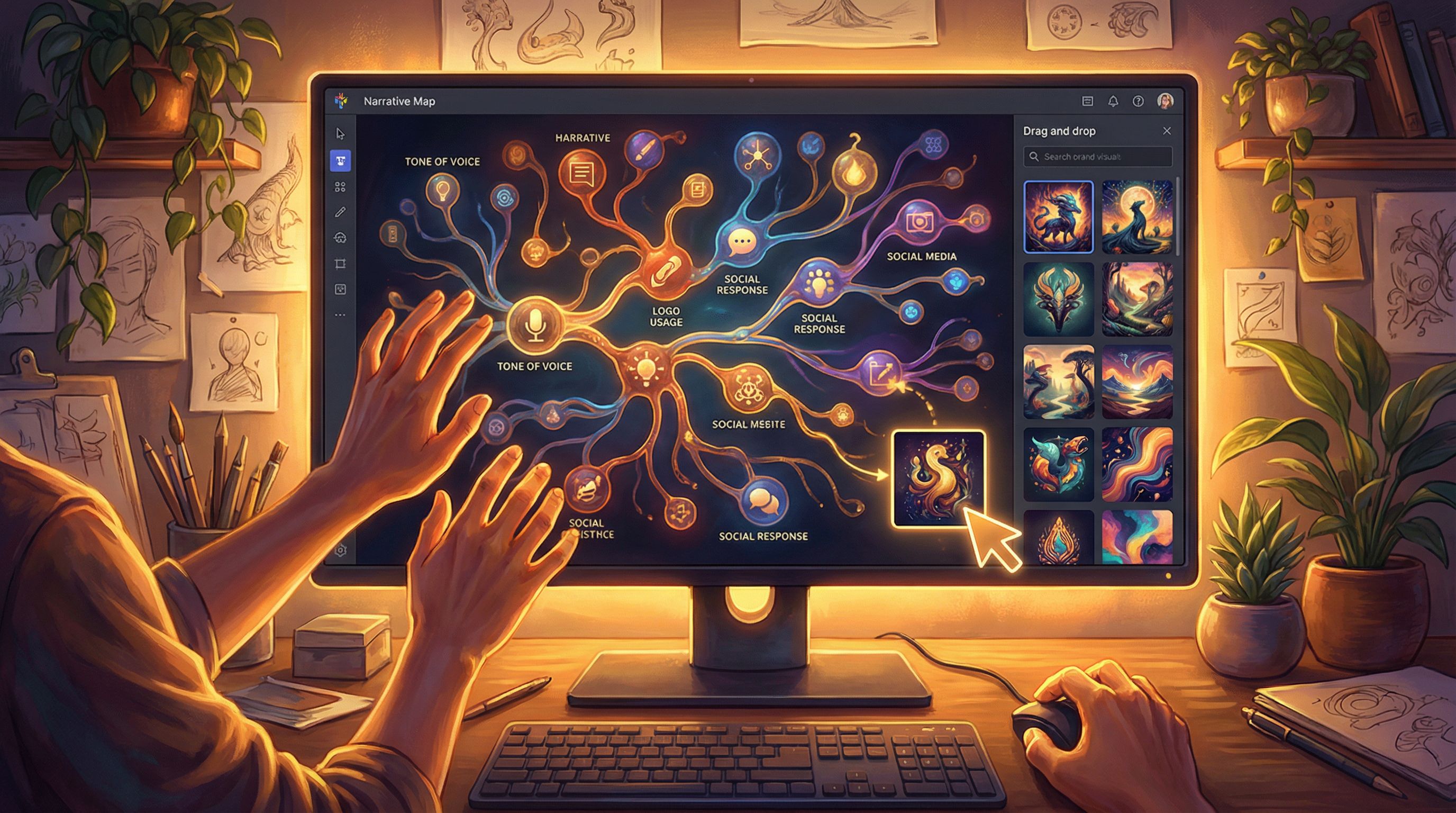
Because Questas is a visual, no-code editor, your brand bible doesn’t have to be “final” in the traditional sense.
You can:
- Add new branches when you launch a product line.
- Update tone examples when your messaging evolves.
- Layer in new scenarios as you see recurring issues in reviews.
Your brand bible becomes a living story system that grows with your company.
Designing Your First Interactive Brand Bible in Questas
Let’s walk through how to actually build one.
Step 1: Decide on the core journeys
Start by choosing 2–3 high-impact journeys where brand alignment really matters. For example:
-
New hire origin story
- Goal: Teach the “why” behind your brand, not just the “what.”
- Player role: A new teammate exploring the company’s past decisions.
-
Campaign creation path
- Goal: Show how visual and verbal guidelines shape a campaign.
- Player role: A marketer or agency partner pitching a new concept.
-
Customer interaction path
- Goal: Practice tone-of-voice and values in real conversations.
- Player role: Support rep, community manager, or salesperson responding to a situation.
Each journey becomes its own playable “chapter” inside your interactive brand bible.
Step 2: Translate guidelines into decision points
Open your existing brand guidelines and highlight anything that starts with:
- “Always…”
- “Never…”
- “Whenever possible…”
- “Avoid…”
- “Examples of on-brand / off-brand…”
These are perfect candidates for branching choices.
For each rule, ask:
“What real-life moment would force someone to apply this rule?”
Then design a scene around that moment. For example:
-
Rule: “Avoid stock photos that feel generic or overly staged.”
Scene: The player must choose images for a landing page hero. One option is polished but fake; another is a bit imperfect but authentic. The outcomes show how each choice affects trust and clarity. -
Rule: “Our tone is confident but never arrogant.”
Scene: The player writes a social post announcing a big milestone. They choose between three drafts, each slightly different in voice, and see how the audience responds.
Inside Questas, you’d represent each of these as a choice node with branches leading to different reactions, visuals, and follow-up scenes.
Step 3: Use AI visuals to embody your brand system
An interactive brand bible is the perfect place to show your visual system in action.
Because Questas supports AI-generated images and video, you can:
- Generate on-brand vs. off-brand visual comparisons right inside scenes.
- Demonstrate how your color palette, typography, and photography style play together.
- Build a reusable “cast” of brand characters (e.g., your archetypal customer, founder, or mascot) that recur across chapters.
If you want a deeper dive into building a consistent visual ensemble, check out “AI as Casting Director: Designing Reusable Character Ensembles for Multiple Questas Stories” (/ai-as-casting-director-designing-reusable-character-ensembles-f). The same techniques apply beautifully to brand worlds.
Practical tips:
- Lock in prompts that match your brand style (e.g., “soft natural lighting, candid photography, muted blues and warm neutrals, minimal composition”).
- Create a mini ‘visual cookbook’ of prompts for:
- Product shots
- People photography
- Abstract backgrounds
- UI mockups
- Reuse these prompts across scenes so the world feels coherent.
Structuring the Adventure: From Lore to Live Decisions
A strong interactive brand bible balances lore, practice, and reflection.
1. Open with a narrative hook
Instead of “Welcome to the brand guidelines,” try something like:
“You’ve just joined the team. It’s your first week, and your manager drops a surprise on your desk: you’re helping with a high-visibility launch.”
Drop the player into a situation where the brand matters immediately.
Then, in the first few scenes:
- Introduce your mission and values through character dialogue and flashbacks.
- Use AI visuals to show key moments from your brand’s history.
- Let the player make a couple of low-stakes choices (e.g., which founder story to explore first) so they feel agency early.
2. Interleave micro-lessons with choices
Avoid front-loading all the rules. Instead, follow a rhythm:
- Present a situation (e.g., “You’re choosing a hero image for the homepage.”)
- Offer 2–3 options that each embody a different interpretation of the guidelines.
- Show the outcome, with a short micro-lesson explaining why one option aligns better.
This is exactly the kind of “invisible tutorial” structure we talk about in “Designing ‘Invisible Tutorials’: Teaching New Mechanics and Rules Inside Your Questas Narrative” (/designing-invisible-tutorials-teaching-new-mechanics-and-rules): people learn best when the teaching is woven into play.
3. Build in “quiet choices” that shape brand feel
Not every decision needs to be a big fork. Sprinkle in small, flavor choices that express personality:
- Which subject line do you choose for a newsletter—playful, direct, or poetic?
- What sign-off do you use in a support email—“Cheers,” “Best,” or your brand-specific phrase?
- Which illustration style do you lean toward—flat icons or textured sketches?
These “quiet choices” don’t drastically change the plot, but they:
- Help players internalize nuance.
- Make the experience feel personal.
- Surface subtle aspects of your brand.
Our post “Designing ‘Quiet Choices’: Low-Stakes Branches that Build Character, Not Just Plot, in Questas” (/designing-quiet-choices-low-stakes-branches-that-build-characte) explores how powerful this can be.
4. Show consequences over time, not just instant feedback
Some of the most interesting branches in an interactive brand bible are delayed consequences:
- Use a slightly off-tone tweet early on, and later see it resurface in a press conversation.
- Choose a mismatched photo style, and later see your campaign grid look disjointed.
- Underplay your values in a sales call, and later find that the customer churns faster.
This mirrors reality: brand decisions ripple outward.
In Questas, you can:
- Track key choices with variables (e.g.,
tone_risk,visual_consistency). - Unlock different scenes or endings based on those scores.
- Use AI visuals to show side-by-side “world states” (e.g., cohesive vs. chaotic brand presence).
Making It Useful Across Departments
A great interactive brand bible isn’t just for designers. It should feel relevant to:
- Marketing & Creative – campaign concepts, content calendars, social posts.
- Sales – decks, one-pagers, outreach emails.
- Customer Support & Success – tone in tickets, escalation messaging.
- People & Talent – employer brand, job descriptions, offer letters.
- Leadership – how public statements and strategy updates reflect the brand.
A few ways to pull everyone in:
-
Role-based paths
Let players pick their role at the start, then branch them into scenes that match their work. -
Shared “brand moments”
Include crossover scenes where multiple roles intersect (e.g., a launch that touches marketing, sales, and support) so everyone sees the bigger picture. -
Optional deep dives
Use optional branches for specialists: typography nerds can go deeper into type scale; support leaders can explore escalation scripts.
Launching and Evolving Your Interactive Brand Bible
Building the experience is only half the work. You also need to launch and maintain it like a product.
Start small, then iterate
You don’t need a 3-hour epic out of the gate. Aim for:
- A 15–30 minute core journey.
- 2–3 key scenarios.
- A handful of meaningful branches.
Use feedback to decide what to add next.
Bake it into real workflows
Make the interactive brand bible a default part of:
- New hire onboarding checklists.
- Agency kickoffs and partner trainings.
- Quarterly brand refresh or enablement sessions.
Link to your Questas experience from your intranet, Notion, or LMS so it’s as easy to find as the old PDF.
Measure what matters
Track things like:
- Completion rates and replay rates.
- Time spent in key scenarios (e.g., tone-of-voice, visual system).
- Common paths or endings—where are people making risky choices?
Use those insights to:
- Update weak spots in your guidelines.
- Design new branches around recurring misunderstandings.
- Prioritize live workshops where the interactive story reveals confusion.
Bringing It All Together
An interactive brand bible reframes your guidelines from “a document to read” into “a world to explore and practice in.”
By turning your style guide into a Questas adventure, you:
- Help people internalize your brand through story, not just rules.
- Give them a safe space to rehearse real decisions before the stakes are high.
- Transform a static, often-ignored asset into a living, evolving system.
Instead of asking, “Why doesn’t anyone use our brand guidelines?” you’ll be asking, “What new chapter should we add next?”
Ready to Build a Brand Bible People Actually Use?
You don’t need to be a game designer—or a developer—to start.
Here’s a simple way to take the first step this week:
- Pick one high-impact scenario where brand alignment often slips (e.g., social posts, sales decks, support replies).
- Outline three key decisions someone makes in that scenario.
- Open Questas and sketch those decisions as a short branching path.
- Use AI visuals to create on-brand vs. off-brand examples right inside the scenes.
- Share it with a small pilot group (a squad in marketing or sales) and ask: “Did this feel more useful than reading the PDF?”
From there, you can grow that prototype into a full interactive brand bible—one chapter, one scenario, one branch at a time.
Adventure awaits in your own brand. It’s time to let your team play it.