Office Politics, But Make It Playable: Using Questas to Rehearse Feedback, 1:1s, and Promotion Conversations

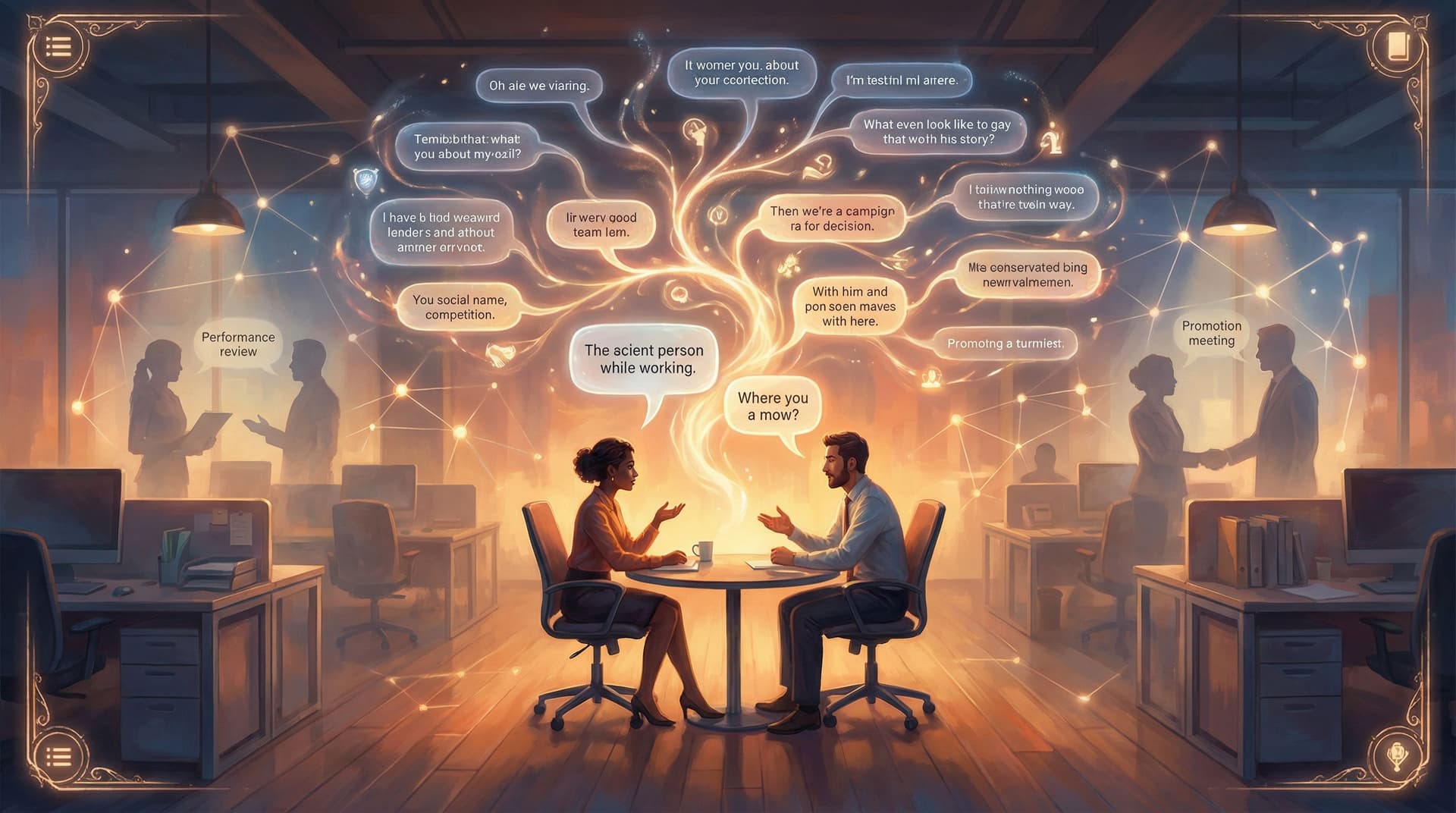
Office politics has a reputation problem.
For many people, the phrase conjures back-channel gossip, power plays, and unwritten rules that seem designed to trip you up. But under all of that is something much more ordinary—and much more trainable:
- How you give and receive feedback
- How you show up in 1:1s with your manager or reports
- How you advocate for promotions, raises, and scope
Those conversations shape careers. They influence who gets stretch projects, who burns out, who quietly leaves, and who feels psychologically safe enough to do their best work.
The trouble: most of us only get to practice these moments live, with real stakes and real people.
That’s where making office politics playable comes in.
Interactive, branching stories built with platforms like Questas let you turn high-stakes workplace conversations into low-risk simulations. You can test different approaches, see how they land, and build conversational “muscle memory” before you walk into your manager’s office—or log into that Zoom.
Why Make Office Politics Playable at All?
Before we get tactical, it’s worth naming why this matters.
1. High-stakes conversations are cognitively overloaded
Feedback and promotion discussions often combine:
- Ambiguous expectations (What does “senior” really mean here?)
- Power dynamics (Your manager or VP controls opportunities and compensation.)
- Identity triggers (Bias, stereotype threat, and past experiences all show up.)
- Time pressure (You’ve got 30 minutes and 12 agenda items.)
Under that load, even experienced people default to:
- Over-explaining or under-communicating
- Getting defensive instead of curious
- Forgetting key examples or evidence
- Saying “yes” to things they shouldn’t
A playable scenario offloads some of that pressure. You can pause, rewind, and explore alternate paths—something you can’t do in a real performance review.
2. Real practice beats abstract advice
You’ve probably read articles on “how to ask for a raise” or “how to give constructive feedback.” They’re helpful, but they live at the level of ideas and templates.
Interactive stories live at the level of decisions and consequences:
- Do you open the 1:1 by naming the tension, or by asking about their week?
- Do you share your promotion case now, or ask your manager how they see your trajectory first?
- When your direct report gets emotional, do you push through the agenda or slow down and validate?
Platforms like Questas are designed around these branching moments. Instead of reading about “good feedback,” you play through good and bad feedback, then see the emotional and political ripple effects.
If you’re curious how this kind of rehearsal shows up in other high-stakes spaces, we dig into that more deeply in Branching Narratives for Therapists and Coaches: Using Questas to Rehearse Tough Conversations Safely.
3. You can safely explore edge cases and failure modes
In a real office, you only see a narrow slice of possible reactions:
- The one manager you happen to have
- The one culture you happen to be in
- The one outcome that actually happened
Interactive simulations let you explore:
- Supportive vs. skeptical managers
- Equitable vs. biased responses
- Short-term wins vs. long-term tradeoffs
You can design stories where:
- The same script lands great with one leader and terribly with another
- Being “nice” in the moment leads to burnout later
- Saying “no” to one project opens a better door down the line
That range of experience is almost impossible to get from one job—or one manager—alone.
Three Core Scenarios to Turn into Playable Stories
You don’t need to model your entire company to get value. Start with three high-impact conversation types.
1. Feedback conversations (up, down, and sideways)
Examples:
- Telling a peer their behavior is derailing meetings
- Giving a direct report tough feedback on quality or reliability
- Giving “managing up” feedback to a manager who’s dropping balls
What to model:
- Tone choices: direct vs. tentative, data-heavy vs. feelings-forward
- Timing: in-the-moment vs. end-of-cycle
- Framing: behavior and impact vs. personality labels
- Follow-through: clear next steps vs. vague “let’s circle back”
2. Career and promotion conversations
Examples:
- Making your case for promotion
- Negotiating scope creep or role drift
- Asking for a raise or title change
What to model:
- Evidence quality: vague “I’ve been working hard” vs. concrete business impact
- Calibration: asking how promotion decisions actually get made
- Strategy: building a case over months vs. a single big ask
- Response patterns: supportive, evasive, dismissive, or biased managers
For a deeper dive on turning complex journeys like this into interactive systems, you might enjoy From Short Story to Story System: Adapting Linear Fiction into Modular Scenes for Questas—the same techniques apply when you’re turning real workplace arcs into playable paths.
3. 1:1s and ongoing relationship management
Examples:
- Weekly 1:1s with your manager or reports
- Skip-level meetings with senior leaders
- Cross-functional check-ins where priorities clash
What to model:
- Agenda-setting: status updates vs. strategic conversations
- Psychological safety: naming concerns vs. staying surface-level
- Expectation-setting: clarifying ownership and deadlines
- Relationship-building: micro-moments of trust or erosion
Designing Your First Office Politics Simulation in Questas
Let’s walk through how you might build a “Promotion Conversation Simulator” using Questas. You can adapt this same pattern for feedback or 1:1s.
Step 1: Define the playable question
Start with a single, sharp question your story will help players explore. For example:
“How can I advocate for a promotion without damaging my relationship with my manager?”
Other strong questions:
- “How do I give tough feedback to a high performer without demotivating them?”
- “How do I push back on unrealistic deadlines from a senior stakeholder?”
This question is your north star. Every branch should help the player see different ways of answering it.
Step 2: Cast your characters
Even in a corporate sim, characters matter. They are your NPCs—the non-player characters that react, remember, and push back.
For a promotion story, you might include:
- You (the player): mid-level IC or manager
- Your manager: supportive but overloaded, skeptical, or politically constrained
- A mentor or peer: someone you can rehearse with before the real convo
- A skip-level leader or HR partner: someone who shapes the broader system
If you plan to build multiple workplace stories, consider designing a reusable “office cast” that can show up across scenarios. The approach in AI as Casting Director: Designing Reusable Character Ensembles for Multiple Questas Stories translates beautifully to corporate training and coaching.
Step 3: Map the critical decision points
Open the visual editor in Questas and sketch a simple backbone:
- Pre-conversation prep
- Do you gather evidence? Talk to a mentor? Or just wing it?
- Opening the conversation
- Do you ask for feedback first? Or state your promotion goal upfront?
- Handling pushback
- Your manager says: “Budget is tight” or “You’re not quite there yet.”
- Do you ask for specifics? Get defensive? Defer and leave?
- Agreeing next steps
- Do you co-create a plan? Ask for written criteria? Or let it fizzle?
For each node, add 2–3 options that reflect real-world instincts:
- The ideal move (clear, curious, grounded in impact)
- The common but suboptimal move (vague, defensive, avoidant)
- The politically naive or risky move (ultimatums, blame, triangulation)
This is where the platform’s branching structure shines: you can let players follow the “wrong” instincts and see what happens, instead of just telling them not to.

Step 4: Write scenes that feel like real meetings
Each node in Questas is a scene. Treat it like a mini script:
- A few lines of dialogue
- The emotional tone in the room
- Body language or environment details
- The internal monologue of the player, if helpful
Tips for authenticity:
- Use actual phrases you’ve heard in the workplace: “Let’s revisit this next cycle,” “We need you to show more leadership,” “Everyone’s working hard right now.”
- Show subtext: the difference between what people say and what they mean.
- Vary power dynamics: some managers are allies, some are blockers, some are simply constrained.
Because Questas supports AI-generated images and videos, you can:
- Visualize the setting: cramped conference room vs. airy remote home office
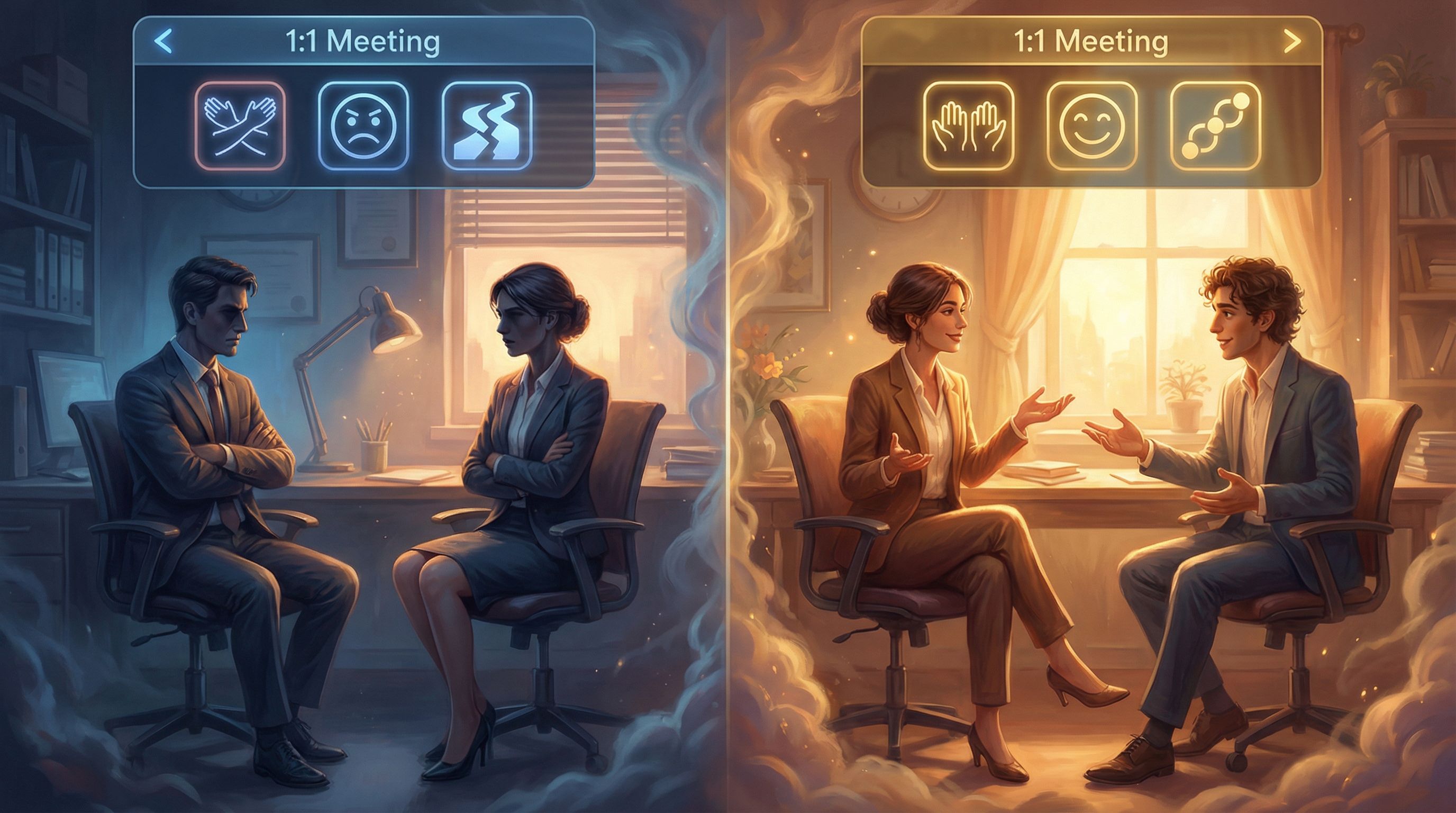
- Depict subtle emotional shifts: a manager leaning back, crossing arms, or relaxing when you bring data
- Give each character a consistent visual identity across scenes
Step 5: Use consequences, not lectures
The magic of a playable simulation is that you don’t need long paragraphs of advice. You can teach through outcomes.
For each branch, ask:
- Short-term impact: How does the manager react in the moment?
- Medium-term impact: What happens in the next 3–6 months?
- Emotional impact: How does the player feel leaving the room—empowered, confused, resentful?
Examples:
- If the player gets defensive when hearing “you’re not ready yet,” maybe the manager shuts down and becomes less transparent.
- If the player asks for specific examples and clear criteria, maybe the manager sends a follow-up email with a concrete plan.
- If the player triangulates (complains to a skip-level leader first), maybe they get a short-term win but long-term trust erosion.
You can surface these consequences as:
- Epilogue cards (“Three months later, your manager…”)
- Branch-specific outcomes (“Unlocked: Fast-track plan” vs. “Outcome: Stalled growth”)
- Subtle relationship meters (trust, clarity, influence) that move based on choices
Step 6: Layer in “quiet choices” that build realism
Not every branch needs to be a career-defining fork. In fact, adding low-stakes, character-revealing choices makes your office simulation feel more human:
- Do you open the 1:1 with small talk or jump straight to business?
- Do you bring a written agenda or keep it loose?
- Do you follow up with an email summary afterward?
These micro-decisions shape tone and trust over time. If you want to go deeper on this design pattern, Designing ‘Quiet Choices’: Low-Stakes Branches that Build Character, Not Just Plot, in Questas offers a rich toolkit you can apply directly to workplace stories.
Step 7: Add reflection and meta-learning
At the end of each run, don’t just show an outcome—help players connect dots.
You can use Questas to:
- Display a summary of key choices and how they influenced trust, clarity, and outcomes
- Offer alternative paths: “What if you’d asked for specific examples here?”
- Prompt self-reflection: short questions like:
- “Which choice felt most like what you’d do in real life?”
- “What surprised you about your manager’s reaction?”
- “What’s one phrase you want to try in your next real 1:1?”
For teams, you can even turn these into group debriefs:
- Everyone plays the same scenario
- People share which path they took and why
- You compare outcomes and discuss what “good” looks like in your culture
Who Can Use This—and How?
You don’t need to be an L&D pro or a game designer to build these simulations.
Individual contributors and managers
Use Questas as your personal practice ground:
- Build a “shadow version” of your next big conversation and play through it a few times.
- Explore how your manager might react in best-case, worst-case, and realistic scenarios.
- Identify phrases and framings that feel authentic and effective.
People leaders and HR / L&D teams
Turn your competency frameworks and leadership principles into playable journeys:
- Onboard new managers with a “feedback gauntlet” of scenarios
- Train ICs on how promotions work in your org through interactive stories
- Normalize tough conversations by letting people experience multiple perspectives
Because Questas is no-code and visual, you can iterate quickly:
- Start with a scrappy MVP scenario
- Watch how people play and where they get stuck
- Add new branches, characters, and media over time
Coaches and facilitators
If you already run workshops on communication, influence, or leadership, you can:
- Offer a pre-work or post-work playable module that reinforces your frameworks
- Customize scenarios for specific clients or industries
- Use branching stories live in sessions as “choose-your-own-debrief” activities
Practical Tips for Building Office-Politics Stories That Land
A few hard-won lessons from creators building workplace simulations:
-
Anchor in real language, not corporate jargon.
Write dialogue the way people actually speak in your org. Sprinkle in the acronyms and idioms your audience will recognize—but keep it human. -
Let players make “bad” choices without shame.
The point is exploration, not moralizing. Design branches where suboptimal choices are understandable, then show their tradeoffs. -
Model multiple kinds of managers.
Don’t assume every leader is enlightened—or terrible. Show:- The well-intentioned but vague manager
- The politically savvy but self-protective manager
- The truly supportive sponsor
-
Keep sessions bite-sized.
Aim for 10–20 minutes per run. It should feel like a coffee break, not a course. -
Use visuals to convey mood and power.
With AI-generated images and video, you can:- Highlight status differences (corner office vs. hot desk)
- Show emotional shifts (a furrowed brow, a relieved smile)
- Contrast remote vs. in-person dynamics
-
Iterate with real players.
Share early drafts with colleagues or pilot groups. Ask:- “Where did this feel unrealistic?”
- “What’s a reaction you’ve seen in real life that’s missing here?”
- “What’s a choice you wished you could make in this situation?”
Bringing It All Together
Office politics isn’t just about who gets invited to which meeting. It’s the accumulated effect of hundreds of conversations:
- The feedback you sugarcoat—or finally say out loud
- The 1:1s you treat as status reports vs. strategic time
- The promotions you advocate for, accept, or quietly give up on
Those moments are hard because they’re rare, emotional, and asymmetric. But they’re also learnable.
By turning feedback, 1:1s, and promotion conversations into interactive stories with Questas, you:
- Create a safe rehearsal space for high-stakes dialogue
- Let people test different strategies and see political consequences without real-world fallout
- Build shared language and patterns for what “good” looks like in your culture
Instead of telling people to “speak up more” or “be more strategic,” you can invite them into a playable world where they practice doing exactly that.
Your Next Step
You don’t need a full-blown curriculum to start.
- Pick one upcoming conversation you’re nervous about—feedback, a 1:1, or a promotion talk.
- Open Questas and sketch a simple four-scene flow:
- Before the meeting
- The opening
- The hard moment
- The outcome
- Add 2–3 choices at each step that reflect what you might actually do.
- Play through your own scenario a few times and notice what changes when you choose differently.
From there, you can expand into richer simulations for your team or organization—but that first, personal story will already change how you show up in the real room.
If you’re ready to turn office politics from something that happens to you into something you can practice, design, and improve, your next move is simple:
Open Questas, and make your next big conversation playable.