Designing ‘Quiet Choices’: Low-Stakes Branches that Build Character, Not Just Plot, in Questas


Most interactive stories obsess over the big forks:
- Do you save the village or chase the villain?
- Do you sign the contract or walk away?
- Do you trust the stranger or turn them in?
Those moments matter. They define endings, stakes, and replay value. But they’re not what players remember most.
What sticks are the small decisions:
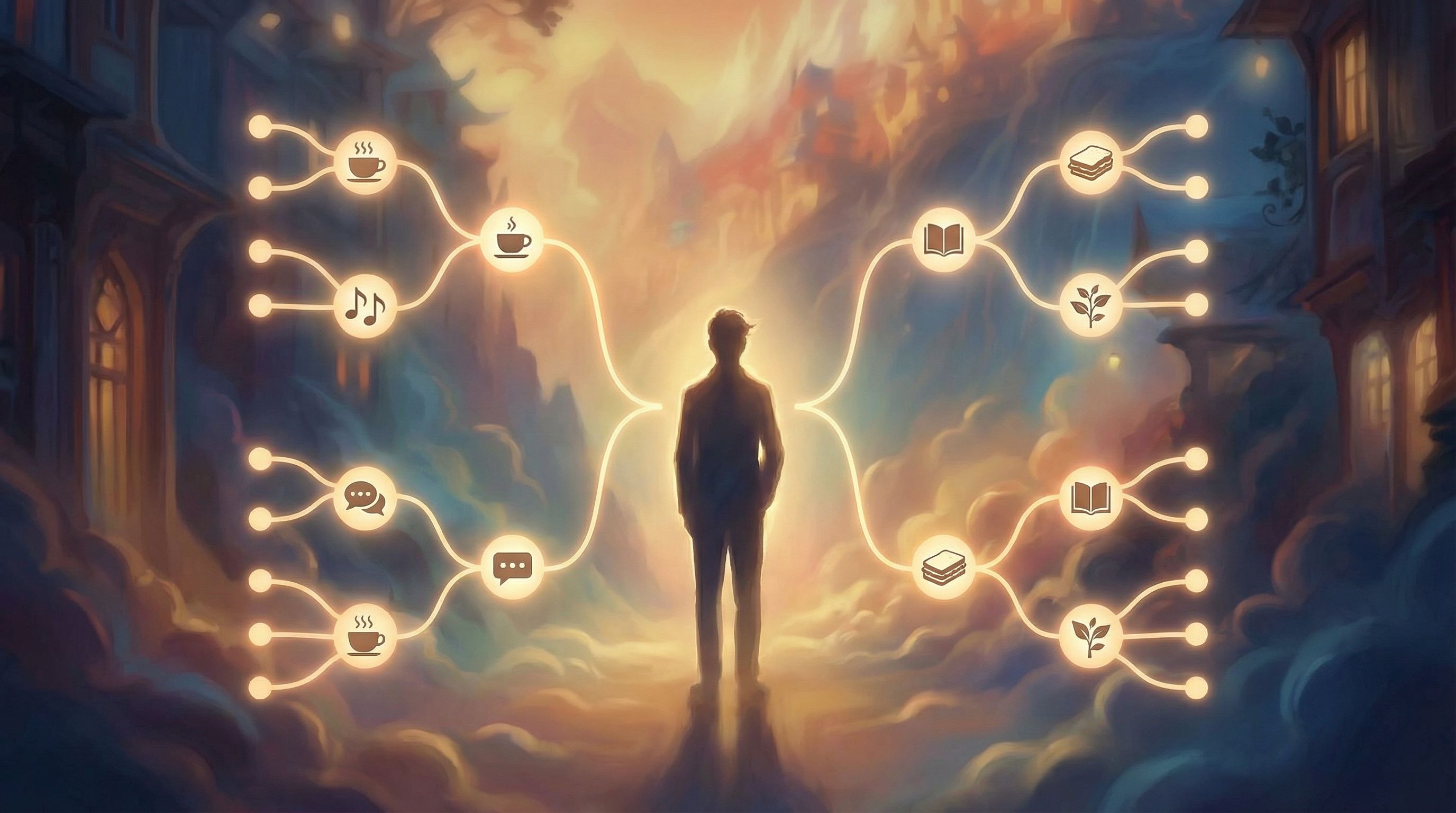
- The snack your character grabs before the mission.
- The playlist they put on during a late-night drive.
- Whether they text back “👍” or type out a real response.
These are quiet choices—low-stakes branches that don’t blow up the plot, but do reveal who the character is, what they care about, and how the player wants to inhabit them.
On Questas, where you can rapidly spin up branching scenes with AI-generated visuals and video, quiet choices are one of the fastest ways to deepen immersion without exploding scope. They give players room to roleplay, not just optimize.
This post is a deep dive into how to design those quiet choices deliberately: where to put them, how to scope them, how to visualize them, and how to make sure they enrich your story instead of derailing it.
Why Quiet Choices Matter More Than You Think
Quiet choices are decisions where:
- The immediate stakes are low (no one dies, no mission fails).
- The player learns something about the character, world, or themselves.
- The story remembers what they did—socially, emotionally, or cosmetically.
They’re powerful because they:
1. Turn avatars into people
When a player chooses how their character speaks, what they notice, or how they spend downtime, they’re not just moving a token through a plot—they’re inhabiting a person.
Examples:
- Picking between a blunt, diplomatic, or sarcastic greeting.
- Deciding whether to pet the dog, ignore it, or be afraid of it.
- Choosing to tidy a messy desk before a meeting or leave the chaos.
Each of these says something about the character’s values and temperament, even if no stat bar changes.
2. Invite replay without rewriting your story
Quiet branches are often soft branches:
- They might alter a line of dialogue later.
- They might recolor a visual, a prop, or a short callback scene.
- They rarely demand a whole new ending.
That’s ideal for Questas creators who want replay value without building a content hydra. You can reuse 80–90% of your scenes while still letting players feel, “This run was mine.”
If you’re already thinking about how to make short, expressive experiences, quiet choices pair beautifully with the ideas in The New Interactive Zine: Short-Form, Lo-Fi Questas Experiments for Writers and Indie Creators.
3. Build trust and emotional investment
When the story respects small decisions, players start to believe:
My presence here matters—even when nothing is exploding.
That belief is what makes later, high-stakes decisions land. A player who has already decided their character’s taste in coffee, music, or conflict style will care more when that character has to choose between loyalty and ambition.
Three Types of Quiet Choices (and When to Use Each)
Not all low-stakes branches do the same work. Here are three useful categories for Questas creators.
1. Flavor Choices: “Who am I in this moment?”
These are the smallest, lightest decisions—often cosmetic or tonal.
Examples:
- Picking one of three outfits before a party.
- Choosing a reaction emoji in a chat interface.
- Deciding whether to sit by the window, bar, or stage at a venue.
Best used for:
- Early scenes, to ease players into interacting.
- Moments where you want to show vibe more than consequence.
- Giving AI-generated visuals a chance to shine (e.g., three distinct outfit images).
How to implement in Questas:
- Create a decision node with 2–4 options.
- Have all options converge to the same next scene, but:
- Store a variable like
outfit = "leather_jacket". - Use that variable later to tweak a line of dialogue or an image prompt.
- Store a variable like
2. Preference Choices: “What do I care about?”
These choices reveal values, tastes, or priorities.
Examples:
- Selecting which coworker to help first when everyone’s overwhelmed.
- Choosing whether to donate time, money, or skills to a cause.
- Deciding which hobby the character leans on to de-stress.
Best used for:
- Mid-story scenes where the player already knows the basics.
- Foreshadowing later dilemmas (e.g., choosing between efficiency vs. empathy).
- Subtle relationship tracking between characters.
How to implement in Questas:
- Track preferences with simple flags:
values_empathy = true,team_loyalty += 1. - Use those flags to unlock optional callbacks: a scene where a character says, “You always look out for the new folks,” or an image where a previously chosen hobby appears in the background.
If you’re working on training or coaching content, these preference choices mesh well with the approaches in Branching Narratives for Real-World Skills: Turning Coaching Frameworks into Questas Scenarios.
3. Reflective Choices: “How do I make sense of what just happened?”
Here, the choice is about interpretation, not action.
Examples:
- After a tense meeting, asking the player: “What stung the most?” with options like:
- “Feeling dismissed.”
- “Being called unprepared.”
- “Letting my team down.”
- Letting the player label their character’s emotion: “angry,” “embarrassed,” “determined.”
- Offering different internal monologues in response to the same event.
Best used for:
- Scene transitions and debriefs.
- Learning or coaching experiences where reflection is a core goal.
- Stories dealing with ethics, tradeoffs, or grey areas (see Beyond Branching Dialogues: Using Questas to Prototype Ethical Dilemmas, Tradeoffs, and Grey-Area Choices).
How to implement in Questas:
- Follow a high-stakes scene with a short, quiet branch that doesn’t change the outcome—but does change:
- The next scene’s tone.
- The coach/mentor character’s feedback.
- The visual mood (lighting, color, camera angle) via AI prompts.
Designing Quiet Choices Step-by-Step in Questas
Let’s walk through a practical workflow you can use for your next Questas story.
Step 1: Start with your character, not your plot
Before you add a single branch, answer:
- What contradictions live inside this character?
- Confident in public, insecure in private?
- Idealistic but financially stressed?
- What habits or tics do they have?
- Always early, always late, always over-prepared?
- What are 2–3 tensions they wrestle with?
- Independence vs. belonging.
- Ambition vs. rest.
- Honesty vs. harmony.
Then ask: How could a small, everyday decision expose one of these? That’s your first quiet branch.
Step 2: Identify “breathing spaces” between big beats
Open your story map in Questas and look for:
- A commute before a crucial meeting.
- A night at home between missions.
- A hallway walk after a conflict.
These are ideal slots for quiet choices because:
- The player expects a pause.
- You don’t need to justify why the world isn’t exploding.
- You can safely converge branches back without breaking logic.
Add 1–2 low-stakes decision nodes into these spaces, not to change what happens next, but to color how it feels.
Step 3: Scope each quiet branch ruthlessly
Quiet choices are easy to overbuild. To keep scope sane, give yourself constraints (and if you like working with constraints, you’ll enjoy the techniques in Creative Constraints as Superpowers: Time-Boxed, Word-Count, and Image-Only Challenges in Questas).
For each quiet choice, decide:
- Max branch depth:
Flavor choice? 0–1 extra scenes, then reconverge.
Preference choice? Maybe 1–2 optional follow-ups. - Max unique media:
Flavor choice? Up to 3 distinct images.
Reflective choice? Same image, different captions or overlays. - What will “remember” this later?
- A one-line callback.
- A prop in the background.
- A slightly different reaction from an NPC.
If you can’t answer “What remembers this?” in one sentence, your quiet choice might actually be a major branch in disguise.
Step 4: Use variables lightly but intentionally
You don’t need complex systems. A few booleans and counters go a long way.
Example variable set for a workplace drama:
prefers_direct_feedback(true/false)values_team_over_self(0–3)stress_coping_style("avoid", "vent", "plan")
How to use them:
- In a later scene, show a different AI-generated image:
- If
stress_coping_style = "plan", the desk is covered in sticky notes. - If
stress_coping_style = "avoid", the character is scrolling on their phone.
- If
- Adjust dialogue snippets:
- “I know you like me to be direct, so I won’t sugarcoat this…”
- “You’re always looking out for the team, even when it costs you.”
Step 5: Pair quiet choices with visual storytelling
Because Questas includes AI-generated images and video, quiet branches are a perfect place to:
- Swap props based on choices (favorite mug, jacket, pet).
- Shift lighting and color to mirror emotional labels.
- Reuse the same composition with small, meaningful differences.
Example: After a tough call, you offer a reflective choice:
“Right now, I feel…”
“Guilty” / “Relieved” / “Motivated”
All three options lead to the same next plot beat, but you generate three versions of the transition image:
- Guilty: cooler tones, character’s shoulders slumped.
- Relieved: warmer tones, a small half-smile.
- Motivated: stronger contrast, character leaning forward toward a laptop.
The player sees their emotion reflected back visually, reinforcing that the story is listening.
Quiet Choices in Different Use Cases
Quiet choices aren’t just for character-driven fiction. They shine across many Questas use cases.
1. Learning & development scenarios
In training stories, quiet choices can:
- Let learners choose how to phrase feedback before seeing the “model” answer.
- Ask them to label what felt hardest about a scenario.
- Let them pick which stakeholder to check in with between big decisions.
These small branches help learners own their perspective, not just chase the “correct” option. For more on weaving learning goals into story structure, see From Knowledge Checks to Narrative Arcs: Rethinking eLearning Quizzes as Questas Stories.
2. Product and UX prototyping
When teams use Questas to prototype flows (onboarding, upgrade paths, etc.), quiet choices can:
- Let users choose their preferred setup path (guided vs. fast-track).
- Ask how confident they feel at certain points.
- Offer different “tone of voice” options for helper copy.
You’re not just testing whether users can complete a flow—you’re learning how they want to experience it.
3. Marketing, campaigns, and storytelling
For brand stories or campaigns, quiet choices:
- Help players align with a persona (e.g., “The Pragmatist,” “The Dreamer,” “The Connector”).
- Let them pick what kind of examples or stories they prefer (customer success, behind-the-scenes, data-driven).
These branches don’t change the core message, but they make the experience feel tailored and respectful of the audience’s style.
Common Pitfalls (and How to Avoid Them)
Even experienced creators can stumble with quiet choices. Watch out for:
1. Fake choices that never echo back
If the story never references a quiet choice again—not visually, not in dialogue, not in a tiny nod—players will quickly sense that these branches are decorative.
Fix: Before adding a choice, write one simple callback you’ll use later. Don’t add the choice until you know how you’ll pay it off.
2. Overcomplicating the logic
You don’t need RPG-level stats. If your variable sheet starts to look like a spreadsheet, you’re probably over-engineering.
Fix:
- Limit yourself to 3–5 core variables for character shaping.
- Use them repeatedly instead of adding new ones every time.
3. Letting quiet branches steal focus from the main arc
If players spend more time picking snacks than facing the central conflict, your pacing will sag.
Fix:
- Reserve quiet choices for transitions, intros, and debriefs.
- Keep them short: 1–2 clicks, then back to the main thread.
4. Making every quiet choice “quirky” but shallow
Not every low-stakes branch has to be about memes or coffee orders. The most memorable quiet moments often brush against vulnerability.
Fix:
- Mix light flavor choices with at least a few emotionally honest ones:
- “Do you tell your friend you’re scared, or pretend you’re fine?”
- “Do you open the message from your dad now, or later?”
A Simple Template You Can Steal
Here’s a plug-and-play structure you can adapt in Questas:
- Opening scene: Introduce character + situation.
- Quiet choice #1 (flavor): How do they start their day / arrive / enter?
- Branch: 2–3 options, 0–1 extra scenes, reconverge.
- First major decision: Something with clear stakes.
- Quiet choice #2 (reflective): How do they feel about what just happened?
- Branch: 3 emotion labels, same next plot beat, different visuals/lines.
- Mid-story challenge: Raises tension.
- Quiet choice #3 (preference): Which relationship or value do they prioritize?
- Branch: 2–3 options, set flags, unlock small callbacks later.
- Climax: Big decision, influenced subtly by prior flags.
- Epilogue: 1–2 lines or images tailored to the quiet choices made.
You can build this in a single afternoon, especially if you lean on AI visuals to quickly differentiate branches.
Wrapping Up: Small Decisions, Big Presence
Quiet choices are where players decide:
- Who this character really is.
- How they move through the world.
- What details the story seems to care about.
When you design those moments with intention in Questas—using light variables, smart callbacks, and AI visuals that echo the player’s decisions—you get:
- Deeper emotional investment without massive scope creep.
- Richer roleplay in stories that are still shippable by solo creators or small teams.
- Experiences that feel personal, even when most of the plot is shared across playthroughs.
The big branches will always get the spotlight, but the quiet ones are where your stories become unforgettable.
Your Next Move
Don’t wait to redesign your entire story structure. Instead:
- Open an existing or new project in Questas.
- Find one transition scene—before or after a major decision.
- Add a single quiet choice: a flavor, preference, or reflective moment.
- Give it one small callback later: a line, a prop, or a visual tweak.
Play through it once from the player’s perspective. Notice how that tiny branch changes your sense of the character.
Then do it again for another scene.
That’s how you build stories where every click, even the quiet ones, feels like a meaningful step into who your characters—and your players—really are.