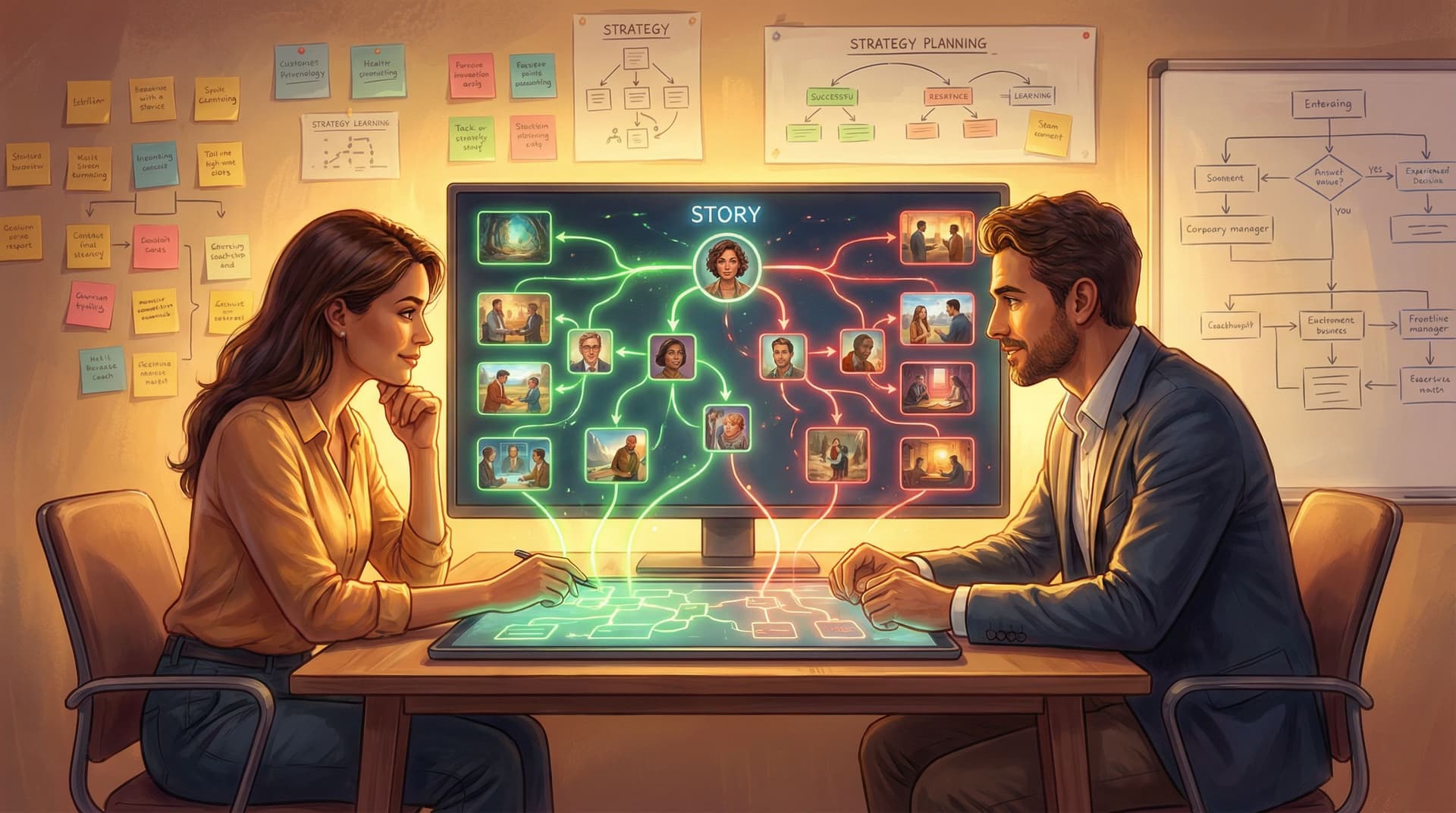
Beyond Branching Dialogues: Using Questas to Prototype Ethical Dilemmas, Tradeoffs, and Grey-Area Choices


Most interactive stories are built around clear goals and obvious wins:
- Rescue the ally
- Close the deal
- Escape the dungeon
But real life rarely hands us neat, binary choices. Leaders decide which team to fund and which to sunset. Product managers weigh privacy against personalization. Students wrestle with plagiarism, loyalty, and fairness. Activists and policymakers weigh harm vs. progress, safety vs. freedom, short-term relief vs. long-term resilience.
Those are ethical dilemmas—and they’re exactly where branching narratives can do their most important work.
Questas gives you a visual, no‑code way to turn those messy, uncomfortable tradeoffs into playable experiences. Instead of lecturing people on what’s “right,” you let them inhabit the tension, make a call, and see what happens next.
This post is a deep dive into how to use Questas not just for fun stories and training modules, but as a sandbox for ethical decision-making.
We’ll cover:
- Why grey-area choices are so powerful for learning and alignment
- How to structure dilemmas so they feel real, not contrived
- Ways to use AI-generated visuals to show consequences and tradeoffs
- Concrete build patterns inside Questas you can reuse across projects
Along the way, we’ll connect to related techniques from posts like “Corporate, But Make It Quest: Turning Dry Compliance Topics into Engaging Branching Stories” and “Beyond Training Modules: How L&D Teams Can Use Questas for Scenario-Based Coaching and Feedback”.
Why Prototype Ethical Dilemmas at All?
Ethical decisions are hard to teach with slides and static documents because:
- Context changes everything. The “right” answer on paper can feel wrong when you layer in time pressure, conflicting instructions, or emotional stakes.
- People need to feel the tension. We remember the knot in our stomach more than bullet points on a policy page.
- There’s rarely a single correct path. What matters is the reasoning process, the values tradeoffs, and the ability to explain a decision.
Interactive, choice-driven stories built in Questas are uniquely suited for this because they:
- Expose hidden assumptions. When a player chooses, “Ignore the minor policy violation,” they’re revealing what they actually prioritize.
- Make consequences concrete. You can show how a “small exception” ripples forward three scenes later.
- Encourage replay and reflection. People can try different paths, compare endings, and talk about what felt right vs. what worked.
If you’re working in ethics-heavy domains—like compliance, healthcare, public policy, AI safety, journalism, or leadership—this kind of prototyping is not just a creative exercise. It’s a way to stress-test values and policies before they’re lived out in the real world.
For a broader view of how branching narratives support change-making and policy exploration, you might also explore “Branching Narratives for Change-Making: Using Questas to Prototype Policies, Futures, and Social Impact Campaigns”.
What Makes a Great Ethical Dilemma Scenario?
Ethical scenarios fall flat when they feel like puzzles with a hidden “correct” answer. The goal instead is to create credible grey areas where:
- Every option has real costs and benefits
- Values collide, not just “good vs. evil”
- Time, information, and social pressure all play a role
When you’re designing for Questas, aim for dilemmas that:
-
Mirror real decisions your audience actually faces.
- A manager deciding whether to promote a high-performing but abrasive employee.
- A social media PM weighing frictionless sharing vs. strong consent flows.
- A student choosing whether to report a friend for cheating.
-
Put at least two values in tension.
For example:- Honesty vs. loyalty
- Transparency vs. confidentiality
- Safety vs. autonomy
-
Avoid obviously “villainous” options.
Every choice should be something a reasonable person might choose under pressure. -
Allow multiple “acceptable” outcomes.
Your design focus is the reasoning and impact, not just moral scoring.

Step 1: Start With a Real Tension, Not a Plot Twist
Before you open Questas, define the core tension in one or two sentences:
“A hospital administrator must decide whether to prioritize scarce ICU beds for younger patients with better prognoses, or allocate them strictly first-come, first-served.”
Or:
“A product lead discovers a feature is collecting more user data than necessary. Disabling it will delay a critical launch; keeping it live risks violating user trust and possibly regulations.”
Then ask:
- Who is most affected by each possible decision?
- What constraints make this hard? (time, money, policy, culture, relationships)
- What information is missing or uncertain?
Turn these into design anchors:
- Stakeholders: list 3–5 people or groups affected
- Constraints: name 2–3 non-negotiables (e.g., legal risk, budget caps)
- Uncertainties: identify 1–2 unknowns that players must act on anyway
These anchors will guide every branch you build in Questas, keeping you honest when you’re tempted to “solve” the scenario too neatly.
Step 2: Map Choices as Tradeoffs, Not Right/Wrong
In a typical branching dialogue, you might design:
- Choice A: The nice answer
- Choice B: The rude answer
- Choice C: The joke answer
For ethical dilemmas, that pattern doesn’t work. Instead, design each major choice as a tradeoff between values.
Try this pattern in your Questas scene editor:
-
Define the decision moment.
Example: “Do you delay the launch, ship with a patch, or proceed as planned?” -
For each option, explicitly write the tradeoff.
- Delay launch → Protect users, hurt revenue and team morale
- Ship with patch → Mitigate risk, but still collect more data than ideal
- Proceed as planned → Hit targets, increase privacy risk and internal discomfort
-
Name the underlying values in your notes.
Use labels likeVALUE: user trust,VALUE: team stability,VALUE: legal compliance,VALUE: innovation speedand attach them to scenes or branches.
This doesn’t have to be visible to players, but it’s tremendously helpful when you later analyze how people moved through your scenario. (For more on analyzing player behavior beyond surface metrics, see “Beyond Click-Throughs: Measuring Learning, Alignment, and Engagement in Narrative Experiences Like Questas”.)
Step 3: Use Visuals to Make Consequences Tangible
Ethical tension often lives in subtext: body language, environment, subtle shifts in mood. This is where Questas’ built-in AI image and video generation becomes a powerful design tool.
Instead of just telling players, “The team looks disappointed,” show it:
- A conference room scene where half the team avoids eye contact after you announce a controversial decision.
- A news article mockup on a screen with a headline hinting at reputational fallout.
- A cluttered apartment with overdue bills visible after a character is laid off due to your choice.
Practical visual techniques
-
Contrast states across branches.
Reuse the same framing (e.g., same office, same characters) but alter lighting, posture, and props to communicate how the world has shifted. -
Signal risk and ambiguity.
Borrow ideas from “Visual Fail States: Using AI Imagery to Signal Risk, Reward, and Consequences in Questas”. For ethical dilemmas, you often want uneasy visuals, not just “game over” screens. -
Embed clues and perspectives.
Use in-world objects—emails, posters, dashboards, chat threads—as images that contain partial information or conflicting signals, forcing players to interpret.
If you’d like a deeper dive on using AI art as a design partner (not just decoration), “AI Art as Storyboard: Rapidly Prototyping Adventure Worlds Before You Write a Single Line” is a great companion read.

Step 4: Layer Short-Term and Long-Term Consequences
Ethical decisions often feel fine in the moment and problematic months later—or vice versa. Questas makes it simple to model this by chaining scenes into time jumps.
A simple pattern you can reuse:
-
Immediate aftermath scene
- Show emotional reactions, quick wins, or visible friction.
- Ask a reflection question like, “How do you feel about your choice right now?” (This can be a non-branching input or a tagged choice.)
-
Medium-term impact scene (days/weeks later)
- Reveal data: churn, survey results, bug reports, press coverage, performance reviews.
- Show how one stakeholder benefited while another was harmed.
-
Long-term ripple scene (months/years later)
- Show culture shifts, trust erosion or reinforcement, policy changes, or career consequences.
You don’t need to build a huge tree. You can:
- Keep the structure narrow but deep (few choices, rich consequences).
- Use reconverging branches where different paths lead back to a shared scene but with different variables or tags set.
This approach is especially effective in leadership and compliance scenarios, where the cumulative effect of many “small” decisions is what really matters.
Step 5: Design for Reflection, Not Just Outcomes
The power of ethical prototyping lies less in “Did you pick Ending B?” and more in “Why did you choose that path?”.
Inside Questas, you can build reflection into the experience in several ways:
In-line micro-reflections
After key decisions, add a short scene that asks players to:
- Pick a statement that best matches their reasoning (e.g., “I prioritized team safety over speed”).
- Rate their confidence in the decision.
- Identify who they think gained and who lost.
These can be:
- Branching choices that tag the player’s reasoning style
- Non-branching prompts that simply log responses for you to review later
End-of-run debriefs
Create a final scene that:
- Summarizes key decisions and their visible consequences
- Mirrors back the values you saw in their choices (e.g., “Across your decisions, you tended to prioritize transparency, even when it created short-term conflict.”)
- Offers alternate paths to explore on a replay
If you’re using Questas with coaches or facilitators, pair this with live or asynchronous discussion, as described in “Branching Narratives for Real-World Skills: Turning Coaching Frameworks into Questas Scenarios”.
Step 6: Calibrate With Real Humans (and Their Discomfort)
Ethical scenarios become meaningful when they feel uncomfortably close to home. But that also means you need to be careful: too contrived, and people disengage; too raw, and they shut down.
Use qualitative playtesting methods (see “Beyond Clicks and Completion Rates: Qualitative Playtesting Methods for Deeply Improving Your Questas Stories”) to:
-
Watch where people hesitate.
Long pauses before clicking often signal genuine tension—these are your strongest moments. -
Ask what felt missing.
Did they want more information? A voice from a different stakeholder? A chance to push back on a constraint? -
Look for “That’s not how it works” reactions.
These comments are gold; they tell you where your scenario needs more realism or nuance.
Iterate by:
- Adding optional branches that let players ask for more context
- Introducing conflicting incentives (e.g., a bonus tied to a choice they consider unethical)
- Softening or sharpening consequences so they feel proportionate, not preachy
Step 7: Use Tags and Data to Surface Value Patterns
One of the most underused powers of Questas is its ability to track player paths and help you see patterns across many runs.
When you’re working with ethical dilemmas, consider tagging scenes and choices with:
VALUE: equityVALUE: efficiencyVALUE: compassionVALUE: rule-followingVALUE: innovation
Then, as people play:
- Track which value tags show up most frequently in completed paths.
- Compare how different groups (e.g., managers vs. ICs, regions, departments) navigate the same scenario.
This transforms your scenario from a one-off story into a diagnostic tool:
- Are leaders consistently optimizing for speed over inclusion?
- Do new hires lean heavily on rules while veterans rely on relationships?
- Are there consistent blind spots around certain stakeholders?
Those insights can feed back into policy design, training, and even product decisions.
Example Use Cases Across Domains
To spark ideas, here are a few concrete ways teams are using interactive ethical dilemmas built on Questas:
-
Compliance & risk teams
Move beyond checkbox training by letting employees navigate conflict-of-interest scenarios, reporting dilemmas, or data misuse cases with real tension. (For a practical angle on making this engaging, revisit “Corporate, But Make It Quest”.) -
Product & UX teams
Prototype how users and internal stakeholders experience tradeoffs around privacy, safety, or algorithmic bias before you ship. Combine this with ideas from “Beyond Story Mode: Using Questas to Prototype Product UX, Onboarding Flows, and Interfaces”. -
L&D and leadership development
Turn abstract values into lived experiences: tough feedback conversations, layoffs, whistleblowing, promotions, and resource allocation. -
Educators & universities
Let students step into roles—journalist, policymaker, CEO, activist—and navigate realistic dilemmas in media ethics, environmental policy, or biotechnology. -
Social impact organizations
Explore tradeoffs in campaign design, community engagement, and funding decisions, then use player data to inform real-world strategy.
Pulling It All Together
When you use Questas to prototype ethical dilemmas, you’re doing more than building a cool interactive story. You’re creating a safe rehearsal space for the hardest decisions people make:
- You anchor each scenario in a real tension your audience recognizes.
- You design choices as value tradeoffs, not quiz answers.
- You use AI-generated visuals to make consequences felt, not just described.
- You stretch decisions across time, showing ripples days, months, or years later.
- You embed reflection and debrief, so players leave with language for what they value.
- You analyze paths and tags to reveal patterns in judgment and culture.
Done well, these experiences become shared reference points:
“This is just like that scenario where we chose speed over transparency and it came back to bite us.”
That’s when your work moves from content to culture-shaping.
Your Next Step
You don’t need a full curriculum or a massive content library to start. Pick one real dilemma your team, class, or community is facing right now:
- A launch with privacy implications
- A hiring or promotion decision with competing priorities
- A policy change that helps some people and hurts others
Then:
- Sketch the core tension and 2–3 major choices.
- Open Questas and build a small, deep scenario: one intro, one big decision point, and 2–3 consequence scenes per branch.
- Add just enough AI-generated visuals to make the stakes visible.
- Playtest with 3–5 people and ask them what felt real, what felt off, and what they’d like to explore next.
From there, you can expand, refine, and connect scenarios into a richer ecosystem of ethical journeys.
If you’re ready to move beyond surface-level branching dialogues and into true grey-area storytelling, start your first ethical dilemma prototype on Questas this week—and let your players show you how they navigate the messy, human middle ground where real decisions live.