Beyond Training Modules: How L&D Teams Can Use Questas for Scenario-Based Coaching and Feedback

Learning & Development teams have spent years perfecting e‑learning modules, slide decks, and LMS pathways. Yet the same problems keep surfacing:
- People “pass” but don’t change behavior.
- Learners can explain the model but freeze in real situations.
- Managers struggle to turn training into ongoing coaching.
Scenario-based coaching is one of the most reliable ways to close that gap. Instead of telling people what “good” looks like, you let them step into realistic moments, make decisions, experience consequences, and then debrief with a coach.
That’s where platforms like Questas shine. Because it’s a visual, no‑code tool for building branching, choose‑your‑own‑adventure stories with AI‑generated images and video, it lets L&D teams move beyond static training modules into living, replayable coaching experiences.
Why Scenario-Based Coaching Belongs in Your L&D Strategy
Scenario-based learning isn’t new, but several trends have pushed it from “nice-to-have” to essential for L&D:
- Skills are increasingly behavioral, not just knowledge-based. Leadership, sales, customer success, and compliance all hinge on judgment in messy, gray areas—not on memorizing policies.
- Hybrid work makes practice harder. You can’t rely on overheard conversations or shadowing to teach nuance.
- Managers are time-poor. They want to coach, but they rarely have the bandwidth to invent realistic practice scenarios from scratch.
Research on experiential learning consistently shows that practice with feedback outperforms passive instruction for complex skills like communication, leadership, and problem-solving. Scenario-based coaching gives you:
- Psychological safety: People can experiment with risky choices in a simulated environment.
- Repetition at scale: The same scenario can be replayed by hundreds of learners, each taking different paths.
- Shared language for coaching: Managers can say, “Remember the escalation path from Scenario 3?” instead of re-explaining the concept.
Traditional e‑learning tools make this hard. Building branching experiences usually requires developers, custom art, and long timelines. Questas removes those barriers so L&D teams can design, test, and iterate scenarios themselves.
From Module to Coaching Journey: What Changes with Questas
Most training modules are built around content delivery:
- Present information.
- Quiz for recall.
- Mark complete.
Scenario-based coaching built in Questas flips that:
- Drop learners into a realistic situation.
- Force meaningful decisions with trade-offs.
- Show consequences through story and visuals.
- Debrief with reflection and coach-led discussion.
Here’s what that looks like in practice.
1. You design from moments, not topics
Instead of “Conflict Management 101,” you design a specific moment:
“You’re a team lead. Two high performers are locked in a disagreement minutes before a client presentation. One wants to delay to fix issues; the other wants to ship now.”
In Questas, that moment becomes a scene with branches:
- Calm things down privately first.
- Make a fast decision and move on.
- Invite the client into the decision.
Each branch leads to new scenes, emotional reactions, and outcomes. You’re no longer teaching conflict theory; you’re letting learners feel conflict.
2. Visuals carry emotional weight
Because Questas can generate images and video for each scene, you can:
- Show a frustrated customer on a video call.
- Zoom into a messy whiteboard with half-finished ideas.
- Present a cluttered inbox that signals urgency.
If you want to go deeper on using visuals to encode subtle cues, our post on AI-Generated Props and Clues is a great companion read: AI-Generated Props and Clues: Using Visual Details to Hide Secrets, Codes, and Easter Eggs in Questas.
Step-by-Step: Turning Coaching Needs into Questas Scenarios
Let’s walk through a concrete workflow L&D teams can use to build scenario-based coaching experiences in Questas.
Step 1: Start from real coaching conversations
The best scenarios come from moments your managers already coach on:
- A sales rep discounts too quickly.
- A support agent escalates everything to Tier 2.
- A new manager avoids giving direct feedback.
Gather raw material by:
- Reviewing call recordings or support transcripts.
- Asking managers, “What situations do you keep coaching over and over?”
- Mining your performance review themes for recurring issues.
If you’re working with support or CX, our post on transforming real logs into stories goes deeper: From Chat Transcript to Quest: Turning Customer Support Logs into Interactive Training Scenarios.
Turn each situation into a short, concrete prompt:
“Rep is 80% to quota, discounts heavily on last calls, and undermines pricing integrity.”
That’s your seed.
Step 2: Define the coaching objective, not just the knowledge goal
Before you open Questas, answer two questions:
- What decision do we want learners to handle better?
e.g., “When to offer a discount vs. hold firm on value.” - What behavior should change after this scenario?
e.g., “Reps explore value and alternatives before discounting.”
Write a simple outcome statement:
“After playing this scenario, reps will be more confident holding the line on price while still preserving the relationship.”
Use that statement to filter every branch: if a choice doesn’t relate, cut it.
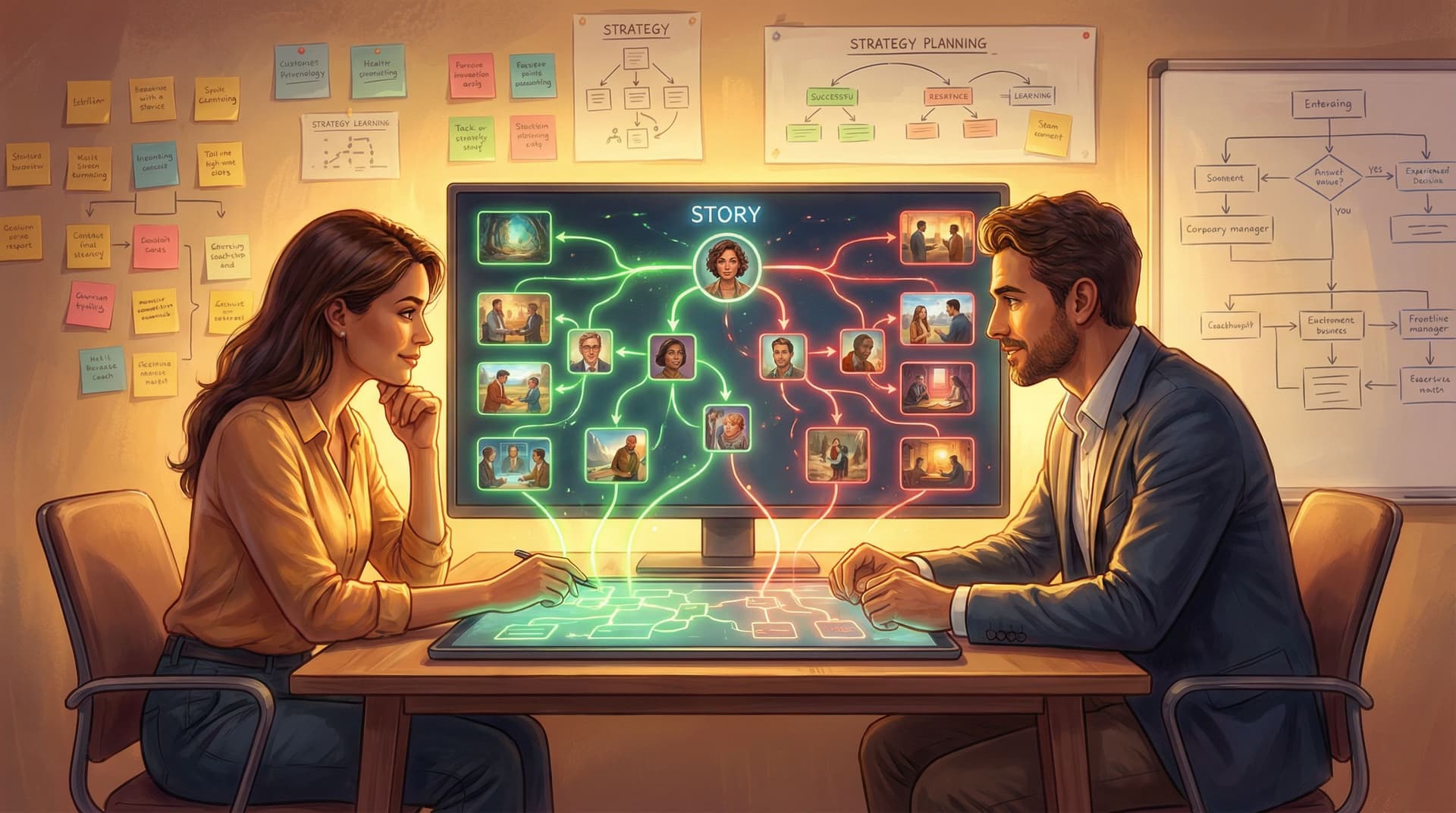
Step 3: Map a minimal but meaningful branch structure
You don’t need a 50-ending epic. For coaching, depth beats breadth. A simple pattern works well:
- Scene 1: Setup – Establish stakes and context.
- Choice 1: First response – Three options that reflect common real behaviors (ideal, acceptable, problematic).
- Scene 2: Consequences – Emotional and practical fallout.
- Choice 2: Repair or double down – Let learners recover or escalate.
- Scene 3: Outcome – Show short-term win/loss and hint at long-term impact.
- Reflection node – Ask the learner to explain their thinking.
In Questas, you can build this quickly with the visual node editor:
- Drag scenes onto the canvas.
- Connect choices to outcomes.
- Label branches with internal notes (e.g., “discount too fast,” “value exploration”).
If you want more guidance on structuring for real-world skill building, check out Branching Narratives for Real-World Skills: Turning Coaching Frameworks into Questas Scenarios.
Step 4: Use AI visuals to amplify coaching moments
Coaching isn’t just about what happened; it’s about how it felt. AI-generated media in Questas helps learners pick up on:
- Micro-expressions: a client’s raised eyebrow when you offer a discount.
- Environmental cues: a chaotic open office vs. a calm 1:1 room.
- Artifacts: a contract on screen with redlined sections.
Some practical tips:
- Keep characters consistent. Use similar prompts and style cues so the same manager or client looks recognizable across scenes.
- Signal stakes visually. Darker palettes or tighter framing can emphasize tension; wider shots and softer light can signal relief.
- Hide coaching clues in the environment. A calendar on the wall showing quarter-end, a Slack notification hinting at internal pressure, etc.
For more advanced visual consistency workflows, you might explore AI as Art Director: Building Cohesive Visual Storyworlds in Questas Without a Design Team.
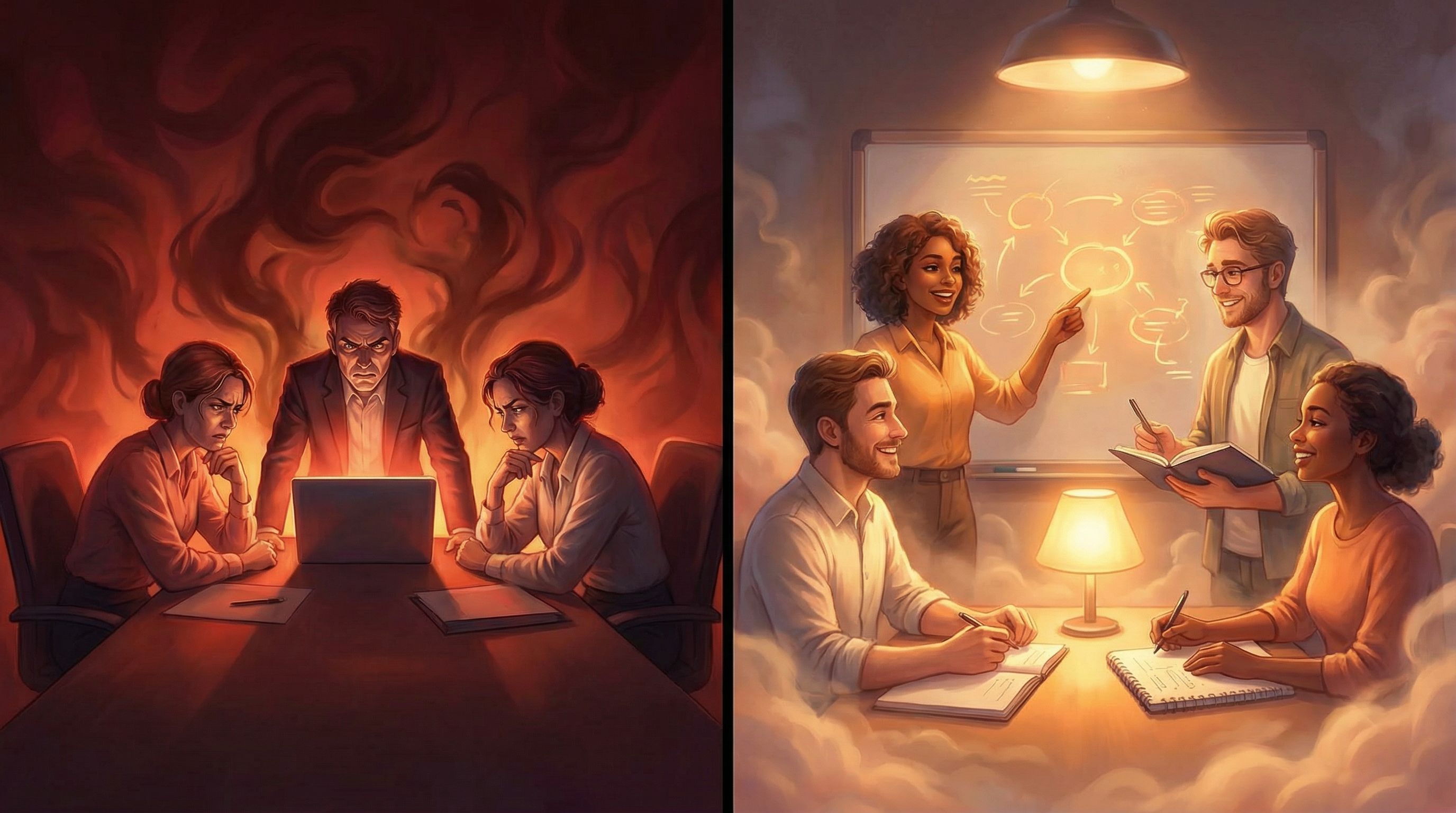
Making Feedback the Core Feature, Not an Afterthought
Scenario-based coaching lives or dies on feedback. Without it, you just have a fancier quiz.
Here’s how to bake meaningful feedback into your Questas builds.
Layer 1: Immediate, branch-specific feedback
After key decisions, provide:
- In-story consequences: Characters react in believable ways (trust erodes, urgency rises, relief shows up).
- Short designer notes: A sentence or two that names the skill:
“You preserved margin, but skipped exploring the client’s underlying concern.”
Keep it non-judgmental and behavior-focused so learners feel safe replaying.
Layer 2: End-of-run debrief inside the experience
At the end of a run, include a debrief scene that:
- Summarizes key decisions.
- Highlights one or two pivotal moments.
- Asks 2–3 reflection questions, such as:
- “Where did you feel most unsure?”
- “What would you try differently on a second run?”
You can let learners type short answers directly in Questas, then export or screenshot these for real coaching conversations.
Layer 3: Live coaching sessions around the scenario
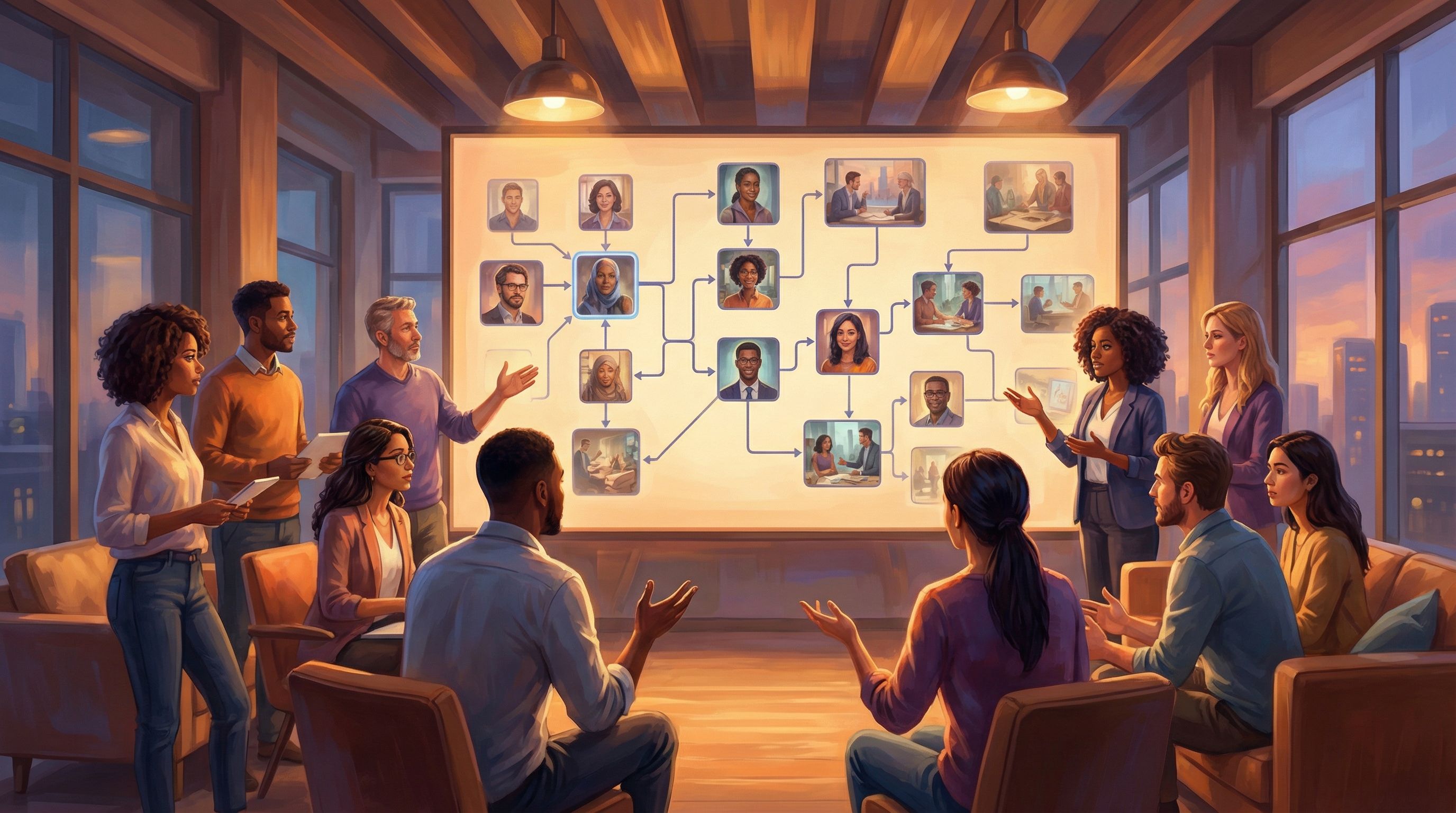
The magic happens when managers or coaches use these scenarios as shared reference points:
- Run the scenario together in a 1:1.
- Let the employee drive the choices while narrating their thinking.
- Pause at key branches to ask, “What else could you have done here?”
Because the story is doing the heavy lifting of setup and consequence, coaches can focus on listening and probing, not inventing examples on the fly.
Measuring Impact Without Reducing Everything to a Quiz
L&D teams still need to show impact. With scenario-based coaching, you can track more nuanced signals than completion rates.
Inside Questas, you can design for data such as:
- Branch selection patterns: Are people consistently choosing the “safe but suboptimal” path?
- Replays: Do learners voluntarily replay to explore alternatives?
- Path convergence: Do experienced reps gravitate toward certain patterns over time?
Pair this with:
- Manager observations: Are coached scenarios showing up in real 1:1 conversations?
- Operational metrics: For example, discount levels, escalation rates, or CSAT before and after a scenario-based program.
If you’re interested in going deeper on measuring narrative experiences, our post Beyond Click-Throughs: Measuring Learning, Alignment, and Engagement in Narrative Experiences Like Questas offers a framework for tying story paths to real outcomes.
Practical Use Cases for L&D Teams
Here are some concrete ways L&D orgs are starting to use Questas for scenario-based coaching and feedback:
1. Sales and customer success
- Handling discount requests without eroding value.
- Navigating multi-stakeholder deals where champions and blockers conflict.
- Responding when a renewal is at risk and emotions are high.
2. People managers and leadership
- Giving difficult feedback to a high performer.
- Addressing microaggressions or exclusionary behavior on the team.
- Prioritizing workload when everything feels urgent.
3. Compliance and ethics
- Spotting subtle conflicts of interest.
- Deciding whether to report a borderline policy violation.
- Balancing whistleblower protection with confidentiality.
If you’re already building compliance content, Corporate, But Make It Quest: Turning Dry Compliance Topics into Engaging Branching Stories can help you reimagine those topics as emotionally engaging stories.
4. Onboarding and role transitions
- “Day in the life” runs for new hires to practice common decisions.
- Shadow scenarios for new managers stepping into people leadership.
- Cross-functional empathy journeys (e.g., “Walk through a week in Support’s shoes”).
In all of these, the pattern is the same: realistic decisions, branching consequences, structured debriefs.
Tips for Shipping Your First Coaching Scenario Quickly
You don’t need a multi-month project to get started. Here’s a lightweight path to your first scenario in Questas:
-
Pick one high-leverage moment.
Ask, “If people got better at just this one decision, what would change?” -
Write a 300–500 word script, max.
Focus on dialogue and key choices. Cut exposition. -
Build a 3-scene, 2-choice prototype.
Use the visual editor to wire it up quickly. -
Generate simple, consistent visuals.
One style, 3–5 images that reinforce emotion and context. -
Pilot with 3–5 learners and 1–2 managers.
Watch them play, then ask:- “Where did this feel real?”
- “Where did this feel off or confusing?”
-
Tighten branches and feedback.
Refine choices and debrief text based on what you observe.
Once that first scenario lands, you can:
- Clone the structure as a template for other moments.
- Build a library of scenarios aligned to your competency framework.
- Run cohort-based programs where each session centers on a different story.
Wrapping Up: From Content to Coaching System
When L&D teams move beyond static training modules and into scenario-based coaching, several things shift:
- Learning becomes practice, not just exposure.
- Feedback becomes embedded in the experience, not bolted on.
- Managers get ready-made tools for rich coaching conversations.
Questas makes this shift practical. With a visual, no‑code editor and built-in AI visuals, you can:
- Turn real coaching challenges into replayable stories.
- Give learners a safe space to experiment with tough decisions.
- Capture data and reflections that feed directly into 1:1s and development plans.
Your Next Step
You don’t need to overhaul your entire L&D strategy to see the benefits of scenario-based coaching. Start with one:
- Choose a single, high-impact coaching moment.
- Map a short branching scenario around it.
- Build it in Questas and pilot with a small group.
From there, you can grow a full library of coaching scenarios that make your training programs feel less like checklists—and more like the real work your people do every day.
Adventure awaits. Your learners are ready to step into the story; your job is to give them the quest.