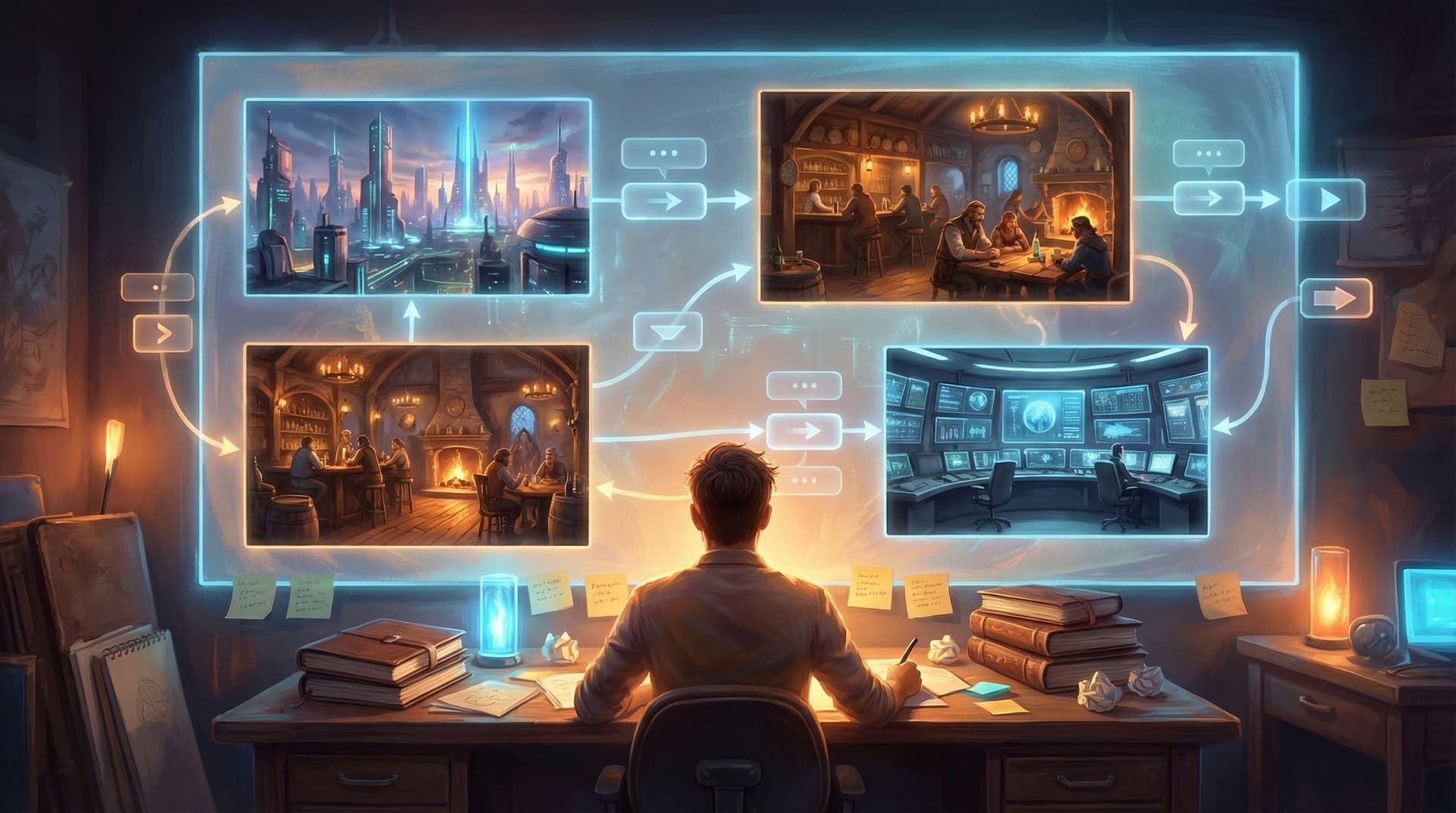
Beyond Clicks and Completion Rates: Qualitative Playtesting Methods for Deeply Improving Your Questas Stories


Numbers are comforting.
Unique players, completion rates, branch popularity, drop‑off points—these metrics absolutely matter. If you’ve read our post on measuring outcomes in interactive narratives, you know analytics can reveal where your Questas experiences are leaking attention and where players get stuck.
But numbers alone can’t tell you why.
Why did a player bail right after meeting your main character? Why did they choose the same “safe” option three times in a row? Why did a supposedly “minor” branch become the fan‑favorite path?
To answer those questions—and to turn a decent prototype into a story people remember—you need qualitative playtesting.
This post is a deep dive into how to run qualitative playtests for your Questas stories: what to look for, how to structure sessions, and how to turn messy observations into clear, actionable changes.
Why qualitative playtesting matters for branching stories
Analytics are great at telling you what happened. Qualitative methods tell you what it felt like.
For branching narratives, that feeling is everything:
- Perceived agency – Do players feel their choices matter, or are they just clicking the top button?
- Emotional engagement – Are they curious, tense, amused, frustrated, bored?
- Cognitive load – Are they overwhelmed by text, choices, or visuals—or are things clear and inviting?
- Story coherence – Do branches feel like part of one world, or like disconnected vignettes?
If you’re building Questas for training, coaching, or product UX, this becomes even more critical. You’re not just entertaining people; you’re trying to change how they think or act. For a deeper look at that angle, check out how we turn coaching frameworks into experiences in Branching Narratives for Real-World Skills: Turning Coaching Frameworks into Questas Scenarios.
Qualitative playtesting gives you:
- Language straight from your players’ mouths you can mirror in dialogue and choices.
- Surprises in how people interpret scenes—often very different from what you intended.
- Signals about pacing and rhythm you’ll never see in a dashboard.
- Evidence for stakeholders that goes beyond, “Well, completion is 72%.”
The three layers of qualitative insight
Before we jump into methods, it helps to think in three layers:
- Moment-to-moment reactions – How players respond to specific scenes, lines, or choices.
- Path-level experience – How a single run through a branch feels as a mini‑story.
- Whole‑experience understanding – How players make sense of the overall world, themes, and purpose.
Great playtesting touches all three.
- If you only test moment‑to‑moment, you’ll polish scenes but miss structural issues.
- If you only look at the whole experience, you’ll miss micro‑frustrations that quietly push people away.
The methods below are organized so you can cover all three layers without needing a research department.
Method 1: Think‑aloud playthroughs (the fastest path to “aha” moments)
Think‑aloud testing is simple: you ask someone to play your Questas story out loud while narrating what they’re thinking.
“I’m clicking this because…”
“Wait, who is this character again?”
“Oh wow, I didn’t expect that.”
How to run a think‑aloud session
1. Recruit 3–5 players who match your audience.
For example:
- Sales reps for a customer‑conversation training quest
- New hires for an onboarding story
- Fans of a specific genre for a narrative adventure
2. Set expectations clearly.
Script this if it helps:
- “You’re not being tested; the story is.”
- “Please say whatever goes through your head, even if it’s ‘this is confusing’ or ‘this is boring.’”
- “If you fall silent, I’ll nudge you with ‘What are you thinking now?’”
3. Capture the session.
Use a simple screen‑recording tool (like Loom or Zoom) with audio. If you’re testing visuals heavily, make sure resolution is high enough to read text and see images.
4. Stay mostly quiet.
Your job is to:
- Prompt gently: “What are you expecting to happen if you choose that?”
- Clarify: “What made you think that character was untrustworthy?”
- Avoid leading: don’t explain or defend the story mid‑play.
5. Debrief for 5–10 minutes after.
Ask open questions:
- “What part felt most interesting or alive?”
- “Where did you feel stuck or unsure what to pick?”
- “If you could change one moment, what would it be?”
What to watch for
- Hesitations before choices – Are they pausing because they’re intrigued or confused?
- Mismatched expectations – “I thought this option meant X, but it actually did Y.”
- Emotional spikes – Laughter, sighs, leaning forward, checking the time.
- Visual friction – Squinting at text, not noticing important imagery, misreading cues.
In the Questas editor, you can quickly tweak copy, reorder choices, or adjust AI‑generated visuals based on what you see. For more on keeping those visuals cohesive across branches, take a look at AI as Art Director: Building Cohesive Visual Storyworlds in Questas Without a Design Team.

Method 2: Silent observation with post‑play interviews
Think‑aloud is powerful, but it also changes how people play. Some players become self‑conscious or over‑explain their choices.
Silent observation plus a rich interview gives you a more natural run‑through.
How to run it
1. Ask them to play “as if they found it on their own.”
No narration this time. Just:
- “Play this like you would if a friend sent you the link.”
- “You can stop whenever you naturally would.”
2. Observe behavior, not just completion.
Take timestamped notes:
- Where do they skim or scroll quickly?
- Where do they hover over choices without clicking?
- Do they ever look away, check their phone, or alt‑tab?
- How often do they replay a branch or backtrack (if you’ve enabled it)?
3. Interview right after.
While the experience is fresh, ask:
- Story clarity – “What do you think this story was about?”
- Agency – “Did your choices feel like they made a difference?”
- Memorable beats – “What’s one moment you’re likely to remember tomorrow?”
- Drop‑off logic – “If you had stopped earlier, when would it have been and why?”
Simple note‑taking framework
For each notable moment, jot down:
- Timecode – 12:34
- Scene ID / title – “Warehouse confrontation”
- Observation – “Player reread the three options twice, then sighed.”
- Hypothesis – “Choices too similar / stakes unclear.”
Later, when you’re back in Questas, you can jump straight to that scene and evaluate:
- Do option labels clearly signal different intentions?
- Is the emotional context strong enough?
- Are you asking the player to recall information that isn’t fresh anymore?
Method 3: Branch‑focused “guided tours”
Most players only see a tiny fraction of your branching structure. That’s fine for launch—but not for testing.
Guided tours are sessions where you direct players to specific paths you want feedback on: edge cases, rare endings, or newly added branches.
How to structure a guided tour
1. Pick 2–3 target branches per session.
Examples:
- The “bad” ending intended as a cautionary tale
- A newly added “quiet” emotional path you’re unsure about
- A high‑stakes decision branch in the middle of the story
2. Use direct links or debug shortcuts.
Depending on how you’ve structured your Questas project, you can:
- Share a link that starts at a specific scene (using variants or entry nodes).
- Ask the player to make a particular choice sequence while you skip filler.
3. Frame the session.
“First, I’d like you to experience this path as if it were your main run. Then we’ll talk specifically about how it felt compared to what you’d expect from the overall story.”
4. Ask branch‑specific questions.
- “Did this ending feel earned based on your choices?”
- “Was there a moment where you thought, ‘I didn’t sign up for this kind of story’?”
- “Did this path feel like it belonged in the same world as the rest?”
Guided tours are especially helpful when you’re designing visual fail states or consequence‑heavy branches. If you’re exploring that territory, you’ll find more tactics in Visual Fail States: Using AI Imagery to Signal Risk, Reward, and Consequences in Questas.
Method 4: Group play sessions and “branch debates”
Interactive stories become richer when people talk about them. Group playtests let you watch that conversation unfold.
Two simple formats
1. One screen, one driver, many commentators
- Project your Questas story on a screen.
- Nominate one person as the “driver” who makes the final choice.
- Before each decision, ask the group to argue for different options.
You’ll hear:
- How people interpret each option
- What stakes they perceive
- Which characters they trust or distrust
Capture quotes like:
- “If we pick that, we’re basically betraying her.”
- “This feels like a trick option.”
- “I don’t care about this side quest at all.”
2. Parallel solo play, then group debrief
- Everyone plays the story individually on their own devices for 15–20 minutes.
- Then you regroup and map where people went.
On a whiteboard (or in a shared doc), sketch a rough tree:
- Start node at the top
- Major branches as lines
- Mark which endings people hit
Ask:
- “Who ended up here? What did that path feel like?”
- “Did anyone feel like they made a wrong choice and wanted to restart?”
Group sessions are fantastic for spotting moral ambiguity, tone mismatch, and hidden assumptions you’ve baked into the story.

Method 5: Lightweight in‑story feedback prompts
Not all qualitative data needs a scheduled session. You can build feedback into the story itself.
Micro‑prompts at key moments
Consider adding optional, one‑click prompts at:
- The first major branch
- A twist or reveal
- The ending (or endings)
Examples:
- “How clear were your options here?” → 😕 / 😐 / 😊
- “How did this ending feel?” → Unsatisfying / Okay / Powerful
- “Would you replay from here?” → Yes / Maybe / No
You can pair these with a tiny text box:
“One sentence: what made you pick that option?”
Even if only a fraction of players respond, the language they use will sharpen your copy and your choices.
Post‑play mini‑survey
At the end of the quest, link to a 3–5 question survey (using tools like Typeform or Google Forms):
- “Describe this experience in three words.”
- “What moment felt most you?”
- “Where did you feel least confident about your choice?”
Keep it short and optional. This isn’t a corporate NPS form; it’s an invitation to help shape the story.
Turning messy notes into clear improvements
After a few sessions, you’ll have:
- Screenshots, recordings, and scribbled notes
- Contradictory opinions
- A long list of “small” issues
Here’s how to turn that into a focused revision plan.
1. Cluster feedback by story layer
Split your notes into three buckets:
- Clarity issues – Confusing choices, unclear stakes, missing context.
- Emotional issues – Flat scenes, unearned twists, tonal whiplash.
- Structural issues – Pacing problems, dead branches, overwhelming complexity.
Within each bucket, look for patterns:
- “Three people didn’t understand why the mentor character was angry.”
- “Two out of four playtesters thought this was a horror story, not a mystery.”
2. Prioritize by impact and effort
Create a simple 2×2 grid:
- High impact / Low effort → Do first
- High impact / High effort → Plan for next major update
- Low impact / Low effort → Batch into a polish pass
- Low impact / High effort → Probably cut
Examples of high‑impact, low‑effort fixes in Questas:
- Renaming a confusing choice to better signal intent
- Adding one clarifying line to a scene
- Swapping a misleading image for one with clearer emotional tone
3. Protect your core design goals
Not every piece of feedback deserves a change.
Before you start editing, write down your design intent for this quest:
- “I want players to feel complicit in the outcome, not like victims of a twist.”
- “This is a training scenario; confusion should come from the situation, not the interface.”
- “This branch is supposed to be uncomfortable but not hopeless.”
When feedback conflicts, use these goals as your filter. If someone says, “I wish there were a safe choice here,” but your intent is to force hard trade‑offs, you might keep the tension—but improve how clearly the stakes are communicated.
Building a repeatable playtest rhythm
Qualitative playtesting works best as a habit, not a one‑time event.
Here’s a lightweight rhythm you can use for each new Questas project:
- Prototype phase – 1–2 think‑aloud sessions on rough branches to catch big structural issues early.
- Alpha build – 3–5 silent observation sessions to assess pacing, clarity, and emotional flow.
- Pre‑launch – 1–2 group sessions to surface debates, misinterpretations, and social dynamics.
- Post‑launch – Always‑on in‑story prompts and periodic mini‑surveys to guide future updates.
If you’re working with limited time or as a solo creator, you can still get huge value from a compressed cycle. For ideas on scoping and shipping without burning out, see Branching Narratives on a Budget: How Solo Creators Can Ship Polished Questas Without Burning Out.
Bringing it all together
Qualitative playtesting isn’t about proving your story is perfect. It’s about discovering where it almost works—and nudging it over the line.
When you:
- Watch players hesitate and hear why they’re torn
- Notice when they lean in, laugh, or go quiet
- Listen to the words they use to describe your characters and choices
…you gain a kind of x‑ray vision into your own design.
Analytics will still tell you where to look—drop‑offs, unpopular branches, low completion segments. But qualitative methods tell you what to do about it.
For Questas creators building training scenarios, product prototypes, or rich narrative worlds, that combination is what turns a playable draft into an experience people share, replay, and remember.
Your next step
You don’t need a lab, a budget, or a research team to start.
This week, pick one of your existing or in‑progress Questas stories and:
- Schedule a 30‑minute think‑aloud session with a friend or colleague who matches your audience.
- Record the session and take notes on:
- Where they hesitate
- Where they light up
- Where they look confused or disengaged
- Make three small changes based on what you saw—no more.
Then run it again with someone new.
That’s how great interactive stories are built: not just from clever branches, but from listening closely to the people who walk those paths.
Ready to see your own quest through fresh eyes? Open up your next project in Questas, invite one tester, and let their reactions guide your next round of improvements.