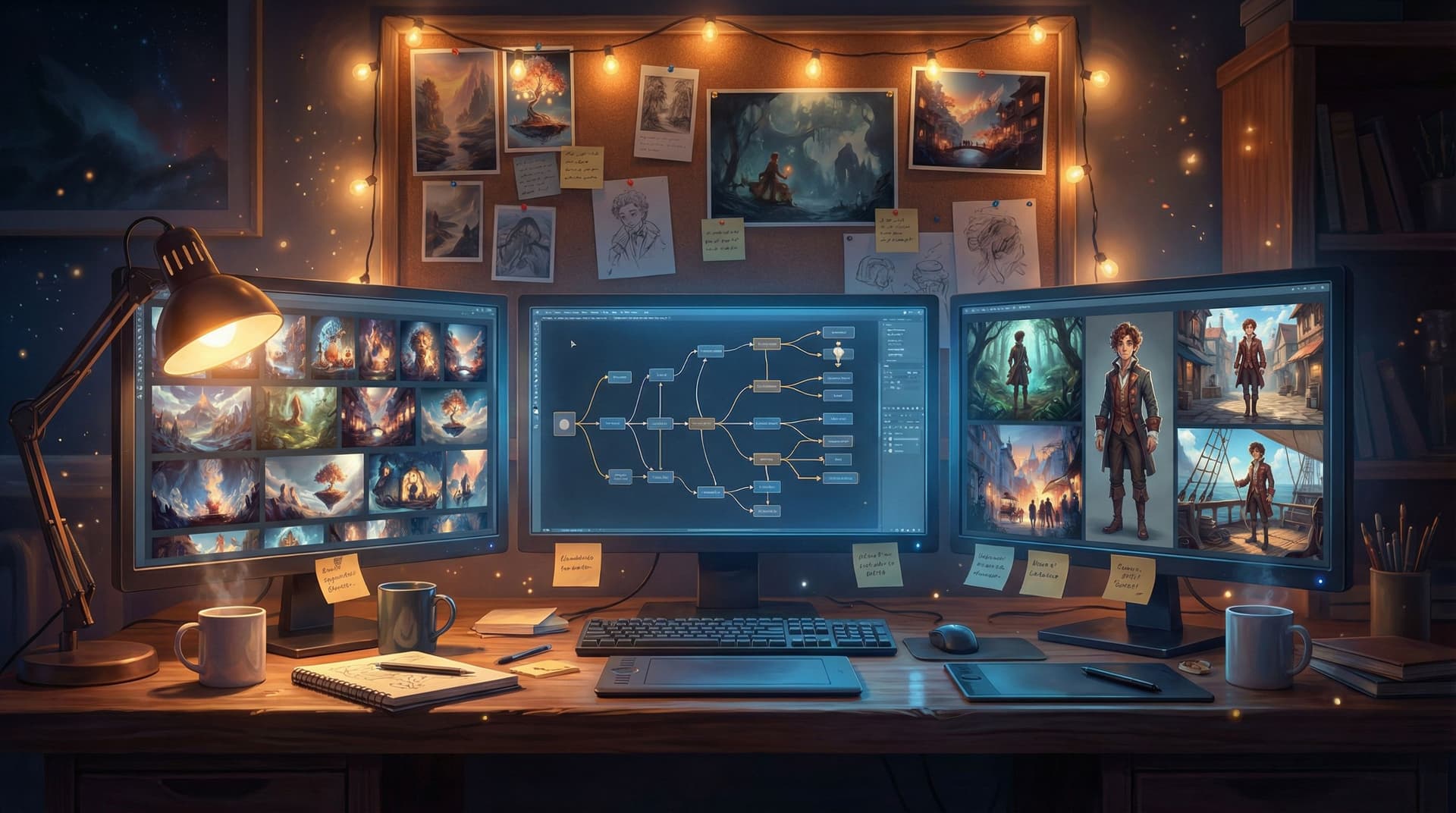
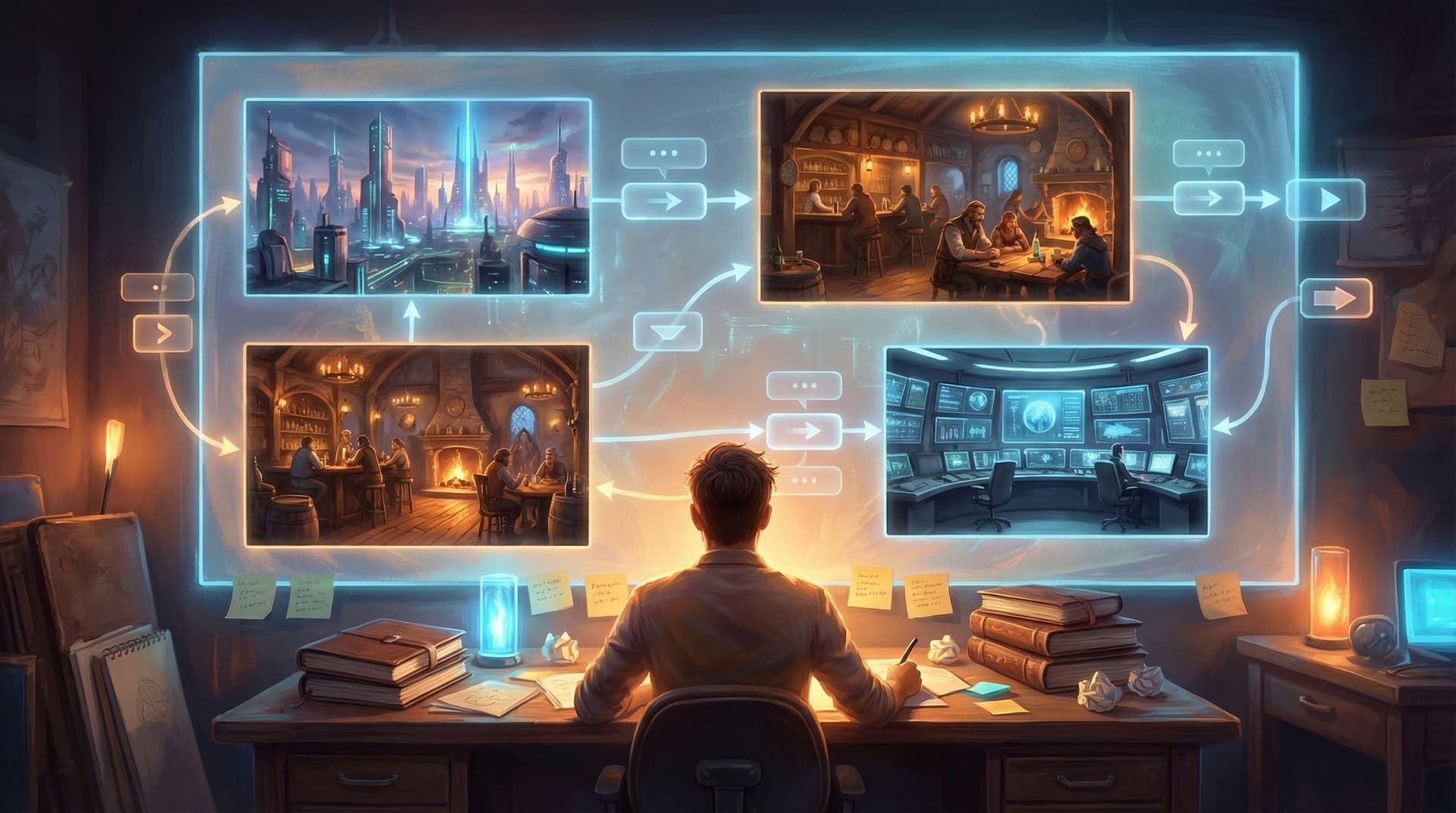
Branching Narratives for Real-World Skills: Turning Coaching Frameworks into Questas Scenarios

Coaching is built on a simple truth: people don’t change because they know something; they change because they’ve practiced doing it differently.
That’s where branching narratives shine. Instead of telling someone, “Here’s how to handle a tough client conversation,” you let them step into that moment, make choices, feel the tension, and see the consequences. And with a visual, no‑code platform like Questas, you can turn your favorite coaching frameworks into interactive, replayable scenarios that actually build skill.
This post is a deep dive into how to do exactly that.
We’ll walk through how to translate coaching models into story structures, how to design meaningful decision points, and how to use AI-generated visuals and video to anchor those lessons in memory.
Why Coaching Frameworks Belong in Branching Stories
Most coaching tools are already structured for decision-making:
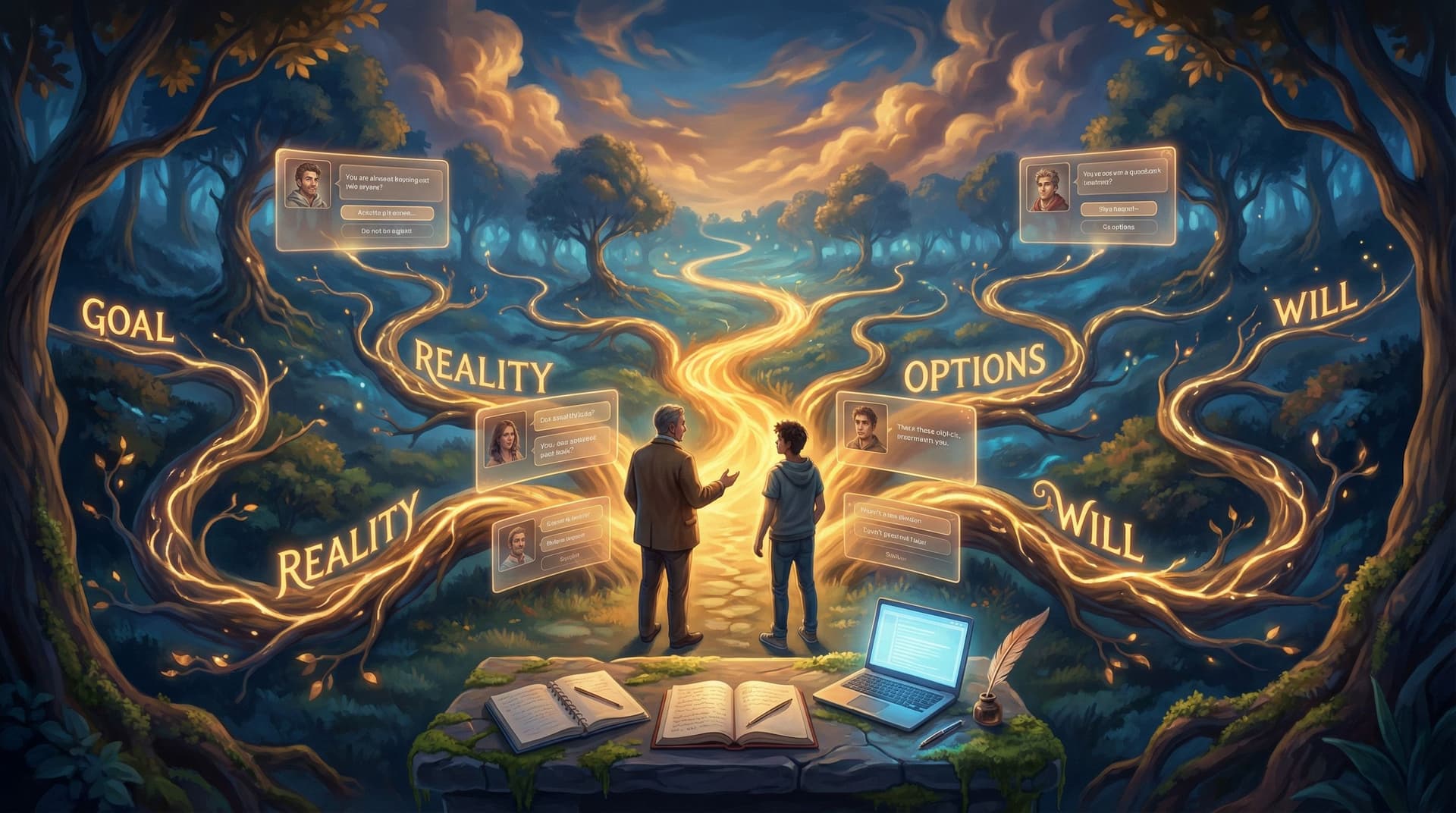
- GROW (Goal, Reality, Options, Will)
- SBI (Situation, Behavior, Impact)
- Nonviolent Communication (Observation, Feeling, Need, Request)
- Difficult conversation frameworks
- Leadership models (situational leadership, servant leadership, etc.)
They’re all about:
- Noticing what’s happening
- Choosing how to respond
- Reflecting on the outcome
That’s the same rhythm as a branching narrative.
Key benefits of turning frameworks into Questas scenarios
1. Safe practice for high-stakes skills
You can simulate:
- Performance review conversations
- Coaching a direct report through burnout
- Handling a client escalation
- Navigating cross-cultural misunderstandings
Learners get to “try on” different approaches without risking real relationships or revenue.
2. From theory to muscle memory
Reading about GROW is one thing. Making a choice inside a scenario—“Do you jump to advice, or ask another question about the Goal?”—turns abstract steps into lived experience.
3. Built-in reflection and feedback
Branching lets you show:
- Short-term reactions (the other person withdraws, opens up, gets defensive)
- Longer-term consequences (trust erodes, performance improves, conflict escalates)
You can then tie each outcome back to the framework explicitly: “Notice how skipping the ‘Reality’ step led you to solve the wrong problem.”
4. Reusable assets across teams
Once a scenario exists in Questas, you can:
- Run it as a workshop exercise
- Assign it as pre-work for coaching cohorts
- Reuse it in manager onboarding
- Adapt it for different roles by tweaking branches, not rebuilding from scratch
If you’re curious how visuals can deepen that sense of a coherent world, you may also want to read AI as Art Director: Building Cohesive Visual Storyworlds in Questas Without a Design Team.
Step 1: Pick a Real-World Skill and a Concrete Moment
Don’t start with “leadership” or “communication.” Start with a moment.
Ask yourself:
- Where do people consistently get stuck or make avoidable mistakes?
- What’s a conversation or decision that’s emotionally loaded, not just procedural?
- Where would 15 minutes of practice change someone’s confidence level dramatically?
Examples:
- A manager giving constructive feedback to a high performer for the first time
- A sales rep deciding whether to push for the upsell when a client sounds hesitant
- A founder responding to a team member’s burnout confession
- A product lead handling a conflict between design and engineering priorities
Choose one.
Rule of thumb: If you can’t describe the moment in one sentence that starts with “You are in a room with…,” it’s probably too broad.
Once you’ve picked the moment, write a quick scenario statement:
“You’re a mid-level manager preparing to give critical feedback to a high-performing team member who’s been missing deadlines.”
This will become the opening scene in Questas.
Step 2: Map Your Coaching Framework to Story Beats
Take your preferred framework and turn it into beats in a branching story.
Let’s use GROW as an example.
- G – Goal: What are you and the other person trying to achieve in this conversation?
- R – Reality: What’s actually happening right now?
- O – Options: What could we do about it?
- W – Will: What will we commit to?
In a Questas scenario, that might look like:
-
Opening scene – The setup
- Visual: Your office or a meeting room, the direct report sitting across from you
- Text: A brief description of the situation and your internal state
-
Beat 1 – Clarifying the Goal
- Choice: “Open with empathy,” “Get straight to the point,” or “Start with small talk and avoid the topic.”
- Branches show how each option affects clarity of the goal.
-
Beat 2 – Exploring Reality
- Choice: Ask open-ended questions vs. make assumptions vs. cite only your frustrations.
- Branches reveal different information (or lack of it).
-
Beat 3 – Generating Options
- Choice: Collaborate on ideas vs. prescribe a solution vs. threaten consequences.
-
Beat 4 – Securing Will/Commitment
- Choice: Agree on a concrete plan vs. leave it vague vs. avoid follow-up.
Each beat becomes a cluster of scenes and choices in Questas. The framework is no longer a slide—it’s the spine of your narrative.
If you like thinking in systems and reusable structures, you’ll find a lot of overlap with the patterns described in No-Code Narrative Systems: Designing Reusable Templates and Story Blueprints in Questas.

Step 3: Design Decisions That Feel Like Coaching, Not Quiz Questions
The biggest trap when turning frameworks into scenarios is making them feel like multiple-choice tests instead of lived moments.
To avoid that, focus on three design principles.
1. Write from the player’s point of view
Instead of:
- “Apply the SBI framework to address the behavior.”
Write:
- “You take a breath. How do you open the conversation?”
Then offer options that sound like real choices:
- “Hey, can we talk about what’s been going on with your deadlines?”
- “You’ve really been slipping lately. This can’t continue.”
- “So… how are things? Busy, I’m guessing?”
Each line carries a different emotional weight and maps to different aspects of your framework (clarity, specificity, psychological safety, etc.).
2. Make tradeoffs explicit
Good coaching decisions often involve tradeoffs, not obvious right/wrong answers.
For each choice, ask:
- What might this build? (trust, urgency, clarity)
- What might this cost? (comfort, time, short-term harmony)
Then reflect that in the outcome scenes:
- “They look relieved that you’re finally naming the issue, but their shoulders tense when you say ‘slipping.’”
- “They relax into the small talk, but the clock is ticking and you’re no closer to the real topic.”
3. Use “soft fails,” not dead ends
When someone makes a less-effective choice, don’t just say “Wrong.”
Instead:
- Show the consequence (awkward silence, defensiveness, confusion)
- Offer a way to recover using the framework
For example:
“You jumped straight to solutions without checking what they want. You notice them pulling back. You can still pivot—how do you bring them back into the conversation?”
Designing these recoverable missteps—what we might call soft fails—keeps players experimenting instead of hunting for the “perfect” path. If you want to go deeper on this pattern, check out Designing ‘Soft Fails’: How to Let Players Backtrack, Reroute, and Recover Inside Questas Adventures.
Step 4: Use AI-Generated Visuals to Anchor Emotional Cues
Real-world skills—especially coaching, leadership, and communication—are emotional as much as they are cognitive. Visuals help convey tone, tension, and subtle shifts in mood.
With Questas, you can generate images and video for each key beat:
- The nervous energy before a tough 1:1
- The moment a direct report’s expression changes from guarded to open
- The tense body language in a conflict scenario
- The relief of a conversation that lands well
Tips for effective coaching visuals
-
Keep the style consistent.
Use similar prompts, lighting, and composition across scenes so players feel like they’re in the same world, not bouncing between unrelated images. The techniques in AI as Art Director: Building Cohesive Visual Storyworlds in Questas Without a Design Team are especially useful here. -
Show micro-expressions and posture.
Prompt for details like “subtle frown,” “tightened jaw,” “relaxed shoulders,” “averted gaze.” These cues help learners practice reading emotional context. -
Use environment to signal stakes.
A crowded open office vs. a private meeting room; a late-night Zoom call vs. a sunny afternoon coffee chat. These settings change how a conversation feels. -
Reserve dramatic visuals for key turning points.
When a player hits a pivotal moment—someone breaks down, a client threatens to leave, a team member opens up—use a more cinematic, close-up image to mark that emotional spike.
Visuals don’t replace good writing, but they do reduce cognitive load and help learners quickly grasp what’s happening in a scene.

Step 5: Build the Scenario in Questas Without Drowning in Complexity
You don’t need a 200-node epic to teach a skill. A tight, 10–20 scene experience can be far more impactful.
Here’s a practical workflow:
-
Outline your beats on paper or a whiteboard
- Write your framework steps down the left (e.g., Goal, Reality, Options, Will)
- For each step, sketch 2–3 key decisions and 1–2 notable outcomes
-
Create a minimal backbone in Questas
- Add one scene per framework step in a straight line
- Write the “ideal” path first (what a great conversation looks like)
-
Branch out from the backbone, not away from it
- For each step, add 1–2 alternate choices that branch off, then rejoin the main path later
- This keeps your graph manageable while still offering meaningful variation
-
Layer in soft fails and recoveries
- When a choice leads to a suboptimal outcome, give players a chance to notice and adjust
- Use short scenes for these pivots to keep pacing snappy
-
Add AI visuals last, not first
- Once text and branches feel solid, generate images for:
- Opening setup
- Each major emotional turn
- Endings (success, partial success, misfire with learning)
- Once text and branches feel solid, generate images for:
-
Playtest with real coaches or managers
- Ask: “Does this feel like real life?”
- Listen for missing options: “I would have said something like…”
- Add or tweak choices based on that feedback
If you’re building this as part of a team or on a tight timeline, you might also borrow techniques from Branching Narratives for Busy Teams: Shipping a Complete Questas Experience in One Workday to keep scope under control.
Step 6: Connect Outcomes to Reflection and Real-World Action
The power of a coaching scenario doesn’t stop at the “ending.” You want learners to transfer what they experienced into their next real conversation.
Build reflection directly into your endings
For each major ending, include:
-
A short debrief in plain language
- What went well
- What could have gone differently
- How this maps to your framework
-
A few targeted reflection questions
- “Where did you feel most uncomfortable in this conversation?”
- “Which question shifted the other person’s openness the most?”
- “What would you do differently if you replayed this scenario?”
-
A concrete next step
- “Pick one upcoming 1:1 this week. Write down a single ‘Goal’ question you’ll ask at the start.”
- “Before your next feedback conversation, outline the Situation, Behavior, and Impact in one sentence each.”
Use branching analytics to improve your coaching program
Once people are playing through your Questas scenario, you can look at:
- Which branches most learners choose first
- Where they tend to “fail” or trigger soft fails
- How often they replay to explore alternatives
This data can inform your live coaching:
- If most people avoid direct feedback options, you know courage and candor need airtime.
- If many jump to solutions without exploring reality, you can emphasize curiosity and inquiry in workshops.
Putting It All Together: A Mini Blueprint
Here’s a compact blueprint you can follow to turn any coaching framework into a Questas experience:
- Choose one real-world moment where your learners struggle.
- Pick one framework you already use to address that moment.
- Map framework steps to 4–6 story beats (scenes where something changes).
- Design 2–3 realistic choices per beat, with at least one “soft fail” option.
- Build a backbone path in Questas, then add branches that rejoin it.
- Generate consistent visuals that highlight emotional stakes and key turning points.
- Write reflective endings that tie outcomes back to the framework and suggest real-world actions.
- Playtest with a small group, revise, then roll it out more widely.
Do that once, and you’ve got a reusable asset for your coaching practice, leadership program, or internal L&D library. Do it a few times, and you’ve got an entire interactive curriculum—one that people actually want to revisit.
Summary
Turning coaching frameworks into branching narratives isn’t just a clever content format. It’s a way to:
- Give people safe, vivid practice with high-stakes conversations
- Transform abstract models into felt experiences
- Use AI-generated visuals to anchor emotional nuance and context
- Build reusable, measurable assets for coaching, L&D, and leadership development
With a visual, no‑code platform like Questas, you don’t need engineers or a production studio. You need a clear moment, a framework you trust, and a willingness to let your learners make imperfect choices—and learn from them.
Your Next Step
Don’t try to boil your entire coaching practice into one mega-scenario.
Instead:
- Pick one real conversation you wish every client, manager, or leader could rehearse before it happens.
- Open Questas and sketch a 10–15 minute branching story around that moment using the steps above.
- Share it with a small, trusted group and ask: “Did this feel like real life?” Then refine.
The gap between “I know this framework” and “I can actually do this when it counts” is where growth lives. Branching narratives are one of the fastest, most engaging ways to close that gap.
Your learners don’t just need more information. They need more quests.
Go build the first one.