Beyond Branches and Banners: How Interactive Stories Are Replacing Static Landing Pages in 2026


Static landing pages had a good run.
For a decade-plus, the recipe barely changed: a hero banner, a headline, a subhead, a couple of benefit bullets, maybe a testimonial carousel, and a big button that says “Get Started.” But as audiences get more skeptical, more distracted, and more used to being inside experiences (not just reading about them), that formula is breaking down.
In 2026, the most interesting teams aren’t asking, “How do we write a better landing page?” They’re asking, “What if the landing page were a story you play?”
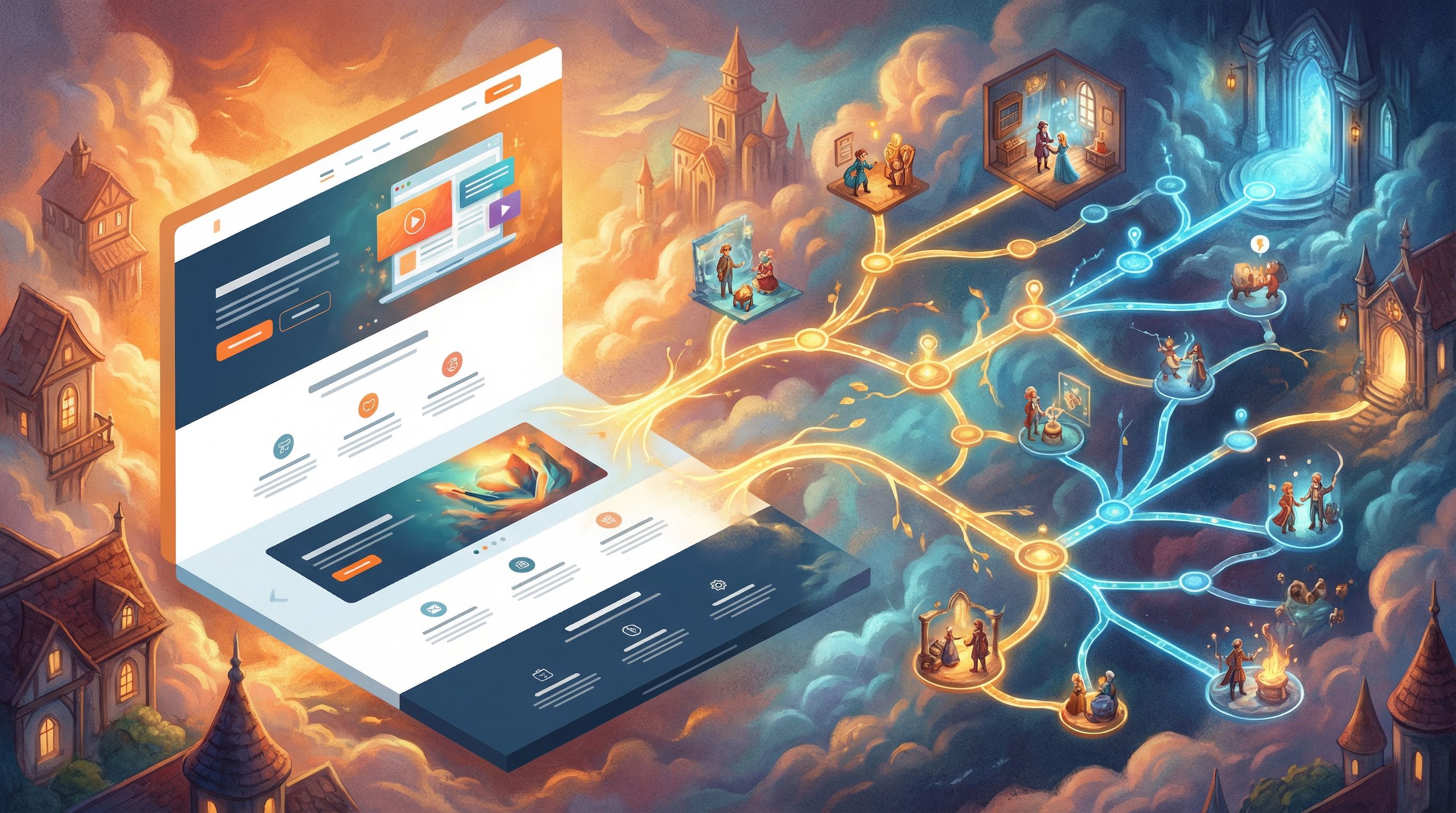
Interactive, branching experiences are quietly replacing static landing pages—especially for products, programs, and stories that are complex, emotional, or high-stakes. And with no‑code tools like Questas, you don’t need a game studio to build them.
This post is a deep dive into why that shift is happening, what it unlocks, and how you can start moving beyond banners into playable journeys.
Why Static Landing Pages Are Losing Their Grip
Static pages still have their place, but they’re running into three big problems:
-
Attention is scarce, but expectations are high.
People are used to apps, games, and interactive explainers that respond to their input. A static wall of copy feels like homework. -
Complex offers don’t fit into a single linear story.
When your product can serve multiple personas, use cases, or industries, a one-size-fits-all page forces you to pick one story—and hope it lands. -
Marketers need more than clicks—they need insight.
A click on a CTA tells you very little. Which benefits resonated? Which tradeoffs did people care about? Static pages can’t show you how someone would behave inside your product or story.
Interactive stories solve these pain points by turning your “landing page” into a guided, branching journey where visitors:
- Make choices that reflect their priorities
- See consequences and outcomes that feel tailored to them
- Reveal their motivations through the paths they take
Instead of asking visitors to believe your claims, you let them experience them.
What an Interactive Landing Experience Actually Looks Like
Let’s get concrete. Imagine you’re launching a new coaching platform.
A traditional landing page might:
- Describe your framework
- List features and benefits
- Include testimonials
- Offer a “Book a Call” or “Start Trial” button
An interactive story built with Questas might instead:
- Drop the visitor into a realistic coaching scenario
- Let them choose how to respond to a difficult client
- Show different outcomes based on their decisions
- Reveal how your platform would support them at each step
By the end, they haven’t just read about your value—they’ve felt it.
You can see similar patterns in:
- Edtech: Instead of a brochure page, prospects play through a sample lesson. For more on classroom use, see how teachers adapt classic texts into interactive journeys in From Library to Lab: How Educators Turn Classic Texts into Experimental Questas Adaptations.
- SaaS onboarding: Visitors explore a “choose-your-own-onboarding” that mirrors their role and goals.
- Podcasts and media: Fans step into a branching side story that doubles as a content discovery path—building on ideas from From Podcast Script to Playable Story: Turning Audio Narratives into Interactive Questas Adventures.
The key shift: your landing experience becomes a playable demo of value, not just a promise.
Why Interactive Stories Win: The Core Benefits
Interactive landing experiences aren’t a novelty add-on; they change the relationship between you and your audience.
1. From “Audience” to “Participant”
When people make choices, they invest.
Instead of skimming, they:
- Slow down to weigh options
- Project themselves into the scenario
- Become curious about alternative paths
That participation creates emotional memory. They remember how it felt to choose the risky path, or to see a character succeed because of a decision they made.
2. Built-In Personalization Without Heavy Engineering
Branching stories let you tailor the experience based on:
- Role (e.g., founder vs. investor vs. end user)
- Industry or context
- Risk tolerance or play style
With a visual editor like Questas, you can:
- Create entry questions that route visitors into different branches
- Swap scenes or endings based on earlier choices
- Adjust tone, stakes, or examples dynamically
It’s a lightweight way to deliver “choose-your-own-persona” messaging without building a full personalization engine.
3. Qualitative Insight Hidden Inside a “Game”
Every choice is a data point:
- Which benefits do people consistently prioritize?
- Where do they abandon the story?
- Which endings correlate with higher conversion?
Interactive journeys give you behavioral insight, not just surface metrics. If you want to go deeper on using story choices for research, check out Beyond Personas: Using Interactive Questas Stories to Research Audience Motivations and Play Styles.
4. A Better Fit for Complex, Risky, or Emotional Topics
Some offers are hard to sell with a simple headline:
- Compliance and ethics
- Healthcare decisions
- High-ticket education or coaching
Branching scenarios let visitors rehearse those decisions in a safe space. They can:
- Explore worst-case outcomes
- See how different values lead to different paths
- Understand tradeoffs before committing
This is where interactive stories feel less like marketing and more like guided exploration.
Designing an Interactive Story That Can Replace a Landing Page
So how do you actually build one of these experiences without turning it into a months-long game dev project?
Here’s a practical blueprint.
Step 1: Decide the One Transformation You’re Selling
Your interactive story should answer a single question:
“What will my visitor feel and understand differently after this?”
Examples:
- “I can see myself using this product in my actual workday.”
- “This program understands the real obstacles I face.”
- “This story world is worth my time and attention.”
Keep that transformation front and center. Every branch should serve it.
Step 2: Choose a Scenario, Not a Slogan
Instead of starting with copy, start with a moment:
- A buyer deciding whether to adopt a new tool
- A student facing a moral dilemma in a history lesson
- A founder choosing between two product roadmaps
Ask:
- What’s at stake here?
- What are the realistic options?
- What would a “win” feel like for the player?
Then sketch that moment as a playable scene.
Step 3: Map 3–5 High-Impact Decision Points
You don’t need 50 branches. For a landing-replacement experience, aim for:
- 3–5 meaningful choices
- 2–3 distinct endings
Each decision should:
- Reveal something about the visitor (risk tolerance, priorities, values)
- Lead to a noticeably different next scene
- Tie back to your core transformation
If you want help shaping those decisions, the framework in The Tension Triangle: Balancing Risk, Reward, and Information in Each Questas Choice Point can guide how you structure risk and reward at each node.
Step 4: Use Visuals as Storytelling, Not Decoration
Because Questas supports AI-generated images and video, you can:
- Show the product or scenario in action
- Use visual metaphors to communicate complex ideas
- Hide clues or easter eggs that reward replay
A few practical tips:
- Stay stylistically consistent. Pick a visual style (illustrated, cinematic, lo-fi zine, etc.) and stick to it throughout the story.
- Use visuals to signal state changes. Different outcomes should look different, not just read differently.
- Leverage props and environments. For inspiration on subtle visual storytelling, see AI-Generated Props and Clues: Using Visual Details to Hide Secrets, Codes, and Easter Eggs in Questas.
Step 5: End with a Natural, Earned Invitation
Your final scene shouldn’t bolt on a CTA—it should be the CTA.
Examples:
- After playing through a tough customer scenario, the ending offers: “Want to see how this would look with your real pipeline? Start a 7‑day interactive trial.”
- After guiding a teacher through a branching lesson, the final node says: “Turn your next unit into a playable journey—import your syllabus and we’ll propose your first 10 scenes.”
Because the player has just experienced the value, the invitation feels like the logical next chapter, not a hard sell.

Practical Build-Once, Iterate-Always Workflow
One of the biggest advantages of interactive landing experiences is how quickly you can learn and iterate.
Here’s a lightweight workflow:
-
Prototype a short version first.
Build a 5–10 minute story in Questas that focuses on a single persona and scenario. -
Run live playtests.
- Watch real users move through the story on a call.
- Note where they hesitate, skim, or light up.
- Ask them to narrate their thinking as they choose. For a deeper dive into this process, From Sprints to Stand-Ups: How Product Teams Run Live Playtests of Questas Prototypes with Stakeholders offers a practical playbook.
-
Tune choices before adding more branches.
Refine language, stakes, and clarity at each decision point. Make sure:- Options are distinct and meaningful
- Consequences are visible and satisfying
- The “boring but realistic” path is still worth taking
-
Scale horizontally, not just vertically.
Once the core arc works, add:- Alternate intros for different personas
- Side-branches that explore edge cases
- Optional “deep dives” into specific features or ideas
-
Instrument and measure.
Track:- Completion rate
- Branch popularity
- Conversion by ending type
Then adjust your narrative and CTAs based on what you learn.
Where Interactive Stories Shine as Landing Page Replacements
Not every page needs to be a branching epic. But certain situations are perfect fits for interactive stories:
- Complex B2B products where buyers need to understand workflows and tradeoffs, not just features.
- Education and training programs where prospective learners want to “try on” the learning experience.
- Ethics, compliance, and safety topics where stakes and nuance matter more than slogans.
- Narrative-driven brands (games, podcasts, media, fiction) where the story is the product.
- Coaching, therapy, and transformation offers where trust and self-reflection are central.
If your current landing page relies heavily on:
- Long FAQ sections
- Multiple persona callouts
- Dense comparison tables
…that’s a strong signal you might benefit from turning the page into a journey instead.
Getting Started: A Simple 7-Day Plan
If you’re curious but overwhelmed, here’s a realistic first step plan:
Day 1–2: Pick the Moment
- Choose one persona and one scenario that captures your core value.
- Write a short, 300–500 word vignette of that moment in prose.
Day 3: Sketch the Branching Map
- Identify 3–4 key decisions.
- For each decision, outline 2 outcomes (positive/negative, safe/bold, etc.).
Day 4–5: Build in Questas
- Create scenes and connect branches in the visual editor.
- Use AI-generated images/video to illustrate key moments.
- Add light UI framing (title, progress, minimal instructions).
Day 6: Playtest with 3–5 People
- Watch them play, ask what felt confusing or delightful.
- Note which branches they gravitated toward.
Day 7: Refine and Ship a “Beta Landing”
- Replace or augment your existing hero section with a “Play the story” entry point.
- Set up tracking to see how story completion and conversions correlate.
From there, you can expand: add more branches, more personas, or even spin off specialized interactive journeys for sales, onboarding, or support.
Summary
Static landing pages ask visitors to read and believe.
Interactive stories invite them to play and decide.
By turning your landing experience into a branching narrative, you:
- Transform passive visitors into active participants
- Personalize journeys without heavy engineering
- Capture rich behavioral insight, not just clicks
- Communicate complex, emotional, or high-stakes ideas more honestly
- Create a natural, earned path into your product, program, or story
Tools like Questas make this shift accessible to marketers, educators, founders, and storytellers who don’t write code or design games. If you can outline a scenario and think in “what ifs,” you can build a playable landing experience.
Your Next Move
You don’t have to rebuild your entire site.
Pick one place where a static page is underperforming—a product detail page, a program overview, a “Who this is for” section. Then:
- Turn that content into a single scenario.
- Map 3–5 decisions that reveal what your visitor truly cares about.
- Build a short, branching story in Questas and link to it as “Try the story version.”
Once you’ve seen how people move through that journey—and how much more you learn from their choices—you may never look at a static banner the same way again.
Adventure awaits. Your next landing page doesn’t have to be a page at all.