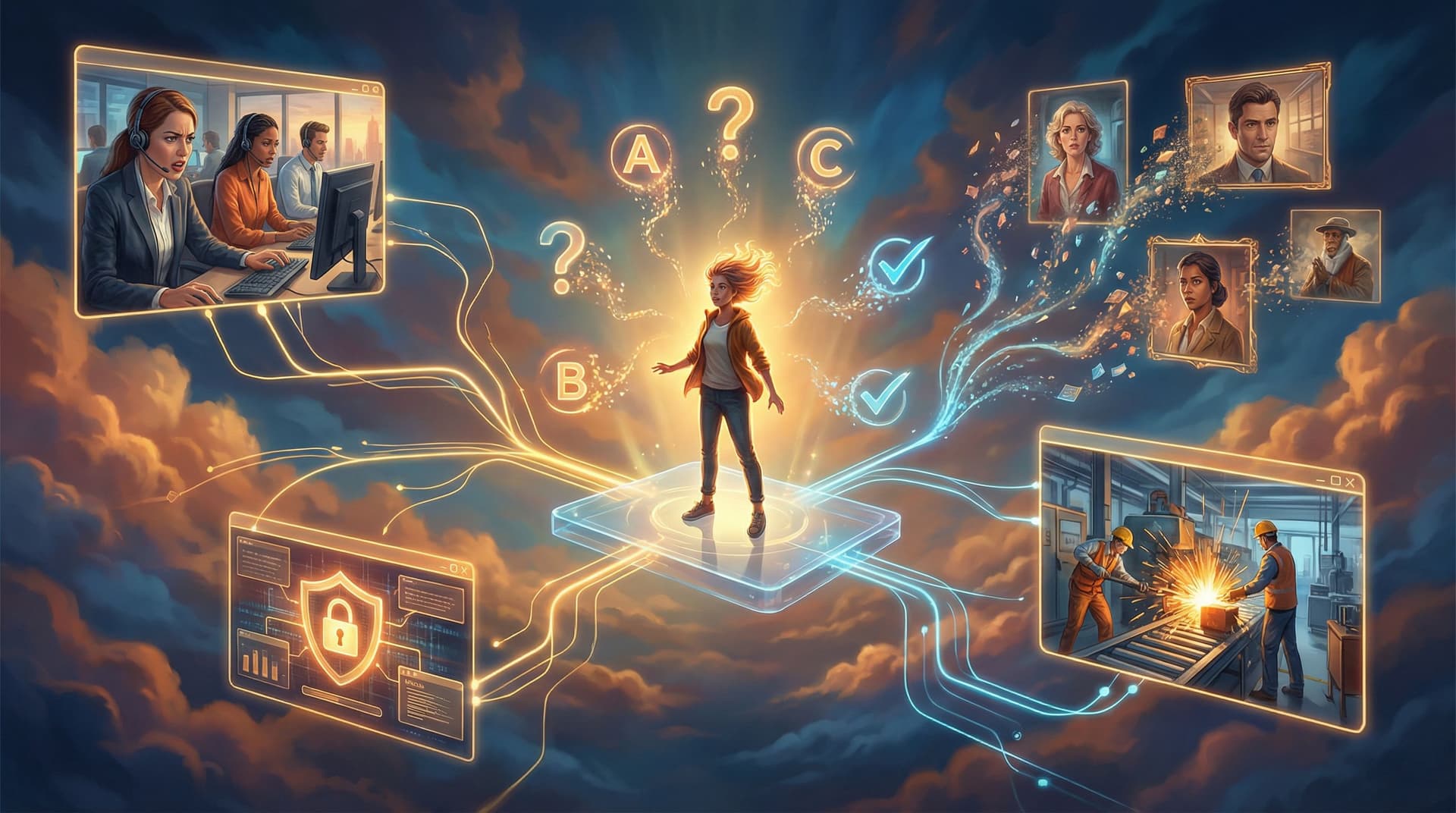
Designing ‘Session Zero’ in Questas: Onboarding Players into Complex Worlds, Rules, and Roles


Tabletop RPG players have known this for decades: if you skip Session Zero, you pay for it later.
Session Zero is the pre-adventure gathering where everyone aligns on expectations, tone, rules, safety, and character roles before the first goblin appears or the first deal is signed. It’s where a random group of people becomes a party.
When you’re building interactive, branching stories in Questas, you’re often asking players to step into dense worlds:
- A high-fantasy kingdom with tangled politics and magic systems
- A speculative near-future city with custom tech, slang, and factions
- A corporate drama with nuanced ethics, compliance rules, and power dynamics
- A coaching or training scenario where choices reflect real-world stakes
If players don’t understand the world, the rules, or who they are in the story, they’ll skim, misinterpret choices, and bounce. A well-designed “Session Zero” inside your Questas experience solves that.
This post is about how to design Session Zero as part of the story itself—not a wall of instructions players click past.
Why Build a Session Zero Into Your Questas Story?
Before we get tactical, it’s worth naming what Session Zero actually does for your interactive experience.
1. It turns confusion into curiosity.
Complex worlds are a feature, not a bug—if players feel invited to explore them. A guided onboarding:
- Introduces key concepts gradually
- Surfaces what matters mechanically and narratively
- Reduces cognitive overload before the branches explode
2. It makes expectations explicit.
Players need to know:
- What kind of agency they have (Can they fail? Can characters die? Are there multiple “right” answers?)
- What tone to expect (grim, playful, satirical, earnest)
- How long this will take and how many endings exist
This is especially crucial in learning and training stories. If you’re rethinking quizzes as narratives, your Session Zero is where you explain how “failing forward” works. For more on that mindset, see how we frame assessment in From Knowledge Checks to Narrative Arcs: Rethinking eLearning Quizzes as Questas Stories.
3. It aligns player identity with the role they’re stepping into.
Who am I in this world? A rookie detective? A compliance officer? A dragon-blooded diplomat? A product manager trying to ship a controversial feature?
Session Zero lets you:
- Clarify the character’s backstory, skills, and constraints
- Let players tune aspects of their persona (values, style, priorities)
- Explain how those traits will affect choices and outcomes
4. It sets up your systems and stakes.
If you’re tracking hidden variables—trust, suspicion, stress, reputation—Session Zero is where you teach the loop without giving away the math.
- “Your choices will affect how much your team trusts you.”
- “This world remembers broken promises.”
- “You’re under time pressure; lingering too long has consequences.”
5. It builds buy-in before the first major choice.
When players feel oriented and invited into co-creating the experience, they’re more likely to:
- Read carefully
- Replay to see alternate paths
- Share the story with others
Framing Session Zero as a Playable Prologue
The worst version of Session Zero is a static “Read this first” page.
The best version feels like a short, guided prologue where players are already making decisions—even if the stakes are low.
Think of it as:
- 3–7 scenes
- 5–10 light choices
- 1–2 moments where players define their role or preferences
Your goal: by the time the “real” story begins, players should already know how choices work, what kind of world they’re in, and what their character is like.
Core ingredients of a playable Session Zero
Consider weaving in these elements:
-
Welcome & premise
- A short, in-world hook: a message, briefing, prophecy, onboarding email, or whispered rumor.
- One or two sentences that state the core conflict or question.
-
Tone-setting micro-scene
- A tiny moment that communicates genre and mood: a tense elevator ride before a board meeting, a tavern rumor, a glitchy AR overlay in a crowded street.
- Players make 1–2 low-risk choices that showcase your branching style.
-
Role selection or calibration
- Players either pick a role or answer questions that shape it.
- You can borrow ideas from personality quizzes, but tie outcomes to the story.
-
Rule reveal through interaction
- Instead of listing rules, demonstrate them:
- Give a choice where delaying has a subtle consequence.
- Let a character react differently based on a prior answer.
- Instead of listing rules, demonstrate them:
-
Soft commitment to the journey
- End Session Zero with a clear threshold: the door to the dungeon, the elevator reaching the executive floor, the shuttle docking at a new planet.
- A final “Are you ready to step through?” moment.

Mapping Session Zero in Questas’ Visual Editor
Because Questas is a visual, no‑code editor, you can treat Session Zero as its own mini-arc.
Step 1: Carve out a dedicated Session Zero cluster
In your canvas:
- Create a distinct cluster of nodes labeled
S0-Intro,S0-Role,S0-Rules,S0-Threshold. - Use a different color tag or naming convention so you can see at a glance where onboarding ends and the main story begins.
This separation helps you:
- Iterate on onboarding without touching the main branches
- A/B test alternate Session Zero flows later
- Reuse a proven Session Zero pattern across multiple stories in the same world
Step 2: Decide what must be learned here
Ask yourself:
- What three things do players absolutely need to understand before the first big decision?
- What can they safely discover later through play?
Common “must know” items:
- Point of view: First-person vs. third-person, inner monologue vs. external camera
- Agency style: Are there hidden stats? Multiple endings? Fail states?
- Non-negotiable constraints: Time limits, codes of conduct, non-violence, etc.
Everything else—deep lore, side factions, detailed mechanics—can often be introduced as quiet choices and optional branches later. If you haven’t explored that design pattern yet, check out Designing ‘Quiet Choices’: Low-Stakes Branches that Build Character, Not Just Plot, in Questas.
Step 3: Turn rules into story moments
Instead of writing:
Choices will affect your reputation with the crew.
You might:
- Show a brief scene where you choose how to reply to a crew member.
- Immediately show a subtle shift in their body language or dialogue color.
- Add a tiny on-screen nudge: “You sense their trust in you shift.”
In Questas, you can:
- Use variables to track trust, stress, or suspicion
- Trigger alternate lines, scenes, or visuals based on those variables
- Keep the math hidden, but let the effects be felt
Step 4: Use AI visuals to anchor the world quickly
Session Zero is where first impressions are formed. AI-generated images and videos are your best tools for:
- Establishing visual style (painterly, comic, photoreal, lo-fi zine)
- Introducing recurring motifs (a sigil, a skyline, a corporate logo)
- Making abstract systems feel concrete (e.g., a glowing HUD for stats, a tarot spread hinting at fate)
If you’re still working out your visual language, pair this with the workflows in AI as Art Director: Building Cohesive Visual Storyworlds in Questas Without a Design Team.
Designing Roles, Archetypes, and Player Identity
Session Zero is the perfect place to help players answer: “What kind of person am I in this story?”
Option A: Classic archetype selection
Present 3–5 clear archetypes:
- The Diplomat – excels at relationships and negotiation, struggles with direct confrontation
- The Analyst – spots patterns and hidden info, but overthinks under pressure
- The Maverick – moves fast, breaks norms, draws heat
Each archetype can:
- Unlock unique dialogue options
- Tilt hidden variables (e.g., +10% trust gain, +10% risk of conflict)
- Change how NPCs initially react
Option B: “Answer to discover your style” questions
Instead of explicit archetypes, ask players a few questions:
- “When confronted with a tough decision, you usually…”
- “What matters more to you: loyalty, results, or fairness?”
- “You’re given a rulebook on day one. You…”
Behind the scenes, map combinations of answers to different play styles or starting stats.
This method is especially powerful if you’re using Questas for:
- Leadership development or coaching scenarios
- Ethics and compliance training
- Customer or user research, where you want to observe real preferences
If you’re curious about using interactive stories to understand how people actually behave, not just what they say, you’ll find deeper techniques in Beyond Personas: Using Interactive Questas Stories to Research Audience Motivations and Play Styles.
Option C: Role clarity through diegetic onboarding
Sometimes the world itself can onboard the player:
- A commander reading your file aloud
- An AI assistant walking you through your permissions
- A guild representative explaining your rank and obligations
This lets you:
- Deliver exposition in character
- Show how the world perceives the player, not just how the player perceives themselves
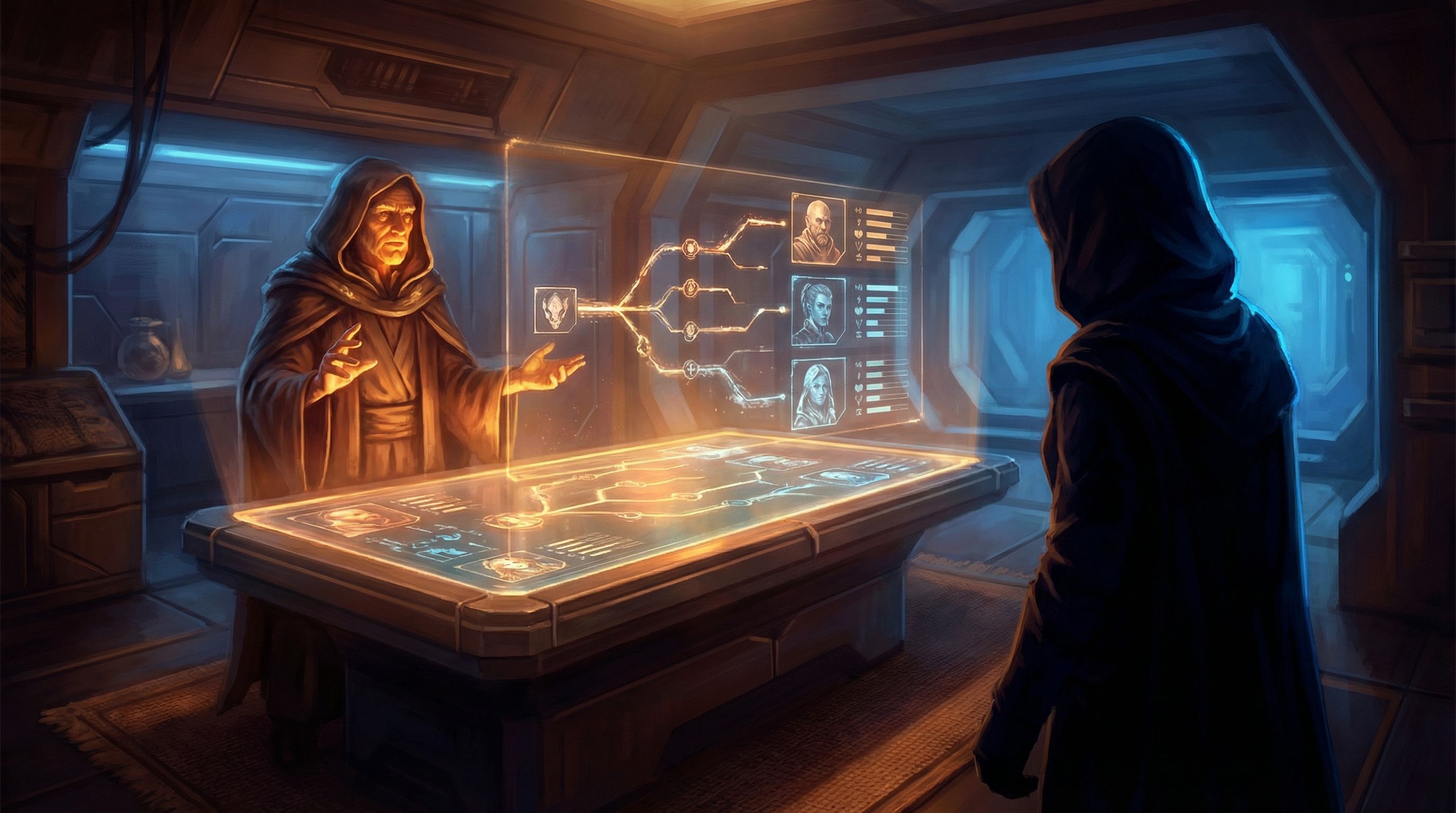
Onboarding Complex Rules Without Overwhelming Players
Complex doesn’t have to mean confusing. Here’s how to introduce intricate systems—ethics, magic, politics, compliance, or mechanics—without dumping a manual on your players.
1. Teach one concept per micro-scene
Break your rules into bite-sized lessons, each embedded in a scene:
- Scene 1: Demonstrate that time matters (delay vs. act now)
- Scene 2: Demonstrate that relationships matter (kindness vs. efficiency)
- Scene 3: Demonstrate that information quality matters (verify vs. assume)
Each scene:
- Presents a simple choice
- Shows a clear, immediate consequence
- Optionally hints that consequences will compound later
2. Use visual metaphors for abstract systems
If you’re tracking something abstract like reputation or psychological safety, anchor it visually:
- A gauge in the corner of the scene art that subtly fills or drains
- Recurring color shifts or glitches when players push a boundary
- A totem object (badge, crystal, device) that changes appearance over time
You can design these visuals directly in Questas with AI image prompts:
- “A close-up of a worn security badge whose color shifts from blue to red as trust decreases, cinematic lighting”
3. Make the first “failure” safe and instructive
If your story includes true fail states, use Session Zero to:
- Let players “fail” in a small way (e.g., lose a minor opportunity)
- Show a short debrief: what happened, why, and how the system works
- Offer an immediate retry or alternate route
This builds psychological safety and teaches players that failure is part of learning, not a punishment.
4. Offer optional deep dives
Not everyone wants to read the full lore codex. For the ones who do:
- Add optional branches like “Ask the AI assistant to explain the protocols.”
- Use hover or click-to-expand panels for definitions and background.
- Reward curiosity with small, flavorful details or easter eggs rather than mandatory info dumps.
Pacing, Length, and When to End Session Zero
How long should Session Zero be? Long enough to orient, short enough to keep momentum.
A practical guideline:
- Short experiences (10–15 minutes total):
- Session Zero: 2–3 minutes, 3–5 choices
- Medium experiences (20–40 minutes):
- Session Zero: 5–7 minutes, 5–10 choices
- Long or episodic experiences:
- Session Zero: 1 self-contained “Episode 0” that can be replayed or skipped on future episodes
Signals that Session Zero has done its job:
- Players can answer, without guessing:
- Who they are
- What they’re trying to do
- What might happen if they ignore people, rush ahead, or break norms
- You’ve demonstrated your core systems once
- You’ve given them a clear “doorway” into the main story
If you’re working under tight time constraints, pair these ideas with the workflow in Branching Narratives for Busy Teams: Shipping a Complete Questas Experience in One Workday.
Making Session Zero Reusable Across Stories
Once you’ve built a strong Session Zero in Questas, don’t treat it as a one-off.
You can:
- Clone and adapt it for sequels or spin-offs in the same world
- Maintain a library of onboarding patterns: ethics-heavy stories, puzzle mysteries, corporate dramas, fantasy epics
- Run playtests focused only on Session Zero, iterating until players feel oriented and excited before they ever reach your “main” content
Because the editor is visual, it’s easy to:
- Drag a tested Session Zero cluster into a new project
- Swap visuals and text while keeping the same branching logic
- Update rule explanations once and propagate them across related stories
Bringing It All Together
Designing a Session Zero inside your Questas experience isn’t extra polish—it’s structural.
A great Session Zero:
- Welcomes players into the world with a playable prologue
- Clarifies who they are and what kind of agency they have
- Teaches key systems through interaction, not exposition
- Uses AI visuals to anchor mood, style, and stakes from the first scene
- Sets a clear threshold between onboarding and adventure
When you get this right, everything downstream gets easier: players make more intentional choices, your analytics become more meaningful, and your story feels less like a quiz and more like a journey.
Ready to Build Your Own Session Zero?
You don’t need a rulebook the size of a tabletop RPG to onboard players into rich, branching stories.
Open up Questas and:
- Sketch a 4–6 node Session Zero cluster at the top of your canvas.
- Decide the three things players must understand before they hit the first big fork.
- Turn each of those into a tiny scene with one meaningful choice.
- Generate 2–3 AI visuals that define your world’s look and feel.
- Add a final threshold moment—“Step into the boardroom,” “Cross the portal,” “Join the heist”—and connect it to your main story.
Your players will feel the difference from the very first click.
Adventure awaits—start designing your Session Zero, and invite your audience into worlds they’re genuinely prepared to explore.