From Lore Bible to Living Wiki: Using Questas to Maintain Continuity Across Expanding Story Universes


Shared universes are no longer just the domain of comic book giants and prestige TV. Solo creators, small studios, classrooms, and brand teams are all building storyworlds that stretch across episodes, seasons, campaigns, and platforms.
That’s thrilling—until you hit the continuity wall.
- Wait, did the capital city have floating markets or underground canals?
- Was the mentor missing an eye… or an arm?
- Didn’t we already destroy that artifact three episodes ago?
A static lore bible (in Google Docs, Notion, or a dusty PDF) works for a while. But as your world grows—and especially as you move into branching, interactive stories—those documents stop being a single source of truth and start feeling like a graveyard of half-updated decisions.
This is where treating your canon as a living wiki inside a tool like Questas becomes a superpower.
In this guide, we’ll explore how to:
- Evolve your lore bible into a dynamic, queryable knowledge layer.
- Wire that knowledge directly into your branching scenes.
- Keep characters, locations, timelines, and themes consistent—even as your universe explodes in complexity.
- Collaborate with co-writers, artists, and even players without losing the plot.
Why Continuity Matters More Once Stories Start Branching
Continuity has always mattered, but branching narratives raise the stakes.
In a linear story, you can occasionally patch over mistakes with a clever retcon. In an interactive universe, contradictions multiply faster:
- Players revisit earlier scenes and spot inconsistencies you forgot about.
- Choices fork timelines, and it’s easy for one branch to quietly break your rules.
- AI-generated visuals can drift in style or details if you don’t keep them grounded.
Meanwhile, audiences are more continuity-aware than ever. Entire communities exist to track canon, timelines, and contradictions. When a major franchise ignores its own rules or forgets past events, fans notice—and it erodes trust in the world.
For indie creators and teams building on Questas, that same expectation applies. The good news: you have far more control than a traditional TV writer’s room, because your story logic, visuals, and lore can live in one connected system.
Lore Bible vs. Living Wiki: What’s the Difference?
Most creators start with some version of a lore bible:
- A document with world rules (magic systems, tech constraints, politics).
- Character sheets with backstory, motives, and relationships.
- A rough timeline of major events.
- A folder of reference images or moodboards.
That’s a great start—but it has limits:
- It’s static. Once written, it rarely keeps pace with the story as actually published.
- It’s disconnected. Your scenes, branches, and visuals don’t “know” what’s in it.
- It’s hard to query under pressure. When you’re mid-writing sprint, you don’t want to dig through 40 pages to confirm the color of a sigil.
A living wiki solves those problems by being:
- Structured: information is broken into entities (characters, locations, factions, items) with fields you can reference.
- Linked: scenes, branches, and media are connected back to those entities.
- Evolving: it updates as you publish new episodes, endings, or spin-offs.
- Operational: it doesn’t just describe your world; it actively drives how your story behaves.
On Questas, that living wiki can sit right inside your project: a blend of notes, tags, templates, and AI-assisted prompts that keep your universe coherent while you focus on storytelling.
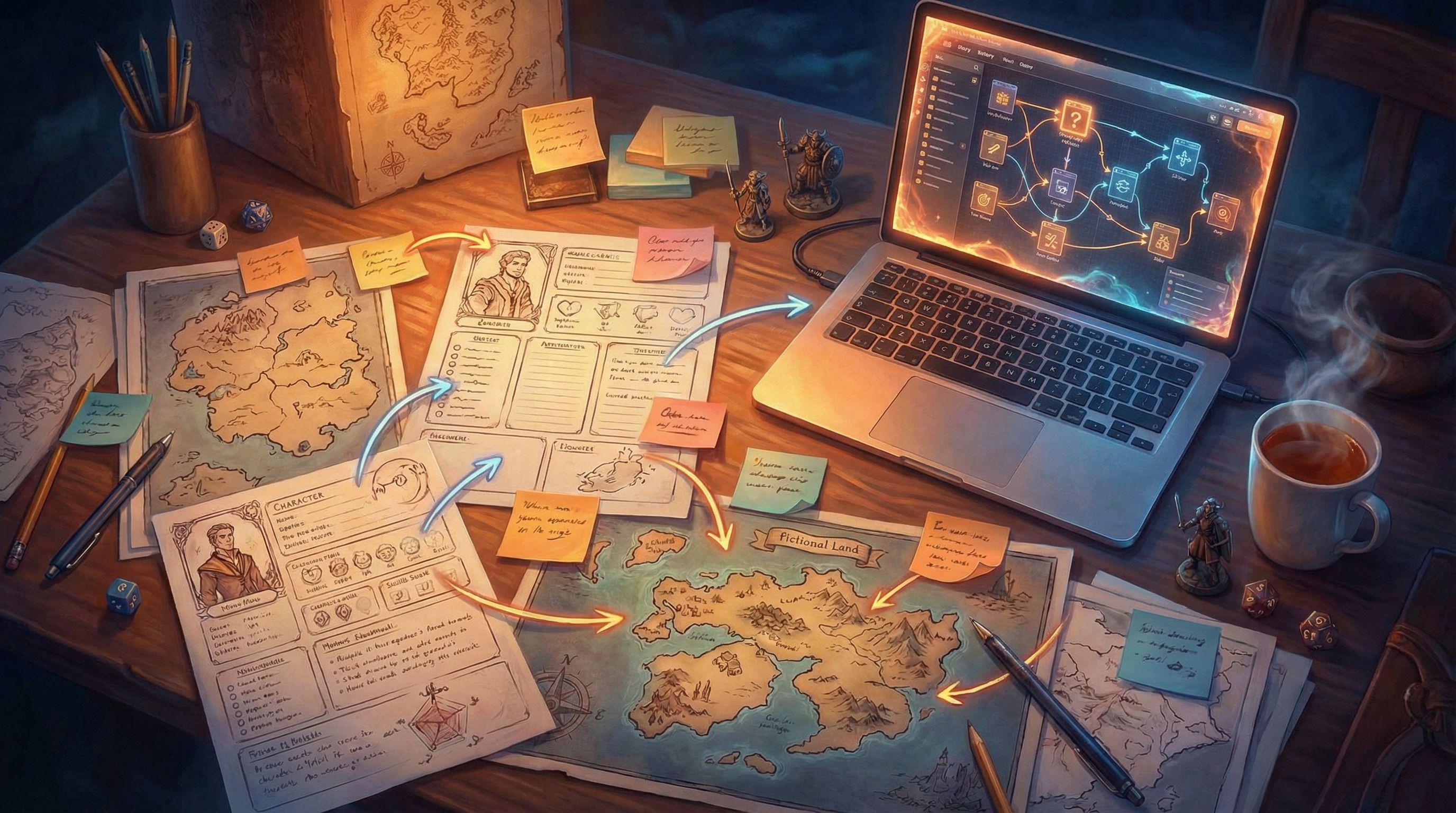
Step 1: Break Your Universe into Canon “Atoms”
Before you wire anything into scenes, you need to de-chunk your lore bible.
Think of your universe as a set of atoms that can be referenced and recombined:
- Characters – names, pronouns, roles, physical traits, signature items, core motives, secrets.
- Locations – geography, climate, culture, key landmarks, sensory details.
- Factions & Institutions – goals, resources, ideology, rivalries.
- Systems – magic rules, technology constraints, economic or social rules.
- Artifacts & Props – unique items with history, powers, limitations.
- Timeline Events – wars, disasters, discoveries, treaties, personal turning points.
For each atom, define:
- Canonical fields: facts that should never silently change (e.g., “The twin moons rise from the west”).
- Flexible fields: things that can evolve in-story (e.g., “Faction reputation with the player”).
In practice, you might start by:
- Skimming your existing lore doc.
- Highlighting every noun that seems important.
- Creating a simple table or database (even before you touch Questas) with columns like:
- Name
- Type (Character, Location, Faction…)
- One-line summary
- Canonical traits
- Known appearances (episodes, scenes, branches)
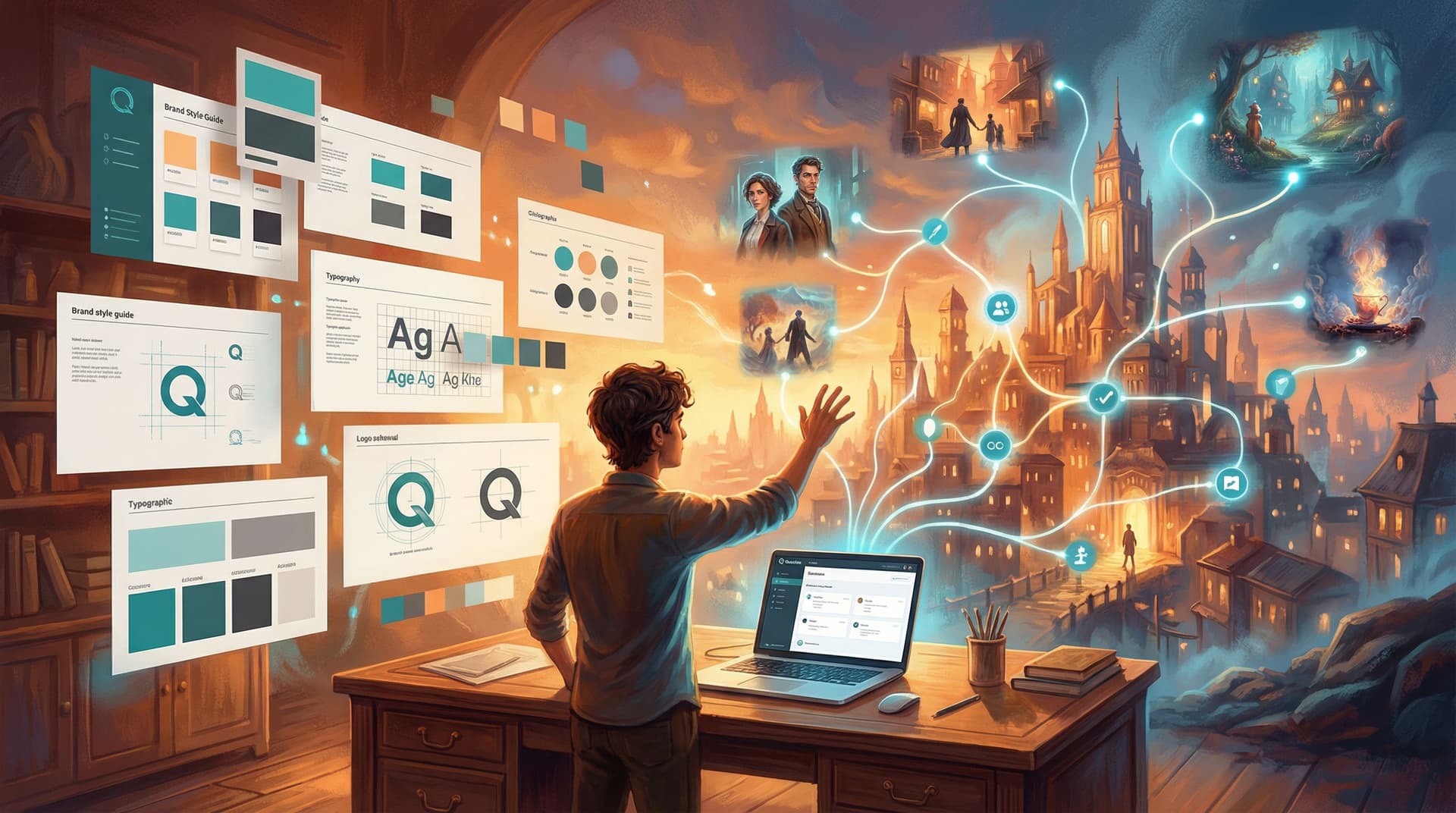
If you’re coming from brand work, you’ll recognize this move from turning guidelines into a story system. Our post on adapting brand systems—From Brand Guidelines to Story Bible: Translating Visual Identity Systems into Questas-Ready Worlds—walks through a similar decomposition process.
Step 2: Turn Canon Atoms into Reusable Building Blocks in Questas
Once your atoms are defined, the next step is to make them usable inside Questas.
Here are practical patterns creators use:
1. Canon Cards for Key Entities
Create a dedicated “canon card” scene (or note) for each major entity that includes:
- A concise description.
- A small set of non-negotiable facts.
- Reference images or style prompts.
- A list of scenes where this entity appears.
You’re not building content for players here—these are for you and your collaborators. Link these canon cards anywhere that entity shows up.
2. Prompt Templates for AI Visuals
AI-generated visuals are powerful, but also a common source of drift. To avoid the “is that really the same character?” problem:
- Create a standard prompt snippet per recurring character or location.
- Include: age, build, clothing style, signature colors, mood, and any distinctive features.
- Store those snippets in a central “Visual Style” node or document.
- When generating new images in Questas, paste or reference that snippet first, then add scene-specific details.
If you haven’t built a visual style system yet, our guide AI Visual Storytelling for Non-Artists: A Practical Style Cookbook for Your First 10 Questas Worlds is a great companion.
3. Tagging and Naming Conventions
Small naming decisions add up to big clarity:
- Prefix scenes with arcs or seasons:
S1_E03_Market_Chase,S2_E01_Prologue. - Tag scenes with the entities they involve:
#Character:Lyra,#Location:Skyport,#Faction:OrderOfGlass. - Use consistent terminology for powers, items, and rituals—if it’s called a "Shard Key" once, don’t let it become a "Shard Token" somewhere else.
Over time, this makes your Questas project feel like a navigable wiki instead of a tangle of nodes.
Step 3: Wire Continuity Directly into Your Branching Structure
A living wiki isn’t just a reference; it should actively shape what’s possible in your story.
Here are concrete ways to do that:
1. Canon as Conditions
Use your established facts and states to gate branches:
- If your magic system has a hard rule (e.g., blood magic always has a cost), encode that as a design constraint:
- Any choice that uses blood magic must:
- Deduct a resource.
- Alter a relationship.
- Or trigger a future consequence.
- Any choice that uses blood magic must:
- If the capital city is under curfew after a certain event, prevent later scenes from casually mentioning crowded nightlife unless the timeline logically allows it.
In Questas, this often looks like:
- Global variables tracking world state (e.g.,
city_under_curfew = true). - Branch conditions that check those variables before unlocking scenes.
2. Character Memory and Consistency
Continuity isn’t just about geography and timelines—it’s also about psychology.
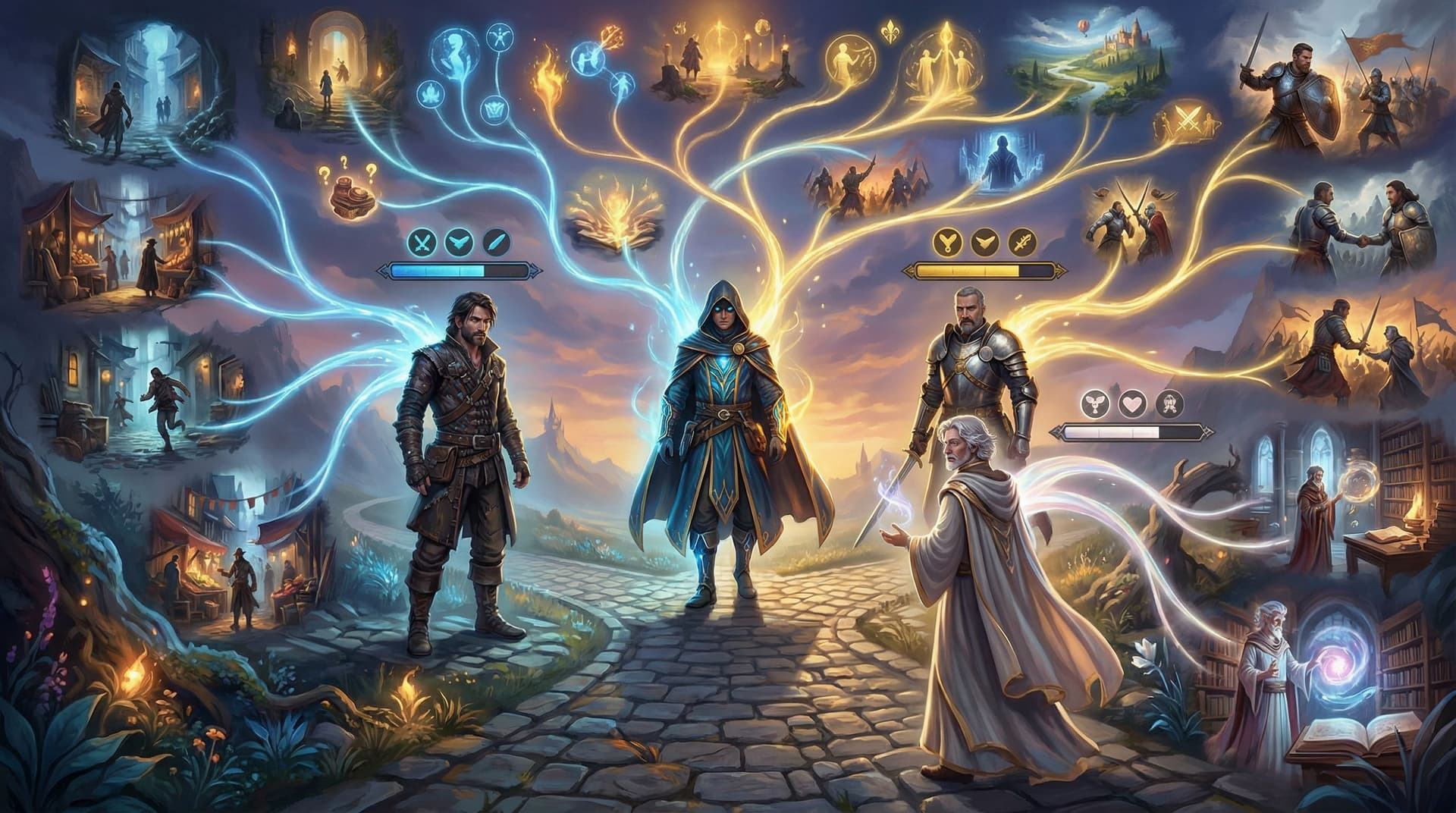
If a character forgives a betrayal in one branch but hunts the player relentlessly for the same action in another, your world stops feeling honest.
To keep characters consistent:
- Track key emotional beats as variables:
trust_Lyra,fear_of_magic,loyalty_to_faction. - Let those values shape:
- Dialogue tone.
- Willingness to help.
- Which endings are even available.
Our post Designing ‘Living NPCs’: How to Give Side Characters Memory, Motives, and Agency in Questas dives deep into this. When you combine that NPC memory model with a structured lore wiki, you get characters who feel grounded in canon and responsive to player choice.
3. Timeline-Aware Design
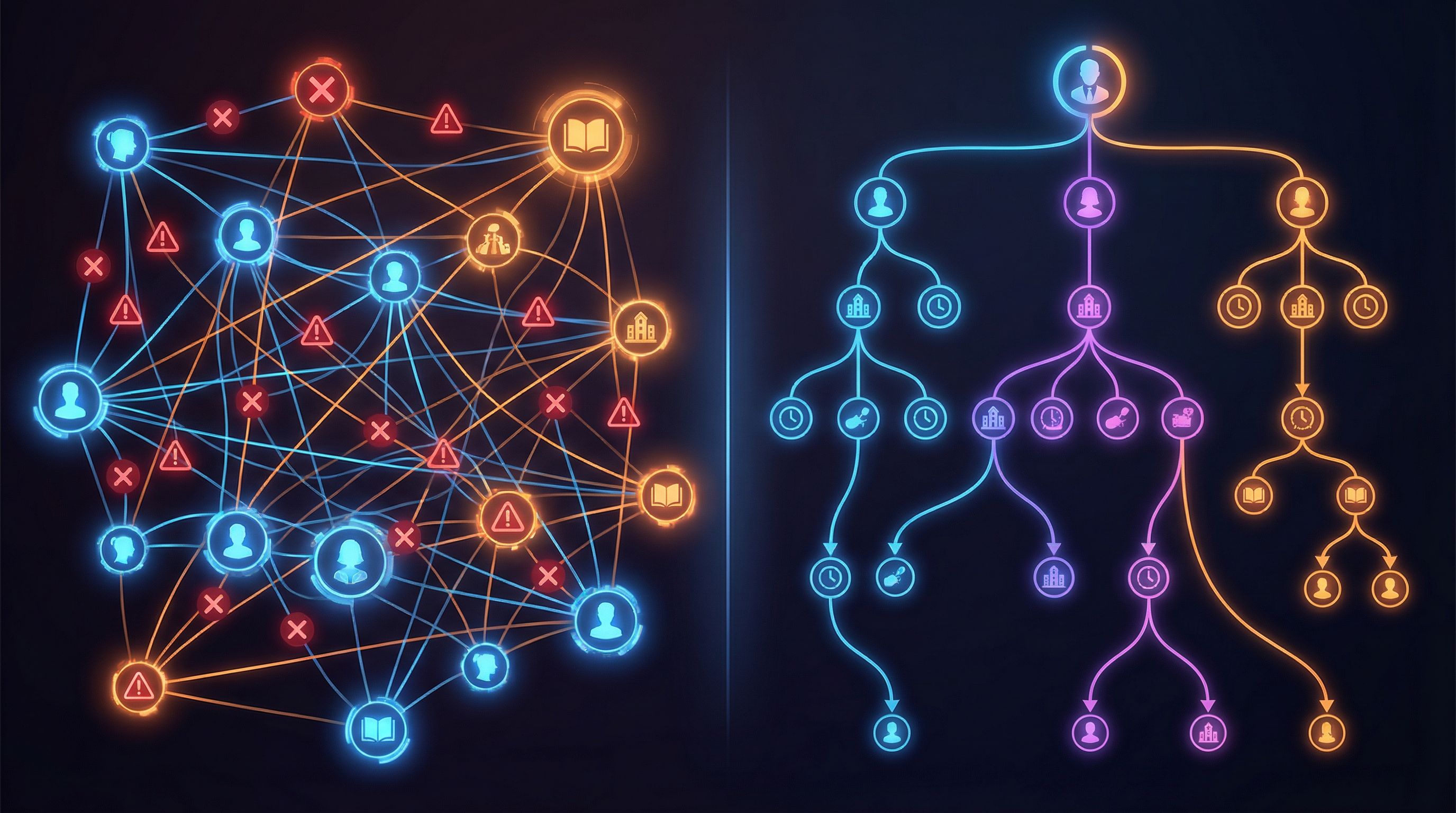
Branching timelines are where continuity usually explodes.
To keep them under control:
- Define anchor events that must happen in every major timeline (or in clearly labeled alt-timelines).
- Label scenes with both in-universe date and relative order.
- Avoid casually referencing “years ago” without checking your own timeline math.
A practical trick:
- Maintain a simple timeline grid where columns are timelines (A, B, C…) and rows are years or major milestones.
- Mark which events occur where.
- When designing a new scene in Questas, decide explicitly which timeline(s) it belongs to.
Step 4: Use AI as a Continuity Assistant, Not a Canon Breaker
Because Questas leans on AI for text and visuals, it’s tempting to let the model improvise everything. That’s how continuity slips in through the back door.
Instead, treat AI as a continuity-aware collaborator:
1. Feed Canon into Your Prompts
When generating dialogue or descriptions:
- Start prompts with a compact canon summary:
- "You are writing in a world where…"
- "This character has…"
- "Previously, the player chose…"
- Include any non-negotiable rules that must not be broken.
This keeps outputs aligned with your lore instead of drifting toward generic fantasy or sci-fi tropes.
2. Ask AI to Spot Inconsistencies
You can also use AI to audit your own work:
- Paste two or three scenes and ask:
- "List any potential continuity conflicts between these scenes (character behavior, setting details, timeline)."
- Use this as a quick check before you publish a new chapter or branch.
3. Generate Canon Summaries Per Arc
As your universe grows, new collaborators (or future-you) need an on-ramp.
Use AI to:
- Summarize each season or major arc into a one-page brief.
- Generate character relationship maps from existing scenes.
- Draft "Previously, in this universe…" recaps that can double as internal references and player-facing intros.
These summaries become part of your living wiki, updated whenever you ship a new chunk of story.
Step 5: Collaborate Without Losing the Thread
Story universes become fragile when more people touch them. But collaboration is also how they get richer.
To protect continuity while inviting others in:
1. Establish a “Canon Gatekeeper” Role
Even if you’re a solo creator, it helps to think in roles:
- Canon Gatekeeper: the person (or hat you wear) responsible for approving changes to core lore.
- Arc Leads: people who own specific storylines or campaigns.
Any proposal that alters:
- World rules,
- Character backstory,
- Major timeline events,
…should go through the gatekeeper. That doesn’t mean you can’t change canon—but changes should be deliberate and recorded, not accidental.
2. Use Prototypes to Test Risky Changes
If you’re considering a major shift—like revealing that a long-dead character is alive in an alternate branch—prototype it as a small, isolated Questas experience first.
- Treat it like a what-if lab.
- See how it feels in play.
- Check whether it breaks existing rules or cheapens earlier choices.
Our post The New Interactive Zine: Short-Form, Lo-Fi Questas Experiments for Writers and Indie Creators explores this idea of low-stakes experiments. It’s a perfect sandbox for testing continuity-bending ideas before you commit them to canon.
3. Document Retcons as First-Class Citizens
Sometimes, you need to retcon. Maybe an early decision is boxing you in, or a better idea emerges.
When that happens:
- Create a Retcon Log in your living wiki.
- For each change, record:
- What changed.
- Why you changed it.
- Which scenes/branches are affected.
- Whether the change is in-universe (explained via time travel, unreliable narrator, etc.) or purely meta.
This keeps your future self from re-opening old wounds—and gives hardcore fans a clear map of how the universe evolved.
Step 6: Let Continuity Serve Emotion, Not the Other Way Around
It’s easy to let continuity become a cage. You start writing for the wiki instead of the player.
The goal of a living wiki is not to enforce bureaucracy—it’s to protect emotional truth:
- If a relationship mattered deeply in Season 1, it should cast a shadow over Season 3.
- If a choice felt weighty in one playthrough, it should echo in others—even if the exact events differ.
- If your world has a core theme (e.g., "power corrupts" or "memory is unreliable"), continuity helps you reinforce that theme instead of accidentally undermining it.
Use your Questas project as a compass:
- When in doubt, ask: Does this scene honor what players have already lived through?
- If the answer is no, either:
- Adjust the scene to align with canon, or
- Consciously break canon and update the living wiki with that decision.
Bringing It All Together
Turning a static lore bible into a living wiki inside Questas isn’t a one-time project. It’s an ongoing practice that evolves with your universe.
To recap the journey:
- Decompose your lore into clear, reusable atoms (characters, locations, systems, events).
- Build canon cards and visual templates so those atoms show up consistently in scenes and AI-generated media.
- Wire canon into your branching logic with variables, conditions, and timeline labels.
- Use AI as a continuity assistant, feeding it canon and asking it to spot conflicts.
- Collaborate with intention, with a canon gatekeeper, a retcon log, and low-stakes prototypes.
- Keep emotion at the center, letting continuity amplify, not flatten, your story’s impact.
Do this well, and your universe stops feeling like a pile of scenes and starts feeling like a place—one your audience trusts enough to keep returning to, exploring new branches, and even co-creating within.
Ready to Turn Your Lore Bible into a Living Wiki?
If you’re:
- Sitting on a massive Google Doc of worldbuilding notes,
- Wrestling with continuity across multiple interactive stories,
- Or dreaming of a universe that can support campaigns, classrooms, and character spin-offs,
…this is your moment to give that world a real backbone.
Open a fresh project in Questas and:
- Create canon cards for your three most important characters.
- Build a simple timeline of five anchor events.
- Draft one short branching scene that must respect both.
It doesn’t have to be perfect. It just has to be living—something you can refine, extend, and rely on as your universe grows.
Adventure awaits. Your world is ready to stop being a document and start being a place your players can truly inhabit.