Designing ‘Living NPCs’: How to Give Side Characters Memory, Motives, and Agency in Questas

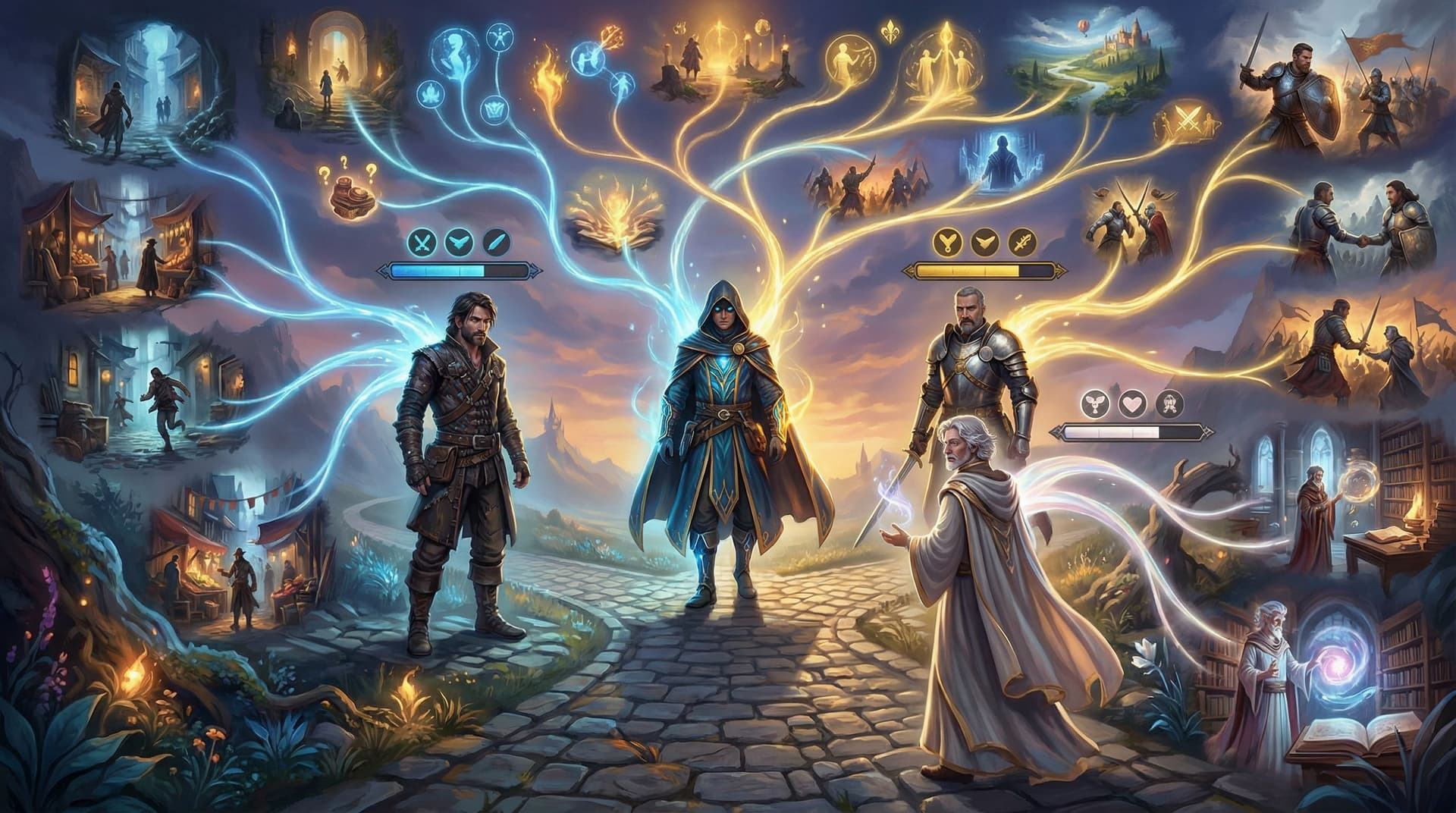
Non‑player characters are where interactive stories either breathe… or feel like cardboard.
You can have gorgeous AI visuals, intricate branching, and a killer premise, but if every shopkeeper, rival, mentor, or roommate repeats the same two lines no matter what the player does, your world will feel thin.
“Living NPCs” are different. They:
- Remember what happened (and what the player chose)
- Want things that may align or clash with the player
- Act on their own logic, not just as quest dispensers
On a platform like Questas, where you’re already thinking in branches and scenes, giving side characters memory, motives, and agency isn’t just flavor—it’s the backbone of replayability, emotional impact, and meaningful choice.
This post is a practical guide to building those living NPCs: how to design them, structure them inside Questas, and use AI visuals to reinforce who they are over the course of a branching story.
Why Side Characters Deserve Main-Character Energy
Before we get tactical, it’s worth asking: why put so much effort into NPCs at all?
1. They turn choices into relationships, not just routes
A bare-bones branch: you choose Path A or Path B.
A branch with living NPCs: you choose who to back, who to betray, whose trust to earn, and those characters react.
Players don’t remember “I went left in the forest.” They remember, “I lied to Mara to protect Jace, and she never forgave me.”
2. They make your world feel persistent
When NPCs:
- Recall past encounters
- Change their tone based on player behavior
- Show up in new contexts with updated goals
…your story stops feeling like a series of disconnected scenes and starts feeling like a place that continues whether or not the player is looking.
3. They multiply your narrative ROI
Every well‑designed NPC becomes a reusable narrative system:
- Drop them into new scenes with consistent motives
- Let them collide with different branches
- Reuse their visual style and voice across multiple Questas experiences
If you’ve read our post on turning linear fiction into modular scenes, you’ve seen this logic applied to plot. Living NPCs apply the same logic to character. (If that idea’s new to you, you might enjoy From Short Story to Story System: Adapting Linear Fiction into Modular Scenes for Questas.)
Three Pillars of a “Living” NPC
You don’t need complex AI agents to make NPCs feel alive. You need three clear design pillars:
- Memory – What do they remember about the player and the world?
- Motives – What do they want, and what will they trade for it?
- Agency – How do they act on those motives across branches?
Let’s break each one down in Questas terms.
Pillar 1: Designing NPC Memory in Questas
NPC “memory” is just state: variables that track what’s happened.
In Questas, you can think of this in three layers:
A. Global flags: big, story‑defining memories
These are yes/no or simple values that matter across the whole story:
saved_mara– Did you rescue Mara at the docks?lied_to_captain– Did you falsify the report?alliance– Are you aligned with the Rebels, the Guild, or Neutral?
How to use them in Questas:
- Create variables in your project to track these decisions.
- On key choice nodes, set or update the variable.
- In later scenes, use conditional logic on dialogue and branches:
- If
saved_mara == true, she greets you warmly. - If
saved_mara == false, she’s missing—or appears as an antagonist.
- If
Design tip: Keep a short list (3–7) of global flags per story. Too many, and you’ll drown in conditionals.
B. Relationship meters: emotional memory
Beyond binary flags, give important NPCs a relationship score:
mara_trustfrom 0–100captain_respectfrom 0–5
Each time the player:
- Supports their goals → increase the meter
- Undermines or betrays them → decrease the meter
Then gate:
- Special scenes (a confession, a secret mission)
- Alternate endings
- Unique items or clues
…behind thresholds like mara_trust >= 70.
How to implement:
- Use numeric variables in Questas and increment/decrement them on choice outcomes.
- Add conditional branches: “If
mara_trust >= 40, show this supportive reaction; else, show distant or hostile dialogue.”
C. Local memories: scene‑level callbacks
Not every memory needs a variable. Some can be lightweight call‑backs inside a scene:
- If the player picked the “joke” dialogue option earlier in the same conversation, have the NPC refer to it later.
- If the player inspected a certain prop, adjust a line of dialogue to acknowledge it.
You can do this with:
- Short‑lived scene variables
- Duplicate nodes with slightly altered text
These micro‑memories make conversations feel responsive without heavy logic.

Pillar 2: Giving NPCs Clear, Compelling Motives
A living NPC is defined less by their backstory and more by their current agenda.
When you’re designing an NPC for Questas, answer three questions:
- What do they want right now?
- What are they afraid of losing?
- What line won’t they cross?
A simple motive template
For each major NPC, jot this in your planning doc or directly in node notes:
“I am [role] who wants [goal], but I’m afraid of [risk], and I will never [boundary].”
Examples:
- “I am a smuggler who wants a clean record, but I’m afraid of my crew turning on me, and I will never cooperate with the Guild.”
- “I am a classroom moderator who wants students to think critically, but I’m afraid of administration backlash, and I will never publicly humiliate a student.”
These motives work beautifully if you’re building educational scenarios or decision journeys, like the ones we explore in From Classroom Debates to Playable Dilemmas: Turning Real Discussions into Questas Decision Journeys.
Turning motives into branching behavior
Once you know what an NPC wants:
- Align some choices with their goal.
- Help the smuggler erase a record → relationship boost, new mission.
- Put them under pressure.
- Force a choice between their safety and their boundary.
- Let motives evolve.
- If the player betrays them twice, maybe their boundary shifts.
In Questas:
- Use variables to track key motive‑related events (e.g.,
smuggler_betrayedcount). - Create alternative dialogue paths where they rationalize, double down, or break.
Motives for “quiet” NPCs
Not every NPC is dramatic. Some are:
- A barista who tracks gossip
- A librarian who notices which books you borrow
- A roommate who comments on your small choices
These are perfect candidates for “quiet choices” that reveal character without derailing the plot. If you like that design space, you’ll find more techniques in Designing ‘Quiet Choices’: Low-Stakes Branches that Build Character, Not Just Plot, in Questas.
Pillar 3: Building NPC Agency Across Scenes
Memory and motives set the stage. Agency is what the NPC actually does.
An NPC has agency when:
- They take actions off‑screen that change the world
- They show up unexpectedly in new branches
- They pursue their own goals, even if the player ignores them
A. Give NPCs their own mini‑arcs
Think of each major NPC as having a 3‑beat arc that can play out differently depending on the player:
- Introduction – They state or hint at their goal.
- Complication – Their goal is threatened or advanced.
- Outcome – They succeed, fail, or transform.
In Questas:
- Map each beat to one or more scenes.
- Use variables to track whether the player helped, hindered, or ignored them.
- Branch the final outcome scene based on those variables.
For example:
- If
helped_mara_mission == trueandmara_trust >= 60→ she becomes a powerful ally in the finale. - If not → she sells your location to the antagonist.
B. Let NPCs move between branches
One mistake creators often make: treating NPCs as tied to a single route.
Instead, design them as mobile pieces:
- The same mentor can appear in the “Academy Path” and the “Street Path,” but with different resources and attitudes.
- A rival might be a direct competitor in one branch and a reluctant partner in another.
Practically:
- Reuse the NPC’s visuals and core variables across multiple scenes.
- Adjust only the context and tone, not their core motive.
C. Show the consequences of ignoring them
Agency isn’t just about what happens when the player engages. It’s also about what happens when they don’t.
Design at least one moment where:
- Ignoring an NPC’s plea leads to a later complication.
- Failing to build trust means losing access to crucial information.
You can implement this with timed or “one‑shot” opportunities:
- A branch that disappears if the player doesn’t pursue it early.
- A variable like
missed_mara_signal == truethat unlocks a later “you could have prevented this” reveal.
Bringing NPCs to Life with AI-Generated Visuals
On Questas, you’re not just writing NPCs—you’re casting and costuming them with AI visuals.
A. Lock in a visual identity early
For each major NPC, decide on:
- Silhouette: Tall and angular? Compact and round?
- Palette: Warm earth tones, neon cyberpunk, muted grayscale?
- Signature props: A chipped mug, a glowing datapad, a red notebook?
Then generate a small set of “anchor” images:
- Neutral portrait
- In‑action shot (doing their job)
- High‑emotion moment (angry, afraid, ecstatic)
Reuse and lightly vary these across scenes so the character feels consistent even as their circumstances change.
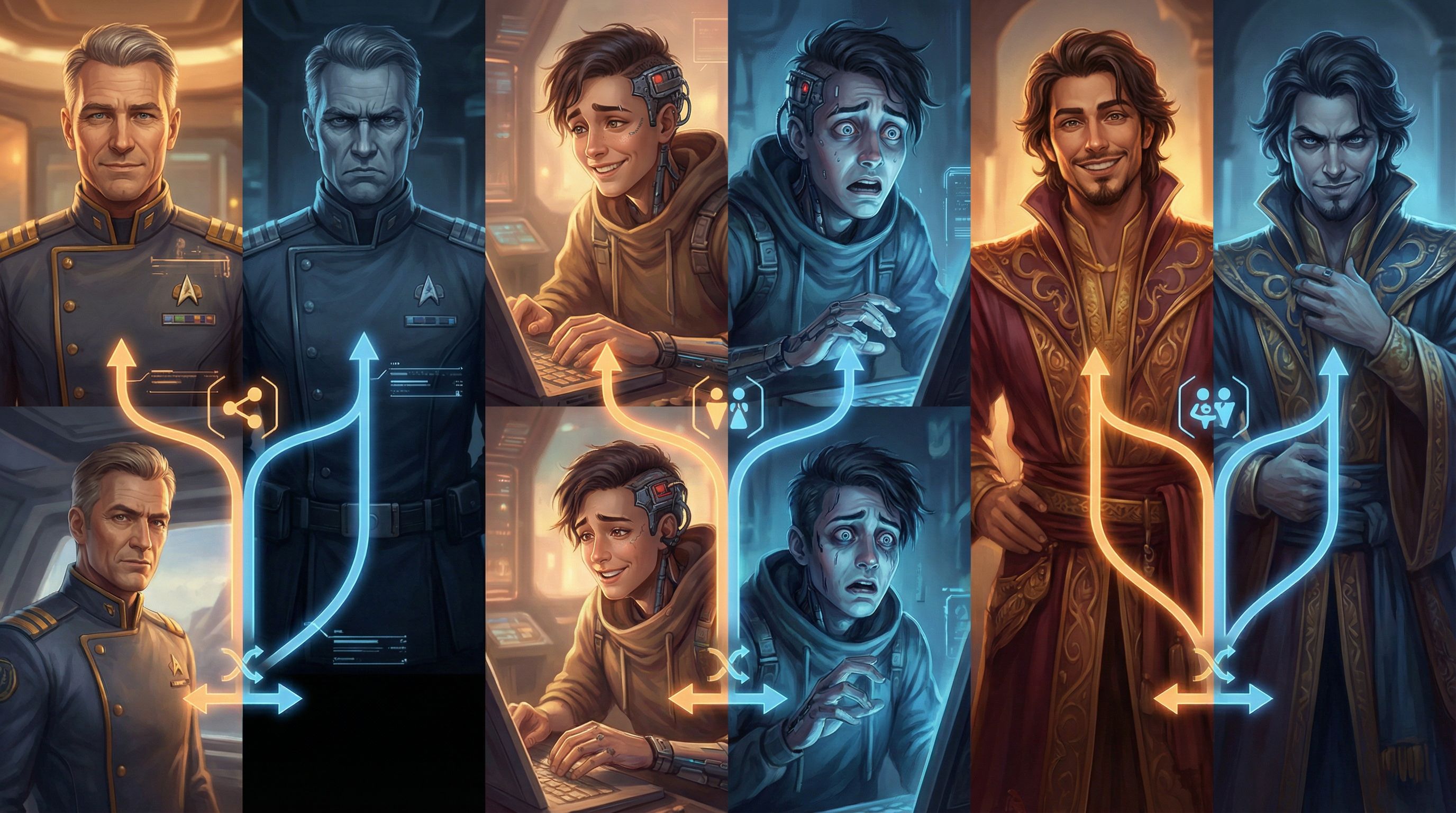
B. Use visuals to reflect memory and motives
You can reinforce your narrative state visually:
- High trust route → softer lighting, open body language, relaxed clothing.
- Low trust route → harsher shadows, guarded posture, visible weapons.
- Motive shift → new props (the smuggler now wears a Guild badge), different environments.
Because Questas lets you attach images to specific nodes, you can:
- Create alternate versions of the same scene art keyed to relationship variables.
- Show the same location gradually changing as NPCs pursue their goals.
C. Hide story clues in NPC-centric visuals
NPCs can also be carriers of secrets:
- A tattoo that hints at a hidden allegiance
- A whiteboard behind them with a code
- A family photo that reveals a twist
If that excites you, you’ll get a lot out of our deep dive on visual clues and Easter eggs in AI-Generated Props and Clues: Using Visual Details to Hide Secrets, Codes, and Easter Eggs in Questas.
Practical Workflow: Building a Living NPC in Questas, Step by Step
Let’s put this together into a concrete process you can follow for your next project.
Step 1: Draft a one-page NPC brief
Include:
- Role in the story
- Motive template (goal, fear, boundary)
- Relationship to the player character
- 3 key scenes where they’ll appear
Keep it scrappy—this is a working document, not a novel.
Step 2: Define 3–5 variables
For a major NPC, you might track:
npc_trust(0–100)npc_helped(true/false)npc_betrayed_count(integer)- One or two global flags tied to their arc
Set these up in your Questas project before you start wiring branches.
Step 3: Map their mini-arc across scenes
In the visual editor:
- Drop in Intro, Complication, and Outcome scenes.
- Connect them with your main story flow.
- Add at least one optional scene where the player can deepen or damage the relationship.
Step 4: Layer in conditional dialogue
Within each scene:
- Write a base version of the interaction.
- Add conditional variants based on your variables.
Examples:
- If
npc_trust >= 60, they share a secret. - If
npc_betrayed_count >= 1, they’re curt and suspicious.
You don’t need new branches for every variation—sometimes a single line swap is enough to make the memory feel real.
Step 5: Generate and attach visuals
For each key scene:
- Generate an NPC image that matches their current emotional and narrative state.
- Attach it to the node.
- If you have relationship‑based variations, create alt versions.
Step 6: Playtest for emotional continuity
When you test your story (ideally with real players):
- Ask them how they feel about each NPC at different points.
- Watch for moments where the NPC’s reaction feels off or unearned.
- Tweak variables, thresholds, and dialogue to smooth out those bumps.
If you’re already looking at analytics and qualitative feedback for your Questas stories, you can fold NPC reactions into the same playtesting habits you’d use for overall structure—see Beyond Clicks and Completion Rates: Qualitative Playtesting Methods for Deeply Improving Your Questas Stories for ideas.
Common Pitfalls (and How to Avoid Them)
Pitfall 1: Overcomplicating the logic
You add a variable for every tiny interaction and end up with a spaghetti bowl of conditions.
Fix:
- Limit yourself to 3–5 meaningful variables per major NPC.
- Let smaller moments use tone and wording, not new variables.
Pitfall 2: NPCs that only react, never initiate
They remember things, but they never actually do anything with that memory.
Fix:
- Design at least one scene where the NPC starts the interaction based on past events.
- Have them confront, thank, recruit, or betray the player.
Pitfall 3: Visuals that don’t match the narrative state
The text says they’re furious, but the image shows them smiling serenely.
Fix:
- Generate emotion‑specific variants of NPC portraits.
- Name and organize them clearly so you attach the right one to each node.
Wrapping Up: What “Living NPCs” Give Your Questas Stories
When you invest in NPC memory, motives, and agency, you’re not just adding polish—you’re changing how your audience experiences your work:
- Choices feel weighty because they affect relationships, not just plot branches.
- Replays stay interesting as players experiment with different alliances and betrayals.
- Your worlds feel inhabited, not staged—like they’d keep going even if the player walked away.
And because Questas is built around a visual, no‑code editor with AI visuals baked in, you don’t need a dev team to pull this off. You need a clear design approach and the willingness to treat your side characters as systems, not scenery.
Your Next Move
If you’re ready to try this in your own work, here’s a simple starting challenge:
- Pick one existing Questas project (or start a new micro‑story).
- Choose one side character you like.
- Give them:
- A one‑sentence motive
- A
trustvariable - A three‑scene mini‑arc with at least two alternate outcomes
- Generate two distinct visual states for them (friendly vs hostile, hopeful vs defeated, etc.).
Ship that experiment, even if it’s small. Once you’ve done it once, you’ll see how quickly living NPCs can transform the feel of your stories.
Ready to build your first cast of living side characters? Head over to Questas, open a new project, and give one NPC a memory, a motive, and the agency to surprise your players.