Beyond Fantasy: 10 Unexpected Use Cases for Questas in Business, Training, and Marketing


Interactive, choose-your-own-adventure stories are usually associated with fantasy quests, sci‑fi sagas, and roleplaying campaigns. But the same mechanics that make those stories so engaging—choice, consequence, replayability, and visual immersion—are incredibly powerful outside of entertainment.
For teams in business, training, and marketing, interactive stories can:
- Turn dry content into memorable experiences
- Let people practice decisions instead of just reading about them
- Reveal how customers think and what they care about
- Shorten onboarding and learning curves
That’s where platforms like Questas come in. With a visual, no‑code editor and AI‑generated images and video, you can design branching experiences that feel like playable simulations—without needing a dev team.
Below are 10 unexpected, practical ways to use Questas far beyond elves and starships.
1. Sales Training as a Safe, Playable Sandbox
Traditional sales training often means slide decks, scripts, and one‑off roleplays. The problem: reps don’t get enough varied practice, and feedback is inconsistent.
With Questas, you can turn sales scenarios into interactive journeys:
- Simulate discovery calls where reps choose how to respond to objections.
- Branch by customer persona (budget-conscious, technical, skeptical, in-a-hurry).
- Show consequences: lost deals, stalled timelines, or upsells based on their choices.
How to build it in Questas:
- Define 3–5 core scenarios (e.g., first call, renewal risk, competitive bake-off).
- For each scenario, map the key decision points: opening, discovery questions, objection handling, closing.
- Use the visual editor to branch each decision into 2–3 likely outcomes.
- Add AI-generated visuals to represent different customers, environments, and emotional beats.
- Tag endings as ideal, acceptable, or risky and include short coaching notes.
Over time, you can use engagement data (and, if you’re tracking performance, win rates) to refine these branches—much like we discuss for story refinement in Analytics for Adventure: Using Player Data to Improve Your Questas Stories Over Time.
2. Customer Onboarding That Feels Like a Guided Quest
New users rarely read full documentation. They skim, click around, and hope for the best. An interactive onboarding journey built in Questas can:
- Walk customers through key features based on their goals
- Let them choose what to explore first
- Reduce support tickets by pre‑empting common mistakes
Example use case: A SaaS product could offer an interactive “Choose Your First Win” experience:
- “I want to set up my first project.”
- “I want to invite my team.”
- “I want to see a quick ROI example.”
Each path becomes a short, visual walkthrough with branching choices: Do you want to use a template or start from scratch? Are you integrating with Slack or email?
Build steps:
- Start with 3–4 common onboarding goals.
- For each goal, outline the minimum path to success—the fewest steps that deliver a clear win.
- Use scenes to simulate screens and decisions, embedding screenshots or AI-generated UI-style imagery.
- Add forks for different tools, roles, or levels of experience.
When users feel like they’re playing through a quest instead of trudging through a manual, completion rates go up—and so does product adoption.

3. Compliance and Policy Training People Don’t Dread
Compliance training has a reputation problem: long modules, dense text, and quizzes that feel like a formality. But the stakes—privacy, safety, legal risk—are very real.
Using Questas, you can design scenario-based compliance journeys where employees:
- Step into realistic situations (a suspicious email, a data request, a safety shortcut)
- Choose how they’d respond
- See immediate, story-driven consequences
Design tips:
- Frame each module as a short narrative arc: setup → decision → outcome.
- Use AI-generated images to show environments (server rooms, offices, warehouses) and emotional cues (stressed coworker, urgent email, ambiguous request).
- Offer branching difficulty: let learners opt into more complex scenarios after they succeed on basics.
- End each path with a clear takeaway: what went right, what went wrong, and the policy it connects to.
This approach doesn’t just check a box—it builds real judgment and memory.
4. Interactive Product Tours for Marketing Campaigns
Instead of sending prospects to a static landing page, imagine inviting them into a mini interactive story:
“You’re a marketing lead trying to launch a campaign in 48 hours. Which path do you choose?”
Each choice reveals a feature of your product, framed within a narrative:
- Pick a strategy → see how your product supports it
- Hit a roadblock → unlock a feature that solves it
- Reach an ending → see a tailored CTA based on their path
How to structure it:
- Identify 3–4 core value props you want to highlight.
- Wrap each value prop in a story beat (e.g., “You’re behind schedule, but your team is excited.”).
- Use branching to let players prioritize what matters to them: speed, cost, collaboration, analytics.
- End with different CTAs depending on their path: book a demo, download a template, start a free trial.
Pairing this with UTM tracking and analytics can show which paths convert best—something we dive deeper into in Analytics for Adventure: Using Player Data to Improve Your Questas Stories Over Time.
5. Hiring and Culture Previews for Candidates
Job descriptions and culture decks only go so far. Candidates want to feel what it’s like to work with you.
With Questas, you can build an interactive role preview:
- Walk candidates through a “day in the life” with branching choices.
- Show how your team handles conflict, feedback, and trade‑offs.
- Let candidates self‑select out if the role isn’t a fit—before interviews.
Example branches:
- “Your teammate missed a deadline. Do you…?”
- “A client pushes for a feature that conflicts with your roadmap. Do you…?”
- “You’re overwhelmed. Which support option do you explore first?”
This doesn’t replace interviews, but it sets expectations, reveals values, and differentiates your brand.
6. Leadership and Soft Skills Simulations
Soft skills—leadership, communication, conflict resolution—are notoriously hard to teach with slides alone. People need to practice messy situations.
Interactive stories are ideal here. You can:
- Create branching scenarios around difficult conversations, performance reviews, or cross-team projects.
- Offer multiple “good” answers to show there’s more than one valid leadership style.
- Highlight how different choices affect trust, morale, and outcomes.
Practical build approach:
- Choose 3 recurring challenges: e.g., giving constructive feedback, pushing back on unrealistic timelines, advocating for your team.
- For each, map a few distinct leadership styles: direct, collaborative, data-driven, empathetic.
- Let players experiment—then replay the same scenario with a different style to compare outcomes.
The replayability of Questas makes it easy to see “What if I’d handled that differently?” without risking real relationships.
7. Interactive Case Studies and Portfolios
Static case studies hide the most interesting part: the decisions behind the work.
With Questas, you can build interactive case studies where:
- Prospects choose what they care about (strategy, design, technical implementation, results).
- They explore branches that reveal your process, trade‑offs, and outcomes.
- They see alternate paths: “What if we’d chosen a different approach?”
This is especially powerful for agencies, consultants, and freelancers. It turns your portfolio into a playable demonstration of your thinking, much like we explore in depth in Build an Interactive Portfolio: Using Questas to Showcase Your Skills, Case Studies, and Client Work.
Quick structure:
- Start with a hook scene: the client’s problem.
- Offer 2–3 strategic directions.
- Show the impact of each direction on timeline, budget, and results.
- Close with real metrics and a clear summary.
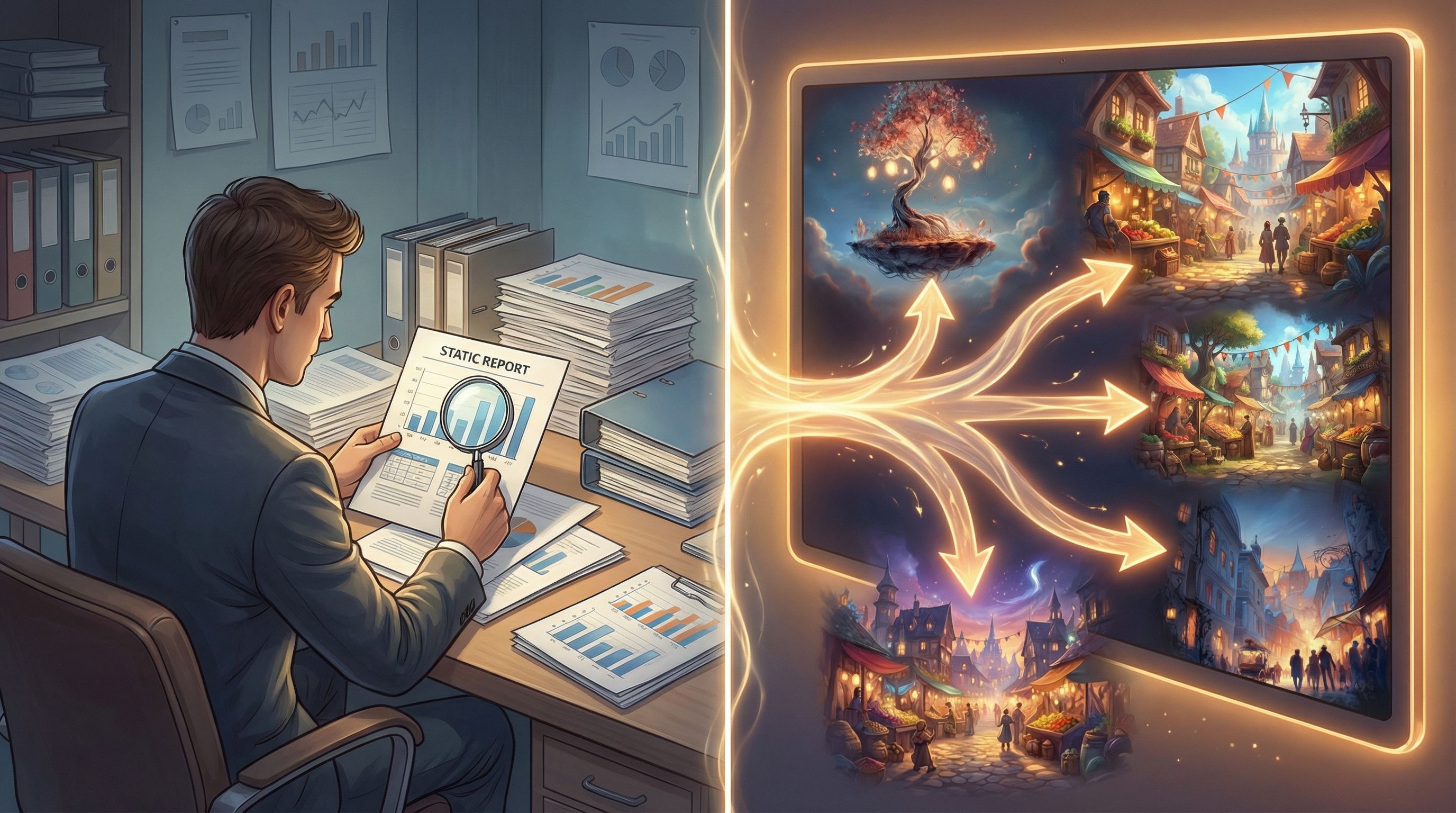
8. Internal Change Management Journeys
Rolling out a new tool, process, or org structure is hard. People resist what they don’t understand or didn’t help shape.
Interactive journeys in Questas can:
- Explain why the change is happening through story, not just memo.
- Let employees choose paths based on their role or concerns.
- Address objections in-context: “What does this mean for my workload?”
Example paths:
- “I’m a manager worried about my team’s capacity.”
- “I’m an IC wondering how this affects my day-to-day.”
- “I’m curious how this aligns with our long-term strategy.”
By acknowledging concerns and showing concrete scenarios, you build understanding and buy‑in instead of confusion.
9. Customer Education and Thought Leadership
If you publish ebooks, blog posts, or webinars, consider turning your flagship content into a playable adventure.
For example, a B2B brand could create an interactive guide:
“You’re leading a transformation project. Choose your approach.”
Along the way, players:
- Make strategic choices
- See fictional (but realistic) outcomes
- Unlock insights, frameworks, or templates
This format:
- Makes complex concepts easier to digest
- Encourages sharing (“You have to try this path!”)
- Gives you analytics on which ideas resonate most
You can even serialize these experiences into a recurring series, borrowing patterns from From One-Shots to Series: Planning Episodic Questas Stories That Keep Players Coming Back.
10. Event and Workshop Experiences That Live On
Events and workshops are intense but fleeting. Once the session ends, most of that energy evaporates.
By building an accompanying Questas experience, you can:
- Turn your session into a replayable journey attendees can share with colleagues.
- Offer pre‑event primers that get everyone up to speed.
- Create post‑event follow‑ups that reinforce key decisions and concepts.
Sample flow:
- Before the event: a short interactive intro that lets attendees pick their current challenges.
- During the event: live playthrough of a scenario, with the audience voting on choices.
- After the event: a deeper branching version attendees can explore on their own, with links to resources and offers.
This transforms your event from a one‑time moment into an ongoing, interactive asset.
Making These Use Cases Work: Practical Build Tips
Whether you’re building for sales, onboarding, or marketing, a few principles will help your Questas projects land:
Start with decisions, not features
Ask:
- What decisions do I want the player to practice or understand?
- What trade‑offs do they face in real life?
Design your branches around those decisions first. Then layer in visuals, copy, and polish.
If you’re new to structuring branches, check out Branching Without Chaos: Simple Story Mapping Techniques for Complex Questas Narratives for practical mapping methods.
Keep paths short but meaningful
You don’t need a 200‑node epic. For business use cases:
- Aim for 5–15 scenes per experience.
- Include 2–4 major decision points with visible consequences.
- Provide multiple endings that reflect different outcomes (great, good, risky, failure).
Short, focused journeys are easier to build, easier to maintain, and more likely to be completed.
Let visuals carry part of the story
Use AI-generated images and video to:
- Set tone (tense negotiation vs. relaxed workshop)
- Signal stakes (rising charts, angry emails, crowded dashboards)
- Differentiate personas and environments
If you’d like to lean more heavily on imagery as your starting point, Visual First Storytelling: Building Worlds in Questas by Starting with AI Images walks through that approach step by step.
Build for accessibility and inclusion
Business and training stories often need to serve everyone in your org or audience. Keep in mind:
- Clear, readable text and high contrast
- Descriptive alt text for images
- Simple, intuitive navigation and choice wording
For a deeper dive, see the principles in Accessibility by Design: Building Inclusive, Player-Friendly Questas Stories Everyone Can Enjoy.
Bringing It All Together
Interactive storytelling isn’t just for fantasy heroes and space pirates. The same mechanics that make adventures addictive can:
- Help sales reps practice tough conversations
- Guide customers through their first wins
- Turn compliance into something people actually remember
- Show candidates and clients what it’s really like to work with you
- Extend the life and impact of your events and content
With Questas, you don’t need to code or hire a game studio. You need a clear goal, a set of real‑world decisions, and the willingness to experiment.
Your Next Step
Pick one of the use cases above that resonates most with your work—maybe it’s sales training, onboarding, or an interactive case study.
Then:
- Write down the real decisions your audience faces in that context.
- Sketch a short, 8–10 scene flow with 2–3 key branching points.
- Open Questas and build a simple first version—no perfectionism, just a playable draft.
- Share it with a small group, watch how they play, and refine.
The moment you see someone lean forward, hesitate over a choice, and say, “Wait, what happens if I try this?”—you’ll know you’re onto something powerful.
Adventure really does await. It just might look like better onboarding metrics, more engaged teams, and marketing that people actually want to click through.