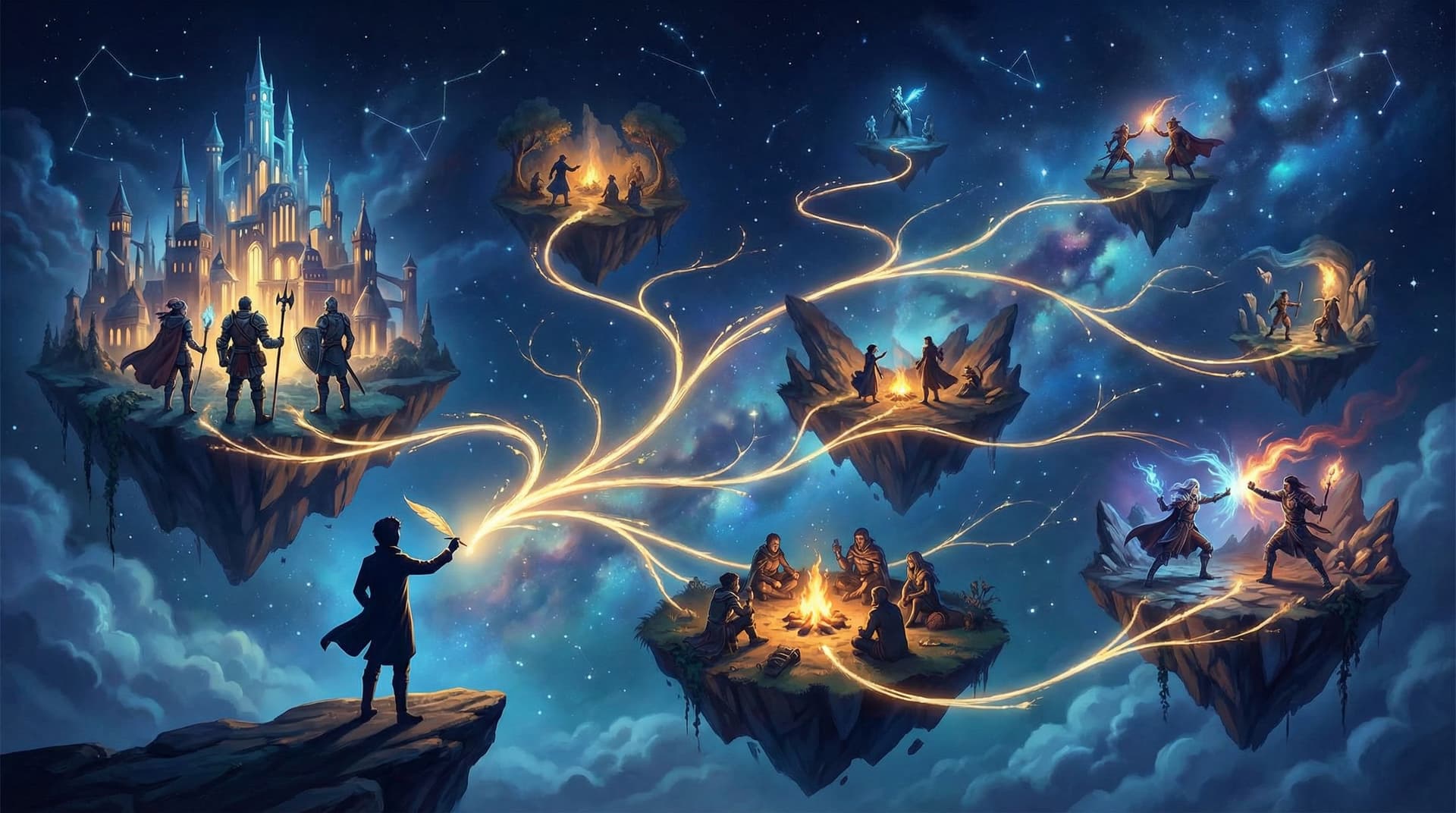
Branching Without Chaos: Simple Story Mapping Techniques for Complex Questas Narratives

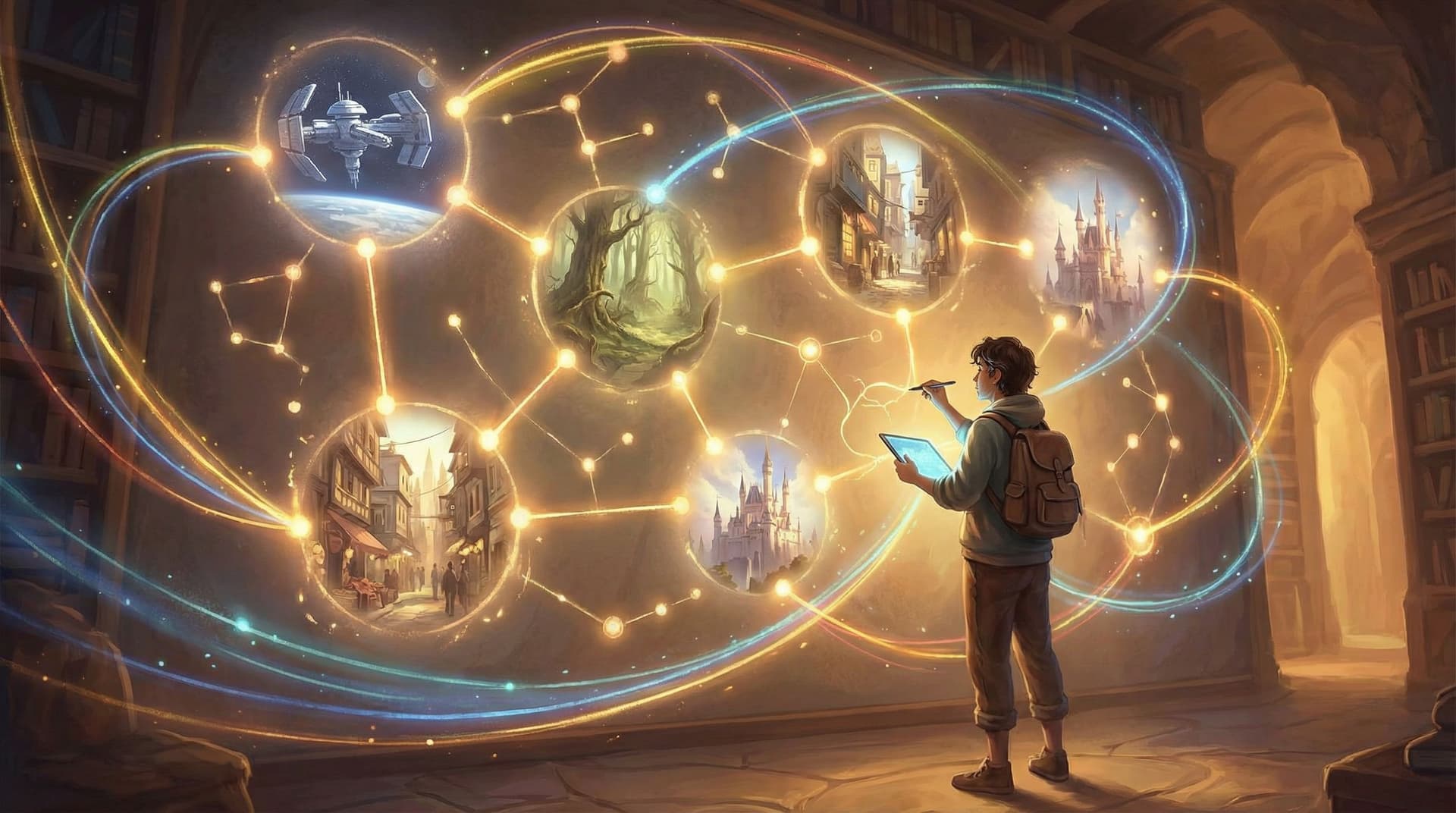
Branching Without Chaos: Simple Story Mapping Techniques for Complex Questas Narratives
Interactive stories are supposed to feel wild and alive for your players—not for you as the creator.
If your branching narrative feels like a tangle of half-finished ideas, orphaned scenes, and endings you can’t quite trace back to their choices, you’re not alone. Branching is powerful, but without structure, it can quickly become unmanageable.
That’s where simple story mapping comes in.
In this guide, we’ll walk through practical ways to map complex narratives for Questas so you can:
- Design richer choice paths without losing track of them
- Keep your logic clean as your story grows
- Plan visuals, pacing, and accessibility from the start
- Confidently ship bigger, more ambitious adventures
Whether you’re building your first multi-path mystery or scaling into a full episodic universe, these techniques will help you branch without chaos.
Why Story Mapping Matters for Branching Narratives
When you’re building with Questas, it’s tempting to jump straight into the visual editor and start dropping scenes and choices. That creative momentum is valuable—but if you don’t have a map, you’ll pay for it later.
Story mapping matters because it:
- Prevents “spaghetti branches.” You avoid random detours, dead ends, and scenes that don’t clearly connect to choices.
- Keeps choices meaningful. You can see at a glance whether decisions actually change the experience or just swap a line of dialogue.
- Supports better pacing. Mapping helps you balance tension, quiet moments, reveals, and payoffs across different paths.
- Makes collaboration easier. If you’re working with co-writers, artists, or educators, a clear map is a shared source of truth.
- Scales into series. A well-structured map is the foundation for ongoing worlds and recurring characters. If that’s your goal, you’ll love the strategies in From One-Shots to Series: Planning Episodic Questas Stories That Keep Players Coming Back.
Most importantly, mapping lets you think like a systems designer and a storyteller at the same time. You’re not just asking, “What happens next?” You’re asking, “What are the possible nexts, and why do they matter?”
Start With a Simple Spine Before You Branch
The biggest mistake creators make is trying to plan every branch from the start. Instead, begin with a story spine—a single, linear version of the adventure that captures your core arc.
Think of this as the “default playthrough” if the player made the most straightforward or “middle of the road” choices.
Your spine should include:
- Inciting incident – What pulls the player into the situation?
- First major decision – Where do they first meaningfully shape the story?
- Rising complications – What obstacles escalate tension?
- Climax – The biggest turning point or confrontation.
- Resolution – How things settle (for better or worse).
You can sketch this spine in:
- A notebook
- A simple outline tool
- Sticky notes on a wall
- A basic flowchart app like Miro, Whimsical, or Figma FigJam
Once you have a spine, you’re no longer facing infinite possibilities. You’re just asking: Where does this line need to branch to create meaningful variation?

Think in “Beats,” Not Just Scenes
When you’re mapping for Questas, it helps to zoom out from individual scenes and think in story beats—discrete moments where something important changes.
Examples of beats:
- The player meets a key ally.
- A hidden truth is revealed.
- The stakes escalate (time runs out, danger increases).
- A relationship shifts (trust gained or lost).
Why beats are powerful:
- They’re easier to move around and remix than fully written scenes.
- They help you track emotional rhythm across branches.
- They make it clear which moments must exist in all paths (anchor beats) vs. which can be exclusive to certain choices.
Try this quick exercise:
- List 8–12 key beats you know you want in the story.
- Mark each beat as:
- Core – must appear in almost every playthrough.
- Optional – only appears if specific choices are made.
- Arrange your core beats in order to form your spine.
- Attach optional beats as branches off the core.
Now your map isn’t just a tangle of boxes—it’s a deliberate pattern of emotional and narrative shifts.
For more on how visuals can inspire beats, check out Visual First Storytelling: Building Worlds in Questas by Starting with AI Images. Letting a single striking image suggest a beat (“the hero stands alone on the flooded highway”) can save you hours of plotting.
Use Three Simple Mapping Patterns (and Combine Them)
You don’t need a degree in narrative design to build elegant branching. A few simple patterns will cover most of what you want to do.
If you haven’t already, you may want to pair this section with the structures in Level Up Your Plots: 7 Branching Narrative Patterns to Try in Questas.
1. The Fork and Rejoin
Shape: One path splits into two or more, then converges back to a shared beat.
Use it when:
- You want different experiences but a common destination.
- You’re controlling scope on a shorter project.
Example:
- Choice: Sneak through the vents or bluff past the guards.
- Each path has 1–3 unique scenes.
- Both rejoin at “Inside the control room.”
Mapping tip:
- Draw a straight line for your core path.
- Add short “loops” off that line and reconnect them.
- Label the rejoin point clearly (e.g.,
B3 – All Paths Rejoin).
2. The Branching Hub
Shape: A central node the player can return to, with multiple choices radiating out.
Use it when:
- You’re designing a location-based story (a town, a space station, a school).
- You want players to feel free to explore.
Example:
- Hub: “Courtyard at the Academy.”
- Branches: Talk to mentor, visit library, train in arena, sneak into archives.
Mapping tip:
- Draw the hub as a large, central node.
- Connect each option as a spoke, then draw arrows back to the hub when appropriate.
- Track state changes (e.g., “mentor convinced” or “archive key obtained”) with simple tags on the map.
3. The Diverging Endgame
Shape: Paths that stay relatively tight early on but diverge dramatically toward the end.
Use it when:
- You want endings to feel truly different.
- You’re okay with more content that some players won’t see.
Example:
- Early game: Most players share the same 60–70% of scenes.
- Late game: Choices splinter into several distinct finales (victory, tragedy, exile, secret ending).
Mapping tip:
- Draw a thick “trunk” for the shared early game.
- Let the final third fan out into bold, separate lines.
- Color-code endings by tone (hopeful, bittersweet, dark, comedic) so you can see your emotional spread.
You can mix and match these patterns inside a single Questas project: a hub structure in Act I, fork-and-rejoin in Act II, and a diverging endgame in Act III.

Color-Code for Clarity (Characters, Stakes, and More)
Once your map grows past a handful of nodes, visual cues become essential.
Here are simple color-coding schemes that work well for complex Questas narratives:
- By function:
- Blue = setup scenes
- Orange = choice moments
- Red = high-stakes confrontations
- Green = resolutions or rewards
- By character focus:
- One color per key character or faction
- Helps you see who’s underused (or overused) in certain paths
- By production status:
- Gray = idea
- Yellow = drafted
- Purple = written
- Green = implemented in Questas
You can apply this in digital tools (labels, node colors) or with physical index cards and markers. The goal is to make it obvious, at a glance, where the story might be:
- Too slow
- Too talky
- Too focused on a single character
- Missing payoffs for earlier setups
Keep Choices Focused and Track Their “Echoes”
A chaotic map often comes from choices that spawn too many consequences too soon. Instead, think in terms of choice echoes—how a decision ripples out over time.
For each major choice, ask:
- Immediate effect: What changes in the next 1–2 scenes?
- Mid-term echo: What changes 3–6 scenes later?
- Long-term echo: Does this choice influence the ending?
On your map, you can:
- Add small icons or tags (e.g.,
C1,C1-Mid,C1-End) to show where a choice’s impact is felt. - Use dotted lines or subtle arrows to connect choice nodes to later echo nodes.
This keeps your story from ballooning into dozens of unrelated branches while still giving players the sense that their choices matter over time.
Design for Accessibility From the Map Up
It’s much easier to make your adventure inclusive when you plan for it at the mapping stage—not after everything is built.
As you sketch your structure, consider:
- Reading load: Are there long stretches of text-heavy scenes without choices? Could you break them into smaller beats?
- Complexity of decisions: Are there too many branching options in one node? Can you limit to 2–3 clear, distinct choices?
- Replay clarity: Will players understand why they got a certain outcome if they replay and choose differently?
You can annotate your map with reminders like:
- “Add recap before big branch.”
- “Simplify wording of choices here.”
- “Offer content warning or safety tool before intense scene.”
For a deeper dive into inclusive design considerations—color contrast for visuals, audio description, choice phrasing, and more—see Accessibility by Design: Building Inclusive, Player-Friendly Questas Stories Everyone Can Enjoy.
Turn Your Map Into a Build Plan in Questas
Once your map feels solid, it’s time to bring it into Questas. Treat this as implementation, not more discovery.
A simple workflow:
-
Create your core nodes first.
- Build out the spine and core beats.
- Use placeholder text if needed; focus on structure.
-
Add choices exactly as mapped.
- Keep choice text clear and distinct.
- Double-check that each choice connects to the correct node.
-
Layer in optional branches.
- Implement your fork-and-rejoin loops and hub spokes.
- Tag or name nodes consistently (e.g.,
Act2_Hub_Library_01).
-
Plan visuals alongside beats.
- For each node, decide: image, short video, or text-only?
- If you’re new to visual planning, pair this step with the ideas in Picture This: How to Prompt AI for Consistent Characters and Worlds in Questas.
-
Test one path at a time.
- Do a full playthrough of each major route.
- Note any logic gaps, missing echoes, or pacing issues.
Because Questas is a visual, no‑code editor, this step feels a lot like “inking” over your pencil sketch. You already know what the story does; now you’re making it real.
Use Analytics to Refine Your Map Over Time
Your initial map is a hypothesis. Once players start exploring, you’ll see where you were right—and where the story behaves in surprising ways.
When your Questas story is live, pay attention to:
- Drop-off points: Where do most players stop? That might signal pacing or clarity issues.
- Overloved paths: Are some branches getting almost all the traffic? Maybe they’re better signposted—or more interesting.
- Ignored content: Are there whole branches almost no one sees? You might need to surface those choices more clearly or merge that content elsewhere.
You can then:
- Simplify or remove underperforming branches.
- Add new echoes to make certain choices feel more impactful.
- Adjust choice wording to better communicate what’s at stake.
For a full walkthrough of this feedback loop, check out Analytics for Adventure: Using Player Data to Improve Your Questas Stories Over Time.
Common Pitfalls (and How Your Map Solves Them)
Even experienced creators run into similar problems. A good map helps you avoid them.
1. Endless setup, no payoff
- Symptom: Long intro with very few choices, then a sudden explosion of branches.
- Mapping fix: Ensure your first meaningful choice appears early on your spine, and that each act has at least one satisfying payoff node.
2. Too many micro-branches
- Symptom: Every minor choice leads to a bespoke scene; scope explodes.
- Mapping fix: Group small choices into flavor variations that rejoin quickly, and reserve full branches for big decisions.
3. Orphaned endings
- Symptom: You can’t remember which choices lead to a particular ending.
- Mapping fix: Draw clear lines from each ending back to the major choices that unlock it, and label them with short criteria (e.g., “betrayed ally + took shortcut”).
4. Visual inconsistency across branches
- Symptom: The same character or location looks wildly different depending on the path.
- Mapping fix: Mark key visual anchors on your map (e.g., “same outfit,” “same time of day”) and reuse or tweak prompts accordingly when generating images in Questas.
Bringing It All Together
When you combine these techniques, you get a clear, flexible process:
- Sketch a simple spine so you’re not branching into the void.
- Define key beats and decide which are core vs. optional.
- Choose 1–3 structural patterns (fork-and-rejoin, hub, diverging endgame) and apply them intentionally.
- Color-code your map to track function, characters, and production status.
- Track echoes of major choices instead of spawning endless new branches.
- Bake in accessibility by considering load, clarity, and safety from the mapping stage.
- Implement in Questas as a faithful translation of your map.
- Refine with analytics and playtesting to tune pacing and impact.
The result: ambitious, replayable adventures that feel complex to players—but stay legible and manageable for you.
Ready to Map Your Next Adventure?
You don’t need a massive team or a custom engine to build intricate branching stories. With a clear map and a visual, no-code platform like Questas, you can:
- Experiment with new structures without getting lost
- Scale from one-shots to full series
- Give players endings that feel earned, not random
If you’re just getting started, pair this guide with From Idea to Interactive Epic: A Step‑by‑Step Beginner’s Guide to Building Your First Questas Story and build a small, well-mapped adventure as your first project.
Then, open up your favorite mapping tool—or a blank sheet of paper—and sketch a spine, three key choices, and two possible endings. Once that’s on the page, head into Questas and turn your map into a playable journey.
Your story doesn’t have to be chaotic to feel adventurous. Start mapping, start building, and let your players discover just how many paths your world can hold.