Beyond PDFs and Portals: How HR Teams Can Turn Policy Rollouts into Playable Questas Change Journeys


Policy rollouts are one of the toughest parts of HR’s job.
You’re asking busy people to:
- Understand new rules
- Change familiar habits
- Trust that this isn’t “just another initiative” that will vanish in six months
And you’re doing it with… PDFs, email blasts, and LMS modules.
No surprise that adoption often lags, managers improvise, and HR ends up in “policing” mode instead of partner mode.
Interactive, playable change journeys offer a different path. Instead of pushing information at employees, you invite them into a story where their choices, context, and concerns actually matter.
That’s where a platform like Questas comes in. It lets HR and L&D teams design choose‑your‑own‑adventure style experiences—with AI‑generated visuals and videos—without touching a line of code. Policies stop being documents and start becoming journeys people can explore.
Why Turning Policy into Playable Journeys Works
Before we get tactical, it’s worth grounding in why this approach works so well for HR.
1. Policies live or die in the gray areas
Most people don’t struggle with the headline rule. They struggle with:
- Edge cases (“Does this apply to contractors?”)
- Trade‑offs (“Do I prioritize speed or security here?”)
- Social pressure (“My manager does it this way… is that okay?”)
Linear documents can list rules but can’t easily rehearse judgment. Branching stories can.
In a playable journey, employees:
- Step into realistic situations
- Choose what they’d actually do
- See the downstream impact—on colleagues, customers, and themselves
This mirrors the scenario‑driven approach we explored in Scenario‑First Story Design: Building Training Questas That Start with Real‑World Decisions, and it’s exactly what policy adoption needs.
2. People remember what they do, not what they skim
Engagement data across learning and marketing keeps pointing to the same pattern: interactive experiences beat static content on completion, recall, and satisfaction.
Playable change journeys:
- Turn passive reading into active decision‑making
- Give immediate feedback (“Here’s what would likely happen next”)
- Encourage replay (“What if I’d chosen differently?”)
Instead of a one‑and‑done training, you get a practice arena employees can revisit.
3. HR gets insight, not just checkboxes
Traditional rollouts tell you who opened the policy or completed the module. They don’t tell you:
- Where people are most confused
- Which trade‑offs feel hardest
- How managers are modeling decisions
Branching experiences—especially those built in Questas—can surface patterns like:
- Most employees choose path B when under time pressure
- Managers are consistently under‑escalating certain risks
- New hires interpret a policy very differently from veterans
That’s gold for iterating your communication, coaching managers, and refining the policy itself.
From Static Policy to Playable Journey: A Practical Blueprint
Let’s walk through how an HR team could turn a policy rollout into a playable change journey using Questas.
We’ll use a concrete example—say, a new hybrid work and meeting norms policy—but the same steps apply to:
- DEI and anti‑harassment policies
- Information security and data privacy
- Performance management and feedback
- Travel and expense guidelines
- AI usage and ethics
Step 1: Start from the real decisions, not the policy headings
Don’t begin with your policy table of contents. Begin with moments of truth where people actually feel the policy.
Ask:
- When do employees feel tension between the “old way” and the “new way”?
- Where do managers have to make a tough call?
- What’s a situation that has gone wrong in the past?
For our hybrid work policy, those moments might be:
- A manager scheduling a recurring meeting that overlaps multiple time zones
- An employee deciding whether to work from home on a high‑stakes client day
- A team debating whether a sensitive conversation belongs in Slack, email, or a live call
Each of these becomes a scenario seed—a node in your future Questas journey.
If you want a deeper dive into this way of working, the post on Scenario‑First Story Design walks through this mindset in detail.

Step 2: Map a simple branching spine (then resist over‑branching)
You don’t need 200 endings. You need just enough branches to:
- Let people try different approaches
- Show meaningful consequences
- Highlight best practices and common pitfalls
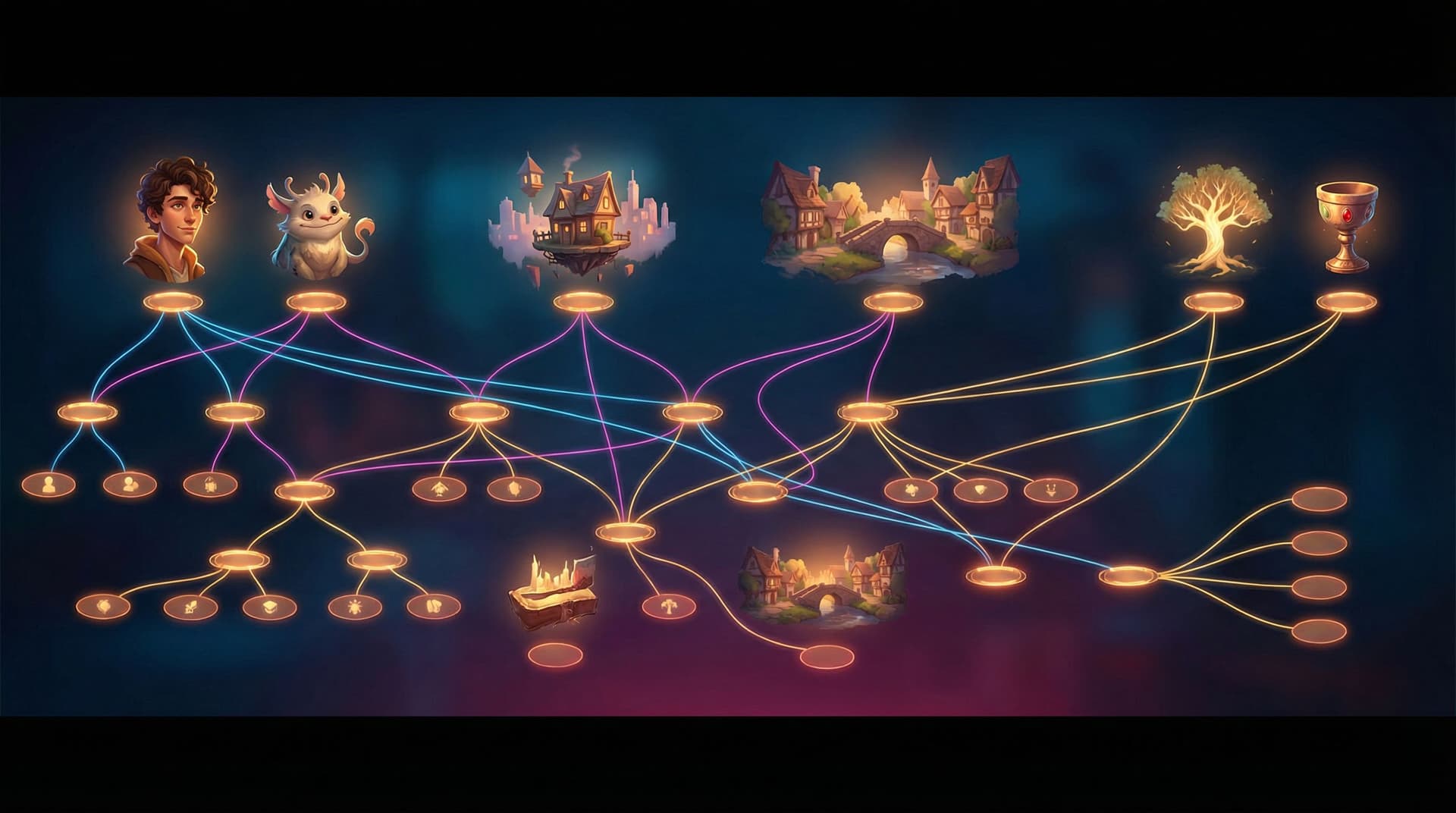
In Questas, start with a simple graph:
- Opening scene – Set context and stakes.
- First big choice – Two or three options that reflect real behavior (not just “right vs obviously wrong”).
- Immediate consequences – What happens in the next day or week.
- Second‑order effects – How this choice plays out with:
- Team trust
- Customer satisfaction
- Compliance or risk exposure
- Reflection and debrief – Help the player make sense of what happened.
A useful pattern is the “diamond” structure:
- Branch out into several paths
- Let them play out differently
- Converge back into a shared scene where characters compare outcomes
This keeps scope sane while still honoring choice.
Step 3: Turn policy text into character‑driven scenes
Policies are written in abstract language. People live them through relationships.
Instead of “Employees must schedule meetings within core collaboration hours,” write a scene where:
- A manager, Priya, is under pressure to ship a feature
- One engineer is in London, another in New York
- The only shared slot is outside someone’s preferred core hours
Now give the player options:
- Schedule a recurring meeting at 7am for the London engineer
- Alternate meeting times weekly to share the burden
- Keep the meeting in Priya’s preferred time and tell others to watch the recording
Each choice can:
- Trigger different reactions from the team
- Affect burnout, inclusion, and project risk
- Tie back explicitly to policy language, but in plain speech
This is where HR can collaborate with people managers and comms partners—almost like a writers’ room. If you’re designing more complex arcs across multiple policies or programs, the workflows in AI as Co‑Writer, Not Ghostwriter: Collaborative Writing Workflows for Complex Questas Plots are a useful model.
Step 4: Use visuals to make the change feel concrete
One advantage of building in Questas is that you can enrich every node with AI‑generated images and even short video clips.
For HR, visuals can:
- Show body language in a tricky feedback conversation
- Depict a cluttered vs. secure workstation in an infosec scenario
- Contrast a chaotic Zoom grid with cameras off vs. an engaged hybrid meeting
A few practical tips:
- Anchor visuals in your real world. Use prompts that reference your kind of office, devices, and dress code.
- Avoid stereotypes and visual overload. Be intentional about representation and focus, as discussed in AI Visual Etiquette: Avoiding Tropes, Stereotypes, and Overload in Image‑Heavy Questas Stories.
- Keep key characters consistent. If Priya is a central manager in several stories, maintain her look across journeys so employees recognize her.
The result: employees don’t just read about “a manager”; they feel like they know her.

Step 5: Build multiple perspectives, not just “the official view”
Real change journeys involve conflicting perspectives:
- HR wants consistency and fairness
- Managers want flexibility and speed
- Employees want autonomy and psychological safety
In your Questas journey, consider:
- Letting the player switch roles mid‑story (e.g., from individual contributor to manager to HR partner)
- Showing how the same decision feels different from each vantage point
- Surfacing tensions explicitly (“As a manager, you’re balancing empathy with performance expectations… how do you respond?”)
This reduces the sense that the policy is being “done to” people and increases empathy across levels.
Step 6: Bake in reflection, not just scoring
It’s tempting to grade players: 8/10, you’re compliant.
That’s rarely the most useful outcome.
Instead, focus on guided reflection inside the story:
- After a choice, ask: “What were you optimizing for here?” with options like speed, harmony, risk avoidance.
- At the end, show how often they leaned on each value.
- Invite them to replay a scene with a different priority and compare results.
Reflection turns a one‑off clickthrough into a coaching moment. It also gives HR nuanced insight into how people naturally think about trade‑offs.
For more advanced teams, you can even experiment with moral gray areas—designing ambiguous choices that still feel fair, as explored in Writing Moral Gray Areas: Designing Ambiguous Choices That Still Feel Fair in Questas.
Step 7: Launch like a campaign, not a compliance task
A brilliant playable journey won’t help if it’s introduced as “mandatory training – due Friday.”
Treat your rollout like a campaign:
- Tease the story. Short clips or screenshots of key scenes in Slack or email.
- Invite curiosity. “What would you do if your manager asked you to join a 10pm call every week?”
- Give managers a facilitation guide. Encourage teams to play scenes together and discuss their choices.
- Offer recognition. Highlight teams who engaged deeply, not just those who finished fastest.
Because Questas is web‑based, you can:
- Embed journeys in your intranet or LMS
- Link them from policy PDFs and announcement emails
- Use QR codes in physical spaces (e.g., posters near meeting rooms for a hybrid norms journey)
Step 8: Iterate based on real behavior
The first version of your journey is a hypothesis.
Use data and feedback to refine:
- Path analytics: Where do people drop off? Which branches are rarely chosen?
- Qualitative comments: What surprised them? What felt unrealistic?
- Manager insights: Which scenes sparked the best conversations in team sessions?
Then:
- Add or tweak scenes to cover missing edge cases
- Clarify confusing language or choices
- Split one large journey into a series (e.g., “Hybrid Meetings 101,” “Hybrid Performance Reviews,” “Hybrid Career Growth”) while keeping characters and visual style consistent
If you’re building a series, the techniques in AI Style Chains: Keeping Characters, Locations, and Props Consistent Across a Questas Series (/ai-style-chains-keeping-characters-locations-and-props-consiste) can help you maintain continuity without reinventing everything from scratch.
Where HR Can Start: High‑Impact Use Cases
Not every policy needs a full playable journey on day one. Focus first on areas where behavior change is critical and nuanced.
Good candidates include:
- Anti‑harassment and inclusion
- Explore bystander intervention, microaggressions, and power dynamics.
- Performance and feedback
- Let managers rehearse difficult conversations and calibration discussions.
- Information security and AI usage
- Walk through realistic phishing attempts, data handling, or AI prompt misuse.
- Hybrid and remote norms
- Practice meeting design, availability expectations, and documentation habits.
For each, ask: “Where do we keep seeing the same misunderstandings or escalations?” That’s your first story.
Bringing It All Together
Turning policy rollouts into playable change journeys isn’t about making everything a game for the sake of novelty. It’s about aligning your methods with how people actually learn and change:
- Through stories and characters they care about
- Through decisions that feel real
- Through seeing consequences play out in a safe space
Platforms like Questas give HR teams the tools to:
- Design branching, visual stories without code
- Reuse characters and settings across multiple journeys
- Embed journeys into existing HR systems and communication channels
The payoff:
- Employees who understand and trust new policies
- Managers who feel prepared instead of exposed
- HR teams who are seen as designers of experiences, not just owners of documents
Your Next Step
If you’re an HR or L&D leader, you don’t need to overhaul every policy at once. Pick one upcoming or recently launched policy and ask:
- What’s a real moment of tension this policy is meant to address?
- Who are the characters involved?
- What are three different ways that moment could play out?
Then, open Questas, drop those scenes into the visual editor, and sketch a simple three‑choice journey. Don’t worry about perfection; aim for something a small pilot group can play through in 10–15 minutes.
From there, you can:
- Invite a handful of managers or employee resource group leaders to test it
- Gather feedback on what felt real vs. off
- Iterate and expand into a fuller change journey
Policy doesn’t have to mean “PDF plus portal.” It can mean stories people step into, choices they own, and change they can feel.
The adventure of better policy adoption is waiting. Your first Questas change journey is how you start.