Scenario-First Story Design: Building Training Questas That Start with Real-World Decisions


Most training content starts from the wrong end.
We begin with topics ("compliance," "onboarding," "sales discovery"), list learning objectives, then cram everything into slides, handbooks, or videos. Only at the very end do we ask: "Where could we add an interactive scenario?"
Scenario-first story design flips that.
Instead of starting with content, you start with a real decision your learner actually has to make—the moment they feel stakes, uncertainty, and pressure. Then you build your training story outward from that choice, using a platform like Questas to turn it into a branching, visual experience people can safely rehearse.
This approach is especially powerful for training because it mirrors how the real world works: you act first, then deal with the consequences.
In this post, we’ll walk through how to design training stories in Questas that begin with authentic decisions, not abstract theory—and how to turn those moments into rich, replayable practice.
Why Start with Real-World Decisions?
When you’re designing learning experiences, decisions are the curriculum.
A scenario-first approach to training Questas gives you:
1. Relevance your learners can feel
Instead of "Module 3: Active Listening," you drop someone into a moment like:
Your direct report just missed a deadline for the second time this month. Your 1:1 is in five minutes. What do you do?
That’s not content; that’s their Tuesday.
2. Built-in motivation
People lean in when they sense:
- “This could actually happen to me.”
- “I’ve been here before and I’m not sure I handled it well.”
- “I really don’t want to screw this up next time.”
Starting with a real decision means your training doesn’t have to work as hard to justify itself.
3. Natural branching structure
Real-world decisions rarely have a single "correct" path. They involve:
- Tradeoffs (speed vs. quality, empathy vs. directness)
- Uncertainty (incomplete information, hidden motives)
- Multiple viable options
Those ingredients are exactly what make branching narratives compelling. If you’ve explored moral nuance in your stories before, you’ll recognize the overlap with techniques from Writing Moral Gray Areas: Designing Ambiguous Choices That Still Feel Fair in Questas.
4. Practice, not just exposure
Training that only tells people what to do rarely changes behavior. Training that lets people practice making decisions and seeing consequences has a much better shot.
A scenario-first Questas becomes a flight simulator for your learners’ hardest moments.
Step 1: Identify the Decisions That Actually Matter
Don’t start with a content outline. Start with a decision inventory.
Pick a specific domain—say, manager training, sales, customer support, or clinical communication—and ask:
- Where do people consistently get stuck or stressed?
- Where do small choices create big downstream consequences?
- Where do we hear “it depends” a lot?
- What stories do leaders tell when they talk about “classic mistakes”?
Then, turn those into decision statements using this pattern:
"You are [role] in [context]. [Trigger event] just happened. You need to decide [X] before [time/constraint]."
Examples:
- Manager feedback: You’re a team lead. A high-performing engineer shuts down whenever you give critical feedback. A major release just slipped. You need to decide how to address it in your next 1:1.
- Customer support: You’re a support specialist. A long-time customer is furious about a billing error. You need to decide whether to bend a policy to keep them.
- Healthcare: You’re a nurse on a night shift. A patient’s vitals are borderline, but the attending is in surgery. You need to decide whether to escalate immediately or monitor.
Aim for 5–10 high-impact decisions for a focused training Questas. You can always expand later.
Step 2: Choose the Moment of Entry
Scenario-first doesn’t just mean “include decisions.” It means start at the decision.
That usually means:
- No long exposition dump.
- No 12-slide lecture before anything interactive happens.
- You drop the learner into the scene as close as possible to the choice.
Ask yourself:
- What’s the earliest moment where the learner must choose between meaningful options?
- What sensory details (visuals, dialogue snippets, environment) make that moment feel real?
- What do they know—and not know—right now?
In Questas, that becomes your opening node:
- A short narrative paragraph or two
- A strong visual or video that sets mood and context
- 2–4 choices that map to realistic options
You can deepen the world later with flashbacks, debriefs, or optional branches. But the opening should feel like a cold open in a TV episode: we’re already in the situation.

Step 3: Draft Choices That Reflect Real Tradeoffs
Once you’ve framed the moment, it’s time to write the actual options.
Strong training choices are:
- Plausible – No obviously ridiculous “joke” options unless you’re using them sparingly for contrast.
- Distinct – Each option reflects a different strategy or value, not just minor wording changes.
- Tempting – Even suboptimal choices should have something going for them.
- Consequential – The downstream scenes should feel meaningfully different.
A useful pattern is the tension triangle (expanded in The Tension Triangle: Balancing Risk, Reward, and Information in Each Questas Choice Point):
For each choice, clarify:
- Risk – What could the learner lose?
- Reward – What could they gain?
- Information – How much do they know right now?
Example (manager feedback scenario):
Your engineer, Maya, joins the 1:1 looking tired and guarded. How do you open?
- “We need to talk about the release delay. What happened?”
- “I’ve noticed you seem checked out lately. How are you really doing?”
- “Deadlines matter here. I need you to be more reliable. Let’s walk through your process.”
Each option:
- Signals different priorities (results, relationship, expectations)
- Sets up different emotional tones
- Leads to different branches in your Questas story
You’re not just testing whether learners can guess the “right” answer; you’re letting them feel the consequences of different leadership styles.
Step 4: Map Branches Around Outcomes, Not Content Buckets
Traditional training design often thinks in modules:
- Module 1: Company values
- Module 2: Feedback model
- Module 3: Performance reviews
Scenario-first design thinks in outcomes:
- Outcome A: Relationship strengthened, issue addressed
- Outcome B: Relationship strained, issue avoided
- Outcome C: Short-term compliance, long-term disengagement
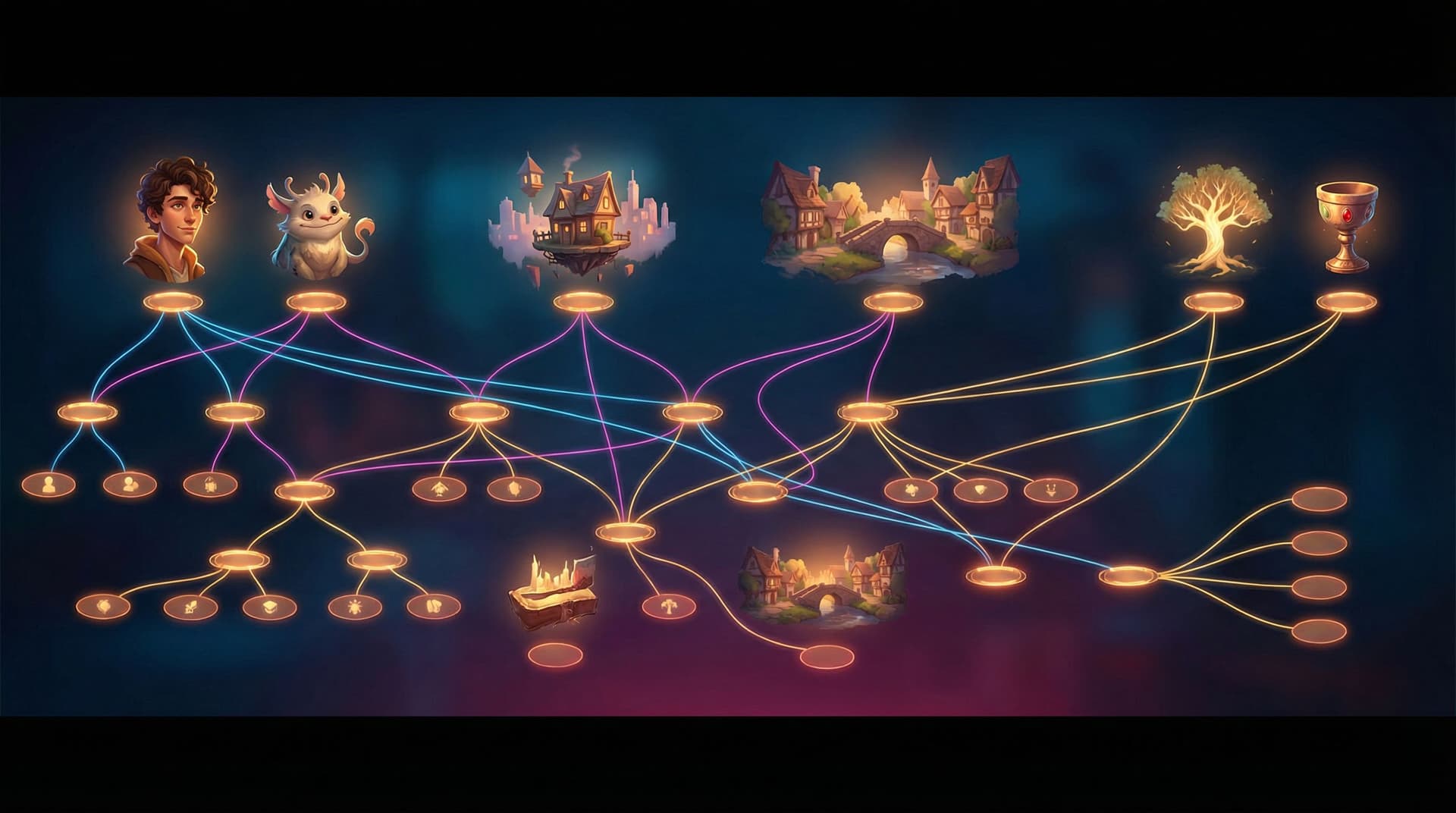
In Questas, that means your graph isn’t just a tree of “topics covered.” It’s a web of consequences.
When you’re building your branches:
-
Define a few core outcome states for each scenario. For example, in a customer escalation story:
- Customer trust high / medium / low
- Policy flexibility used / preserved
- Internal reputation improved / neutral / harmed
-
Tag nodes in your outline with these states.
-
Let different paths converge on similar outcomes via different routes. This keeps the story manageable while still honoring choice.
-
Use lightweight state tracking in your narrative ("Because you pushed back earlier, your manager is already wary…") even if you’re not using formal variables.
If you want to go deeper on maintaining coherence across a whole series of training stories, you may find it helpful to borrow techniques from From Lore Bible to Living Wiki: Using Questas to Maintain Continuity Across Expanding Story Universes. The same continuity principles that apply to fantasy worlds apply to organizational training universes too.
Step 5: Use AI as a Scenario Amplifier, Not an Autopilot
When you’re building complex branching training, AI can feel like magic—and like a trap.
Tools inside Questas can help you:
- Generate variant dialogue for different branches
- Brainstorm alternative choices you might not have considered
- Draft first-pass descriptions for scenes and characters
- Create AI-generated images and videos that visually reinforce context
But you still need to own the decisions:
- You define which decisions matter.
- You decide how forgiving or punishing a path should be.
- You tune the emotional tone of each outcome.
A helpful mindset is outlined in AI as Co‑Writer, Not Ghostwriter: Collaborative Writing Workflows for Complex Questas Plots: let AI propose, but you dispose.
Practical workflow:
- You write the core decision and 2–4 options.
- Ask AI to suggest additional consequences, edge cases, or follow-up scenes.
- Curate ruthlessly: keep only what aligns with your learning goals and organizational reality.
- Use AI again to polish language, vary tone, or localize for different audiences.
Step 6: Design Visuals That Anchor the Scenario
Training scenarios live or die on context. Visuals help learners quickly understand:
- Where they are (office, factory floor, clinic, call center)
- Who’s involved (roles, power dynamics, diversity)
- What’s at stake (body language, environment cues)
With AI-generated visuals inside Questas, you can:
- Give recurring characters consistent looks and expressions
- Show subtle shifts in mood as branches diverge
- Highlight key artifacts (a whiteboard, a dashboard, a product, a medical chart)
To keep your visuals coherent across a series of training episodes, you can lean on techniques from AI Style Chains: Keeping Characters, Locations, and Props Consistent Across a Questas Series. The more your learners recognize familiar faces and spaces, the more your training world feels like an extension of their own.

Step 7: Build Reflection Directly Into the Story
The power of scenario-first design isn’t just what learners choose; it’s how they make sense of those choices afterward.
Instead of saving all reflection for a separate debrief, weave it into your Questas:
- After a critical branch, add a short self-check node:
- “Why did you choose this option?” (Offer 2–3 metacognitive reflections.)
- “What were you optimizing for?” (e.g., speed, harmony, compliance.)
- Use mentor characters to comment on outcomes:
- A senior colleague might say, “You protected the relationship, but we still don’t have a clear plan. What would you do differently next time?”
- Offer rewind points where learners can jump back to a key decision with new insight.
You’re not punishing “wrong” answers; you’re creating low-stakes laboratories where experimentation is encouraged.
Step 8: Connect Scenarios into a Cohesive Training Journey
One scenario is powerful. A sequence of linked scenarios becomes a training arc.
You can:
- Follow the same protagonist over time (e.g., a new manager’s first 90 days).
- Track long-term consequences (how early decisions affect later trust, performance, or opportunity).
- Revisit similar decisions with slightly higher stakes each time.
In Questas, that might look like:
- Episode 1 – A low-stakes feedback conversation with a peer.
- Episode 2 – A performance discussion with a direct report.
- Episode 3 – A promotion calibration meeting with leadership.
Each episode starts with a fresh real-world decision, but subtle callbacks reward learners who’ve played the previous ones.
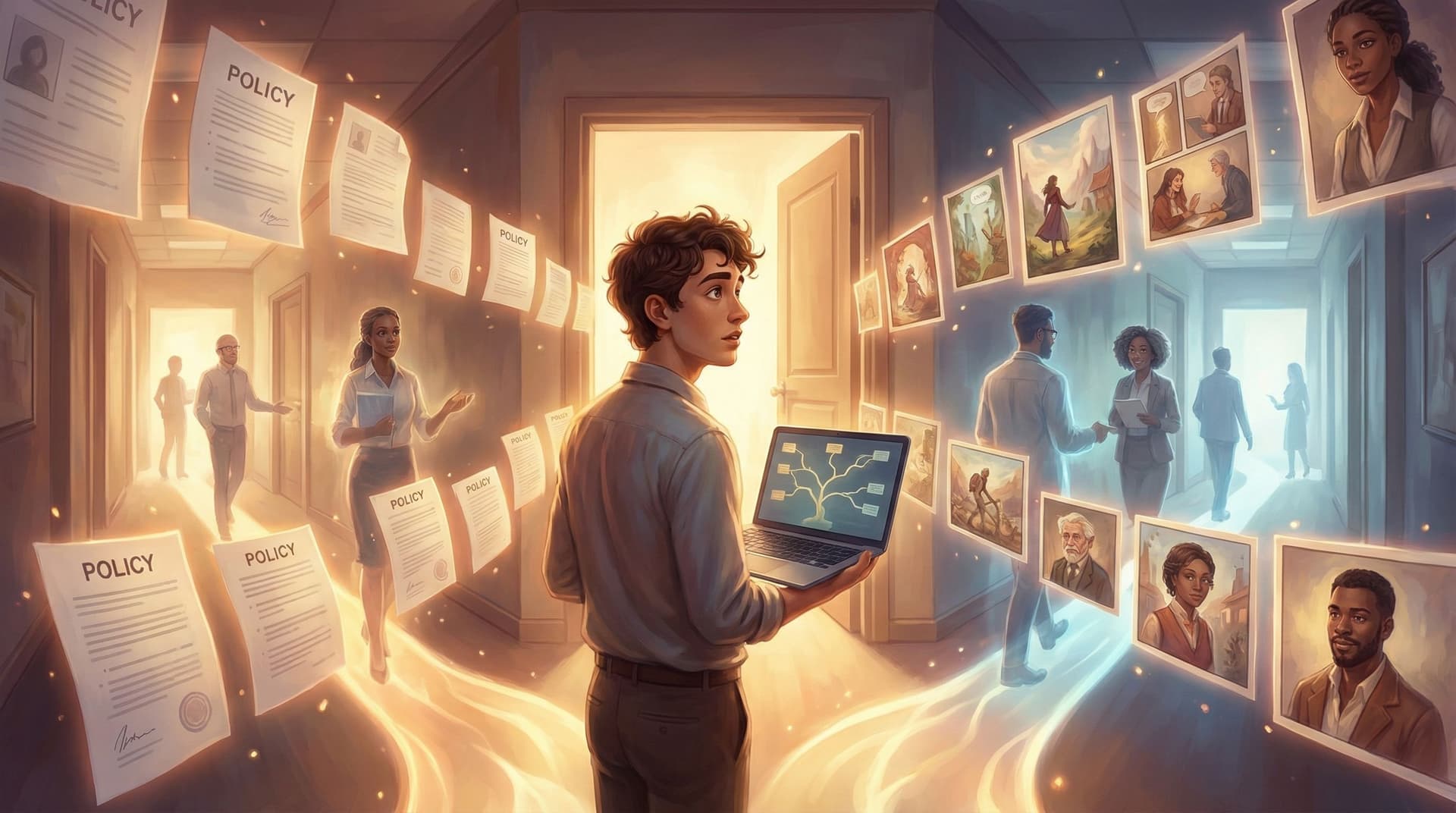
For large organizations, this structure can replace or augment traditional assets (like PDFs and slide decks) much the way we explored in From Onboarding Docs to Day-One Adventures: Turning Employee Handbooks into Questas Storyworlds.
Step 9: Measure What Matters (and Iterate)
Because scenario-first training is built around decisions, you can measure more than completion.
Consider tracking:
- Choice distributions – Which options do learners pick most often? Where do they hesitate or backtrack?
- Path popularity – Which branches are rarely explored? Are they unnecessary, or just under-signposted?
- Outcome patterns – Are most learners ending in “relationship strained” outcomes? That might indicate a real cultural issue, not just a design quirk.
Use these signals to:
- Refine confusing wording
- Add clarifying information before a decision
- Introduce new branches where learners consistently want an option that doesn’t yet exist
Scenario-first design is inherently iterative. Your training Questas can evolve alongside your organization.
Bringing It All Together
Scenario-first story design is about honoring a simple truth: people learn best when they’re practicing the decisions that actually shape their work and lives.
When you:
- Start with real, high-stakes decisions
- Drop learners directly into those moments
- Offer plausible, tempting choices with meaningful tradeoffs
- Map branches around outcomes and consequences
- Use AI and visuals to deepen, not dilute, your intent
- Build reflection and iteration into the experience
…your training stops feeling like a requirement and starts feeling like rehearsal for the real thing.
A platform like Questas gives you the scaffolding—visual node editor, AI-assisted writing and visuals, no-code branching logic—so you can focus on what matters: choosing the right moments, and telling the truth about what those moments feel like.
Your Next Move
You don’t need a full curriculum overhaul to start.
Pick one real decision your learners face this month:
- A tough feedback conversation
- A tricky customer escalation
- A safety or compliance judgment call
- A values conflict with no easy answer
Then:
- Write a single opening scene that drops the learner into that moment.
- Draft 3–4 realistic options, each with a distinct tradeoff.
- Sketch 2–3 follow-up scenes showing different outcomes.
- Open Questas and turn that sketch into a small, playable training scenario.
Ship that one scenario. Watch how people react. Then build your next decision.
Adventure awaits—in the choices your learners are already making. Your job is to give them a place to practice.