The Tension Triangle: Balancing Risk, Reward, and Information in Each Questas Choice Point

Interactive stories live or die on their choices.
Not just how many branches you build, or how wild the endings are—but how each individual decision feels in the moment. Does the player feel pulled between tempting rewards, real risks, and incomplete information? Or are they just clicking the top option to move on?
When you’re building in Questas, you have an unusual amount of control over that moment. Every node, image, and branch can be tuned to create a specific kind of tension. The trick is doing it intentionally instead of by accident.
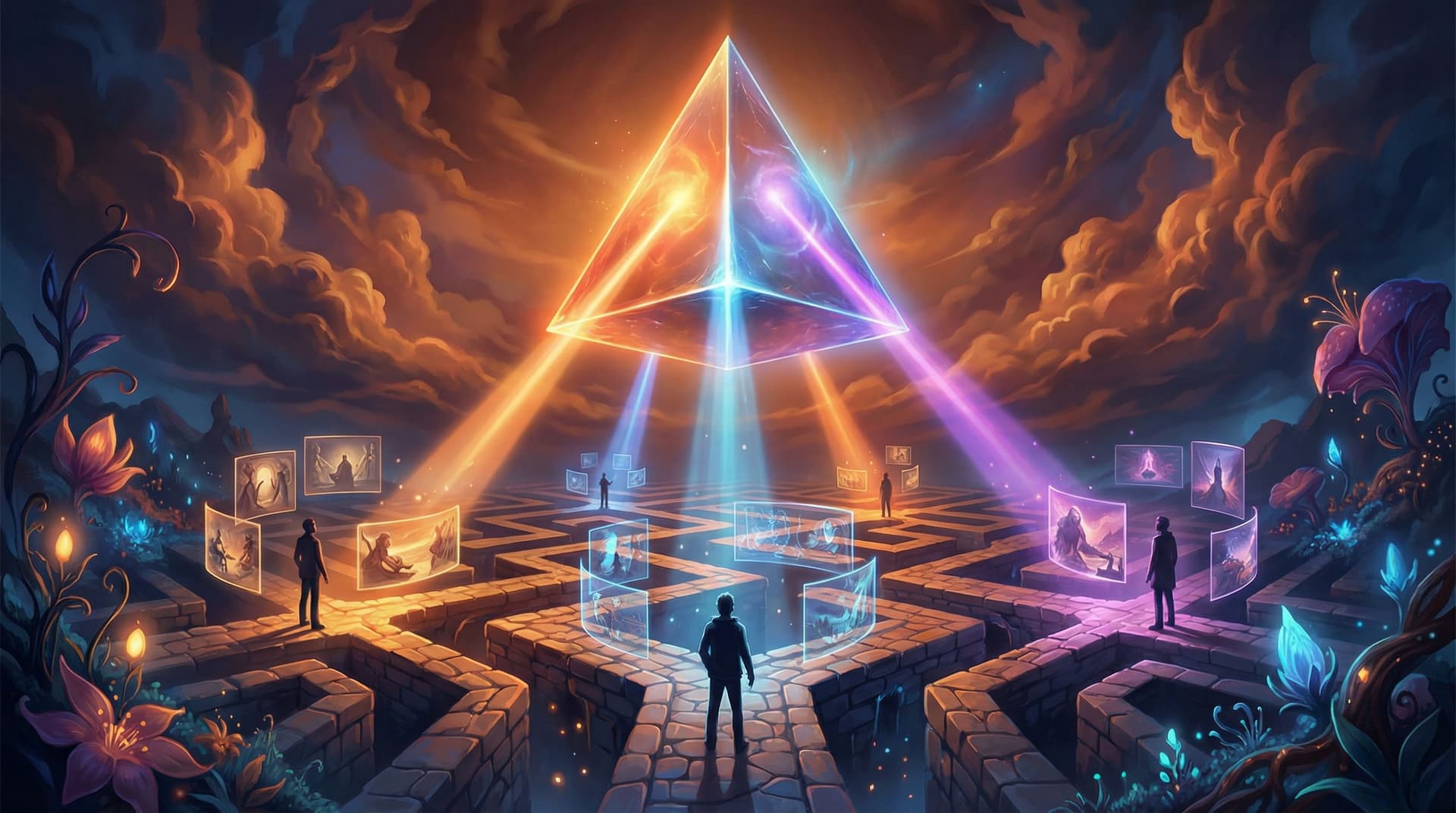
A practical way to do that is to think of every decision as a tension triangle:
- Risk – What could the player lose?
- Reward – What could they gain?
- Information – How clearly do they understand the stakes and outcomes?
Dial any one of these up or down and the whole feel of a choice changes.
This post is a deep dive into how to design that triangle on Questas so each choice point is meaningful, replayable, and aligned with your goals—whether you’re teaching, selling, or simply telling a great story.
Why this triangle matters for your story (and your outcomes)
If you’ve ever watched playtesters blaze through a carefully crafted fork without pausing, you’ve seen what happens when the tension triangle is off.
When risk, reward, and information are unbalanced, players tend to:
- Click safely on autopilot when risk feels high but rewards are vague.
- Spam the most obvious reward when there’s a “correct” answer and everything else feels like a trap.
- Get paralyzed or bounce when information is so thin they can’t tell options apart.
On the other hand, when the triangle is tuned:
- Players pause and weigh options instead of skimming.
- Different personalities gravitate toward different paths (gold for some, reputation for others, curiosity for another group).
- You get richer data about your audience’s motivations and tradeoffs, not just which button looked biggest.
This is especially powerful when you’re using Questas beyond entertainment:
- Educators designing inquiry-based assignments can treat each fork as a thinking prompt, not just a plot beat. (See how this plays out in The New Web Quest: Using Questas to Create Inquiry-Based Assignments for Classrooms and Cohorts.)
- Product teams and founders can model real tradeoffs in prototypes—speed vs. safety, growth vs. trust, short-term gain vs. long-term risk—so investors and users feel the decisions, not just read about them.
- L&D and coaching teams can turn frameworks into lived scenarios, where people practice judgment under pressure.
Designing your choices through the lens of risk, reward, and information is how you get there.
The three corners of the tension triangle
Let’s break down each corner and how it shows up inside a Questas node.
1. Risk: What’s really on the line?
Risk is what the player could lose or jeopardize by choosing an option. That might be:
- Tangible resources – health, money, time, energy, reputation points.
- Relationships – trust with an ally, credibility with a client, team morale.
- Opportunities – locking out future paths, missing secrets, closing an ending.
- Self-concept – acting against the values the player has been role-playing.
On Questas, you can express risk through:
- The branch structure (e.g., a dead-end failure vs. a detour with recovery).
- Variables and conditions (e.g.,
trust_score - 1, or gating a later scene behind a prior risk). - Tone and imagery (e.g., ominous lighting, glitchy UI, anxious body language).
Guideline: Most strong choices have visible risk (hinted at in copy/visuals) and hidden risk (consequences that fully reveal later).
2. Reward: Why would anyone choose this?
Reward is what makes a risky or ambiguous option worth it.
Think beyond gold coins and bonus points:
- Plot progress – unlocking critical information, shortcuts, or unique scenes.
- Power – new abilities, tools, or narrative leverage.
- Status – respect from factions, better offers, invitations.
- Insight – understanding the world, characters, or problem more deeply.
- Expression – the satisfaction of role-playing a certain way.
In Questas, reward can be:
- A branch that reveals lore, backstory, or alternate perspectives.
- A visual payoff – an especially striking AI-generated image or video.
- A mechanical benefit – variables that unlock easier paths later.
Guideline: If a choice is high-risk and low-reward, it will feel unfair. If it’s low-risk and high-reward, it will feel cheap. You usually want some tension between the two.
3. Information: How clearly do they see the tradeoff?
Information is the most underrated corner. It’s how much the player knows about:
- What’s at stake.
- What each option probably leads to.
- How the system works (rules, fail states, resources).
You control information through:
- Copy – how you phrase options and narrate context.
- Visuals – lighting, color, composition, and props that hint at danger or opportunity.
- History – what the player has already learned about your world’s rules.
Too much information and choices feel solved, not interesting. Too little and they feel random.
This is where techniques from Designing ‘Invisible Tutorials’: Teaching New Mechanics and Rules Inside Your Questas Narrative become crucial: you can onboard players into your risk/reward logic gradually so later choices feel fair, not arbitrary.

A practical framework for designing each choice point
Here’s a step-by-step way to design or revise a choice in Questas using the tension triangle.
Step 1: Name the core tension in plain language
Before you touch the editor, write one sentence:
"This choice is really about X vs. Y under Z uncertainty."
Examples:
- "Safety vs. speed under incomplete intel about the route."
- "Short-term revenue vs. long-term trust under investor pressure."
- "Loyalty to a friend vs. loyalty to the mission under time constraints."
This gives you a north star. Every option should be a different way of navigating that tension—not a random assortment of actions.
Step 2: Map the triangle for each option
For each option, sketch:
- Risk: 1–5 (low to high)
- Reward: 1–5 (low to high)
- Information: 1–5 (how clearly the player can anticipate outcomes)
You don’t need exact math; you just want a shape. For example:
- Option A: Risk 2, Reward 2, Information 5 → safe, predictable.
- Option B: Risk 4, Reward 5, Information 2 → big swing, murky.
- Option C: Risk 3, Reward 3, Information 3 → balanced, but ambiguous.
Ask yourself:
- Does at least one option feel safe but small?
- Does at least one option feel tempting but scary?
- Does at least one option feel curious or sideways (not obviously right or wrong)?
Step 3: Express the triangle in copy and visuals
Now translate those numbers into the player’s experience.
For risk:
- Use verbs and adjectives that signal danger: rush, expose, burn bridges, go dark.
- Show consequences in prior scenes so players have a mental model (e.g., they’ve seen what happens when someone cuts corners).
- Use visual cues: darker palettes, tilted angles, cluttered or unstable environments.
For reward:
- Name concrete benefits: "You might secure the contract today" vs. "This could help later."
- Show symbols of success in visuals: upgraded gear, better offices, allies gathered around.
- Let players feel the payoff via unique scenes, not just numbers ticking up.
For information:
- Adjust how specific you are: "There’s probably a patrol" vs. "Cameras cover every exit."
- Use NPC dialogue to seed hints or misdirection.
- Use props and details (see AI-Generated Props and Clues: Using Visual Details to Hide Secrets, Codes, and Easter Eggs in Questas) to reward attentive players with extra intel.
Step 4: Wire consequences that respect the promise
Nothing breaks trust faster than a choice that lies.
If you sell an option as low-risk and it randomly kills the run, players will feel cheated. If you hype a big reward and deliver a throwaway line of dialogue, they’ll stop believing you.
In the Questas editor:
- Make sure high-risk options have proportionate upside or meaningful narrative weight.
- Let low-risk options carry hidden costs (missed intel, slower progress, weaker relationships) without blindsiding players.
- Use variables and conditions to let earlier choices echo later—especially where risk and reward were lopsided.
Step 5: Playtest for emotional truth, not just branches
When you or others play through the scene, ask:
- "Where did you hesitate? Why?"
- "Did any option feel like a fake choice?"
- "Did you ever feel tricked by the outcome?"
Look for:
- Options that are never chosen → often low reward and high risk.
- Options that are always chosen → often high reward with no meaningful downside.
- Moments where players say, "I had no idea what this would do" → information may be too low.
Then tweak the triangle: adjust copy, visuals, or consequences until the emotional experience matches your intent.
Calibrating difficulty: when to push, when to ease up
Not every choice should melt brains. Overloading players with constant high-stakes, low-information forks is a recipe for fatigue.
Think of your story like a series of tension waves:
- Low-stakes, high-information choices let players explore, role-play, and learn the rules.
- Mid-stakes, medium-information choices build momentum and establish patterns.
- High-stakes, partial-information choices are your climaxes—where players cash in what they’ve learned.
You can even structure entire episodes or chapters around shifting one corner of the triangle:
- A chapter where risk is low but information is scarce, inviting playful experimentation.
- A chapter where information is high, turning decisions into puzzles rather than gambles.
- A finale where risk and reward are both maxed, but the player’s prior knowledge gives them confidence.
On Questas, this is a matter of pacing your nodes and being intentional about when you:
- Introduce new mechanics or resources.
- Reveal previously hidden information.
- Cash in long-running risks or promises.

Using visuals to encode risk, reward, and information
Because Questas bakes AI-generated images and video into each scene, you’re not limited to text to convey the triangle.
A few practical patterns:
Visualizing risk
- Color and lighting: Cooler, desaturated tones and harsh shadows for danger; warm, balanced light for safety.
- Composition: Tilted angles, tight crops, and visual clutter to signal instability; wide, centered shots for stability.
- Character posture: Tense bodies, averted gazes, or visible injuries hint at risk without a single word.
Signaling reward
- Before/after contrasts: Show the current cramped office vs. a potential upgraded space in a vision or mockup.
- Symbolic objects: Keys, badges, rare artifacts, or documents that clearly matter.
- Status markers: Crowds listening, upgraded equipment, visible influence.
Encoding information
- Environmental clues: Maps on walls, warning signs, dashboards, or news feeds in the background.
- Props as data: Reports, text messages, diagrams the player can inspect.
- Repetition of motifs: If red lights always mean "system under strain" in earlier scenes, players will recognize it later.
For more on building a coherent visual language that supports your choices, see AI as Art Director: Building Cohesive Visual Storyworlds in Questas Without a Design Team.
Common failure modes (and how to fix them)
Even experienced creators fall into a few predictable traps. Here’s how they map to the triangle—and how to correct them.
1. The fake fork
Symptom: Three options that all lead to the same node with barely any change.
Triangle problem: Risk, reward, and information are effectively identical.
Fix:
- Give each option a distinct risk profile (e.g., time vs. reputation vs. money).
- Change at least one variable or relationship based on the choice.
- Add a unique visual or line of dialogue to each path so it feels materially different.
2. The gotcha trap
Symptom: An option that seems safe suddenly punishes the player hard.
Triangle problem: Information was misleading; risk was hidden.
Fix:
- Seed foreshadowing earlier: rumors, small examples, or visual hints.
- Make sure the risky option feels risky in context, even if the full consequence is a surprise.
3. The obvious meta-choice
Symptom: Players quickly learn, "Always pick the option that sounds like X" (e.g., the most altruistic or the most aggressive) because it always pays off.
Triangle problem: Reward is skewed toward one style with no balancing risk.
Fix:
- Occasionally make the "on brand" choice costly, or at least ambiguous.
- Offer multiple values-aligned options with different tradeoffs.
4. The analysis-paralysis menu
Symptom: Long, dense options that each feel equally complex.
Triangle problem: Information overload; everything looks high-risk and high-reward.
Fix:
- Shorten option text; move nuance into the resulting scene, not the menu.
- Make one option clearly safer, one clearly bolder, and one clearly curious/weird.
Putting it all together
If you want a simple checklist for your next Questas build, use this at every major fork:
- What’s the real tension here? Write the X vs. Y under Z uncertainty sentence.
- How does each option score on risk, reward, and information? Adjust until you have varied shapes.
- Does the copy and imagery match the promise? Tune verbs, tone, and visuals.
- Do the consequences respect the setup? Avoid lying choices; pay off big risks.
- Have I earned this level of ambiguity? Make sure players have learned enough rules earlier.
- What will I learn about my audience from this choice? Consider how you’ll interpret the data.
Over time, you’ll start to see patterns in how your players navigate the triangle. That’s gold for anyone using Questas for research, coaching, or product strategy—building on ideas from Beyond Personas: Using Interactive Questas Stories to Research Audience Motivations and Play Styles.
Summary
Every meaningful choice in an interactive story balances three forces:
- Risk – what the player might lose.
- Reward – what they might gain.
- Information – how clearly they understand the tradeoff.
When you design each Questas node with that tension triangle in mind, your choices become:
- More emotionally engaging.
- More fair and understandable.
- More useful for teaching, testing, or persuading.
By naming the core tension, mapping risk/reward/information for each option, expressing that through copy and visuals, and playtesting for emotional truth, you can transform routine forks into memorable decision points.
Ready to build your next high-tension fork?
Open your next project in Questas and pick just one key decision to rework using the tension triangle. Don’t try to refactor the whole story at once.
- Rewrite the options so each has a distinct risk–reward–information profile.
- Adjust the visuals to echo those differences.
- Tweak the consequences so they pay off the promises you’ve made.
Then share it with a friend, student, teammate, or playtest group and watch where they hesitate, argue, and replay.
That moment of tension—the pause before a click—is where your story comes alive.
Adventure awaits. Go build the choices that deserve it.