From Onboarding Docs to Day-One Adventures: Turning Employee Handbooks into Questas Storyworlds


Employee handbooks are supposed to be the gateway into a company’s culture, expectations, and rituals. In practice, they’re often something else entirely:
- A PDF that gets skimmed once and forgotten
- A compliance checkbox HR has to chase
- A wall of text that overwhelms new hires already juggling logins, intros, and first-week nerves
But what if your handbook wasn’t a document at all? What if it were a playable storyworld—one where new hires make choices, meet characters, explore scenarios, and see how your values play out in practice?
That’s exactly what happens when you turn your handbook into an interactive experience built with Questas. Instead of reading about your company, new hires step into it.
Why Handbooks Make Great Storyworlds
Onboarding is one of the highest-leverage moments in an employee’s journey. Research consistently shows that strong onboarding programs can:
- Boost new hire retention by over 80%
- Increase productivity by up to 70% in the first months
- Improve long-term engagement and alignment with company values
Yet the core artifacts of onboarding—handbooks, policy docs, and compliance training—are usually the least interactive parts of the experience.
Turning your handbook into a branching story built in Questas solves several problems at once:
1. From passive reading to active decision-making
Instead of scrolling through rules, new hires:
- Choose how to respond to a tricky Slack message
- Decide how to prioritize conflicting tasks
- Navigate a realistic scenario about PTO, DEI, or security
Every choice becomes a teaching moment.
2. From abstract values to lived examples
“Integrity,” “ownership,” and “customer obsession” sound great on a poster. They’re far more powerful when a new hire:
- Plays through a scenario where shipping fast conflicts with quality
- Sees how a teammate reacts when they raise a concern
- Experiences the consequences of different approaches
If you’ve explored moral complexity in interactive stories before, you’ll recognize echoes of what we covered in Writing Moral Gray Areas: Designing Ambiguous Choices That Still Feel Fair in Questas.
3. From one-size-fits-all to personalized paths
A senior engineer and a first-time SDR don’t need the same depth on every topic. With branching paths you can:
- Offer “deep dive” branches for people who want more context
- Let experienced hires skip basics (without skipping compliance)
- Tailor scenarios to roles, regions, or teams
4. From forgettable PDFs to memorable adventures
People remember experiences—especially ones with stakes, choices, and characters. A playable handbook stands out, gets talked about, and becomes something people reference, not ignore.
Step 1: Reframe Your Handbook as a Storyworld
Before you open Questas, you need to see your handbook not as chapters, but as locations, characters, and recurring tensions.
Start with three core questions:
-
What are the “world regions” of your company?
These are major domains your handbook covers, for example:- Culture & values
- Communication norms
- Security & privacy
- Benefits & time off
- Performance & feedback
- Inclusion & conduct
-
Who are the key characters a new hire encounters?
Think beyond job titles:- The mentor who’s always busy but kind
- The security lead who cares deeply about details
- The people ops partner who helps untangle bureaucracy
- The product manager juggling priorities
-
What recurring dilemmas define your workplace?
These are your choice engines:- Move fast vs. be thorough
- Say yes to a client vs. protect the team’s capacity
- Speak up vs. stay quiet in a tense meeting
- Follow process vs. improvise in a gray area
Each of these becomes raw material for scenes and branches.
Pro tip: If you’ve ever turned a how‑to guide into a branching experience, the mindset is similar. You’re moving from "read this" to "try this." For a deeper dive on that shift, see From Walkthroughs to Walkthrough Worlds: Turning How‑To Guides into Branching Questas Tutorials.
Step 2: Identify the Moments That Matter on Day One
Your handbook covers everything from holiday schedules to legal disclaimers. Not all of that needs to be interactive.
Focus your first Questas storyworld on moments that actually shape a new hire’s first 30–60 days.
Ask:
- What do we wish every new hire understood by the end of week one?
- Where do new hires most often get confused or make avoidable mistakes?
- Which norms are subtle or unwritten, but critical (e.g., “We default to public channels”)?
Turn those into priority modules:
-
How we communicate
Scenes about:- When to use Slack vs. email vs. project tools
- Expectations for response times
- How we handle disagreement in public channels
-
How we decide and escalate
Scenes about:- Who owns what decisions
- How to raise a concern
- What “disagree and commit” looks like here
-
How we treat each other
Scenes about:- Inclusive meeting practices
- Microaggressions and bystander interventions
- Giving and receiving feedback
-
How we protect customers and data
Scenes about:- Phishing attempts
- Data sharing do’s and don’ts
- Working from public spaces securely
You’re not replacing the legal text—you’re wrapping it in lived examples.

Step 3: Map Your Handbook into Branches
Now it’s time to translate policy into playable structure.
A simple pattern that works well for onboarding:
-
Set the scene
Drop the player into a relatable moment:- “It’s your third day. You’re juggling three Slack DMs and a calendar full of intros…”
-
Introduce the tension
Connect it to a real policy or norm:- A teammate asks you to share a customer spreadsheet via a personal email
- A manager pings you after hours with an ‘urgent’ request
- You notice a joke in a group chat that doesn’t sit right
-
Offer 2–4 meaningful choices
Each option should:- Reflect a real behavior you see (good, bad, or mixed)
- Map to a section of the handbook
- Lead to a different short-term consequence
-
Show outcomes and debrief
After each branch:- Play out a short scene (dialogue, reactions, follow-ups)
- Reflect the impact on relationships, compliance, and culture
- Link back to the underlying policy or value
In Questas, you can lay this out visually: each node is a moment; each edge is a choice. Over time, you’ll build a network of onboarding micro-stories instead of a single linear training.
If you’re curious about how to keep choices tense but fair—so new hires feel responsible, not tricked—the framework in The Tension Triangle: Balancing Risk, Reward, and Information in Each Questas Choice Point translates beautifully to onboarding dilemmas.
Step 4: Cast Your Company as Characters
People remember people more than paragraphs.
Give your onboarding storyworld a recurring cast:
- A mentor who embodies your best practices
- A peer who asks the “naïve” questions out loud
- A leader whose reactions signal what really matters
- A wildcard colleague who sometimes cuts corners
These characters can:
- Reappear across multiple scenarios
- React differently based on the player’s past choices
- Model behaviors you want to encourage—or avoid
Using AI-generated visuals inside Questas, you can keep them visually consistent across scenes. If you want to go deeper on building a reusable cast you can pull into future training or culture stories, check out AI as Casting Director: Designing Reusable Character Ensembles for Multiple Questas Stories.
Step 5: Bring Policies to Life with Visuals
Onboarding content is often text-heavy by necessity. Visuals help:
- Reduce cognitive load
- Set tone (welcoming vs. punitive)
- Make abstract policies concrete
Inside Questas, you can:
- Generate scene images that show the workplace context (remote desk, hybrid office, meeting room)
- Highlight key objects (a suspicious email, a calendar conflict, a benefits portal)
- Use cinematic framing to focus attention on what matters in each moment
A few visual patterns that work especially well:
- Over-the-shoulder shots of a new hire reading a message or document
- Split-screen comparisons (e.g., secure vs. insecure behavior)
- Close-ups on facial expressions during tough conversations
For more on writing prompts that feel like shots from a film—so your AI visuals support the story instead of distracting from it—see Writing with the Camera in Mind: Cinematic Techniques for Framing AI Images in Your Questas Scenes.
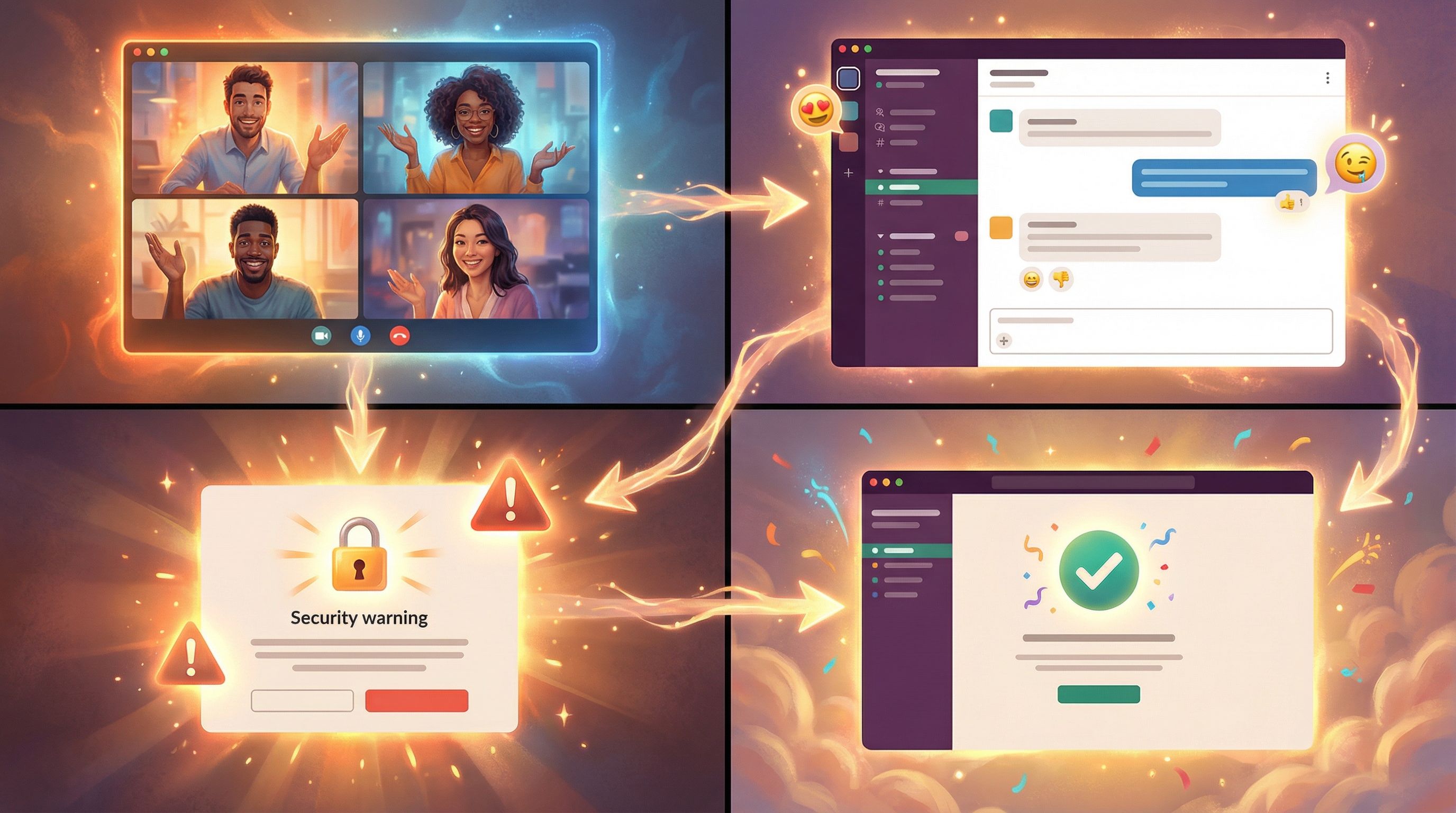
Step 6: Design for Safety, Inclusion, and Psychological Comfort
Onboarding is where people start to answer, “Do I belong here?”
Interactive scenarios give you a powerful way to:
- Model inclusive behavior
- Surface gray areas safely
- Show how the company responds when things go wrong
A few guidelines:
-
Avoid caricatures and stereotypes.
Make sure AI-generated images reflect the diversity you aspire to—and avoid defaulting to narrow archetypes for leaders, technical roles, or caregivers. -
Let players practice allyship and boundary-setting.
Include branches where they can:- Speak up about a biased comment
- Ask for clarification on workload
- Decline a request that conflicts with policy
-
Show institutional backup.
When a player does the right thing, even if it’s awkward, show the company standing behind them: HR following through, managers thanking them, peers learning.
For a deeper dive into using AI visuals responsibly—without tropes, overload, or tokenism—AI Visual Etiquette: Avoiding Tropes, Stereotypes, and Overload in Image-Heavy Questas Stories offers a practical checklist you can adapt directly to onboarding.
Step 7: Connect Your Storyworld to the Real Onboarding Journey
A Questas-powered handbook shouldn’t live in isolation. It should thread through the entire onboarding arc.
Consider:
-
Pre-boarding teaser
Send a short, low-stakes interactive intro before day one:- A “choose your own first day” mini-story
- A quick tour of company rituals and channels
-
Day-one anchor
Use your main onboarding storyworld as a guided session:- Run it live in a cohort workshop
- Or assign it as a solo activity with reflection prompts
-
Week-two reflection
Invite new hires back into the storyworld with:- New branches that build on what they’ve seen at the company
- Scenarios inspired by real questions that came up in week one
-
Ongoing reference
Keep the experience accessible as a:- Refresher before performance review cycles
- Resource for managers onboarding their own reports
Because Questas is a no-code platform, your people team can iterate quickly—adding new branches when policies change or when you notice recurring misunderstandings.
Step 8: Measure, Iterate, and Humanize
To justify the effort (and improve over time), treat your onboarding storyworld like any other product:
What to track:
- Completion and replay rates
- Where players drop off or get stuck
- Which choices are most popular—and which correlate with confusion later
- Qualitative feedback from new hires and managers
How to iterate:
- Add clarifying branches where people frequently choose risky options
- Introduce alternative perspectives (e.g., how a manager or customer experiences a choice)
- Shorten or split scenes that feel too long or didactic
And don’t forget the human layer:
- Use story outcomes as prompts in 1:1s: “Which path did you choose in the escalation scenario? How does that match your past experience?”
- Invite new hires to suggest scenarios from their own careers—then add anonymized versions to the storyworld.
Over time, your “handbook” becomes a living, co-created training universe, not a static artifact.
Bringing It All Together
Turning an employee handbook into a Questas-powered storyworld isn’t about gamifying compliance for its own sake. It’s about:
- Meeting new hires where they are: curious, uncertain, eager to understand how things really work
- Giving them a safe place to rehearse tough moments before they happen live
- Making your values, policies, and norms experiential instead of purely textual
By reframing policies as scenes, dilemmas, and characters; by layering in thoughtful visuals; and by connecting the storyworld to real conversations, you build an onboarding experience that:
- Feels welcoming rather than overwhelming
- Surfaces gray areas instead of hiding them
- Invites people to participate in the culture from day one
Your Next Step
You don’t have to rebuild your entire handbook overnight.
Start with one high-impact moment:
- That recurring Slack etiquette confusion
- That tricky PTO edge case
- That common “Is this harassment?” gray area
Then:
- Sketch a single scene and 2–3 choices.
- Open Questas and lay it out as a small branching story.
- Add a handful of AI-generated visuals to set tone and context.
- Pilot it with your next onboarding cohort and gather feedback.
From there, you can expand scene by scene—until your old static handbook has quietly transformed into a living storyworld your team actually uses.
Adventure awaits… and for your new hires, that adventure can start on day one.