Writing Moral Gray Areas: Designing Ambiguous Choices That Still Feel Fair in Questas


Moral gray areas are where interactive stories get under a player’s skin.
It’s not hard to write a choice between obviously good and cartoonishly evil. What’s hard—and far more memorable—is asking players to pick between:
- Two values they both care about
- Two characters they both like
- Two outcomes that help in one way and hurt in another
Done well, these moments make people pause at a node in Questas, reread the options, and sit with the discomfort. Done poorly, they feel rigged, manipulative, or random.
This post is a practical guide to building morally ambiguous choices that still feel fair—so players feel responsible for what happens, not tricked by the author.
Why Moral Ambiguity Is Worth the Effort
Moral gray choices take longer to design than simple “right/wrong” branches. They’re also where your story becomes uniquely yours.
They deepen engagement. Research on player agency and narrative games keeps finding the same pattern: when players feel that their decisions are meaningful and aligned with their own values, their sense of immersion and satisfaction rises.
They create replay value. A clear “best” choice gives players little reason to replay. Ambiguous choices invite them back to explore:
- What if I’d backed the other character?
- What if I’d taken the short‑term gain instead of the long‑term risk?
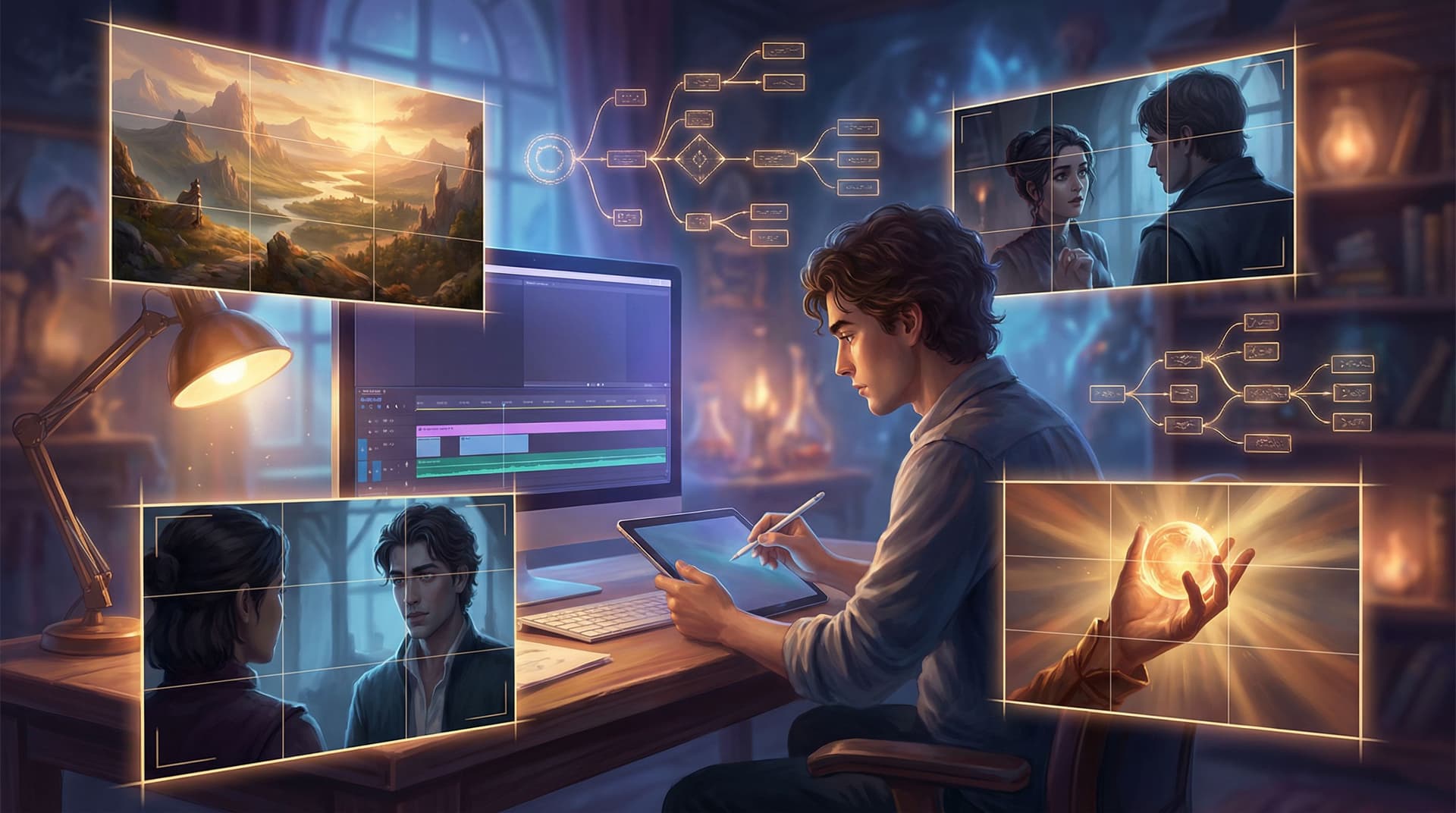
They’re perfect for Questas. A visual, node‑based editor like Questas makes it easy to:
- Fork multiple branches from a single dilemma
- Track consequences over time
- Use AI-generated images and videos to reinforce emotional stakes
If you’re already thinking in branches, you’re halfway to designing ethical dilemmas. The rest is being intentional about how “gray” and how “fair” each choice feels.
For a deeper dive on balancing risk and information at each node, you may want to read The Tension Triangle: Balancing Risk, Reward, and Information in Each Questas Choice Point alongside this post.
What Makes a Moral Choice Feel Fair (Even When It Hurts)
“Fair” doesn’t mean painless. Some of the most powerful choices leave players with regret, guilt, or bittersweet relief. Fairness comes from how you set up and pay off the decision.
Here are four pillars to design around.
1. Clarity of Stakes
Players don’t need perfect information, but they need enough to make an informed decision.
Ask yourself at each decision node:
- What does the player think they’re choosing between?
- Have I clearly framed what’s at risk? (time, safety, reputation, relationships, resources)
- Is any outcome a complete blindside? If so, is that surprise justified by earlier foreshadowing?
Rule of thumb: Hide details, not axes. Players can be surprised by how bad a consequence is, but not by what category of thing they were risking.
In Questas, you can support clarity by:
- Using brief, evocative descriptions above each option that hint at trade‑offs
- Adding optional “Ask more questions” choices that reveal extra context before committing
- Using images to visually signal danger, scarcity, or tension
2. Consistency of Logic
Nothing breaks trust faster than outcomes that ignore the story’s own rules.
If your world has established that:
- The city guard is incorruptible, or
- A magical artifact always exacts a price,
…then your choices must respect those patterns. When players see consistent cause‑and‑effect, even harsh consequences feel earned.
In practice:
- Keep a simple doc (or a Questas “lore node”) of your world rules and values.
- Before you finalize a branch, check: Does this consequence match what we’ve already shown?
- Use similar decisions earlier in the story to “teach” your moral physics.
For help keeping your world rules coherent across multiple stories, From Lore Bible to Living Wiki: Using Questas to Maintain Continuity Across Expanding Story Universes pairs well with this post.
3. Visibility of Consequences (Eventually)
Players don’t need instant feedback, but they do need to see that their choice mattered.
Fair moral ambiguity often works like this:
- Immediate outcome: A short‑term result that seems like a win or loss.
- Delayed echo: A later scene that reveals an unforeseen cost or benefit.
- Thematic payoff: An ending or character beat that reflects the player’s overall pattern of decisions.
In Questas:
- Use branch variables (or tags) to track key moral decisions.
- Call back to those variables in later dialogue, visuals, or options.
- Design at least one late‑game scene that explicitly surfaces the trade‑offs the player has been making.
4. Emotional Honesty
A choice can be mechanically balanced and still feel unfair if the emotional framing is lopsided.
Watch out for:
- Loaded language (“cowardly refuse,” “heroically sacrifice”) that telegraphs which option the author prefers.
- Guilt‑tripping the player after the fact for not picking the “right” answer.
- Invisible author bias where one path gets lush, sympathetic writing and the other feels thin or caricatured.
Instead, aim for:
- Neutral or evenly weighted language in the options themselves.
- Letting characters judge the player, not the narrator.
- Giving each path at least one moment of dignity and one moment of cost.
A Simple Framework for Designing Gray Choices in Questas
When you’re actually staring at a node in the editor, “write morally ambiguous but fair choices” can feel abstract. Here’s a concrete workflow you can run for any key decision.
Step 1: Define the Value Clash, Not the Plot Detail
Start by deciding which values are in tension, not which actions.
Examples:
- Loyalty vs. justice
- Truth vs. kindness
- Personal safety vs. collective good
- Short‑term survival vs. long‑term ideals
Write this at the top of your node notes:
“This choice is X vs. Y.”
Then design actions that embody each side.
In Questas, this might be a node titled:
“Do you expose your friend’s fraud to save the project?”
Value clash: Honesty vs. Loyalty
Step 2: Give Each Option a Genuine Upside and Downside
Ambiguity dies when one option is clearly superior.
For each branch:
- Upside: What legitimate good does this choice pursue? (even if it’s selfish)
- Downside: Who gets hurt, what’s lost, or what risk increases?
Make a quick table in your planning doc:
| Option | Upside | Downside | |--------|--------|----------| | Protect your friend | Preserve relationship; avoid public scandal | Project may fail; others suffer consequences | | Report the fraud | Save project; uphold fairness | Betrayal, guilt, or social fallout |
If you can’t think of an upside for one path, you’re not in gray territory yet—you’re in “secretly right vs. wrong.”
Step 3: Decide How Much the Player Knows
Now ask: What does the player know about each upside and downside at choice time?
Try this structure:
- The primary upside of each option should be visible or strongly implied.
- At least one downside should be hidden or uncertain for each option.
This keeps the choice ambiguous without feeling arbitrary.
In Questas, you can:
- Use short pre‑choice scenes to seed hints (e.g., a nervous glance from the friend, a rumor about budget cuts).
- Offer a “probe” option: “Ask your friend why they did it” leading to a mini‑scene, then loop back to the main decision.
Step 4: Map Short‑Term and Long‑Term Consequences
Use the canvas to sketch two layers of consequences:
- Immediate branch nodes (1–2 hops away):
- Social reactions
- Visible changes to resources or status
- Delayed consequence nodes (3+ hops away):
- Reversals (the “good” choice creates a new problem, or vice versa)
- Reveals that reframe the morality of the earlier action
A good pattern is:
Immediate relief, later cost on one path, and immediate pain, later integrity on the other.
This doesn’t mean one ending is “better,” but that each path feels like a coherent moral arc.
Step 5: Plan Feedback That Respects Player Agency
Avoid heavy‑handed moral meters unless they’re part of the story. Research on game morality systems shows that players often ignore explicit scores when a choice feels morally obvious, but lean on them when they’re unsure—so your scoring can accidentally override their own judgment.
Instead, experiment with diegetic feedback—responses that live inside the story world:
- Characters treating the player differently
- News headlines, rumors, or environmental changes
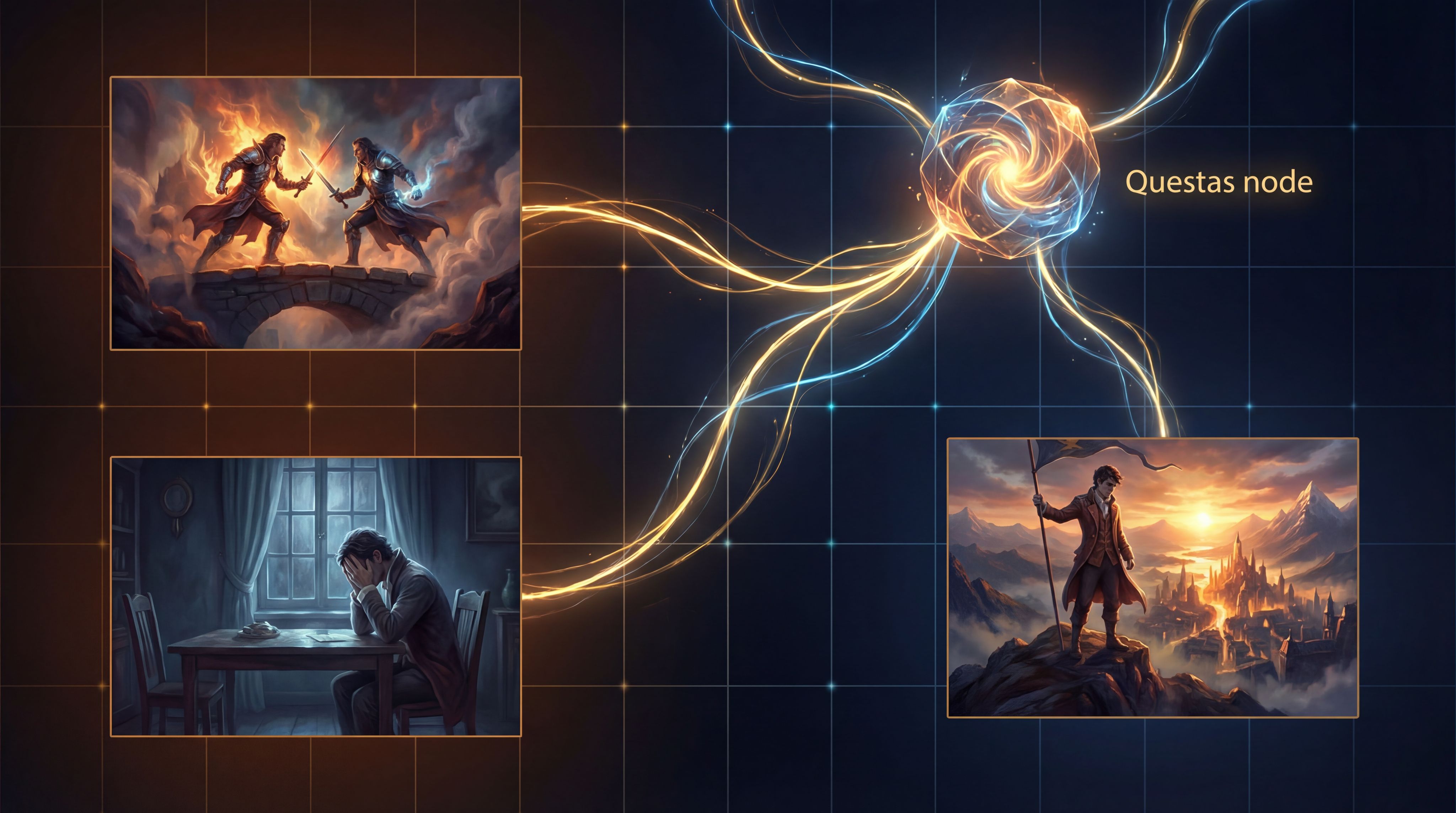
- Visual motifs in your AI-generated images (e.g., growing shadows, warmer lighting, recurring symbols)
If you do want a visible “reputation” or “ethics” system, consider:
- Making it multi‑dimensional (e.g., Justice, Compassion, Loyalty) instead of a single good/evil bar.
- Letting players see why a choice moved a value (e.g., a short tooltip or character comment).
For more on using visual language to reinforce emotional and ethical stakes, check out Writing with the Camera in Mind: Cinematic Techniques for Framing AI Images in Your Questas Scenes.
Using Questas Features to Support Moral Gray Design
The platform you’re building in can either fight you or help you. Here’s how to lean on Questas to make morally complex design easier instead of harder.
Use Tags or Variables for Moral Throughlines
Even a lightweight system can make your story feel much richer.
You might track:
loyalty_to_friendtrust_in_institutionwillingness_to_compromise
Then:
- Branch dialogue based on these values (“I know you always have my back,” vs. “You only care when it suits you.”)
- Unlock or lock certain choices later (e.g., an ally refuses to help if trust is too low).
Reuse Dilemmas as Training or Reflection Tools
Moral gray areas aren’t just for fantasy epics. They’re powerful in:
- Coaching and therapy: letting clients rehearse boundary‑setting, disclosure, or confrontation scenarios.
See Branching Narratives for Therapists and Coaches: Using Questas to Rehearse Tough Conversations Safely for applied examples. - Workplace training: office politics, feedback, promotions, and conflict of interest.
- Brand storytelling: showing real trade‑offs your team navigated instead of sanitized case studies.
In each case, the goal is not to tell players what’s right, but to let them feel the weight of competing goods.
Pair Visuals with Moral Tone—Carefully
AI images and videos in Questas are powerful levers. Use them to:
- Signal mood and stakes (color, framing, composition)
- Highlight who is affected by a choice
- Show the aftermath of decisions in later scenes
Be cautious about:
- Over‑dramatizing one path so much that it feels like the “villain” route visually.
- Leaning on stereotypes or tropes when depicting victims, perpetrators, or communities.
If you’re working heavily with visuals, AI Visual Etiquette: Avoiding Tropes, Stereotypes, and Overload in Image-Heavy Questas Stories is an essential companion read.
Common Pitfalls (and How to Fix Them)
Pitfall 1: The Secretly Optimal Path
You say you’re designing ambiguity, but one route quietly gives:
- More content
- Better loot or endings
- Nicer companions
Fix:
- Deliberately give each path some exclusive rewards and some exclusive losses.
- If you want a “hard mode” moral stance (e.g., radical honesty), make it viable, not masochistic.
Pitfall 2: Consequences That Feel Random
If a choice’s outcome doesn’t connect to what the player thought they were choosing, they’ll feel cheated.
Fix:
- Add one or two foreshadowing beats earlier.
- Use a character to warn about a specific risk.
- In the aftermath scene, briefly explain why this consequence followed.
Pitfall 3: Authorial Finger‑Wagging
If your narrative tone clearly judges one path, you’re not offering a dilemma—you’re giving a quiz.
Fix:
- Let different characters embody different moral perspectives.
- Reserve explicit moral commentary for endings that summarize patterns, not single choices.
Pitfall 4: Too Many Dilemmas, Not Enough Breathing Room
Wall‑to‑wall heavy choices can numb players.
Fix:
- Alternate big moral crossroads with:
- Low‑stakes choices (flavor, exploration, humor)
- Reflective scenes where characters talk about what just happened
- Use pacing tools in Questas (like linear stretches between branches) to give players time to process.
Putting It All Together: A Mini Design Checklist
Before you publish a morally gray sequence in Questas, run through this quick checklist:
- Value Clash
- Can I name the core tension as “X vs. Y”?
- Symmetry of Respect
- Does each option have a real upside and downside?
- Is my language and visual framing roughly balanced?
- Informed Choice
- Do players understand what’s at stake, even if they don’t know every detail?
- Consistent Logic
- Do outcomes follow the story’s established rules and patterns?
- Visible Impact
- Will players see, sooner or later, how this choice changed the world or relationships?
- Emotional Payoff
- Does each path contain at least one moment of pride and one of doubt?
If you can honestly answer “yes” to most of these, you’re in strong territory.
Wrap-Up: Why These Choices Stay With People
Moral gray areas linger because they mirror real life. We rarely face choices between pure good and pure evil. More often, we’re trading:
- One person’s needs for another’s
- Short‑term security for long‑term integrity
- Comfort for truth
Interactive stories built in Questas are uniquely suited to help players explore that terrain safely. When your choices are ambiguous but fair—grounded in clear stakes, consistent logic, visible consequences, and emotional honesty—players walk away not just entertained, but changed.
Your Next Move
You don’t need to redesign your entire project to start working with moral gray areas.
Here’s a simple way to begin today:
- Open one existing decision node in your current Questas project.
- Rewrite it using the value clash approach: name the tension, then adjust the options so each has a real upside and downside.
- Add one new scene down each branch that shows a small, surprising consequence of that choice.
- Play through both paths as if you were a first‑time player. Notice where you hesitate, where you feel nudged, and where things feel arbitrary.
Then iterate.
If you haven’t started building yet, head over to Questas, sketch a 5–10 node story about a single tough decision, and use the checklist above as your guide. Moral gray design is a craft—but it’s a craft you can practice in small, repeatable steps.
Adventure awaits in the spaces between right and wrong. Go build something that makes your players think twice.