AI as Co‑Writer, Not Ghostwriter: Collaborative Writing Workflows for Complex Questas Plots

AI as Co‑Writer, Not Ghostwriter: Collaborative Writing Workflows for Complex Questas Plots
Complex branching stories are hard.
You’re juggling:
- Multiple protagonists and perspectives
- Choices that echo ten scenes later
- Visual continuity across dozens (or hundreds) of AI‑generated images
- The constant temptation to “just let the AI write it all”
That last one is the trap.
When you’re building interactive adventures in Questas, AI can absolutely accelerate your process—but if you hand over the steering wheel, you end up with plots that feel generic, inconsistent, or emotionally flat.
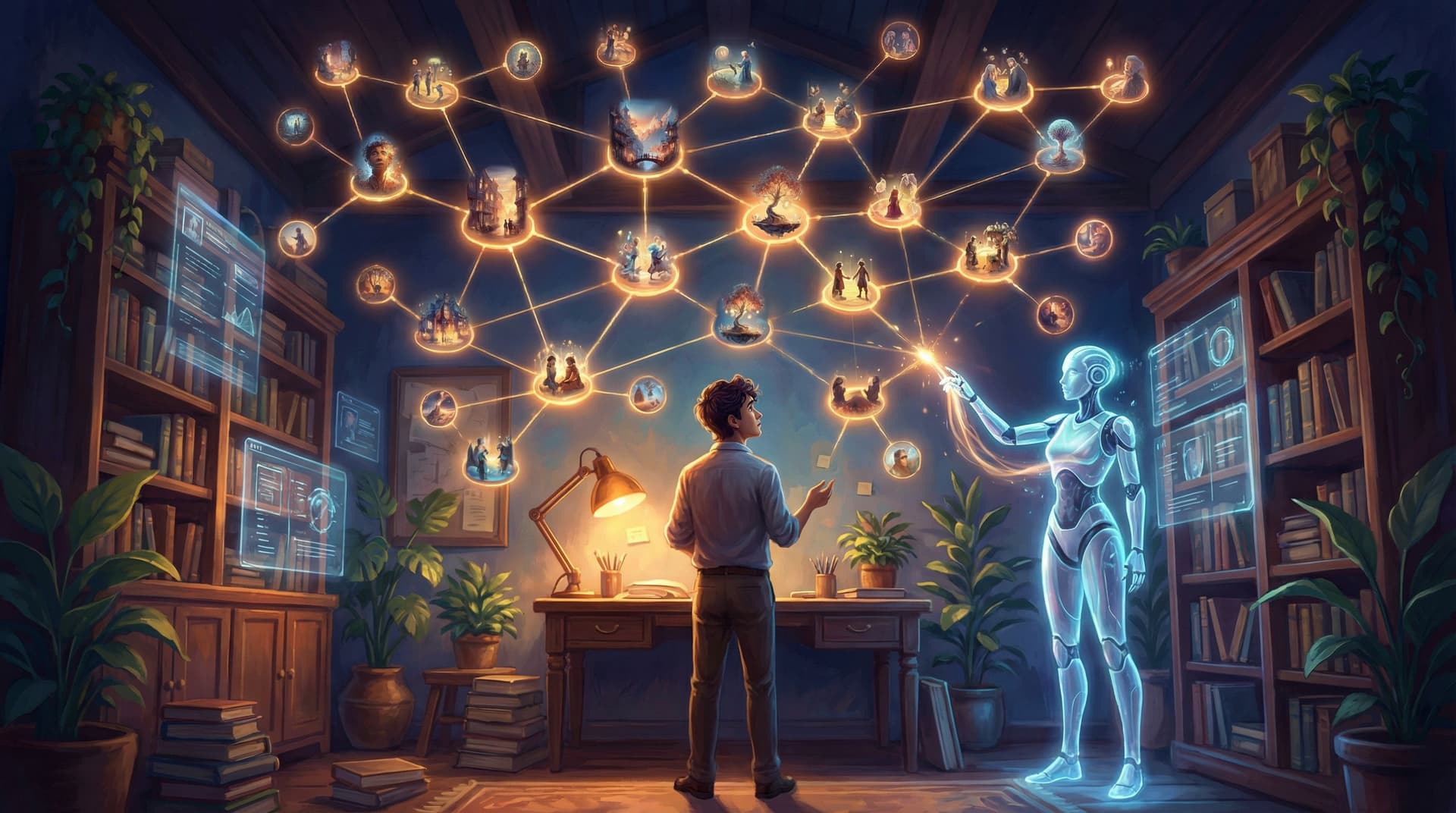
The better model: AI as co‑writer, not ghostwriter.
In this post, we’ll walk through practical, repeatable workflows for collaborating with AI on complex Questas plots—so you stay the author, and the AI becomes your brainstorming partner, continuity checker, and scene‑drafting assistant.
Why “Co‑Writer, Not Ghostwriter” Matters for Branching Stories
Linear stories already strain under messy first drafts. Branching stories multiply that chaos:
- Every choice point spawns new scenes that must still feel like part of the same world.
- Players remember what they did, even when you forget—and they’ll notice when consequences don’t match.
- AI visuals and text must align, or your story feels stitched together instead of designed.
Treating AI as a ghostwriter—“write my Questas for me”—creates problems:
- Inconsistent tone and theme. Different prompts produce wildly different vibes.
- Shallow choices. AI tends to default to safe, familiar tropes unless you push it.
- Continuity gaps. Characters forget what happened in other branches because the AI never saw them.
By contrast, using AI as a co‑writer lets you:
- Offload grunt work (variant endings, alt dialogue, quick recaps) while you focus on core beats.
- Explore more branches safely, because you can ask AI to propose options, then curate.
- Keep a strong authorial voice, using AI as a tool for iteration, not a replacement for judgment.
If you’ve read posts like “From Short Story to Story System”, you’ve already seen how modular thinking transforms your writing. Co‑writing with AI is the next layer: using that modular structure to guide how you collaborate with the machine.
Step 1: Define the Story You’re Actually Telling
Before you touch a node in Questas or open an AI chat, you need a north star.
Think of this as your story contract—a compact set of constraints that every branch must honor.
Answer these questions in a short, human‑written brief:
-
Core premise
One or two sentences. What is this story about? -
Player fantasy
What experience are players here for? (E.g., “being the morally conflicted spy,” “being a junior designer navigating office politics.”) -
Non‑negotiable themes
3–5 words or phrases that must show up across branches (e.g., loyalty vs. ambition, found family, systemic injustice, playful curiosity). -
Tone and rating
Snappy and comedic? Slow‑burn and contemplative? All‑ages or PG‑13? -
Ending space, not specific endings
Instead of locking in exact endings, define types of outcomes:- Tragic but earned
- Bittersweet growth
- Clever win with a cost
This brief becomes the prompt you keep reusing with your AI co‑writer. You’ll paste it at the top of every major request so the AI remembers what game you’re playing.
Pro tip: Store this brief in a “Story Bible” node or doc. If you’re building a larger universe, pair it with the continuity strategies from “From Lore Bible to Living Wiki”.
Step 2: Design the Plot Skeleton Yourself
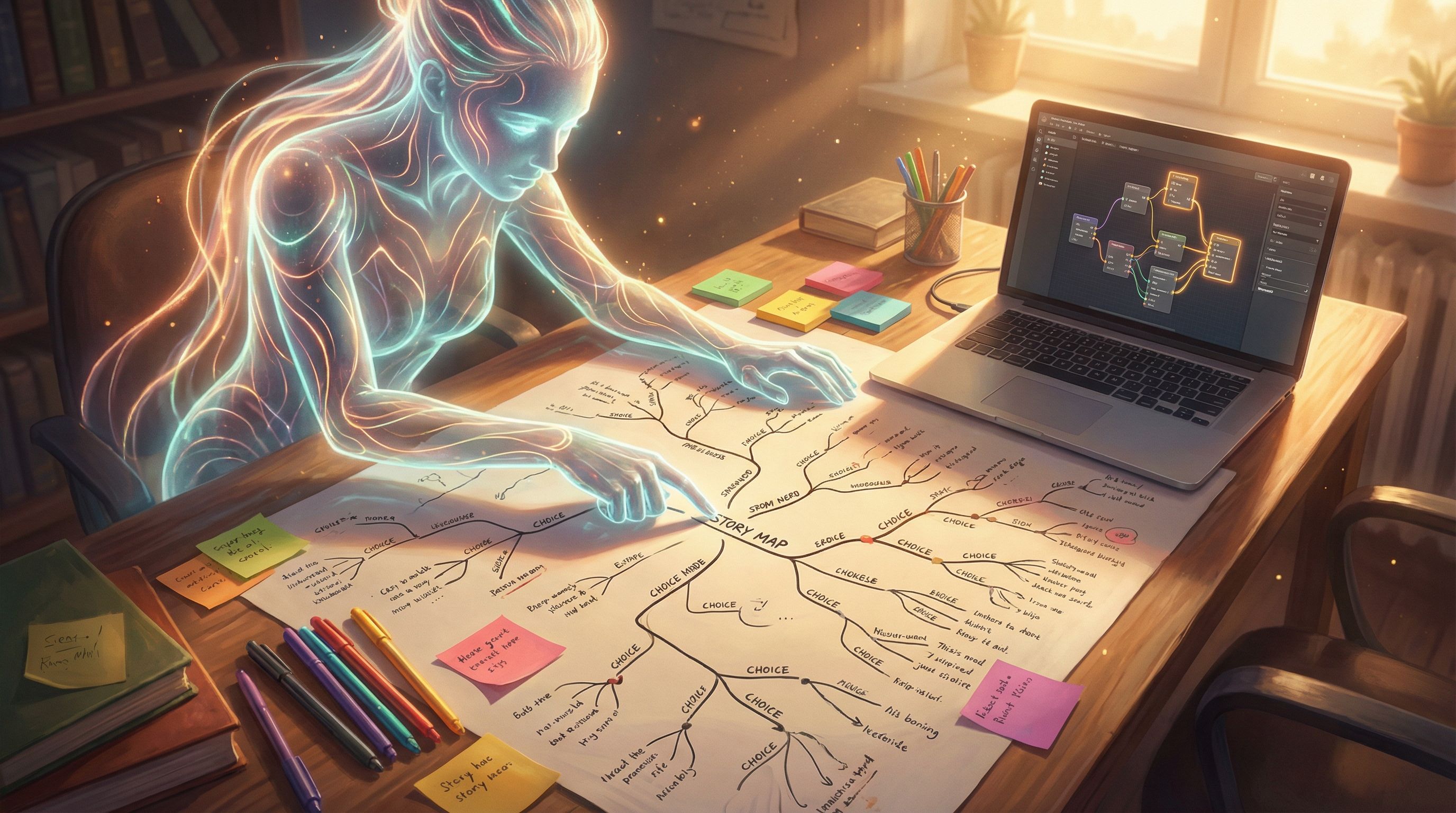
This is where many creators are tempted to ask AI, “Generate a branching plot for my cyberpunk heist story.” Resist that urge.
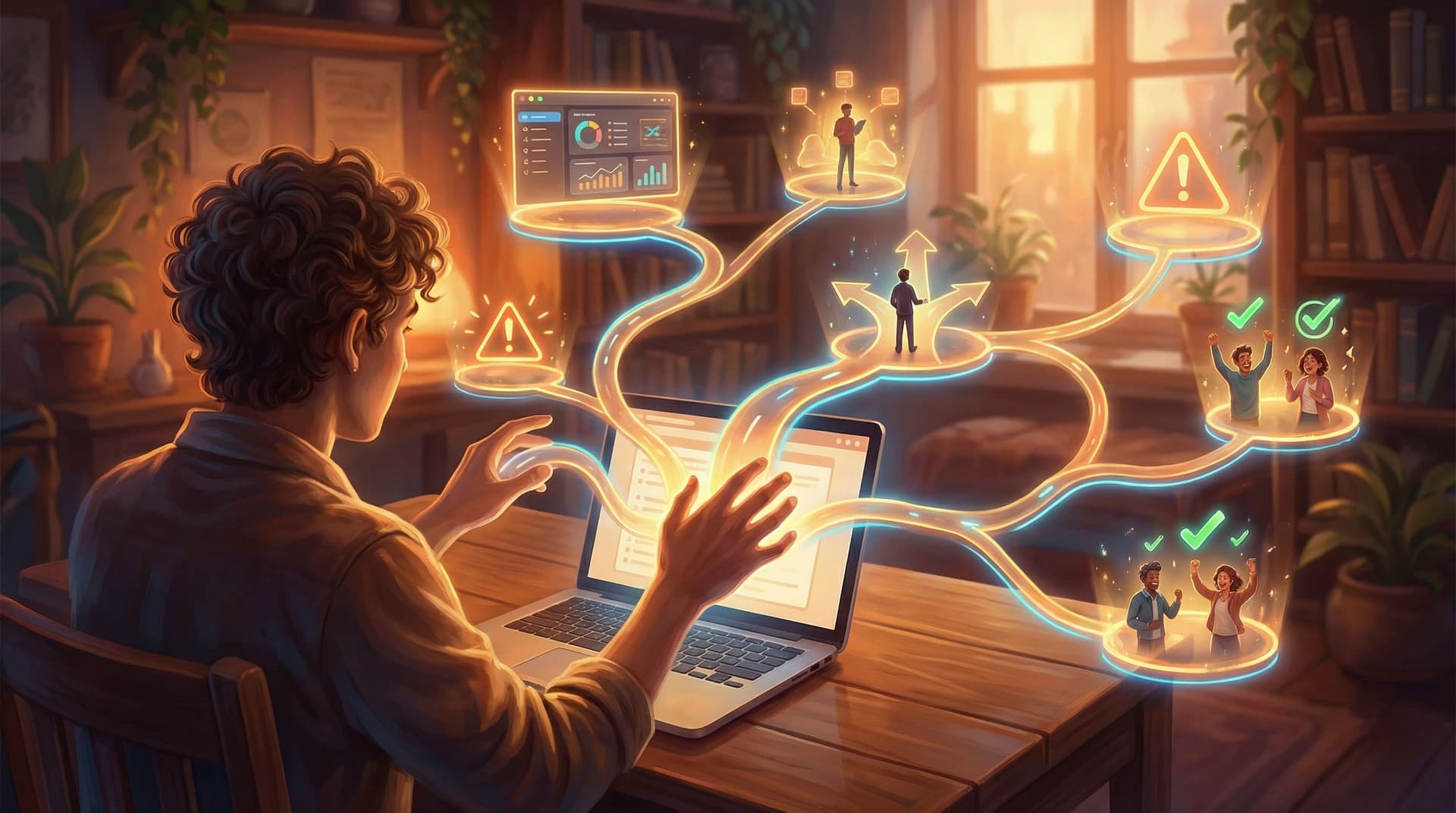
You want to own the topology of your story: how scenes connect, where tension spikes, and where players loop back.
Build a minimal backbone first
Inside Questas or on paper:
-
Map your critical path.
- Start node → 3–5 key turning points → 2–3 major endings.
- Ignore side branches for now; you’re sketching the spine.
-
Mark your “anchor” scenes.
These are scenes that must exist regardless of player choices—maybe with different flavors.- The first encounter with the mentor
- The moment the secret is revealed
- The final confrontation
-
Identify decision types.
Tag each choice as:- Moral (values in conflict)
- Strategic (risk vs. reward)
- Relational (who do you side with?)
- Informational (what do you investigate?)
-
Leave deliberate gaps.
Mark places where you want help:- “Need 3 interesting ways this plan could go wrong.”
- “Need a non‑violent alternative here.”
You’re not writing full prose yet. You’re designing a story system that your AI co‑writer will help you fill.
Step 3: Use AI for Divergent Ideation, Not Final Drafts
Once your skeleton exists, it’s time to invite AI into the room.
The key is to use AI for divergent thinking—generating many possibilities—before you converge on a few strong, human‑curated options.
Good prompts for branching ideation
Here are patterns you can adapt in your AI chat (or even inside node descriptions if your workflow allows):
- Branching options at a decision point
“Given the story brief below and this current scene summary, propose 5 distinct choices the player could make next. Each choice should:
– Reflect the theme of loyalty vs. ambition
– Lead to meaningfully different consequences over the next 3–5 scenes
– Avoid clichés like ‘join the bad guys’ or ‘sacrifice yourself’ unless they have a twist.
Story brief: [paste brief]
Current scene: [1–2 paragraph summary]”
You’ll usually get a mix of strong and weak ideas. Your job is to curate and combine.
- Failure modes and complications
“Here are the stakes of the current mission. Generate 6 ways this plan could partially fail, each revealing a different truth about the world or characters, not just ‘the alarm goes off.’”
- Relational ripples
“The player just chose to prioritize the mission over their friend’s safety. Propose 4 ways this choice could strain their relationship in future scenes, from subtle to dramatic.”
You’re not asking AI to write the node. You’re asking it to expand your option space. Then you:
- Pick 2–3 favorites.
- Rewrite them in your voice.
- Attach them as choices in your Questas node.
This keeps your authorship intact while leveraging AI’s speed.
Step 4: Co‑Draft Scenes with Clear Roles
When it’s time to turn node summaries into playable scenes, define who’s doing what.
A simple division of labor:
- You: Intent, beats, and emotional targets.
- AI: First‑pass prose, alt phrasings, and structural variants.
A practical co‑drafting loop
For each important node:
-
Write a tight scene spec.
Include:- Where we are (location, mood, visual cues)
- Who’s here (character goals, current tension)
- What must happen (non‑negotiable beats)
- Word count range (e.g., 250–400 words)
-
Ask AI for a structured draft, not “a scene.”
“Using the brief and scene spec below, write a draft for this Questas node.
– Use present tense, second person (‘you’).
– Break up long paragraphs.
– End with a clear emotional hook that leads into the next choice.
– Keep dialogue snappy and avoid over‑explaining internal thoughts.
[brief]
[scene spec]”
-
Revise like you would a human co‑writer.
- Cut the generic bits.
- Sharpen character voice.
- Align details with established continuity.
-
Ask AI for alt takes on specific pieces.
Instead of rewriting everything yourself, target the rough spots:
“Give me 5 alternate versions of this line where the mentor sounds more sardonic but still caring: [line].”
“Shorten this paragraph by 30% while keeping the same emotional beat: [paragraph].”
You remain the final editor. AI is your over‑eager junior writer who never gets tired of giving you more options.
Step 5: Keep Characters and Lore Consistent with AI Assist
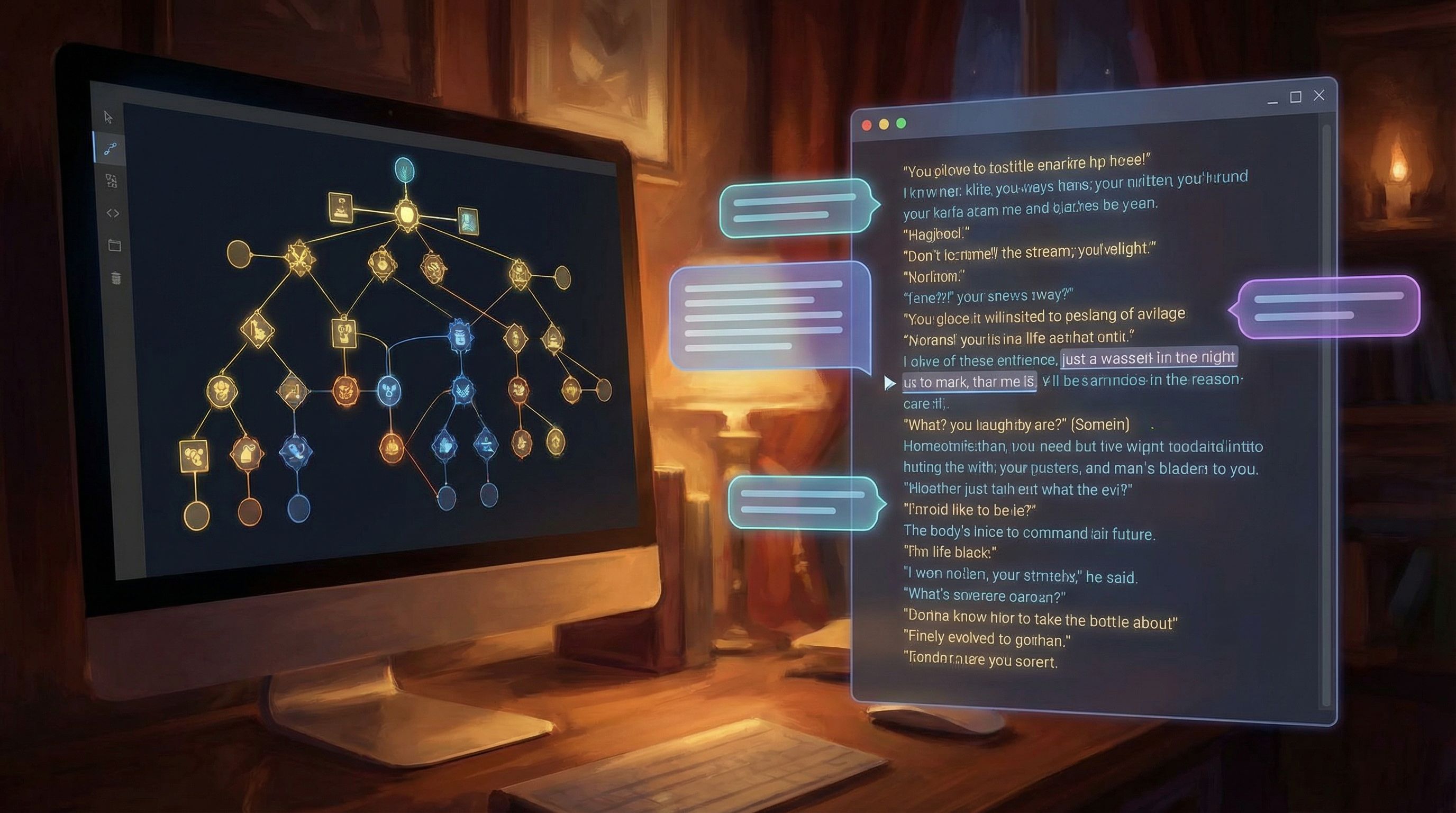
As your Questas project grows, the hardest part isn’t inventing new content—it’s remembering what you already decided.
You can combine the continuity ideas from “Designing ‘Living NPCs’” and “AI as Casting Director” with AI co‑writing in a powerful way.
Build a living character sheet
For each major character, maintain a doc or node with:
- Core beliefs and fears
- Speaking style (rhythm, slang, formality)
- Key relationships and how they’ve evolved
- Visual anchors for AI images (age, posture, clothing, color palette)
When drafting scenes, always paste the relevant character sheet into your AI prompt.
“Here’s the character profile for Rhea, the disillusioned archivist. Here’s the current scene summary. Write only Rhea’s side of a tense conversation where she finally admits why she joined the resistance. Keep her voice consistent with the profile.”
Use AI as a continuity checker
Once you’ve drafted a cluster of nodes:
- Export or copy a sequence of scenes involving the same character.
- Ask AI:
“Read these scenes in order. List any moments where the character’s behavior, knowledge, or tone seems inconsistent with their profile or with earlier events. Suggest specific lines to adjust.”
You still decide what to change, but you’ve outsourced the tedious “spot the contradiction” work.
Step 6: Co‑Design Choices That Actually Matter
The heart of a complex Questas plot isn’t the number of branches—it’s how meaningful each choice feels.
AI can help you pressure‑test your decisions:
- Evaluate choice clarity
“Here are the three options the player sees in this node. For each, explain:
– What the player might think will happen.
– What will actually happen in the next 2–3 scenes.
– Whether this feels fair and interesting.
Suggest improvements to make the tradeoffs more legible without spoiling.”
- Balance risk, reward, and information
This echoes the framework from “The Tension Triangle”.
“Analyze these choices in terms of risk, reward, and information. Are we giving the player enough information to make a thoughtful decision, while still leaving uncertainty? Propose revisions.”
- Sharpen morally gray decisions
If you’re leaning into ambiguity (and you probably should), use AI to explore edge cases:
“The theme here is ‘loyalty vs. self‑preservation.’ Propose 3 new variants of this decision that make both options tempting and defensible, not obviously right or wrong.”
Again, you’re not letting AI design your ethics. You’re using it to surface options you might not have considered, then choosing the ones that align with your story’s values.
Step 7: Align Text and Visuals Without Overload
Because Questas bakes AI images and video directly into your workflow, it’s easy to go overboard: every node gets a new, wildly different visual style.
Your co‑writing process should treat visuals as part of the story, not decoration.
Co‑writing visual prompts
For each major location or recurring character, co‑design a master prompt with AI:
“Help me refine a stable AI image prompt for this character. They are a 30‑something archivist in a near‑future library city, always wearing layered earth‑tone clothing, with a tired but sharp gaze. The mood is hopeful melancholy. Suggest 3 versions that would work across multiple scenes.”
Once you’ve locked these in, reuse and lightly adapt them instead of reinventing every time. For more on this, pair your workflow with the framing techniques in “Writing with the Camera in Mind”.
Use AI to spot visual continuity issues
If you’re generating a batch of images:
“Here are descriptions of 10 scene images I plan to generate. Identify any inconsistencies in character appearance, lighting, or visual tone that might break immersion. Suggest how to adjust prompts to keep a cohesive look.”
Your goal is a cohesive visual language that supports the narrative, not a collage of cool but disconnected pictures.
Step 8: Let AI Help You Playtest and Polish
Once you have a playable draft in Questas, AI can act as a tireless (if somewhat literal) playtester.
Scripted playthroughs
Copy the text and choices from a full run and ask:
“Pretend you’re a player who values clever, low‑violence solutions. Walk through this story path, summarizing your feelings at each major decision. Note anywhere you felt railroaded, confused, or under‑informed.”
Then do the same for other player archetypes:
- The chaos gremlin
- The moral purist
- The min‑maxer
You’ll get a rough sense of where different playstyles feel underserved.
Micro‑polishing passes
Use targeted prompts for final cleanup:
- Clarity: “Rewrite this node for clarity while keeping the same tone and length.”
- Pacing: “Shorten this scene by 20% but preserve the emotional arc.”
- Voice: “Make this narration slightly more wry without turning it into a joke.”
Treat these as suggestions, not replacements. Always read the output in context before pasting it back into your Questas node.
Putting It All Together: A Sample Workflow Checklist
Here’s a condensed workflow you can adapt for your next complex Questas project:
- Write your story brief (premise, player fantasy, themes, tone, ending space).
- Map your plot skeleton inside Questas: critical path + anchor scenes.
- Mark AI collaboration points (where you want help with options, failure modes, or alt scenes).
- Use AI for divergent brainstorming at each decision point, then curate and rewrite.
- Co‑draft scenes with tight specs and structured prompts; you revise for voice and continuity.
- Maintain character sheets and lore; use AI to check for contradictions across branches.
- Co‑design visual prompts and reuse them to keep a consistent look.
- Run AI‑assisted playtests for different player archetypes; adjust choices and pacing.
- Do micro‑polish passes on clarity, rhythm, and emotional impact.
At every step, the principle holds: AI proposes, you dispose.
Summary
Complex branching plots can feel overwhelming—but they don’t have to.
When you treat AI as a co‑writer instead of a ghostwriter, you:
- Stay in control of your story’s themes, tone, and ethics.
- Use AI where it shines: generating options, spotting inconsistencies, and iterating quickly.
- Build richer, more coherent Questas experiences without burning out.
The workflows above—story briefs, plot skeletons, divergent brainstorming, co‑drafted scenes, continuity checks, and AI‑assisted playtests—form a toolkit you can reuse on every project, whether you’re adapting a podcast, designing a training simulation, or turning a dense handbook into a storyworld like we explored in “From Onboarding Docs to Day-One Adventures”.
You don’t need to choose between “write everything myself” and “let the AI do it.” There’s a middle path where your creativity sets the direction, and AI helps you explore more of the map.
Ready to Build Your Next Adventure?
The best way to internalize these co‑writing patterns is to use them on a real project.
- Pick a story idea you care about—a workplace scenario, a brand investigation, a personal journey, or a speculative fiction concept.
- Write a one‑page brief capturing premise, player fantasy, themes, and tone.
- Open Questas and sketch a 10–15 node skeleton.
- Choose one cluster of nodes and deliberately run through the co‑writing loop:
- AI‑assisted choice ideation
- Co‑drafted scenes
- Continuity checks
- A quick AI‑driven playtest
By the time you’ve done that once, you’ll feel the difference between AI as a ghostwriter and AI as a true collaborator.
Adventure awaits—your next branching story is already in your head. It’s time to invite a (machine) co‑writer to help you build it, one node at a time.