Branching Narratives for Brand Research: Let Customers ‘Choose Their Own Pain Points’ Before You Build


Most teams still learn about customer problems the hard way: interviews that favor the most articulate voices, surveys that flatten nuance into 1–5 scales, and feature launches that double as very expensive experiments.
Branching, choose-your-own-adventure style research flips that script.
Instead of asking customers what hurts in the abstract, you let them play through their frustrations—making decisions, running into constraints, and revealing what they actually care about through the paths they take.
That’s where a platform like Questas shines: it lets you build interactive, branching stories with AI-generated images and video, no code required. For brand, product, and research teams, that means you can turn “What are your biggest challenges?” into a lived, visual experience your customers navigate in minutes.
This post is about how to use branching narratives as a brand research lab—a place where customers can literally choose their own pain points before you commit to features, campaigns, or positioning.
Why Letting Customers “Choose Their Own Pain Points” Works
Traditional research methods are good at what people say. Branching narratives are good at what people do when they’re inside a situation.
When you invite customers into an interactive scenario and ask them to make choices, three powerful things happen:
-
You surface real trade‑offs, not wishlists.
In a story, customers can’t say “I want everything.” They have to pick: speed vs. control, price vs. quality, automation vs. human touch. Those choices map directly to product and messaging decisions. -
You uncover emotional context, not just rational answers.
A branching scenario can show stress, confusion, or relief through visuals and pacing. With Questas, AI images and micro‑video can make a “simple” workflow feel hectic or calm, revealing whether your brand should lean into reassurance, empowerment, or urgency. -
You get structured, analyzable signals from qualitative experiences.
Every branch, choice, and outcome is a datapoint. You’re not just collecting quotes—you’re collecting patterns: which paths people replay, where they rage‑quit, which endings they label as “success.” -
You test brand narratives before you bet the campaign.
You can frame the same core product around different pain points (e.g., “save time,” “reduce risk,” “unlock creativity”) and see which story arc customers voluntarily follow.
In other words: branching narratives let customers show you which problems feel real enough to navigate.
From Persona to Playable Scenario
To use branching narratives for brand research, you don’t start with wireframes. You start with a moment.
Ask: “What is the stressful, pivotal, or high‑stakes moment my customer lives through that my brand claims to help with?”
Examples:
- A founder trying to decide whether to ship a risky feature before a launch event.
- A parent juggling three tools to manage a child’s remote learning schedule.
- A marketing manager under pressure to prove ROI on a new channel.
Then, turn that moment into a playable scenario:
-
Anchor in a single setting.
One office, one kitchen table, one factory floor. This keeps the story concrete. -
Define the core tension.
- “Hit the deadline vs. maintain quality.”
- “Protect data privacy vs. personalize deeply.”
- “Stay within budget vs. delight the customer.”
-
List 3–5 plausible decisions your user might face in that moment.
Don’t overthink it. You’re not writing a novel; you’re building a decision map.
If you’re new to compact formats, it’s worth checking how we approach tiny but powerful structures in The Minimal Viable Quest: Tiny, Three-Choice Questas Formats That Still Deliver Big Insight.

Designing Branches That Reveal Pain Points (Not Just Plot Twists)
For brand research, your goal isn’t “most surprising twist.” It’s maximum clarity about what actually matters to your audience.
Here’s how to structure branches so they expose pain points:
1. Turn each major pain hypothesis into a branch family
Start with 3–4 hypotheses about what really hurts for your customers. For example:
- Time pressure: “I don’t have hours to figure this out.”
- Uncertainty/risk: “I’m afraid of making the wrong call.”
- Complexity/overwhelm: “Too many tools, steps, or stakeholders.”
- Reputation/credibility: “If this goes badly, I look incompetent.”
For each hypothesis, design a key decision point that amplifies that pain if the user chooses a certain path. Let them feel it.
If most players willingly walk into “more complexity” to avoid “more risk,” you’ve learned something crucial about how to position your product.
2. Use choices as mirrors for your value props
Each choice should implicitly test a claim your brand makes. For example, if your product promises “clarity in chaotic decisions,” your branches might look like:
- Option A: Move forward with incomplete data but keep momentum.
- Option B: Pause to gather more data, risking delay.
- Option C: Escalate to a manager for guidance.
Then, in the outcomes, show the emotional and practical consequences of each. Where do users feel most “right”? That’s where your value prop resonates.
3. Make friction visible and countable
In Questas, you can:
- Add extra micro-steps or screens to represent friction.
- Use AI-generated visuals to show cluttered dashboards, overflowing inboxes, or confused teammates.
- Vary the number of clicks or decisions required per path.
If users consistently abandon paths that are visually or structurally overwhelming—even if they lead to “better” results—you’ve identified a pain point around cognitive load or process complexity.
For more inspiration on how visual language shapes experience, see how we use camera framing and motion in Camera Moves Without a Camera: Simulating Pans, Zooms, and Cuts with AI Images in Questas.
A Simple Blueprint: Your First Brand-Research Quest
Here’s a concrete structure you can adapt for almost any B2B or B2C scenario.
Step 1: Define the scenario
- Title: “Your First Week With [Your Product Category]” or “The Campaign That Has to Work.”
- Player role: Your primary persona (e.g., “Growth Lead at a Series B startup”).
- Timeframe: Short and specific (a day, a week, a single meeting).
Step 2: Map a 3-layer branch structure
Think of it like three “rounds” of decisions:
-
Round 1 – Setup:
Introduce the situation and a first choice that lightly tests priorities.- Do they prioritize speed, thoroughness, or stakeholder alignment?
-
Round 2 – Escalation:
Consequences from Round 1 appear. New constraints arrive (budget cut, new requirement, sudden deadline). Choices now test deeper values:- Do they cut scope, push back, or accept more personal workload?
-
Round 3 – Resolution:
The story converges into a few distinct “endings” that each embody a different pain point:- “We shipped, but I’m burned out and worried about quality.”
- “We’re safe, but we’re late and lost momentum.”
- “Stakeholders are happy, but I feel like a bottleneck.”
Step 3: Instrument the story like a research study
Decide what you’ll measure before you build:
- Path popularity: Which branches get the most traffic?
- Drop-off points: Where do people quit the story?
- Replay behavior: Do people replay to try different paths, or stop after one?
- Self-reported tags: After each ending, ask: “Which part of this felt most like your real life?” with 3–5 options.
If you’re curious about what to instrument and what to ignore, you’ll find a deeper dive in From Playtest Notes to Narrative Analytics: What to Measure (and Ignore) in Your Early Questas Builds.
Turning Story Data Into Brand Decisions
Once customers have played through your scenario, you’ll have a map of their choices. The magic is in how you interpret it.
1. Cluster endings by “felt pain,” not just success/failure
Instead of labeling endings simply as “good” or “bad,” cluster them like this:
- Time-crunched but successful
- Safe but stalled
- Aligned but overworked
- Fast and sloppy
Then ask:
- Which cluster do most players land in?
- Which cluster do they avoid at all costs?
If 70% of your audience accepts being time-crunched but avoids “fast and sloppy,” your brand story should emphasize reliability over speed-at-all-costs.
2. Map common paths back to messaging themes
Take your most-traveled paths and annotate them with the themes they express:
- “Avoids risk, seeks validation from peers.”
- “Tolerates complexity if it preserves control.”
- “Trades quality for speed when reputation is secure.”
These annotations become raw material for:
- Landing page headlines
- Ad copy angles
- Sales talk tracks
- Onboarding flows
3. Compare segments by path, not by survey answer
Because every path is structured, you can compare:
- New vs. experienced customers
- Different industries or company sizes
- Prospects vs. existing users
Instead of asking, “Do enterprise buyers care more about security?” you can see whether they:
- Consistently choose the “more secure but slower” branch.
- Replay the scenario to explore riskier options.
Those behavioral differences are gold for both brand and product.
Making It Feel Like Play, Not a Questionnaire
If your interactive story feels like a disguised survey, people will treat it like one. You’ll get shallow, “performative” choices.
To get honest, revealing behavior, design for play:
-
Use strong visual cues.
With Questas, you can generate scenes that instantly frame a decision: a tense boardroom, a cluttered Jira board, a late‑night home office lit by a laptop glow. -
Keep the copy light but specific.
Avoid corporate jargon. Write like a colleague describing a real day. -
Offer meaningful but not overwhelming choices.
Two to three options per node is plenty. Each should feel like something a real person might actually do. -
Reward curiosity.
Add small surprises—an unexpected stakeholder reaction, a hidden branch—for people who explore. -
Respect time.
Tell players upfront: “This takes 5 minutes.” Then actually hit that mark.
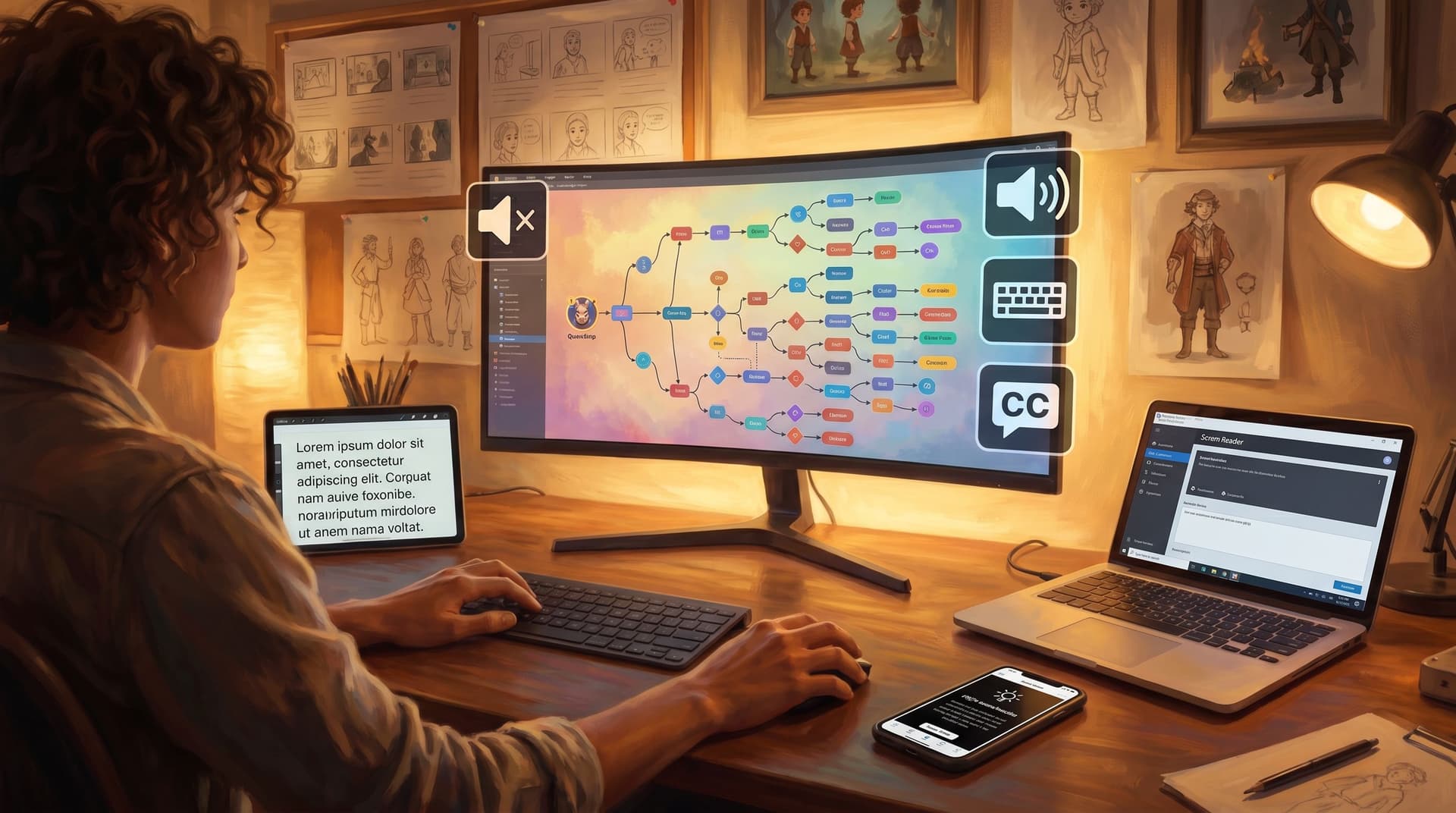
If you’re designing for broad audiences or internal teams, remember accessibility from the start: readable text, clear contrast, keyboard navigation, and multiple ways to consume content. Our post on Accessibility-First Quest Design: Building Questas That Welcome Every Player walks through practical patterns you can borrow.
Practical Tips for Running Branching-Story Brand Research
Once your quest is built, treat it like any other research asset—just with more flavor.
1. Recruit with a clear promise
Position the experience as:
- “A 5-minute interactive scenario about how you handle X.”
- “Play through a day in the life of someone like you—and help us design better tools.”
Offer a small incentive if needed, but many people will participate just for the novelty.
2. Combine quantitative paths with qualitative reflection
At the end, ask 2–3 open prompts:
- “What felt most accurate to your real life?”
- “What did we miss about how you handle this situation?”
- “If you had a magic wand in this scenario, what would you change?”
Because players just lived through a concrete story, their answers will be far more grounded than a generic “What are your challenges?”
3. Run multiple “story cuts” in parallel
You don’t have to bet on a single scenario. Using the same core structure, you can:
- Emphasize different pain points (time vs. risk vs. complexity).
- Emphasize different emotional tones (pressure vs. curiosity vs. ambition).
Then compare engagement and path patterns across versions.
4. Share replays internally like case studies
Record or export anonymized paths and walk your team through them:
- “Here’s how a typical enterprise buyer navigated the scenario.”
- “Here’s the route that small teams keep taking—and where they stall.”
It’s a powerful complement to static personas. If you want to go deeper on turning personas into experiences, see Designing ‘Playable Personas’: Using Questas to Let Teams Step Into Their Users’ Shoes.
Summary: What Branching Narratives Unlock for Brand Research
Letting customers “choose their own pain points” through interactive stories gives you:
- Behavioral evidence of what really matters, not just stated preferences.
- Richer emotional context for how your brand should sound and feel.
- Sharper segmentation based on paths and trade‑offs, not only demographics.
- Faster, safer testing of narratives before you commit budget to big campaigns.
With tools like Questas, you don’t need engineers or a game studio to pull this off. You can:
- Sketch a scenario around a pivotal customer moment.
- Map a compact branching structure tied to your key pain hypotheses.
- Layer in AI-generated visuals and micro‑interactions that make the experience feel real.
- Instrument the story to capture the paths and endings that reveal where the real pain lives.
Do this a few times, and you’ll stop guessing which problems to build for—and start watching your customers show you.
Your Next Move: Build One Tiny Research Quest
Don’t start with a sprawling saga. Start with one small, sharp scenario that captures a moment your brand cares deeply about.
- Pick a persona and a single stressful decision they face.
- Draft three rounds of choices that test different pain points.
- Open Questas and lay out a minimal, three-choice quest.
- Add just enough AI-generated visuals to make the stakes feel real.
- Share it with 10–20 customers or teammates and watch how they move.
That first playable research story will teach you more about your brand’s true job in your customers’ lives than another dozen slide decks.
Adventure awaits—especially when your customers are the ones choosing the path.