Branching Narratives for Sales Teams: Using Questas to Rehearse Objections, Negotiations, and Closing Moves


Most sales leaders agree on one thing: reps don’t get enough live practice on the moments that actually decide deals.
Objections. Procurement pushback. Last‑minute competitors. Discount requests. Silent buying committees.
These are the moments where confidence, clarity, and emotional control matter more than product knowledge. Yet most teams still rely on:
- One‑off workshops
- Awkward peer role‑plays
- Static playbooks and PDFs
- Post‑mortems after deals are already lost
Simulation‑based sales training is changing that. Teams that adopt scenario‑based, interactive practice are seeing double‑digit gains in win rates and faster ramp times compared to traditional training alone. Many report measurable improvements in negotiation outcomes and objection handling speed once reps can rehearse high‑stakes conversations in a safe environment first.
This is where branching narratives shine—and where a no‑code, visual platform like Questas becomes a serious advantage for sales enablement.
Instead of reading about “how to handle objections,” your reps play through them. Instead of watching a negotiation video, they negotiate, make trade‑offs, and see the consequences of their choices unfold.
In this guide, we’ll look at how to design interactive, branching sales stories that help your team rehearse objections, negotiations, and closing moves—without needing a game studio or engineering support.
Why Turn Sales Training into a Branching Story?
Before we get tactical, it’s worth naming what branching narratives actually fix in typical sales training.
1. Reps need realistic, repeatable practice
Top‑performing teams practice critical conversations frequently, not just at quarterly kickoffs. But live role‑plays are hard to schedule, uneven in quality, and often cringe for the people involved.
Branching simulations built in Questas give you:
- Consistency – Every rep can run the same scenario, with the same stakes and constraints.
- Replayability – Reps can try multiple paths: “What if I pushed back on discount?” “What if I looped in the champion first?”
- Safe failure – They can make mistakes, see deals stall or die, and then rewind to test a different approach.
2. Sales is a chain of decisions, not a script
Real calls don’t follow neat scripts. They’re branching trees:
- Does the rep clarify the objection or jump into defense?
- Do they anchor on value or concede price?
- Do they invite more stakeholders or keep the scope narrow?
Branching narratives mirror that structure. Each node in your Questas story represents a real decision point, with:
- Multiple options (including tempting but suboptimal moves)
- Immediate reactions from the buyer
- Longer‑term consequences several scenes later
That’s far closer to the real job than memorizing a list of “top 10 objection responses.”
3. You can encode your best reps’ judgment
Most teams have a few people who are consistently strong at handling pushback and closing complex deals. But their judgment is hard to capture in a static playbook.
Branching simulations let you:
- Interview those top performers
- Map how they actually navigate tough conversations
- Turn those patterns into playable stories everyone can learn from
If you’re curious how this same approach works for other kinds of real‑world decisions, you might enjoy AI Storyboarding for Nonfiction: Mapping Real Events into Branching Questas Timelines.
Start from Real Deals, Not Hypotheticals
The biggest mistake in sales role‑play is starting with vague, generic scenarios. Your reps can feel when a situation doesn’t match reality—and they tune out.
Instead, build your first Questas simulations directly from recent deals.
Step 1: Choose 3–5 pivotal moments from your pipeline
Pull from:
- Won deals where a rep navigated a tough objection or negotiation
- Lost deals where the team got stuck on price, timing, or a competitor
- Stalled deals that keep looping between “maybe” and “not now”
Look for moments like:
- A CFO pushing back on ROI assumptions
- A champion nervous about internal politics
- Procurement demanding a steep discount
- A competitor undercutting your price by 30%
Each of these can become the central decision node in its own branching story.
Step 2: Capture the real voices
Before you write anything in Questas, gather:
- Actual phrases prospects used
- Internal Slack threads or emails about the deal
- Call transcripts or notes
Drop key lines into your story. When reps see the exact language they’ve heard on calls, the scenario feels immediately credible.
Step 3: Define what “good” looks like
For each moment, answer:
- Primary objective – What outcome are we training toward? (e.g., secure a multi‑year commitment, protect margin, expand seats)
- Non‑negotiables – What must not happen? (e.g., no discounting below X, no throwing product under the bus)
- Signals of success – How should the buyer feel at the end? (e.g., confident, understood, not pressured)
These criteria will later inform how you score branches and endings inside your Questas story.
Designing a Sales Objection Story in Questas
Let’s walk through a concrete pattern you can reuse: an objection‑handling simulation.
1. Frame the scenario
Create an opening scene that orients the rep:
- Who they are (AE, AM, SDR)
- Who they’re talking to (title, role in the deal)
- Where they are in the sales cycle (late‑stage demo, renewal, expansion)
Example setup:
You’re an AE at a B2B SaaS company. You’ve just finished a strong demo with a Director of Operations who loves the product. As you move to next steps, they say: “This all looks great, but your price is almost double what we’re paying today.”
2. Present the first branching choice
Offer 3–4 plausible responses, not just “good vs bad” caricatures:
- Defend the price immediately – Emphasize features and ROI.
- Ask a clarifying question – Explore their current solution and costs.
- Offer a discount right away – Try to remove the objection.
- Defer the conversation – Suggest looping in procurement later.
In Questas, each option becomes a branch leading to a new scene with the buyer’s reaction.
3. Show realistic reactions and emotional shifts
The power of branching narratives is that you can model not just what the buyer says, but how they feel.
For each branch, write:
- The buyer’s immediate response (words, tone, body language)
- A short internal note to the player about what just changed (trust up/down, urgency up/down, etc.)
You can even use AI‑generated images to reinforce that emotional shift.

4. Build depth, not just width
You don’t need 50 branches to make this powerful. Focus on:
- 3–4 key decision points where reps commonly go wrong
- 2–3 plausible paths at each point
- A handful of endings (e.g., deal rescued with healthy margin, deal saved but margin destroyed, deal delayed, deal lost)
The goal is to help reps see cause and effect:
- “When I jump to discounting, I close—but on bad terms.”
- “When I slow down and clarify, I often discover budget flexibility or hidden value drivers.”
5. Add coaching overlays
Because Questas is a visual editor, you can layer in coaching without breaking immersion:
- Tooltips that appear after a choice: “Notice how you validated their concern before responding—that builds trust.”
- Branch labels visible only to managers: “Best practice,” “Risky but recoverable,” “Common pitfall.”
- Post‑run debrief summarizing:
- Key decisions made
- Trust / urgency / value perception over time
- Alternative paths they might replay
If you want more ideas on designing training that starts from real decisions, take a look at Scenario‑First Story Design: Building Training Questas That Start with Real‑World Decisions.
Turning Negotiations into Playable War Games
Objections are one thing. Multi‑stakeholder negotiations are another.
Branching narratives are ideal for modeling complex negotiations because they let you:
- Track multiple stakeholders’ incentives
- Model give‑and‑take trades
- Show delayed consequences of early concessions
Map the negotiation like a strategy game
In Questas, think of each scene as a “round” of negotiation. For a typical enterprise deal, you might have:
- Champion alignment – Defining what a “win” looks like for them.
- Procurement intro – First conversation about terms.
- Legal review – Redlines, risk, and liability.
- Executive sponsor check‑in – Budget, timing, and strategic fit.
For each round:
- Define what’s at stake (price, term length, scope, risk).
- Give the rep 3–4 moves (hold firm, trade, concede, reframe).
- Track hidden variables like trust, perceived fairness, and risk tolerance using simple tags or notes.
Example: The discount trade‑off
You might create a branch where the rep is asked for a 20% discount.
Their options:
- Hold price, offer phased rollout and risk‑sharing.
- Trade discount for a 3‑year term and case study.
- Grant full discount with no trade.
Each choice leads to a different path:
- Short‑term win but weaker LTV
- Stronger strategic partnership
- Deal at risk if procurement feels stonewalled
Because Questas supports AI‑generated visuals, you can:
- Show contract redlines as stylized overlays
- Visualize stakeholders in a virtual “war room”
- Emphasize tension or relief with lighting and composition
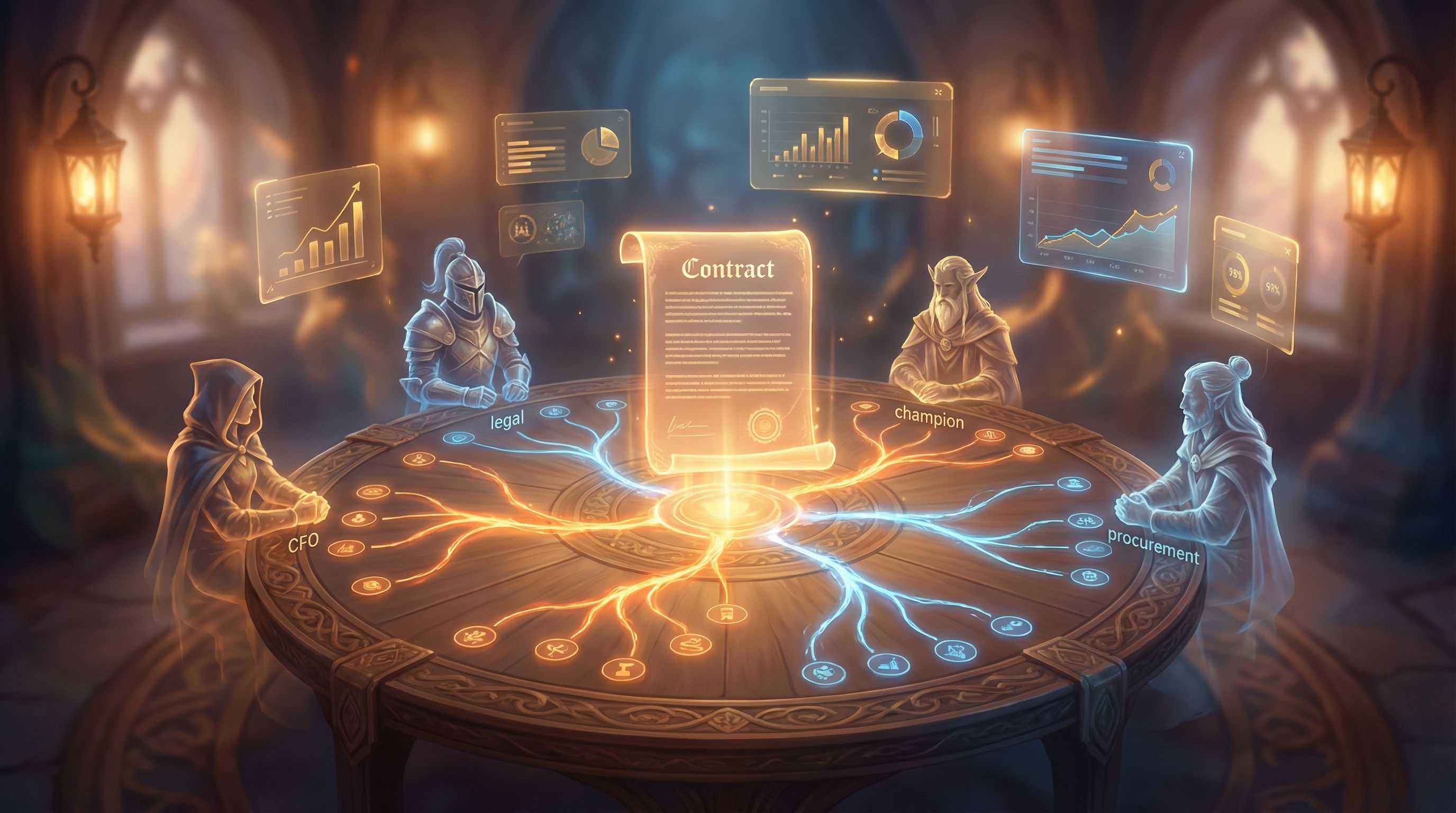
If you’re used to designing game‑like experiences, you’ll recognize this structure from encounter design; the same thinking is explored in depth in AI as Dungeon Builder: Designing Replayable Dungeons, Raids, and Heists in Questas.
Making Closing Moves Trainable, Not Mystical
Closing often gets mythologized as a mysterious talent. In reality, it’s a sequence of small, observable behaviors:
- Checking for alignment along the way
- Surfacing hidden objections early
- Making a clear, confident ask
- Handling last‑minute anxiety without pressure
Branching simulations help you break those behaviors into trainable moments.
Patterns to encode in your closing stories
When building closing scenarios in Questas, focus on:
- Temperature checks – Give the rep chances to ask, “How are you feeling about this so far?” and show different paths depending on the answer.
- Soft vs. hard closes – Let them experiment with gentle next‑step asks vs. direct commitment requests.
- Silent stakeholders – Model situations where someone off‑screen (a VP, legal, finance) vetoes late in the game if the rep doesn’t proactively engage them.
- Post‑close setup – Include scenes where the rep either sets strong expectations for implementation… or doesn’t, leading to churn risk later.
The endings shouldn’t just say “You closed the deal!” or “You lost.” They should reveal quality of the close:
- Healthy, referenceable customer
- Fragile deal with hidden landmines
- Delayed but stronger multi‑year agreement
Operationalizing Questas Simulations in Your Sales Org
A brilliant simulation no one plays doesn’t help anyone. You’ll get the most value from Questas when you treat branching stories as part of your sales operating system, not a one‑off experiment.
Build a repeatable creation rhythm
Borrow from the idea of a “story sprint” described in The One‑Evening Story Sprint: Shipping a Complete Questas Prototype from Blank Page to Playtest:
- Pick one real deal moment (1 hour)
- Map the core branches on a whiteboard or Miro (30–45 minutes)
- Build the first version in Questas (60–90 minutes)
- Playtest with 2–3 reps and a manager (30 minutes)
- Ship v1 to the team and iterate based on feedback
You’re not trying to build the perfect simulation on day one; you’re trying to build a living library of scenarios that evolve with your market.
Integrate into existing cadences
Make Questas simulations part of:
- Onboarding – New hires must complete specific objection and negotiation stories before taking live calls.
- Weekly enablement – Start pipeline review with 15 minutes of scenario play tied to common current objections.
- Quarterly kickoffs – Launch new stories that reflect updated pricing, packaging, or competitive dynamics.
Measure impact like you would any enablement program
Track both engagement and performance:
- Completion rates and replays per rep
- Branches chosen most often (and where people get stuck)
- Correlation with:
- Win rates by segment
- Average discount granted
- Sales cycle length
- Ramp time for new reps
When you see that reps who’ve completed certain Questas stories consistently hold margin better or navigate procurement faster, you’ll know where to double down.
Summary: Why Branching Narratives Belong in Your Sales Playbook
To recap, turning your objection handling, negotiation, and closing training into branching stories helps you:
- Give reps realistic, repeatable practice on the exact scenarios they face in the field.
- Mirror the real structure of sales conversations as chains of decisions, not linear scripts.
- Encode your best reps’ judgment into playable simulations everyone can learn from.
- Make negotiation strategy tangible by modeling trade‑offs, stakeholders, and long‑term consequences.
- Demystify closing into trainable micro‑skills and observable behaviors.
- Operationalize learning through reusable, evolving stories that plug into onboarding and ongoing enablement.
With a visual, no‑code platform like Questas, you don’t need engineering resources or a game design background to do this. You’re already sitting on the raw material: real deals, real objections, real negotiations. Branching narratives simply turn that experience into a shared, playable asset.
Your Next Step
If you’re curious but busy (and what sales leader isn’t), here’s a concrete starting point you can tackle this week:
- Pick one real deal from the last quarter where:
- An objection almost derailed things, or
- A negotiation got messy, or
- A close took longer than it should have.
- Write down the 3–4 key decision points in that conversation.
- Open Questas and:
- Create a new story
- Turn each decision point into a node
- Add 2–3 plausible options per node
- Sketch buyer reactions and outcomes
- Share the prototype with two reps and ask them to:
- Play through once “as themselves”
- Replay once trying a different path
- Tell you where it felt real vs. off
By the end of that experiment, you’ll have:
- A working, branching simulation based on a real deal
- Immediate feedback from your team
- A template you can reuse for future objections, negotiations, and closing moves
From there, it’s just iteration. One story becomes three. Three become a library. And your team moves from reading about high‑stakes conversations to rehearsing them—until the right moves feel natural when it counts.