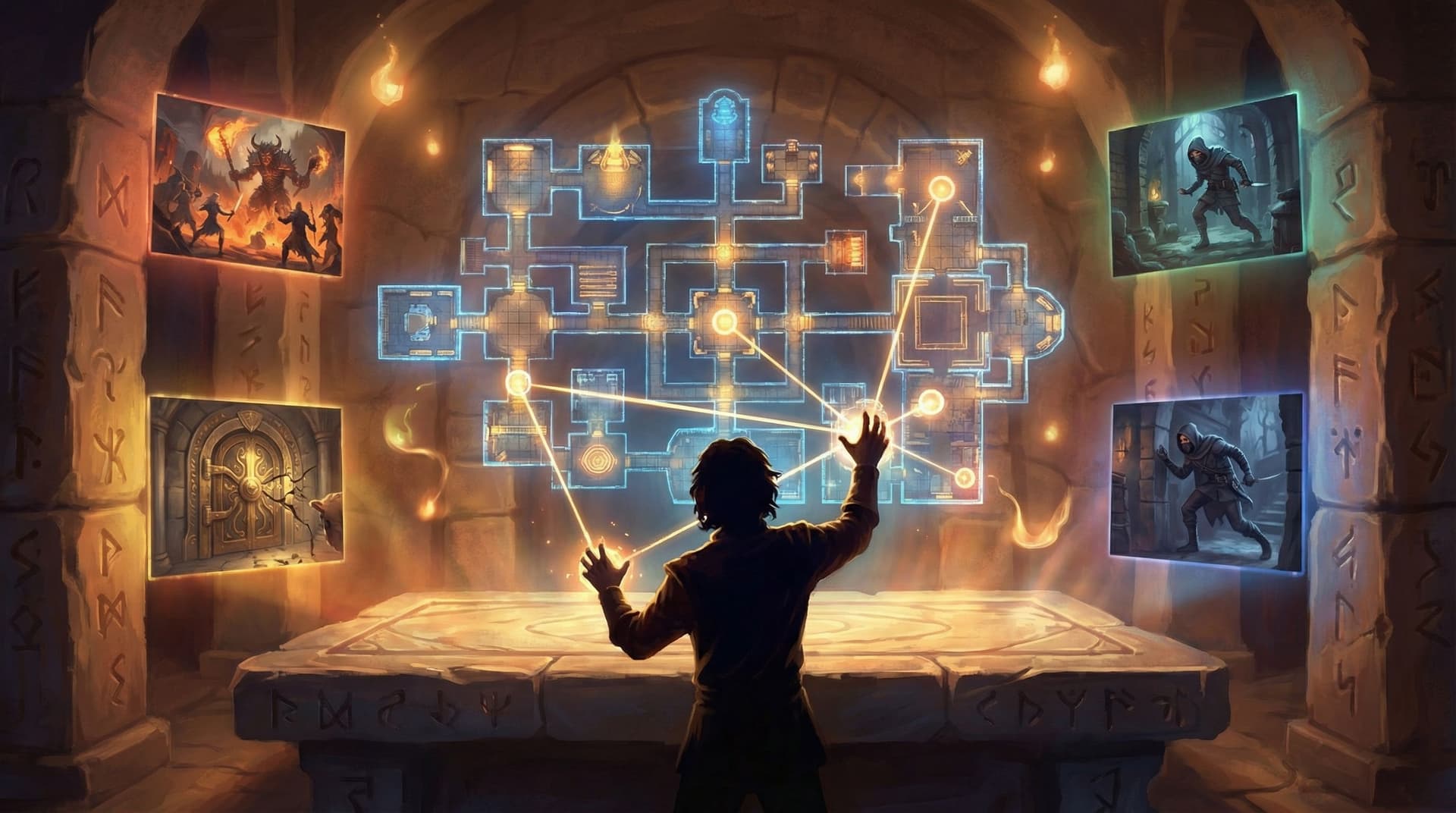
From Workshop to World: Using Questas for Live Writing Classes, Retreats, and Cohorts


Live writing experiences are having a moment.
From Zoom-based generative workshops to week-long retreats in the mountains, writers are looking for spaces where they can:
- Draft in community
- Get immediate feedback
- Experiment with new forms
- Leave with something finished, not just a notebook full of prompts
Interactive storytelling adds a new layer to that mix. When your students or participants can see their choices ripple through a branching story, the craft lessons land deeper. And when they can build those experiences visually—without code—you unlock a whole new format for classes, retreats, and cohort-based courses.
That’s where Questas shines: a web-based platform for building interactive, choose‑your‑own‑adventure stories with AI‑generated images and video, all through a visual editor that’s friendly enough for first‑time creators and powerful enough for advanced story architects.
This post is a practical guide to taking Questas into the room—whether that “room” is a weekend retreat, a six‑week cohort, or a one‑off live workshop.
We’ll look at:
- Why interactive stories are such a good fit for live learning
- How to structure sessions around building a shared Questas project
- Ways to adapt the same toolkit for retreats, cohorts, and recurring workshops
- Concrete facilitation patterns you can swipe for your own teaching
Why Interactive Storytelling Belongs in Live Writing Spaces
Live formats—classes, retreats, cohorts—already deliver benefits that self‑paced courses struggle to match:
- Community and accountability. Cohort‑based learning research consistently finds higher engagement and stronger group cohesion when learners move through material together rather than solo.(teachfloor.com)
- Immediate feedback. Writers get real‑time reactions to their choices, not just line edits weeks later.
- Shared momentum. Deadlines and group expectations push people to actually finish work.
Interactive storytelling amplifies those strengths:
-
Choices become visible craft decisions.
When a student adds a branch in Questas, they’re making a concrete decision about tension, pacing, or character motivation. You can literally point to a node and say, “Here’s where the protagonist could walk away instead—what does that do to your theme?” -
Collaboration is built‑in, not bolted on.
Collaborative story formats like “addventures” (online collaborative gamebooks where multiple authors contribute branches) have been around for decades.(en.wikipedia.org) With a visual node map, it becomes natural for different students to “own” different branches while still contributing to one shared world. -
Live sessions feel like playtesting, not just critique.
Instead of reading a piece aloud and asking for comments, you can play through a draft together, exploring different paths and annotating the map as you go. -
Retreats and cohorts can ship something public.
Many writing retreats now emphasize leaving with a finished piece or clear system.(awritingroom.com) With Questas, that “finished piece” can be a playable story you can send to friends, agents, or students.
If you’ve been intrigued by ideas like cohort‑based learning or interactive fiction tools such as Twine(en.wikipedia.org) but want something more visual and media‑rich for live teaching, building your next workshop around Questas is a compelling next step.
Designing a Live Session Around a Shared Questas Story
Let’s start small: a single 2–3 hour live workshop where participants co‑create a branching story.
A simple structure:
1. Frame the Session Around a “Playable Question”
Instead of starting with “We’re going to learn branching narratives,” start with a question participants will answer through story, such as:
- What does your protagonist do when their plan falls apart?
- How does power shift when a secret comes out?
- What happens when a character finally says the thing they’ve been avoiding?
This aligns nicely with the “scenario‑first” approach we explored in Scenario‑First Story Design: Building Training Questas That Start with Real‑World Decisions, where everything grows from one meaningful decision.
2. Introduce the Core Questas Canvas (15–20 minutes)
Give a quick tour of Questas, but keep it focused on what matters for this session:
- Nodes = scenes or beats
- Choices = links between nodes
- Media = AI‑generated images or videos that set mood and context
Have a starter project open so you can:
- Add a node live while sharing your screen
- Show how to add 2–3 choices
- Generate a quick image to demonstrate visual storytelling
Emphasize: they don’t need to be tech experts; if they can drag arrows between boxes, they can build.
3. Co‑Design the Spine Together (20–30 minutes)
On a shared screen, create a minimal “spine” for the group story:
- Opening scene (Node 1)
- First major choice (Node 2A vs 2B)
- Two follow‑up scenes (Node 3A, 3B)
Facilitation tips:
- Invite the group to pitch opening situations; vote quickly.
- Ask: “What’s the first real decision this character faces?”
- As you add branches, narrate the craft: “If we split here, we’re promising two different emotional journeys. Are we ready to pay off both?”
This is a great place to reference ideas from From Short Story to Story System: Adapting Linear Fiction into Modular Scenes for Questas, especially around turning beats into modular nodes.
4. Breakout Branch Building (40–60 minutes)
Now, let participants own branches:
- Assign each person (or pair) a node to extend.
- Their task: add 1–2 new scenes and at least one meaningful choice.
- Optional: have them generate at least one AI image for their section.
Provide a simple checklist:
- Goal: What does the character want in this mini‑arc?
- Obstacle: What stands in the way?
- Choice: Where must they commit?
- Consequence: What changes because of that choice?
Circulate (online or in person) to troubleshoot both craft and tooling questions.
5. Group Playthrough and Debrief (30–40 minutes)
Reconvene and play the story:
- Ask for a volunteer to “drive” the choices.
- As you hit each branch, briefly spotlight the author(s).
- Pause after key scenes to ask:
- What emotion did this choice create?
- What expectations do you have now?
- Where could we foreshadow this outcome earlier?
End with a quick reflection round:
- What did you notice about your own decision points?
- Where did the map feel crowded vs. sparse?
- What’s one branch you wish we had time to add?
This single‑session format can stand alone, or become Session 1 of a deeper cohort.
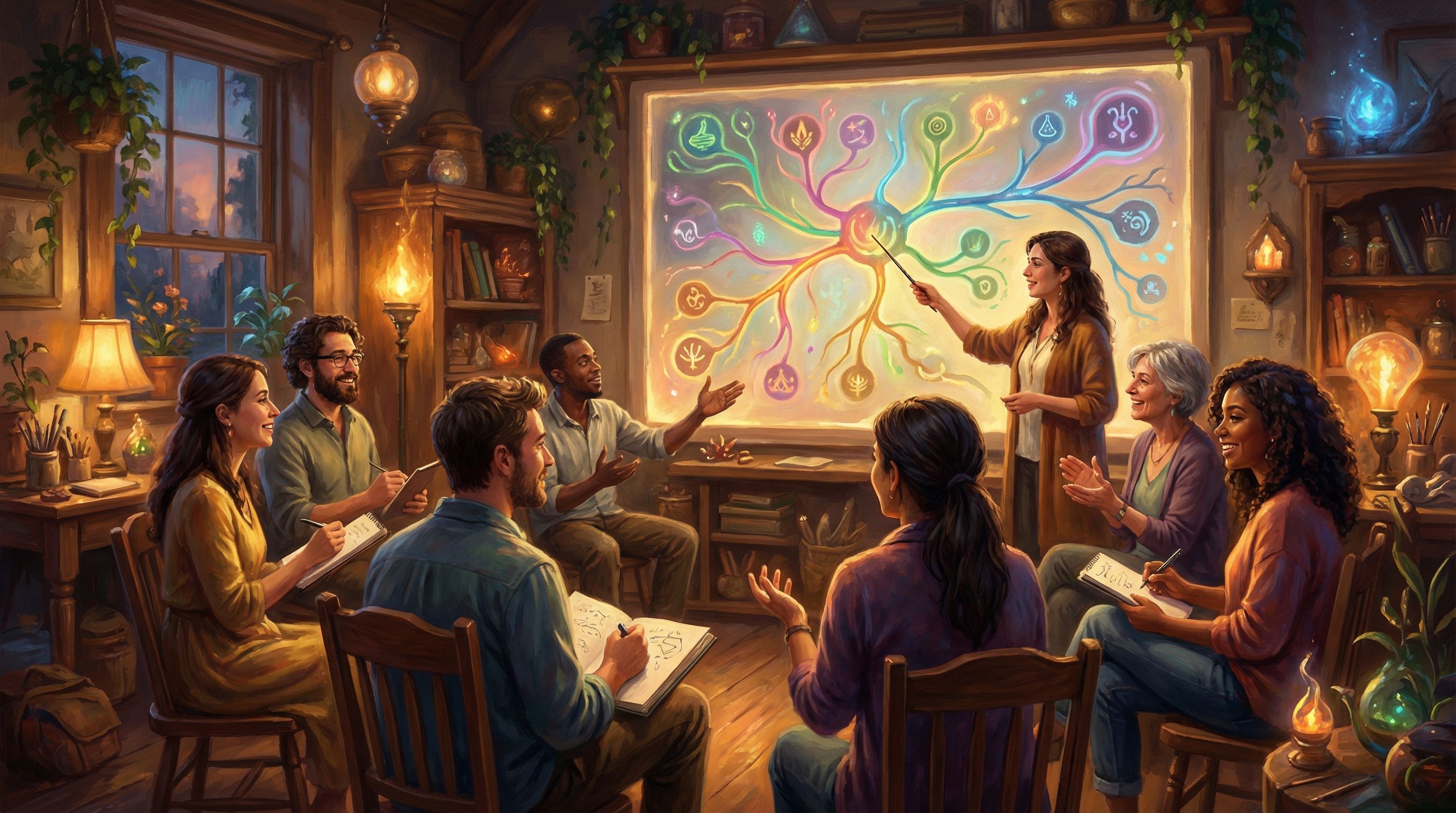
Scaling Up: Using Questas in Multi‑Week Cohorts
Cohort‑based courses are particularly effective for skills like writing that benefit from feedback, structured practice, and peer accountability.(buddyboss.com) When you layer in an interactive story project, you give the cohort a shared artifact they’re building together.
Here’s a sample 4–6 week arc for a cohort anchored in Questas.
Week 1: World and Premise
- Introduce core Questas concepts and the group project.
- Co‑create a story bible lite: setting, tone, core conflict, protagonist.
- Map 3–5 “anchor nodes” everyone must respect (e.g., opening, midpoint twist, final confrontation).
- Homework: each student drafts one possible inciting incident branch.
Week 2: Choices and Consequences
- Workshop inciting incident branches; merge the strongest into the shared project.
- Teach a mini‑lesson on designing fair but meaningful choices (you can draw from concepts in Writing Moral Gray Areas: Designing Ambiguous Choices That Still Feel Fair in Questas). Link students to Writing Moral Gray Areas: Designing Ambiguous Choices That Still Feel Fair in Questas.
- In Questas, have each student add:
- One choice node
- Two consequence scenes (one for each option)
Week 3: Visual Storytelling and Tone
- Introduce “writing with the camera in mind”: framing, focal characters, color and light to signal mood.
- Have students generate or refine AI images for their scenes.
- Point them to Writing with the Camera in Mind: Cinematic Techniques for Framing AI Images in Your Questas Scenes for deeper study.
- Group activity: do a “visual continuity walk” through the map and flag jarring shifts in style or tone.
Week 4: Revisions and Replayability
- Playtest multiple paths as a cohort.
- Identify:
- Dead ends that feel unsatisfying
- Over‑explained branches
- Under‑supported twists
- Have students revise at least one branch for replay value—e.g., adding a hidden condition, a secret route, or a call‑back to an earlier choice.
- Optional extension weeks:
- Week 5: Character arcs and “living NPCs” (drawing on ideas from Designing ‘Living NPCs’: How to Give Side Characters Memory, Motives, and Agency in Questas).
- Week 6: Publishing, sharing, and analytics.
Cohort Logistics That Work Well with Questas
-
Shared project + personal mini‑quests.
Maintain one central “class story” plus individual side projects students can experiment on. -
Weekly “map reviews” instead of only manuscript critiques.
Looking at the graph view together helps students see structure problems that are hard to spot in linear text. -
Rotating roles.
Each week, assign roles like:- Continuity Keeper – checks for plot/visual consistency
- Choice Auditor – ensures every branch feels meaningful
- Pace Tester – flags sections that drag or rush
These patterns help students internalize system‑level thinking about story, not just sentence‑level polish.
Retreats: Turning Time and Place into a Story Engine
Retreats—whether online or in person—offer what most writers crave: protected time, focused environment, and a sense of shared journey. Many retreats now lean on structured prompts, craft talks, and quiet writing blocks.(barrakalzaid.com)
Questas gives you a way to turn the retreat itself into a branching narrative.
Model 1: The Retreat as a Meta‑Story
Design a Questas project where the protagonist is effectively “a writer at this retreat.” Branches mirror questions your participants are actually facing:
- Do they share a vulnerable piece in group critique or keep it private?
- Do they abandon a stuck project to chase a new idea?
- Do they say yes to a collaboration or protect solo time?
Use this story as a recurring ritual:
- Opening night: Play through the first act together; discuss the choices as metaphors for how they want to show up.
- Mid‑retreat: Unlock new branches based on themes that have emerged.
- Closing session: Invite participants to add one final node reflecting the choice they’re taking home.
This turns the retreat into a living case study in decision‑making and creative courage.
Model 2: Micro‑Sprints Inside a Longer Stay
Borrow from the structure in The One‑Evening Story Sprint: Shipping a Complete Questas Prototype from Blank Page to Playtest and run daily or half‑day sprints:
- Morning: Introduce a specific craft focus (e.g., “branching around real events,” “designing a moral dilemma”).
- Midday: Quiet time where each participant builds a small Questas vignette.
- Afternoon: Group playtest and discussion.
By the end of a 3–5 day retreat, each writer could leave with:
- A portfolio of small interactive pieces
- One larger prototype ready to expand
- A clearer sense of how their voice translates into interactive form
Model 3: Themed Retreats (Nonfiction, Therapy, Brand, etc.)
Because Questas works well for nonfiction and applied storytelling, you can theme retreats around:
- Memoir and personal essays – Branching “what if” versions of pivotal life events (see also AI Storyboarding for Nonfiction: Mapping Real Events into Branching Questas Timelines).
- Coaching and therapy – Safe rehearsal spaces for hard conversations, similar to the approaches in Branching Narratives for Therapists and Coaches: Using Questas to Rehearse Tough Conversations Safely.
- Professional storytelling – Brand journalism, onboarding journeys, or policy rollouts, building on posts like Interactive Brand Journalism or Beyond PDFs and Portals.
Each theme gives participants a clear reason to experiment with branching structures while staying grounded in their own work.
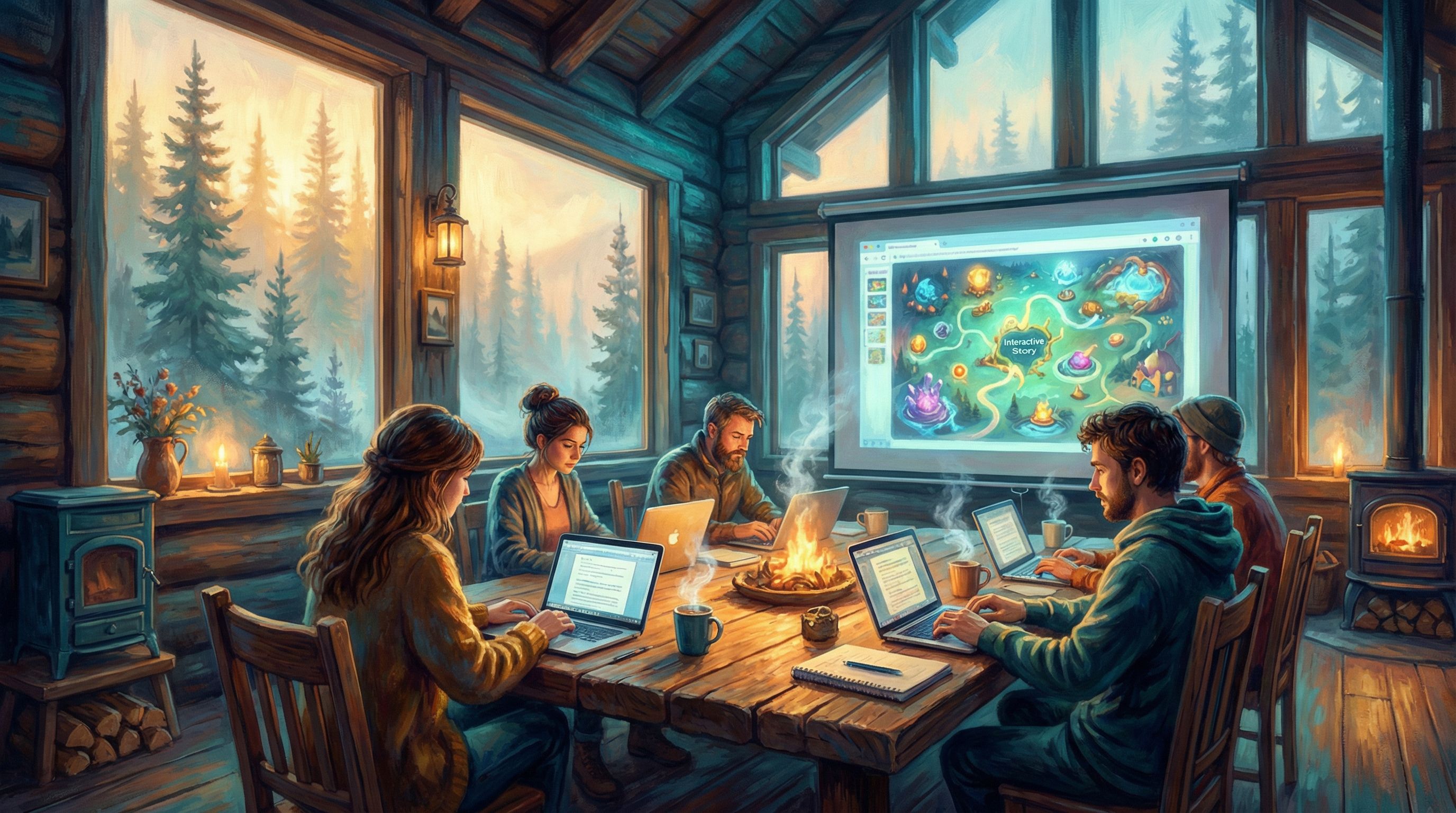
Practical Tips for Facilitators
You don’t need to be a game designer to bring Questas into your teaching. But a few facilitation habits will make the experience smoother for everyone.
Start with Constraints, Not Infinite Possibility
Blank maps can be overwhelming. Give participants:
- A fixed node budget (e.g., “You have 5 scenes and 3 choices to work with”).
- A simple branching pattern to follow, like:
- Linear intro → 2 branches → 2 endings
- Hub‑and‑spoke (one central location, many short visits)
You can always add complexity later.
Normalize “Ugly First Maps”
Just like first drafts, first node graphs are messy. Say this explicitly:
- The goal of Session 1 is not to make a masterpiece.
- The goal is to see your story as a system for the first time.
Show a deliberately rough example map and a cleaned‑up version to demystify the process.
Make Choices About Choices
Teach students to ask of every branch:
- Does this choice reveal character?
- Does it change the situation in a meaningful way?
- Does it unlock a different theme or perspective?
If the answer is “no” to all three, it might be better as a beat inside a scene, not a full branch.
Use Visuals as Teaching Moments
Because Questas includes AI‑generated images and video, you can:
- Talk about visual stereotypes and tropes (and how to avoid them), drawing on ideas similar to those in AI Visual Etiquette: Avoiding Tropes, Stereotypes, and Overload in Image‑Heavy Questas Stories.
- Show how color, angle, and composition can foreshadow mood before a single line is read.
Encourage students to iterate on prompts and keep a shared “style library” for recurring characters or locations.
Build Reflection into the Playtest
When you play through cohort or retreat stories, pause and ask:
- “Where did you feel most in the story?”
- “Which choice felt unfair or confusing?”
- “What branch would you replay if you had more time?”
These questions help students connect their structural decisions to actual reader experience.
Bringing It All Together
Using Questas in live writing classes, retreats, and cohorts isn’t about turning everyone into game designers. It’s about giving writers a visible, playable canvas for the decisions they’re already making:
- Where to start and end a scene
- When to force a character’s hand
- How to balance surprise with fairness
- How to keep a world coherent as it grows
Live formats add the missing ingredients that interactive tools alone can’t provide: community, accountability, and the energy of co‑creation. When you combine them, you get workshops where:
- Craft lessons are grounded in concrete choices on a map
- Retreats become story engines, not just quiet rooms
- Cohorts leave with finished, shareable, replayable work
Whether you’re running a one‑evening experiment or designing a flagship program, Questas gives you the scaffolding to move your teaching from workshop to world—from isolated drafts to living, branching experiences your students and participants can keep exploring long after the session ends.
Next Step: Turn Your Next Session into a Playable Story
If this sparked ideas, don’t wait for the “perfect” curriculum. Pick one upcoming live session—a single class, a weekend mini‑retreat, or the first week of a new cohort—and:
- Choose a single meaningful decision you want participants to explore.
- Sketch a 5–7 node map that branches around that decision.
- Open Questas, build a tiny prototype, and plan to playtest it live.
You’ll learn more from that one experiment than from weeks of theorizing.
Your students are already making choices on the page. It’s time to let them see—and play through—what those choices can do.