AI as Dungeon Builder: Designing Replayable Dungeons, Raids, and Heists in Questas

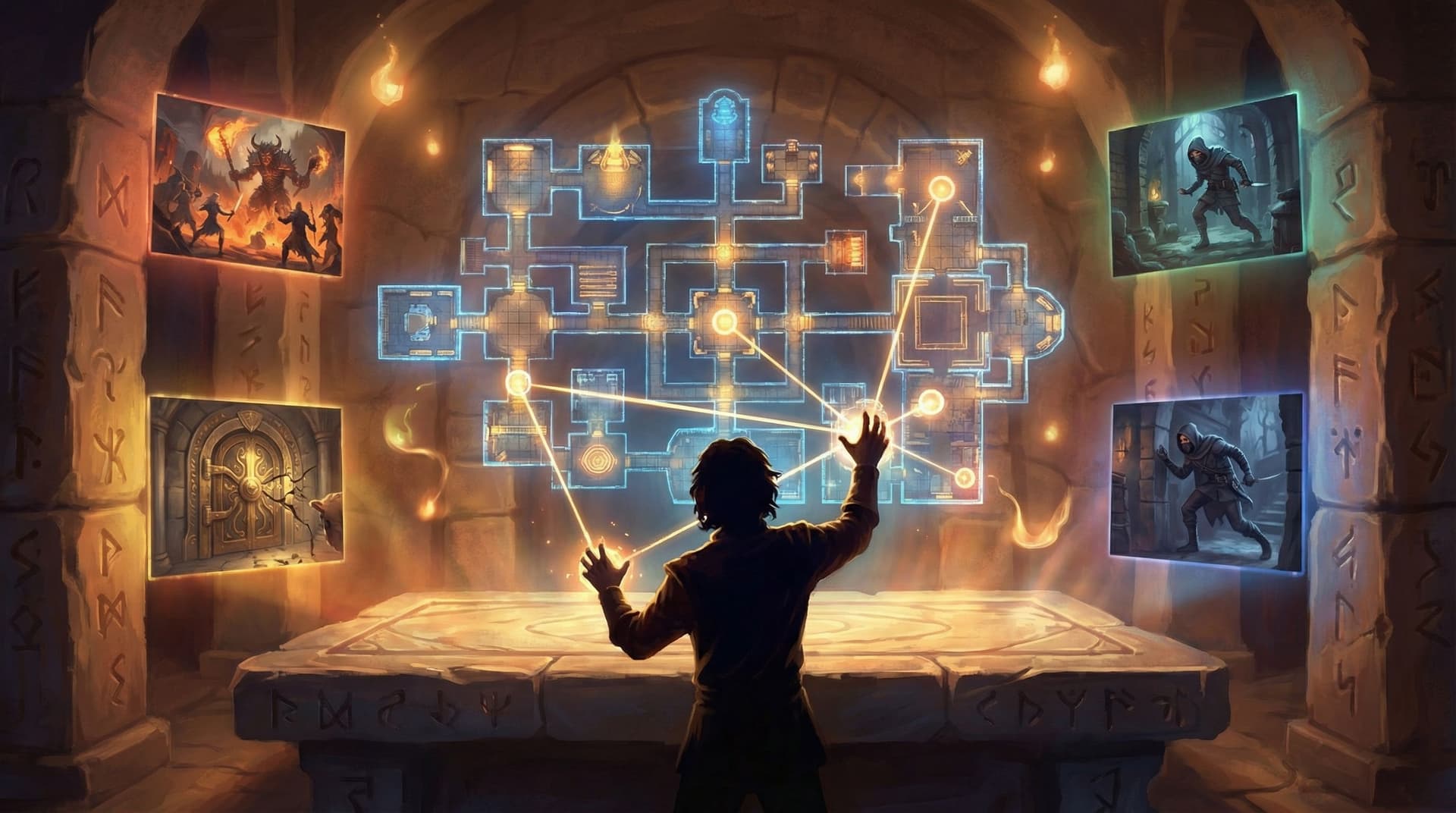
If you’ve ever sketched a dungeon on graph paper, improvised a heist in a tabletop session, or wiped for the tenth time on a raid boss, you already know the magic of a well‑designed encounter:
- The anticipation as players step into the unknown
- The tension of limited information and risky choices
- The relief or devastation when a plan finally either works… or spectacularly fails
Now imagine bottling that energy into interactive stories anyone can play in a browser—and that you can build visually, without code.
That’s where Questas shines as an “AI dungeon builder”: a place where you can design branching dungeons, raids, and heists powered by AI‑generated images and videos, then tune them for replayability.
This post is a practical guide to doing exactly that: turning your ideas into tightly constructed, endlessly re‑playable adventures.
Why Replayable Dungeons Matter (Far Beyond Fantasy)
Replayability isn’t just a “gamer” concern. It’s the difference between a one‑and‑done curiosity and a living experience people share, revisit, and compete over.
Designing for replay in Questas pays off in several ways:
1. More playtime from the same content
A single dungeon can support:
- Multiple difficulty modes
- Alternate routes and endings
- Role‑based perspectives (tank, healer, infiltrator, negotiator)
You’re not just publishing a story; you’re publishing a system people can explore.
2. Emergent storytelling
When your dungeon is built as a branching network of scenes, players start telling their own stories:
- “We snuck past the guards and stole the relic without triggering the alarm.”
- “We sacrificed the loot to save the NPC—turns out that unlocks a secret raid path.”
If you’re building a series, that emergent energy plugs directly into how you maintain continuity and canon across episodes. For a deeper dive on that, see From Static IP to Living Canon: Keeping Fan Theories and Player Choices in Sync Across a Questas Series.
3. Built‑in replay loops for learning and training
Dungeons and heists are also perfect metaphors for:
- Security drills
- Incident response run‑throughs
- Compliance or safety scenarios
A replayable structure lets learners try different approaches, fail safely, and see consequences. That’s the same philosophy behind scenario‑based training covered in Scenario‑First Story Design: Building Training Questas That Start with Real‑World Decisions.
4. Easier iteration with AI support
Because Questas uses AI for both text and visuals, you can:
- Rapidly prototype alternate rooms, traps, and NPC reactions
- Generate variant art for different runs (e.g., “corrupted” vs. “pristine” versions of the same temple)
- Adjust tone and difficulty without rewriting everything from scratch
Start with the Run, Not the Lore
It’s tempting to begin with a lore bible: ancient orders, forgotten kings, factions with 500‑year feuds. All of that can be fun—but for a replayable dungeon, start with the run.
Ask three questions:
-
What is the core objective?
Examples:- Steal the artifact from the vault.
- Defeat the raid boss and cleanse the corrupted grove.
- Extract a double agent from a fortress without killing anyone.
-
What are 2–3 viable playstyles?
Think in verbs:- Stealth, social engineering, brute force
- Puzzle‑solving, resource management, speedrunning
- Negotiation, sabotage, infiltration
-
What makes a second run meaningfully different?
Some options:- New information (you now know where traps are)
- Unlocked shortcuts or alternative entrances
- Changing enemy behaviors based on previous attempts
In Questas, translate those answers into a simple backbone:
- Entrance node: where expectations are set
- Three mid‑nodes: each centered on a key decision (route, ally, or tactic)
- Climax node: success/failure with variations
- After‑action node: debrief, rewards, and hints about what you didn’t see
You can always expand later. The crucial part is that each run feels like a coherent attempt on the same space, not a random assortment of scenes.
Turning Dungeons into Node Networks
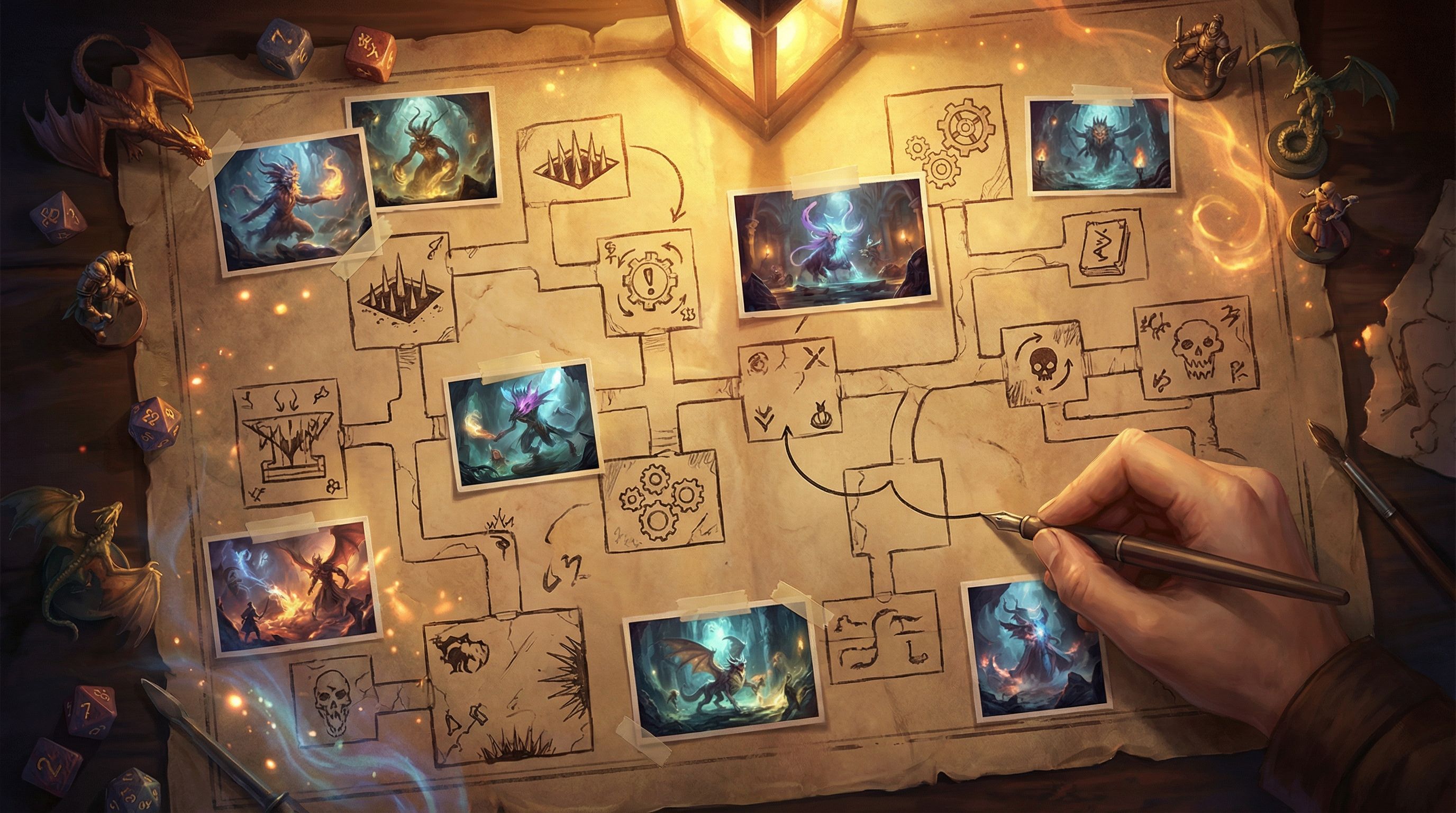
Once you have the run concept, you’re ready to turn it into a branching structure in Questas.
1. Map Your “Rooms” as Scenes
Think of each scene as a room or phase, even if your setting isn’t a literal dungeon.
Examples:
- Dungeon: Entry hall → Guard barracks → Puzzle chamber → Boss arena
- Raid: Trash waves → Mini‑boss → Environmental hazard → Final boss
- Heist: Scouting → Infiltration → Vault → Escape route
In the visual editor, create a node for each room/phase. Give each a clear label like:
R1 – Sewer EntranceR2 – Guard Rotation Control RoomR3 – Vault Antechamber (Puzzle)
This naming discipline pays off when your map grows.
2. Design Decisions, Not Just Directions
Instead of “Left corridor” vs. “Right corridor,” focus on meaningful decisions:
- Risk vs. reward: “Short route with heavy guards” vs. “Longer, safer route with time pressure.”
- Ethical tradeoffs: “Free the prisoners (risk alert)” vs. “Ignore them (keep stealth bonus).”
- Information vs. resources: “Use a rare consumable to scan for traps” vs. “Save it for the boss and proceed blind.”
In Questas, each choice can:
- Lead to a different node
- Set variables (e.g.,
alarm_level,party_trust,time_remaining) - Unlock or lock future options
3. Use Variables as Your Hidden Architecture
Variables are where your dungeon becomes a system instead of a tree of one‑off branches.
Useful variables for dungeons, raids, and heists:
alarm_level(0–3): affects enemy density and dialoguetime_remaining: gates certain paths or endingsparty_trust: changes whether NPC allies help or betray youinjury_levelorresources_left: influences difficulty of later checks
Design a few global rules like:
- If
alarm_level >= 2, spawn an elite patrol in the next combat scene. - If
party_trust <= 1, the rogue refuses to pick the vault lock. - If
time_remaining <= 0, you must use the emergency extraction route.
Because Questas supports conditional logic, you can surface or hide choices based on these variables, which makes repeat runs feel reactive.
Using AI as Your Dungeon Architect
The built‑in AI tools in Questas aren’t just there to decorate your scenes. Used intentionally, they can help you design better dungeons.
1. Brainstorm Room Concepts and Hazards
Start by prompting AI to propose:
- Variants of the same room at different difficulty tiers
- Environmental twists (flooding, darkness, shifting gravity)
- Non‑combat challenges (social puzzles, moral dilemmas, resource scarcity)
Example prompt to a text model:
“Give me 6 room concepts for a replayable arcane vault heist, each with a unique twist that changes how players might approach it on a second run.”
You can then:
- Pick the best ideas
- Merge or simplify them
- Turn each into a node in your Questas map
2. Generate Visual Variants that Signal State
AI images and video are perfect for signaling state changes between runs:
- Vault hallway before and after the alarm triggers
- Boss arena in “phase 2” with corrupted terrain
- Safehouse when your crew trusts you vs. when they’re suspicious
Use consistent prompts (or styles) plus small modifiers:
"ancient stone corridor, torches, no guards, calm""ancient stone corridor, red alarm lights, sprinting guards, chaos"
If you’re building a series of related dungeons, pair this with techniques from AI Style Chains: Keeping Characters, Locations, and Props Consistent Across a Questas Series so your world feels coherent even as states change.
3. Let AI Propose Failure States and Edge Cases
Ask AI explicitly:
- “How could this plan go wrong?”
- “What’s an unexpected but fair consequence if players ignore the wounded NPC?”
Then turn the best suggestions into:
- Secret branches
- Rare fail‑forward outcomes
- Hidden achievements or unlocks for players who “fail interestingly”
Building Raids: Phases, Roles, and Coordination
Raids are dungeons turned up to 11: more players, more coordination, more moving parts. Even if your Questas story is single‑player, you can simulate raid dynamics.
1. Structure the Encounter in Phases
Design 2–4 distinct phases, each with:
- A mechanic (what the boss or environment is doing)
- A check (what the player must notice or manage)
- A twist on replay
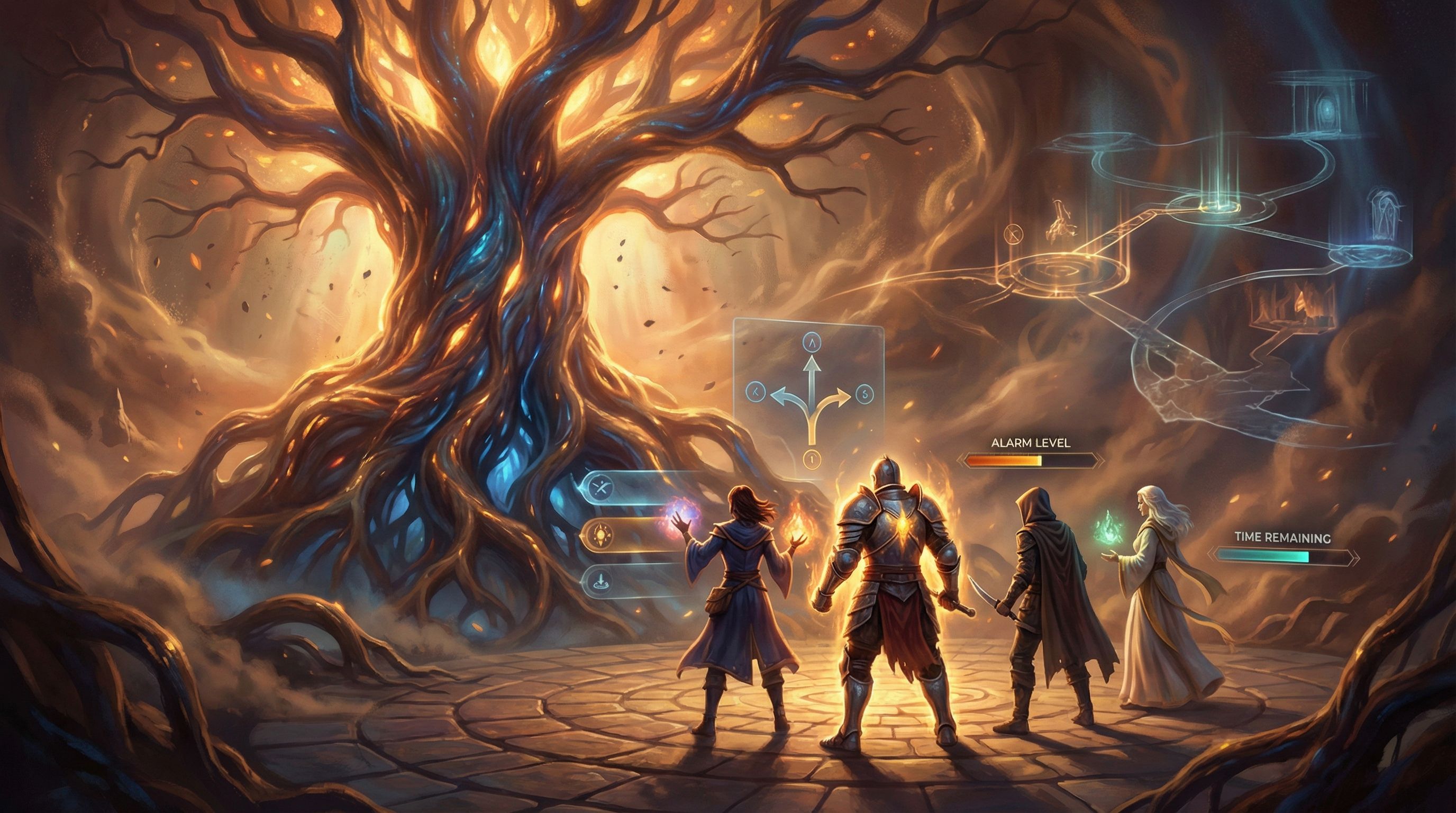
Example (Corrupted World‑Tree Raid):
-
Phase 1 – Roots Awaken
- Mechanics: Periodic root slams, poison pools.
- Check: Positioning and resource use.
- Replay twist: On later runs, players can pre‑purge some roots if they completed a side path.
-
Phase 2 – Heart Exposed
- Mechanics: Vulnerable heart, adds spawning.
- Check: Target priority and timing.
- Replay twist: If
party_trustis low, an NPC abandons their role, forcing a harder version.
-
Phase 3 – Last Stand
- Mechanics: Enrage timer, collapsing platforms.
- Check: Risky burst vs. safe play.
- Replay twist: If you saved a specific relic, you unlock a unique defensive ability.
2. Simulate Party Roles through Choice Design
Even in a solo experience, you can let players choose a role at the start:
- Defender / tank
- Striker / DPS
- Support / healer or controller
Then:
- Tailor choices and skill checks to that role
- Gate certain options by role (e.g., only supports can stabilize a collapsing platform)
- Offer different narrative payoffs per role
In Questas, this is just a matter of setting a role variable early and using it to condition later branches.
3. Make Wipes Interesting
A classic raid problem: failed runs feel like wasted time. In interactive narrative form, you can make wipes part of the story.
Consider:
- Memory fragments unlocked only on failure, hinting at alternate strategies
- Persistent scars (variables) that slightly alter future attempts
- Meta‑progression: new starting options (“Skip trash,” “Begin with a blessing,” etc.) after enough runs
This turns “Game Over” into “New Data Unlocked.”
Designing Heists: Information, Timing, and Double‑Crosses
Heists live and die on information asymmetry and timing. Questas lets you make both deeply replayable.
1. Separate Planning, Execution, and Fallout
Break your heist into three acts:
-
Planning
- Gather intel, scout routes, recruit specialists.
- Choices here set variables like
intel_quality,crew_loyalty,exit_route.
-
Execution
- Navigate guards, bypass locks, improvise when things go wrong.
- The game reveals which assumptions were right or wrong.
-
Fallout
- Debrief, divide loot, handle betrayals.
- Future runs can start from a new status quo based on how this act ends.
2. Use Partial Information on Early Runs
On a first playthrough, keep some systems opaque:
- Guard patterns are approximate, not exact.
- There’s a rumored “inside person,” but you don’t know who.
- Blueprints are outdated in one key area.
On later runs, let players:
- Start with better intel if they extracted it before
- Exploit knowledge of hidden passages or blind spots
- Anticipate double‑crosses they fell for the first time
3. Make Betrayal a System, Not a Twist
Instead of a fixed betrayal, tie it to variables:
- If
crew_loyalty < 2andloot_valueis high, the safecracker might bail with the prize. - If you sacrificed your cut to save an NPC earlier, they’ll cover for you during the escape.
Because Questas lets you branch on these conditions, you can design:
- Runs where everything goes according to plan (rare, satisfying)
- Runs where it unravels in different ways
- Secret “perfect heist” endings that require knowledge from prior failures
Keeping Your Dungeon World Alive Between Runs
Replayability doesn’t just live inside a single map. It also lives in how your world evolves over multiple stories.
Some ideas:
- Persistent factions: If players sided with the Shadow Guild in one heist, that affects who shows up as allies or enemies in the next dungeon.
- Evolving hub locations: A safehouse that visually upgrades as players succeed.
- Living canon: Summaries of notable player choices at the start of each new episode.
If you’re planning a whole campaign of dungeons, raids, and heists, you’ll want a continuity strategy. That’s exactly what From Lore Bible to Living Wiki: Using Questas to Maintain Continuity Across Expanding Story Universes is about—worth bookmarking as your world grows.
Practical Build Checklist for Your First Replayable Dungeon
To bring this all together, here’s a concrete checklist you can follow inside Questas:
-
Define the core run
- One clear objective
- 2–3 viable playstyles
- One big reason to replay (hidden path, alternate ending, or meta‑progression)
-
Sketch the node map
- Entrance, 3–5 key rooms/phases, climax, aftermath
- Label nodes clearly (R1, R2, etc.)
-
Add meaningful decisions
- At least one risk/reward choice per room
- At least one ethical or narrative choice across the whole run
-
Set up core variables
alarm_level,time_remaining,party_trust(or equivalents)- Decide 2–3 global rules that change scenes based on these
-
Generate visuals that signal state
- Baseline images for each room
- One variant image for a “changed” state (alarmed, corrupted, damaged)
-
Design at least one alternate entrance or shortcut
- Locked on first run, unlocked by a specific outcome
-
Make failure informative
- Debrief scenes that hint at missed opportunities
- Small persistent benefits for subsequent runs
-
Playtest with a small group
- Ask: “What made you want (or not want) to replay?”
- Adjust variables and branches rather than rewriting everything
Wrapping Up: AI as Your Co‑Architect, Not Your Overlord
AI can’t replace your taste for what makes a dungeon tense, a raid epic, or a heist clever. What it can do—especially inside Questas—is:
- Rapidly propose room ideas, hazards, and failure modes
- Generate visual states that make your world feel reactive
- Help you manage complexity as your node map grows
You’re still the architect. AI just handles a lot of the scaffolding.
If you want to go deeper on collaboration workflows—how to let AI help without losing your authorial voice—check out AI as Co‑Writer, Not Ghostwriter: Collaborative Writing Workflows for Complex Questas Plots next.
Summary
- Replayable dungeons, raids, and heists are about systems, not just scenes.
- Start from the run: objective, playstyles, and why a second attempt feels fresh.
- Use Questas nodes as rooms/phases, and variables as the hidden architecture that makes your world responsive.
- Let AI help you brainstorm rooms, hazards, failure states, and visual variants that signal state changes.
- For raids, think in phases, roles, and interesting wipes; for heists, focus on information, timing, and systemic betrayals.
- Treat failure as data, not dead ends, and let your world evolve over multiple runs and stories.
Your Next Step
You don’t need a full campaign bible or a 50‑room mega‑dungeon to begin. The best way to learn this style of design is to ship a small, replayable run.
- Open Questas.
- Create a new project called something like “Three‑Room Heist” or “First Raid Attempt.”
- Build just one objective, three rooms, and two distinct endings.
- Add a couple of variables (
alarm_level,crew_loyalty) and one alternate route that only unlocks on a second run.
Then share it with a friend, a class, or your community—and watch how differently they approach the same space.
Your dungeon doesn’t have to be perfect. It just has to be playable… and replayable. The rest, you’ll discover run by run.