Branching Narratives for Thought Leadership: Turning Your POV into Playable Questas Essays


Thought leadership has a format problem.
You pour weeks into a manifesto, a long-form article, or a “definitive guide.” People skim it on their phones between meetings, maybe highlight a quote, and move on. Your hard-won perspective becomes just another tab in a crowded browser.
Branching narratives give you a different option: instead of asking people to read your point of view, you invite them to play through it.
On a platform like Questas, you can turn an essay into a structured, visual, choose‑your‑own‑adventure that lets your audience test your ideas in context, make trade‑offs, and see consequences unfold. It’s still thought leadership—but now it’s experiential.
This post is about how to do that on purpose: how to design “playable essays” that carry your voice, sharpen your positioning, and stick in people’s memories.
Why Turn a POV Essay into a Branching Experience?
Before we get tactical, it’s worth being clear on why this format is so powerful for thought leadership.
1. Your ideas move from abstract to embodied
Most POV pieces live at the level of principles:
- “We believe in long-term thinking over short-term wins.”
- “AI should augment, not replace, human judgment.”
- “Customer-centricity means saying no more than you say yes.”
Those lines sound good—but they only become real when someone has to make a call under pressure.
Branching narratives let you drop readers into those pressure points:
- Do they ship an under‑baked feature to hit the quarter or delay to protect trust?
- Do they override an algorithmic recommendation when their gut disagrees?
- Do they prioritize one customer’s needs over another’s roadmap influence?
Instead of nodding along with your thesis, they feel the friction your worldview is built for.
2. You differentiate not just by what you say, but how you help people decide
Most thought leaders in a space share similar talking points. What sets you apart is how you:
- Frame trade‑offs
- Define “good” and “bad” outcomes
- Weigh competing values (speed vs. safety, growth vs. ethics, etc.)
When someone plays through your interactive essay in Questas, they don’t just hear your arguments—they experience your decision logic. That’s a much deeper brand signal than a clever tagline.
3. You unlock replayability and shareability
A static article is usually “one and done.” A branching essay invites:
- Replays: “What if I’d taken the risky path?”
- Debate: “My ending was brutal. What did you pick?”
- Team use: “Let’s run this in our next offsite as a decision‑making exercise.”
If you’re already thinking about replay value, you’ll find more techniques in Designing Replay Value on Purpose: Structuring Questas Stories So Players Actually Want a Second Run.
Step 1: Distill Your POV into a Core Dilemma
Playable essays work best when they revolve around a live tension in your domain—not a trivia quiz.
Ask yourself:
-
What’s the uncomfortable decision my audience actually faces?
Examples:- “Do we automate this process and risk edge‑case failures?”
- “Do we centralize data access or let teams move fast and break things?”
- “Do we prioritize profitability or market share this year?”
-
What belief of mine runs against the grain?
Maybe you believe:- Slower, more deliberate onboarding beats aggressive growth targets.
- The best AI tools deliberately limit what users can do.
- The right answer to compliance is more transparency, not more secrecy.
-
What would be a ‘headline decision moment’ that expresses that belief?
You’re looking for a scene like:- A board meeting
- A crisis escalation call
- A product launch go/no‑go
That scene becomes the spine of your Questas essay. Everything else (setup, branches, endings) exists to illuminate that moment.
Tip: If you’re stuck, skim your existing essays or talks and look for stories where someone “did the brave thing” or “paid the price.” Those anecdotes are often ready‑made anchor scenes.
Step 2: Choose the Right “Player Lens”
For thought leadership, who the player is matters as much as what they do.
Common lenses that work well:
- You, lightly fictionalized – A founder, principal, or strategist at a firm that looks suspiciously like yours. Great for “walk a mile in my shoes” essays.
- Your ideal reader – The PM, policy lead, or VP Ops you’re writing for. They get to test‑drive your recommendations in a safe sandbox.
- A skeptic – Someone who doesn’t buy your thesis. Let them try their way first, then feel the consequences.
In Questas, you can reinforce this lens visually:
- Use AI‑generated portraits or POV shots that match the player’s role.
- Show environments they recognize: war rooms, dashboards, customer chats, or even fictionalized cityscapes.
When the player sees themselves reflected in the visuals and copy, your “essay” stops feeling hypothetical.
Step 3: Map a Simple, Opinionated Branch Structure
You don’t need a sprawling story tree to make a powerful playable essay. In fact, for thought leadership, constraint is your friend.
A reliable pattern:
-
Onramp (1–2 scenes)
- Set context: stakes, time pressure, key characters.
- Surface the core dilemma early.
-
First fork: value choice (1 scene)
- Present 2–3 options that clearly express different values.
- Example: “Optimize for speed,” “Optimize for safety,” “Pause to gather more data.”
-
Consequences (2–4 scenes per path)
- Show immediate effects, then second‑order effects.
- Introduce new constraints (customer reactions, internal politics, technical debt).
-
Reflection + resolution (1 scene per ending)
- Let the player see a short “epilogue” that makes your POV explicit without scolding.
This might look like:
- 1 intro node
- 1 setup node
- 1 major decision node
- 2–3 nodes of fallout per branch
- 2–3 endings
That’s well within the comfort zone for a first build and aligns nicely with workflows in From Idea to Interactive: A Step‑By‑Step Workflow for Building Your First Questas Story.

Step 4: Turn Arguments into Decisions (Not Quiz Questions)
The biggest trap in “interactive thought leadership” is turning your essay into a multiple‑choice test where there’s one obviously correct answer.
Instead, design choices that:
- Are genuinely tempting in more than one direction
- Align with real‑world pressures your audience feels
- Reveal values rather than checking knowledge
For each key choice, ask:
-
What is the ‘default’ behavior my audience currently exhibits?
Make that one of the options—and let it play out honestly. -
What is the behavior I’m advocating for?
Put that on the menu too, but don’t make it magically painless. -
What’s a wild card?
An option that’s risky, creative, or counterintuitive. Sometimes this becomes the most memorable path.
Then, in your node copy:
-
Write short, concrete prompts, not abstract ones.
- Instead of: “Choose an ethical AI strategy.”
- Try: “Ship the model as‑is, add a disclaimer, or delay launch for a bias audit?”
-
Let NPCs argue your talking points.
- The GC warns about regulatory risk.
- The Head of Sales pushes for revenue.
- The DEI lead raises representation concerns.
Your POV emerges from how you frame those voices and what the story treats as costly or rewarding.
Step 5: Use Quiet Branches to Deepen Empathy
Not every branch needs to be a cliff‑edge decision.
Low‑stakes choices—who you sit next to, what question you ask first, how you phrase a difficult message—are perfect for:
- Revealing biases and assumptions
- Letting players experiment with different personas
- Building emotional investment before the “big” choice arrives
If you want a deeper dive into this technique, you’ll find it in The Quiet Choice: Using Low-Stakes Branches to Build Empathy, Not Just Drama, in Questas.
In a thought‑leadership context, these quiet branches can:
- Let the player choose how they justify a decision to a colleague.
- Offer optional side conversations with affected stakeholders.
- Change the tone of later scenes without rewriting your entire plot.
The result: your essay feels less like a lecture and more like a lived‑through scenario.
Step 6: Pace Your Argument Like a Story, Not a Slide Deck
Even if your goal is to teach, you still need rhythm.
Borrow techniques from narrative pacing:
-
Alternate tension and relief
- Follow a high‑stakes decision with a quieter scene: a hallway debrief, a late‑night email, a customer’s reaction.
-
Plant and pay off
- Introduce a small detail early (a risky vendor, a skeptical board member) and let it matter later depending on choices.
-
Converge strategically
- Different branches can reconverge at major beats, as long as you acknowledge what’s changed. This keeps scope manageable while preserving the feeling of agency.
If you’re wrestling with uneven pacing across branches, From Branch Map to Beat Sheet: Structuring Scene Pacing in Complex Questas Stories offers a practical way to think in beats instead of just nodes.
Step 7: Let Visuals Carry Some of the Argument
A playable essay on Questas isn’t just text with buttons. AI‑generated images and video can express your worldview in subtle ways:
-
Contrast outcomes visually
- Ethical path: a calm, well‑lit office with diverse teammates collaborating.
- Short‑termist path: a chaotic war room, harsh lighting, exhausted faces.
-
Signal values through environments
- A product team that cares about accessibility might be shown testing with screen readers, not just shipping dashboards.
-
Use recurring motifs
- A “red line” appearing in multiple scenes to represent a boundary you refuse to cross.
- A city skyline gradually brightening or dimming based on systemic decisions.
You don’t need to overdo it. Even one or two well‑chosen visuals per path can make your message visceral.

Step 8: Build for Reflection, Not Just “Winning”
Traditional games often encourage players to “optimize” for the best ending. Your thought‑leadership essay has a different job: prompt reflection.
Design your endings to:
-
Summarize key decisions, not just outcomes
- “You consistently prioritized short‑term revenue over trust…”
-
Hold up a mirror, not a scorecard
- “You avoided conflict by deferring to louder voices. How does that pattern show up in your real work?”
-
Invite a second run‑through
- “What if you’d listened to the junior engineer earlier? Try rewinding to the vendor selection scene.”
You can also:
- Add post‑play questions: “Which moment felt most uncomfortable? Why?”
- Link to your original linear essay for those who want a deeper breakdown of your framework.
Step 9: Add Light Systems to Make Choices Feel Weighty
You don’t have to turn your playable essay into a full game, but a few simple systems can make it feel more consequential.
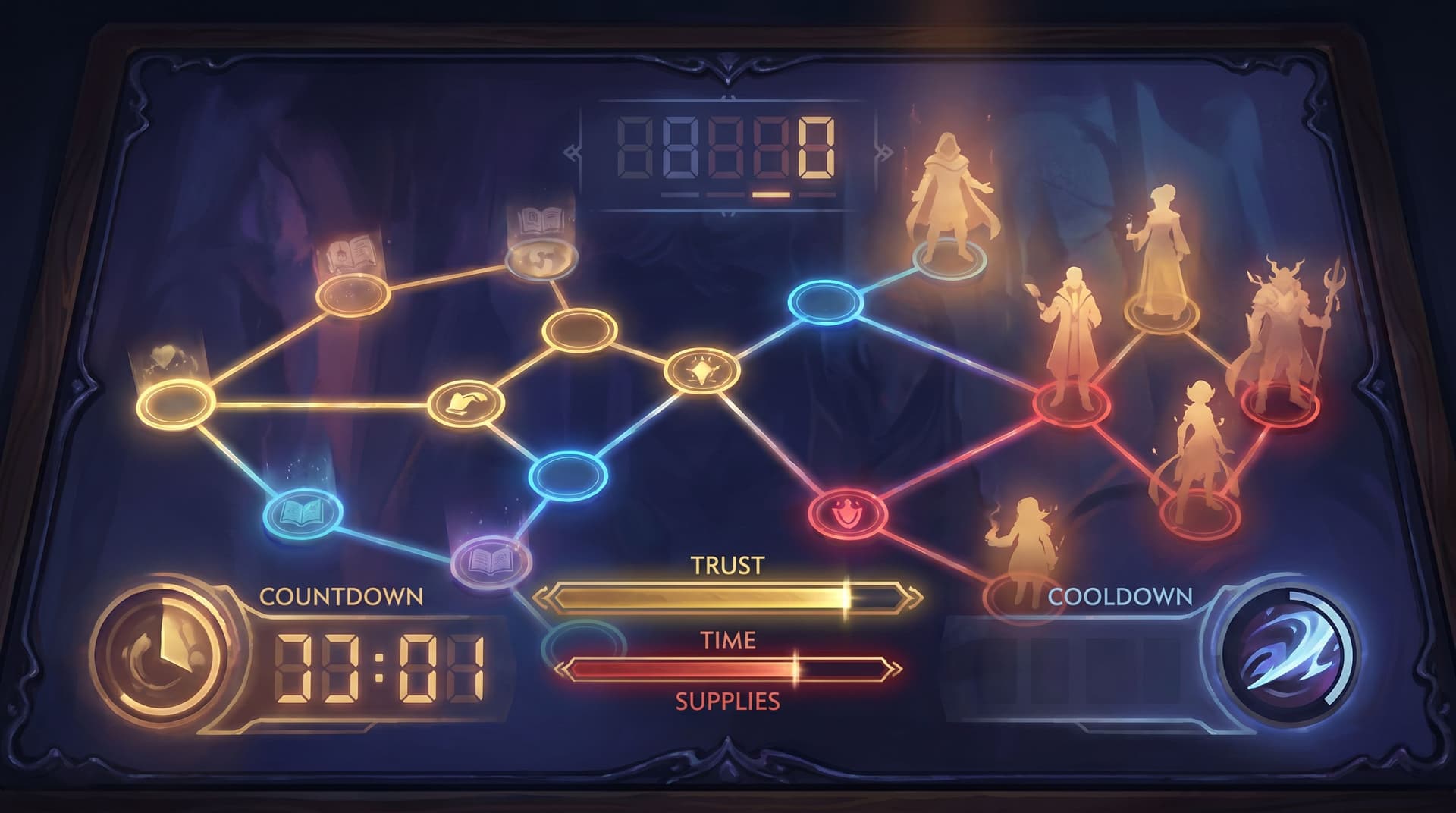
Consider tracking 2–3 invisible “meters,” such as:
- Trust (from customers or team)
- Risk (legal, technical, reputational)
- Sustainability (burnout, long‑term viability)
Each choice nudges these up or down. At key moments, you surface their state:
- “Your team’s trust is low; they’re following orders but no longer volunteering ideas.”
- “Risk has quietly accumulated; the regulator’s audit hits harder than expected.”
If you’re curious about more sophisticated systems like timers, cooldowns, or limited resources, check out No-Code Narrative Systems: Building Timers, Cooldowns, and Limited Resources Inside Questas.
These mechanics don’t just add drama—they reinforce your thesis about what really matters over time.
Step 10: Ship, Observe, Iterate
The first version of your playable essay doesn’t need to be perfect. It needs to be playable and honest.
Once you’ve built your draft in Questas:
-
Playtest with 3–5 people in your target audience
- Watch where they hesitate.
- Ask which choices felt “rigged” or unrealistic.
-
Look for alignment (or misalignment) with your brand
- Do the endings feel like something you’d stand behind publicly?
- Are there branches that unintentionally endorse positions you don’t actually hold?
-
Tighten scope, deepen key beats
- It’s often better to cut a weak branch and invest more in your strongest path than to sprawl.
-
Pair the quest with a short intro post or newsletter
- Frame it as: “A playable essay about X decision. You’re the one in the hot seat.”
Over time, you can grow a whole library of these scenarios—each one a compact, replayable artifact of your thinking.
Bringing It All Together
Turning your point of view into a playable Questas essay isn’t about gimmicks. It’s about:
- Choosing a real, consequential dilemma your audience wrestles with
- Letting them step into a role where that dilemma feels immediate
- Designing branches that reveal values, not just knowledge
- Using pacing, quiet choices, and light systems to make the experience feel lived‑in
- Ending with reflection and replayability, so the ideas stick
You’re still doing thought leadership. You’re just doing it in a medium where thought meets action.
Where to Start This Week
If you want to make this concrete, here’s a simple 5‑day plan:
- Day 1: Pick one existing essay, talk, or manifesto and identify its core dilemma and headline decision moment.
- Day 2: Draft a 10–12 node outline using the onramp → fork → consequences → reflection pattern.
- Day 3: Build the skeleton in Questas: nodes, choices, basic text.
- Day 4: Add 3–5 key visuals and one or two simple “meters” (trust, risk, etc.).
- Day 5: Playtest with a colleague or customer, then publish and share with a short framing note.
By the end of the week, you won’t just have another article—you’ll have a playable argument.
Ready to Turn Your POV into Something People Can Play?
Your next big essay doesn’t have to be a static PDF or a long scroll. It can be a guided, branching experience that:
- Shows how you think under pressure
- Helps your audience rehearse the decisions your ideas are meant to inform
- Leaves them with stories they’ll remember—and talk about
Open Questas, pick one decision that defines your worldview, and start sketching the first branch.
Adventure awaits—not just for your readers, but for your ideas.