Designing Replay Value on Purpose: Structuring Questas Stories So Players Actually Want a Second Run


If you’ve ever poured weeks into an interactive story only to watch players run it once and never come back, you’re not alone.
Replay value doesn’t happen by accident. It’s something you design into your quests from the start—especially when you’re working with a branching, visual platform like Questas.
In this post, we’ll walk through how to structure your stories so people want to hit “Play again,” explore alternate paths, compare endings with friends, and even treat your quest like a world they revisit, not a one‑off.
Why Replay Value Matters for Questas Creators
Whether you’re building with Questas for fun, for training, or for storytelling at work, replay value is a force multiplier:
- More time in your world. Every re-run deepens attachment to your characters, setting, and themes.
- Better learning and retention. In training or simulation builds, multiple playthroughs expose people to more cases and edge conditions.
- Richer data and insight. More replays = more choice data, which makes it easier to see how people actually think and behave.
- Higher ROI on your build. The same quest supports more sessions, cohorts, and audiences without constant new production.
The catch: players only replay when they believe a second run will feel meaningfully different, not just cosmetically tweaked.
That belief doesn’t come from a marketing blurb. It comes from how your story is structured.
The Three Pillars of Replayable Quests
When you’re designing in Questas, think about replay value as a combination of three pillars:
- Visible variation – Players can see that different choices unlock different content.
- Emotional and thematic contrast – Routes don’t just change events; they change how the story feels and what it says.
- Meta-motivation – Players have reasons outside a single run to come back: achievements, challenges, social comparison, or curiosity.
Let’s turn those into concrete patterns you can build into your next quest.
Start With “Replay Hooks” in Your Story Concept
Before you open the editor, ask one question:
“What will someone be curious to try differently on their second run?”
Designing with replay in mind means baking in hooks from the concept stage.
1. Multiple Roles or Viewpoints
One of the strongest replay drivers is perspective. If your story can be experienced from different roles, you’ve already created a reason to come back.
Examples:
- A crisis sim where you can play as:
- The comms lead
- The legal counsel
- The product owner
- A fantasy quest where you can be:
- The idealistic hero
- The morally gray fixer
- The rival who might turn ally (or not)
How to do it in Questas:
- Create a short prologue scene where the player chooses their role.
- Branch immediately into role-specific early scenes (even if you reconverge later) so the choice feels real.
- Use AI-generated portraits and costumes to visually differentiate each role.
If you’re interested in using role choice to explore complex systems (like customer journeys or policy trade‑offs), check out how other creators handle multi-perspective builds in posts like “Beyond Static Personas: Using Questas to Let Stakeholders ‘Play Through’ Customer Journeys”.
2. Clear, Distinct Endings
Players rarely replay for a +2% score bump. They replay for different fates.
Think in terms of end states, not just “good vs bad endings”:
- Reconciled but compromised vs principled but alone
- Short-term win, long-term risk vs short-term pain, long-term resilience
- Hero of the people vs hero of the system
Design tip: Name your endings in a way that teases their flavor. Even a simple end card like “Ending: The Quiet Betrayal” hints that other endings exist.

Build Branches That Reward Second Runs (Not Punish First Ones)
A common trap in interactive fiction is designing branches that feel like punishment: one “correct” path and a forest of dead ends.
Replayable Questas stories instead aim for soft failures and interesting detours, not constant game overs. If you haven’t read it yet, “Designing ‘Soft Fails’ in Questas: Letting Players Mess Up Without Breaking the Story” is a great companion to this section.
3. Use “Route Signposting” So Players Know There’s More to See
Players only replay when they suspect they missed something.
You can create that suspicion without spoiling every twist:
- NPC hints: Characters say things like, “Funny, you’re the first person who didn’t check the old archives…”
- Locked nodes: Briefly show a grayed-out choice (“Confront them with the hidden memo”) with a tooltip like “Requires evidence you don’t have… yet.”
- End screen prompts: At the end, summarize key branches not explored in neutral language.
In Questas, this can be as simple as:
- Adding a “Paths you didn’t take” panel with a few evocative labels.
- Using different background images or color palettes for major routes; when players notice new art, they feel the novelty.
4. Design “Route Families” Instead of Sprawling Trees
Replay value dies when your structure becomes unmanageable.
Instead of a wild tangle of branches, think in route families:
- Three major routes (e.g., Pragmatist, Idealist, Opportunist)
- Each with 2–3 key decision points that define its flavor
- Occasional reconvergence scenes where routes overlap but remember past choices
This lets you:
- Promise players: “There are three main ways this can go.”
- Actually finish your build.
- Make each route emotionally distinct.
If you want a concrete way to prototype these routes quickly, pair this approach with the techniques in “The 5-Scene Story Lab: Rapidly A/B Testing Branches, Endings, and Visual Styles in Questas”.
5. Make Early Choices Echo Late
Replay feels pointless when early choices don’t matter.
You don’t need complex state tracking to fix this—just a few well-placed callbacks:
- An offhand decision in scene 2 (“Share the data” vs “Hold it back”) changes:
- Who trusts you in scene 6
- Which visual you see in the final montage
- A single but memorable line in the epilogue
In Questas, you can:
- Use variables or tags to mark key decisions.
- Reference those tags in later dialogue or scene variants.
- Swap AI-generated images at the end based on those tags (e.g., your character standing alone vs surrounded by allies).
You’re not chasing simulation-level complexity; you’re aiming for emotional callbacks that make a second run feel like a genuinely different journey.
Use Visuals as Replay Incentives, Not Just Decoration
Because Questas leans heavily on AI-generated images and video, your visuals can themselves be a reward for trying new paths.
6. Give Each Route a Distinct Visual Signature
Players should be able to recognize which route they’re on at a glance.
Options:
- Color grading:
- Idealist route → brighter, warmer tones
- Cynical route → cooler, desaturated palette
- Risky route → high contrast, dramatic lighting
- Composition cues:
- “Power” route → low-angle shots, characters framed large
- “Vulnerable” route → wider shots, characters small in frame
- Motifs and props:
- A recurring symbol (a badge, a mask, a data chip) that appears in different contexts depending on choices.
These differences don’t just look good; they signal to players, “You’re somewhere new. This run is worth paying attention to.”
7. Turn Key Variations Into Collectible Moments
Replay value goes up when players feel like they’re collecting experiences.
Ideas:
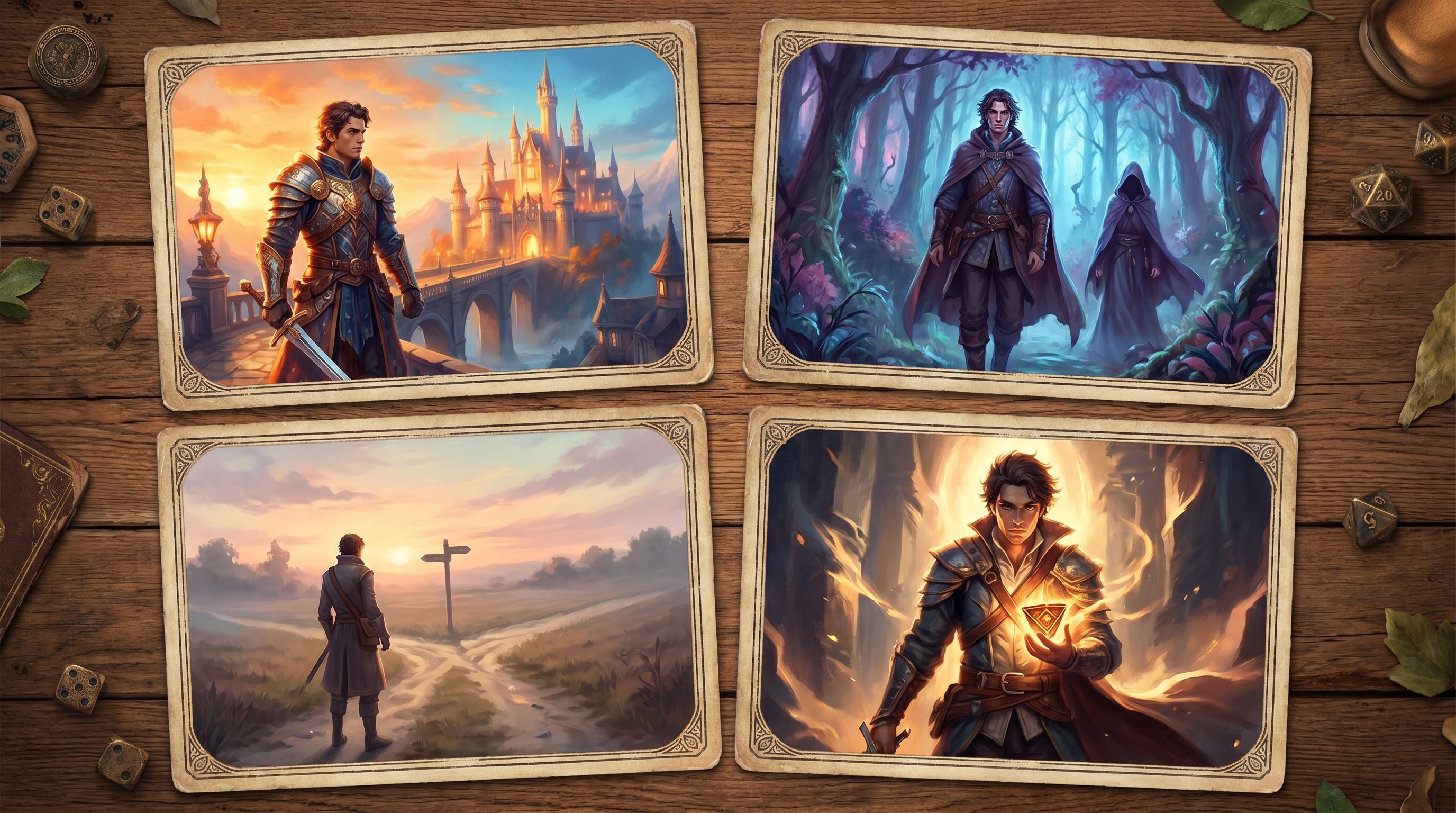
- “Gallery unlocks”: Each major ending adds a new image to a post-run gallery: alternate climactic scenes, epilogue vignettes, character portraits.
- “Route posters”: Generate a stylized “poster” image for each major route, shown only when that route is completed.
- “What-if reels”: Use short AI-generated video snippets for a few pivotal moments that look very different across routes.
You can even encourage players at the end:
“You’ve unlocked 2 of 4 climax images. Replay to discover the others.”
Design Meta-Motivations: Why Bother Replaying Now?
Even with great structure, players need a nudge to replay right away, while the story is still fresh.
8. Offer Explicit Challenges and Achievements
You don’t need a full-blown achievement system. Simple, story-aligned challenges are enough:
- “Can you finish the investigation without checking the security footage?”
- “See if you can keep all three factions on your side until the end.”
- “Find the one route where no one gets fired.”
Where to surface these:
- On the start screen as optional goals.
- On the end screen, with checkmarks for completed challenges.
9. Build for Conversation, Not Just Completion
Some of the strongest replay drivers are social:
- “What ending did you get?”
- “Wait, you can save that character?”
- “I played as legal—what happened when you played as comms?”
To encourage this:
- Write end cards that are easy to screenshot and share.
- Include route names that sound like something people would mention (“The Martyr’s Gambit,” “The Clean Hands Ending”).
- If you’re using Questas in workshops or classrooms, prompt small groups to compare routes right after playing.
For more ideas on using Questas builds as shared experiences in live settings, you might find “From Workshop Icebreakers to Full Simulations: Scaling Live Activities into Questas Experiences” helpful.
Practical Build Pattern: A Replay-Ready Skeleton
Here’s a concrete story skeleton you can adapt directly in Questas. Think of it as a replay-ready template.
Structure Overview
- Scene 1 – Hook & Role Choice
- Short cold open, then: choose between 2–3 roles or stances.
- Scene 2–3 – Role-Specific Setup
- Each role gets 1–2 scenes that:
- Establish their unique perspective.
- Introduce at least one role-only character or location.
- Each role gets 1–2 scenes that:
- Scene 4 – First Major Fork (Route Family Choice)
- A decision that roughly maps to your three route families (e.g., Pragmatic / Idealist / Opportunist).
- Scene 5–7 – Route Development
- Each route gets 2–3 key scenes.
- Include:
- One soft fail moment where a suboptimal choice leads to complications, not a dead end.
- One callback to an early decision.
- Scene 8 – Climax Variants
- Three main climax scenes (one per route family), each with:
- A visually distinct AI-generated image.
- A different emotional resolution.
- Three main climax scenes (one per route family), each with:
- Scene 9 – Epilogue & Replay Tease
- Short epilogue that:
- Names the ending.
- Summarizes 2–3 key decisions.
- Hints at at least one big thing that could have gone differently.
- Short epilogue that:
Implementation Tips
- Limit yourself to 3 route families on your first attempt. You can always expand later.
- Use labels and color-coding in your Questas node graph so you can visually see which scenes belong to which family.
- Start with placeholder text and simple prompts for images to prove the structure, then refine visuals once the routes feel strong.
Playtesting Specifically for Replay Value
Replayability isn’t something you can fully reason out in your head. You’ll catch the biggest issues by watching real people play.
When you test your quest, don’t just ask, “Did you like it?” Ask questions like:
- “Did you feel like your choices mattered?”
- “Is there a decision you’d love to try differently?”
- “On a scale of 1–10, how curious are you about alternate endings?”
Watch for:
- Players who immediately hit “Restart” without prompting.
- Moments of visible hesitation at a choice (those are high-leverage forks; consider giving them more downstream impact).
- Branches no one sees – maybe they’re too hidden, or your earlier signposting doesn’t hint they exist.
Then iterate:
- Strengthen signposting where people missed cool content.
- Add a few more visual or emotional differences between routes that felt too similar.
- Trim branches that add complexity but not meaningful variation.
For a deeper dive into using player behavior to refine your builds (especially visually), you may enjoy “The Visual Feedback Loop: Using Player Screenshots and Replays to Iteratively Refine Your Questas Worlds”.
Bringing It All Together
Designing replay value on purpose means:
- Concept first: Start with roles, perspectives, and distinct endings that naturally invite “What if I tried…?”
- Structure with intent: Use route families, soft fails, and callbacks so each run feels coherent but different.
- Visual differentiation: Let color, composition, and AI-generated imagery signal that players are on a new path.
- Meta-motivation: Challenges, achievements, and social comparison give players a reason to replay now, not someday.
- Iterative refinement: Watch how people actually move through your quest and tune branches for curiosity and contrast.
When you combine these, your quest stops being a one-and-done story and becomes a world worth revisiting.
Ready to Build a Quest People Actually Replay?
You don’t need a giant, 40-scene epic to start. A tight, 8–10 scene build with three clearly different routes can already deliver huge replay value.
Here’s a simple way to take the first step this week:
- Open Questas and sketch a 9-scene graph using the replay-ready skeleton above.
- Define three route families in a sentence each (e.g., “Play it safe,” “Break the rules,” “Sacrifice yourself”).
- Give each route a distinct visual vibe with a few targeted AI image prompts.
- Ship a rough version to 3–5 trusted testers and ask them specifically about their desire to replay.
- Iterate once based on what you learn, then share the quest with a wider audience.
Your players don’t just want to click through a story. They want to explore it.
Design your next Questas build so a single playthrough feels satisfying—but the second one is irresistible.


