Designing ‘Soft Fails’ in Questas: Letting Players Mess Up Without Breaking the Story


Interactive stories are at their best when players feel like their choices matter—including the bad ones.
If every path in your Questas build leads to a dead end or a harsh “Game Over,” players learn to play defensively. They click the safest option, avoid experimentation, and stop testing the edges of your world. On the flip side, if nothing truly goes wrong, choices feel cosmetic and tension evaporates.
Soft fails are the middle lane.
They’re the moments where a player does make a mistake—or at least a sub‑optimal choice—but the story bends instead of breaks. The world responds, stakes shift, and the player gets to keep going, a little wiser and a little more invested.
This post is about how to design those soft fails intentionally in Questas, so your stories feel forgiving and meaningful.
What Is a “Soft Fail,” Exactly?
A soft fail is any outcome where:
- The player’s choice has visible negative consequences (loss, setback, awkwardness, risk, etc.)
- The story continues—they’re not kicked out of the experience
- The player learns something about the world, the system, or themselves
Compare that to a hard fail:
- The story ends immediately or snaps back to a checkpoint
- The player is told (explicitly or implicitly), “You were wrong”
- There’s little to no emotional or narrative payoff
In Questas, soft fails might look like:
- A sales rep choosing the wrong stakeholder to champion their deal and having to repair the relationship later
- A crisis team delaying a key decision, which raises the stakes in the next scene instead of ending the sim
- A fanfic hero trusting the wrong ally, leading to a tense escape branch rather than instant doom
If you’re building crisis simulations, you’ve already seen how powerful these near‑misses can be. Experiences like the ones in From Escape Rooms to Escape Routes: Turning Crisis Playbooks into Questas Simulations live on that edge: you want people to feel the cost of missteps without shutting them down.
Why Soft Fails Make Your Quests Stronger
Soft fails aren’t just “nice to have.” They’re foundational to how players learn, remember, and replay your stories.
1. They turn fear of failure into curiosity
When players know they can mess up without being booted out, they’re more willing to:
- Explore risky branches
- Try “what if” choices they’d never risk in real life
- Replay the story to see how different mistakes play out
2. They make your world feel more like real life
Real systems rarely collapse from a single bad decision. Instead, they:
- Accumulate small missteps
- Force trade‑offs
- Offer recovery paths—at a cost
Soft fails mirror that complexity. They let you model how things break gradually, which is especially useful in enterprise scenarios like those in Branching for B2B: Designing Questas Scenarios That Actually Move Enterprise Deals Forward.
3. They deepen emotional investment
When a character or team survives a mistake and has to live with the consequences, players feel:
- More ownership over the story
- More empathy for the people involved
- More tension around future choices (because they’ve seen what can go wrong)
4. They give you richer data
If you’re using Questas for training, research, or strategy, soft fails reveal:
- Where people systematically misjudge risk
- Which “wrong” paths are most tempting
- How different personas respond to setbacks
That’s the same insight engine behind ideas like The Minimal Viable Quest: Tiny, Three-Choice Questas Formats That Still Deliver Big Insight. Soft fails turn your story into a safe lab for bad decisions.

Step 1: Decide Where Failure Should Live in Your Story
Before you open the Questas editor, zoom out.
Ask yourself:
-
What’s the core journey I want every player to experience?
Is it “survive the crisis,” “close or lose the deal,” “reach one of three emotional endings”? Your soft fails should orbit this core, not derail it. -
Where are the natural failure points in this world?
Think about:- Misjudged trust (ally vs. antagonist)
- Misread signals (customer intent, political dynamics, safety warnings)
- Poor timing (acting too fast or too slow)
-
What absolutely can’t be a soft fail?
Some things should be hard fails:- Violent or abusive choices that cross ethical lines
- Decisions that would instantly end the scenario in real life (e.g., hitting “send” on a confidential email to the wrong list)
Mark these on a simple outline or whiteboard:
- Circles = major scenes
- Stars = places where failure is interesting
- X’s = boundaries you don’t want players to cross without a hard consequence
You’re not drawing every branch yet—just spotting where soft fails will be most meaningful.
Step 2: Turn Binary Outcomes into Sliding Scales
Soft fails thrive when success isn’t binary.
Instead of thinking in “pass/fail,” think in states:
- Trust: high / medium / low
- Risk: contained / rising / critical
- Momentum: advancing / stalled / reversing
In Questas, you can model these states through:
- Branch structure – Different paths that represent different states
- Tags or variables (if you’re using advanced logic) – Tracking scores like “trust_level = 2”
- Recurring motifs in visuals and copy – The world looks and feels more strained or hopeful depending on prior choices
For each key decision, ask:
“If this choice goes badly, how could the state shift without ending the story?”
Examples:
-
A stakeholder meeting that goes poorly might:
- Lower trust (they become cooler and more formal)
- Increase risk (they bring in legal or procurement early)
- Stall momentum (you have to schedule a follow‑up with more people)
-
A fantasy quest where the hero chooses the wrong path might:
- Cost resources (lost supplies, injured companion)
- Reveal hidden information (they overhear enemy plans while lost)
- Change the emotional tone (the group becomes tense and blameful)
Write these states directly into your scene notes before you build:
- If success: trust +1, clean path forward
- If soft fail: trust −1, new obstacle introduced
- If hard fail: story ends or snaps back with clear framing
Step 3: Design the Player’s Experience of Failing Softly
A soft fail isn’t just a structural trick; it’s an emotional beat.
When a player messes up, you want them to feel three things:
- Clarity – They understand what went wrong
- Consequence – They see and feel the cost
- Continuity – They know the story isn’t over
Here’s how to build that into your Questas scenes.
Make the consequence visible and specific
Instead of vague “That wasn’t ideal” messages, show:
- A character’s body language shifting in the next AI image
- A terse email or message popping up in‑story
- Environmental changes (sirens, weather, crowd mood) that signal rising stakes
This is where techniques from Camera Moves Without a Camera: Simulating Pans, Zooms, and Cuts with AI Images in Questas shine. A subtle “zoom in” on a worried face or an over‑the‑shoulder shot of someone texting a rival can make the soft fail land.
Give players a moment to process
Right after the soft fail, consider a short reflective beat:
- A character asking, “Are you sure that’s how you wanted to handle it?”
- An inner monologue scene where the protagonist second‑guesses themselves
- A quick recap: “Because you chose to delay, the rumor mill has had time to spin up.”
This doesn’t have to be long—one or two lines is enough—but it helps players connect cause and effect.
Offer a path forward (with a twist)
The next choice after a soft fail should:
- Acknowledge the new state (damaged trust, higher risk, etc.)
- Present a meaningful trade‑off
For example:
- “You’ve lost the CFO’s confidence. Do you:
- Bring in a senior exec to vouch for you (but owe them a favor later)?
- Double down on data and try to win the CFO back yourself?”
The key: the player is still in control, but now they’re navigating a more complex, more expensive world.
Step 4: Build Soft Fails into Your Questas Structure
Now it’s time to open the Questas editor and translate your ideas into branches.
Start with a “spine,” then hang soft fails off it
-
Build the main success path first.
A clean route from beginning to desired ending. -
Identify 3–5 key decision points along that path.
-
For each key decision, add:
- One “strong success” branch that rejoins the spine quickly
- One “soft fail” branch that:
- Detours into a short sequence (1–3 scenes)
- Changes the state (trust, risk, resources)
- Rejoins the spine later, at a different emotional or logistical starting point
Visually, your map might look like a river with side eddies: players can swirl into a soft fail, spin around in consequences, then rejoin the main current further downstream.
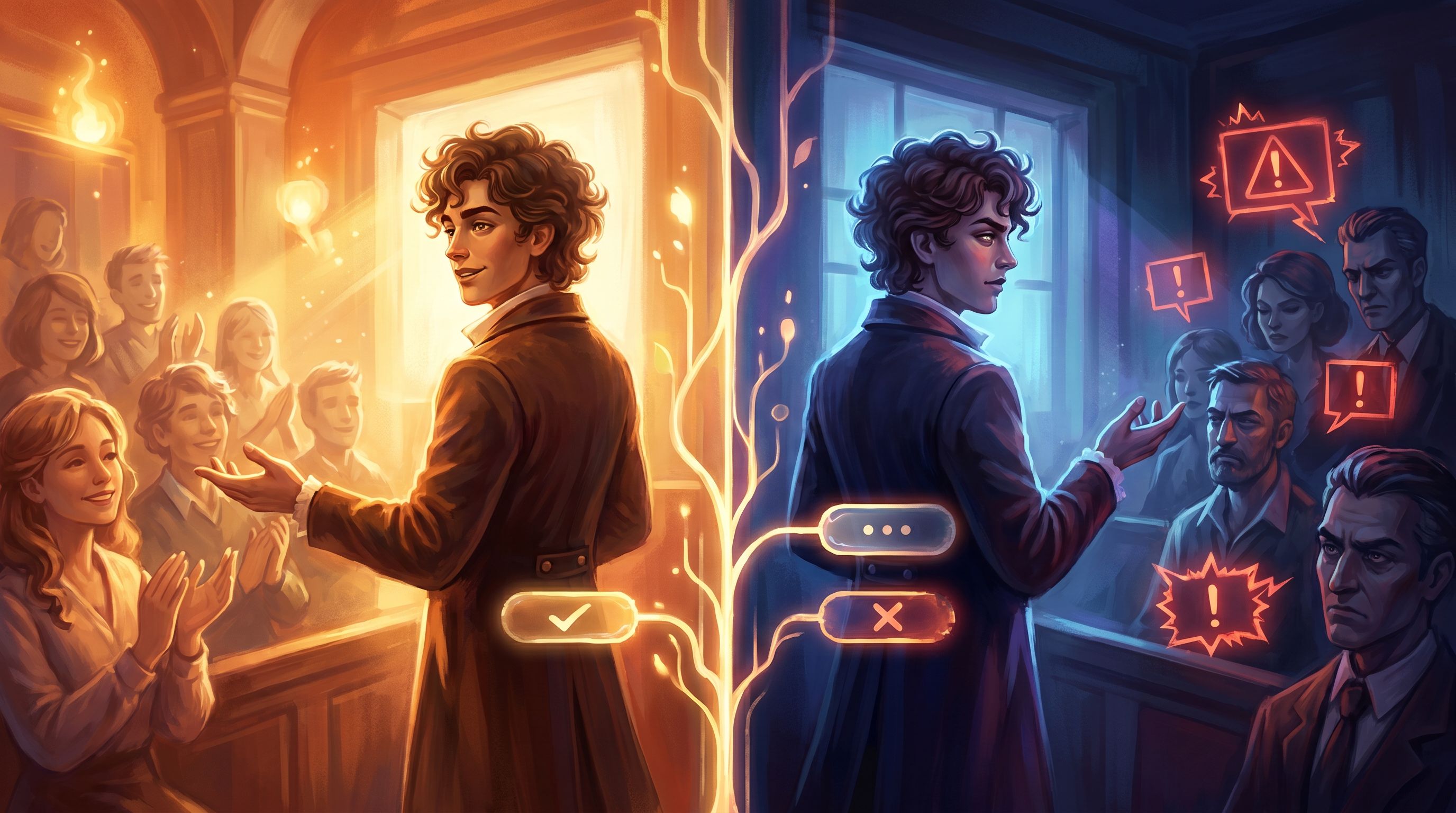
Use visuals to differentiate soft fails from hard fails
Consistent visual language helps players feel what just happened without reading a wall of text.
You might:
- Use a slightly cooler or harsher color palette in soft fail scenes
- Introduce a recurring visual motif when things go wrong (e.g., a cracked glass reflection, a red notification badge, storm clouds)
- Shift camera angle to feel more constrained (closer crops, tighter framing)
If you’re building a series, posts like From Style Guide to Shot List: Building Reusable Visual Systems for Ongoing Questas Series and Prompt Libraries That Scale: Building Reusable AI Image Systems for Long-Running Questas Series can help you keep these visual cues consistent.
Keep soft fail detours short but meaningful
A good rule of thumb:
- 1–3 scenes per soft fail branch
- Each scene should:
- Show a consequence
- Offer at least one meaningful choice
- Move the player back toward the main flow
If your soft fail branches are too long, they’ll feel like alternate campaigns. Too short, and they’ll feel like cosmetic scolding.
Step 5: Playtest Specifically for Soft Fails
Once you have soft fails wired into your quest, you’re not done—you need to see how real players experience them.
When you run playtests (whether live or async), ask your testers to:
- Deliberately choose “wrong” options at least once per major decision point.
- Narrate their expectations out loud or in a feedback form:
- “I thought this would be a minor setback.”
- “I expected to get fired here.”
- Rate the fairness of each soft fail:
- Did the consequence feel earned?
- Did they understand why it happened?
- Did they feel motivated to keep going?
Then look at your Questas analytics and notes:
- Are players avoiding certain branches entirely? Maybe the soft fail feels too punishing.
- Are they replaying specific sequences? Those might be your most engaging soft fails.
- Do many players misinterpret the same choice? That might be a copy or visual clarity issue.
If you’re not sure what to measure, the patterns and questions in From Playtest Notes to Narrative Analytics: What to Measure (and Ignore) in Your Early Questas Builds are a great starting point.
Common Pitfalls (and How to Avoid Them)
Even experienced creators trip over soft fails. Watch out for these traps:
1. The “fake choice” soft fail
- Problem: The story scolds the player but nothing actually changes.
- Fix: Tie every soft fail to a visible change in state, relationship, or environment.
2. The invisible soft fail
- Problem: The player technically failed, but the consequences are so subtle they miss them.
- Fix: Add at least one strong signal—a line of dialogue, a visual shift, a metric change.
3. The spiral of doom
- Problem: One soft fail makes it nearly impossible to recover, turning the rest of the story into a slow collapse.
- Fix: Design multiple recovery ramps—moments where a smart or empathetic choice can partially repair the damage.
4. The moralizing narrator
- Problem: The story shames players for experimenting.
- Fix: Let characters react authentically, but keep your narrative tone curious and observational rather than judgmental.
Bringing It All Together
Designing soft fails in Questas is about more than mercy. It’s about:
- Treating failure as information, not just punishment
- Letting players feel real consequences without ejecting them from the experience
- Building worlds that are resilient, where stories bend and adapt instead of snapping
When you:
- Map where failure belongs in your story
- Turn binary outcomes into sliding states
- Make consequences visible, specific, and recoverable
- Build short, meaningful detours into your quest structure
- Playtest with an eye on how failure feels
…you end up with interactive stories people want to explore, replay, and talk about.
Ready to Let Your Players Mess Up (Safely)?
You don’t need a sprawling epic to start experimenting with soft fails.
Try this:
- Open Questas and sketch a 5‑scene mini‑quest with one pivotal decision.
- Design one strong success and one soft fail branch off that decision.
- Make the soft fail:
- Clearly signposted
- Visually distinct
- Followed by a meaningful recovery choice
- Put it in front of 3–5 people and watch how they navigate.
From there, you can scale up—adding more states, more recovery arcs, and more nuanced emotional journeys.
Your players are ready to make mistakes. The question is: will your story know what to do with them?
Open your next build in Questas, pick one key decision, and design your first soft fail. That’s your next step toward worlds that feel alive, forgiving, and unforgettable.