The Hybrid GM: Running Tabletop RPG Campaigns Partly in Questas, Partly at the Table


Tabletop RPGs are already a kind of collaborative storytelling magic: a few sheets of paper, some dice, and suddenly you’re deep in a haunted forest arguing with a talking door.
But if you’ve ever wished you could:
- Show players a vivid visual of that haunted forest without spending hours in an art tool
- Keep track of branching possibilities without drowning in notes
- Let absent players “play through” key scenes between sessions
- Reuse your best encounters for other groups
…then running a hybrid campaign—partly in person, partly inside Questas—might be your next level as a GM.
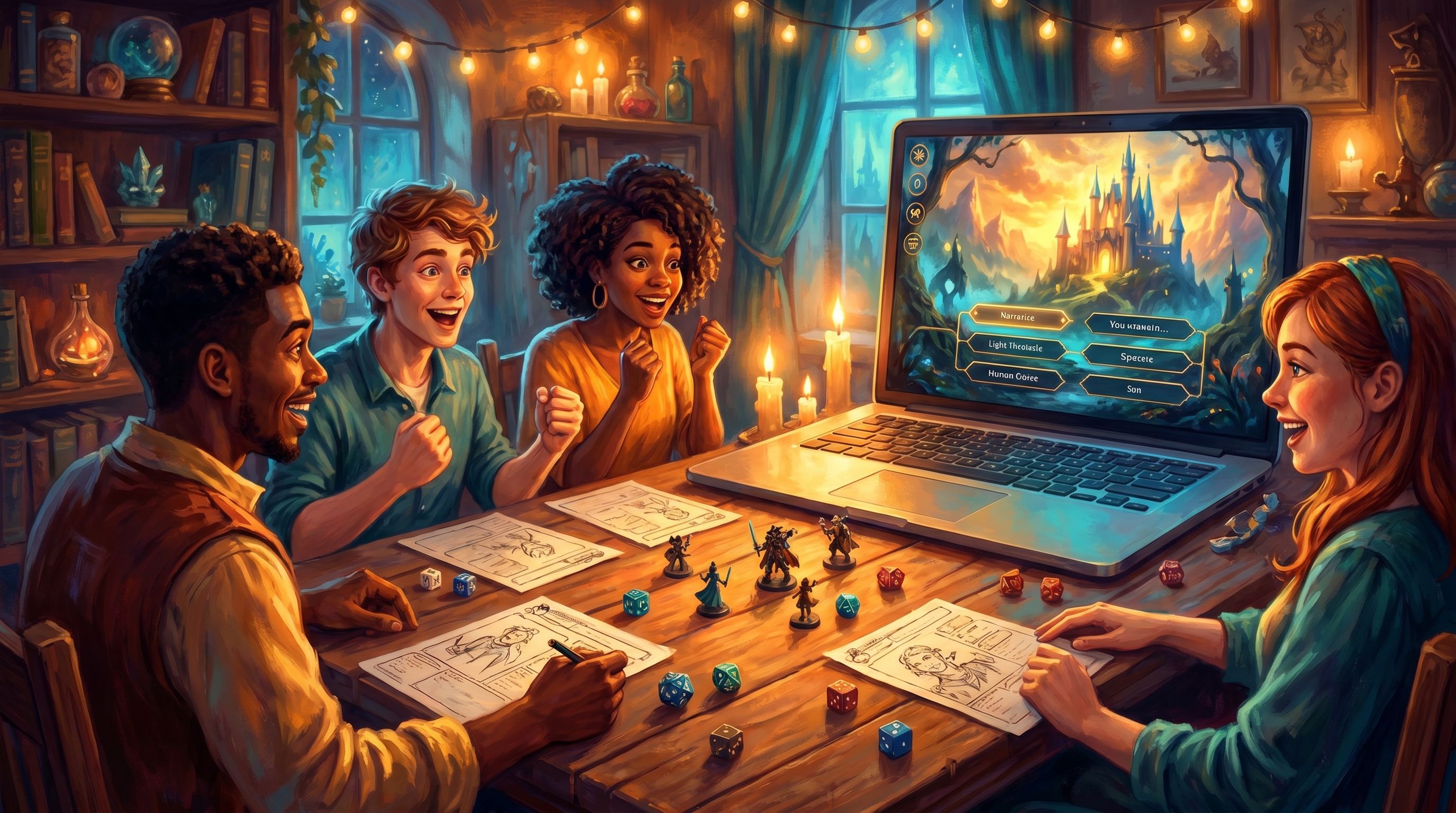
In a hybrid model, you still get all the social energy of gathering around a table, but you offload certain scenes, arcs, or logistics to a structured, visual, interactive experience built in Questas. Think of it as having a co‑GM that never gets tired, remembers every branch, and can present your world with AI‑generated images and videos on demand.
Why Hybrid Campaigns Are Worth Your Time
Blending tabletop play with an interactive platform isn’t about replacing your GM skills. It’s about amplifying them.
Here are some of the biggest benefits:
1. More immersive scenes with less prep
Instead of spending hours searching for maps and art, you can:
- Use Questas’s AI image and video generation to spin up location shots, NPC portraits, and key moments.
- Build reusable “set pieces” (like a heist, trial, or boss fight) that you can drop into multiple campaigns.
2. Cleaner branching for complex choices
Some story beats are inherently branching: political negotiations, moral dilemmas, heists with multiple entry points. Running those entirely at the table can be a cognitive load nightmare.
By structuring those branches in Questas:
- You pre‑bake the major outcomes and consequences.
- Players still make choices live, but you have a visual map of what happens next.
- You can even let players explore “what if we’d picked the other option?” later as a side experience.
If you’re curious about non‑linear structures that shine in interactive stories, you’ll find a deeper dive in Beyond the Hero’s Journey: Non-Linear Story Structures That Shine in Questas.
3. Between-session play that actually matters
Players love the world, but schedules are messy. Hybrid campaigns let you:
- Give players solo side quests between sessions via a Questas story.
- Run downtime activities (crafting, research, political maneuvering) as asynchronous, branching experiences.
- Let absent players catch up through an interactive recap instead of a wall of text.
4. Better onboarding for new or anxious players
New players can be intimidated by rules, roleplay, or social pressure at the table. You can ease them in with:
- A “session 0.5” inside Questas: a short, low‑stakes interactive intro to the world and tone.
- Guided character backstory journeys that end with a ready‑to‑play hook.
For more on using interactive stories to introduce systems and tools, check out Beyond Tutorials: How SaaS Teams Use Questas Stories to Replace Walkthrough Videos and Tooltips—the same ideas apply beautifully to teaching rules and setting expectations for your campaign.
5. Reusable, shareable story assets
When your key arcs live partly in Questas:
- You can rerun them for different groups without rebuilding from scratch.
- You can share or even publish modules for other GMs.
- You can iterate based on player feedback, just like a game designer.
Where the Table Shines vs. Where Questas Shines
The secret to a great hybrid campaign is intentional division of labor between you and your tools.
Keep these moments at the table
These are usually better live, with dice and face‑to‑face energy:
- Freeform roleplay between PCs or with a key NPC
- Tactical combat where players want to improvise, rules‑lawyer, and banter
- Open‑ended problem solving where you want them to break your plans
- Emotional climaxes that benefit from real‑time pacing and tone
Move these moments into Questas
These are great candidates for Questas scenes or arcs:
- Structured investigations with clear clue paths and consequences
- Travel montages with branching encounters and flavor scenes
- Downtime systems (crafting, training, intrigue, domain management)
- Complex political decisions with multiple stakeholders and outcomes
- Flashbacks and visions that reveal backstory or foreshadowing
A useful mental model: the table is for improvisation and connection; Questas is for structure, visuals, and replayable branches.
Designing a Campaign That Lives in Two Places
Let’s walk through how to design a hybrid campaign step by step.
1. Start with your campaign spine
Before you touch any tools, sketch the core arc:
- What’s the central conflict or mystery?
- What’s the expected length (short arc, season, epic)?
- Which 3–5 moments must land emotionally?
From there, identify anchor sessions—in‑person sessions where big beats happen (meeting the villain, major heist, final confrontation). These will be mostly table‑driven, potentially supported by a few Questas scenes.
2. Tag scenes as “table-first” or “Questas-first”
Go through your rough outline and label each planned scene:
- T – Table-first
- Q – Questas-first
- T/Q – Hybrid (start at table, branch into an interactive sequence, then return)
Examples:
- T: “Session 1: The village council hires the party and we roleplay introductions.”
- Q: “Between sessions: Each player explores a solo dream sequence that hints at their destiny.”
- T/Q: “At the table, players decide how to approach the duke. Then we play through a Questas scene that simulates the web of court politics and outcomes.”
This simple labeling keeps scope realistic and stops you from trying to build everything into Questas.
3. Build your first hybrid arc, not your whole campaign
Resist the urge to digitize the entire world at once. Instead, pick one self‑contained arc—maybe 3–5 scenes—that will live partly in Questas and partly at the table.
A great first candidate:
- A murder mystery in a single location
- A heist with multiple entry paths
- A political vote with different factions to persuade
Use the “5‑scene lab” mindset from The 5-Scene Story Lab: Rapidly A/B Testing Branches, Endings, and Visual Styles in Questas:
- Scene 1: Inciting incident (table)
- Scene 2: Investigation path A/B/C (Questas)
- Scene 3: Confrontation (Questas or table depending on choices)
- Scene 4: Fallout and rewards (table)
- Scene 5: Epilogue or teaser (Questas between sessions)
This lets you learn what actually feels good for your group before you scale up.
4. Decide how players will interact with Questas
You have a few practical options:
-
GM‑driven, on a shared screen
You run Questas on a laptop or TV, clicking choices based on player decisions. Great for in‑person play where you want to keep everyone focused together. -
Players on their own devices, live
Each player opens the same story link and you tell them when to advance. Good for remote or hybrid groups. -
Asynchronous, between sessions
You send links for solo side quests, recaps, or downtime activities. Players complete them on their own time and you fold outcomes back into the next session.
You can mix and match, but be explicit with your group about when and how you’ll use each mode.
5. Lock in your visual style early
Nothing breaks immersion faster than a world that looks inconsistent from scene to scene. When you’re using AI‑generated visuals, spend a bit of time upfront to:
- Choose a consistent art style (painterly, comic, anime, photoreal, etc.).
- Create a small style board of 6–10 images that define your look.
- Save prompts for key characters, locations, and props.
For deeper guidance on this, From Style Guide to Shot List: Building Reusable Visual Systems for Ongoing Questas Series and From Moodboard to Mission: Using AI Style Boards to Lock In the Look of Your Next Questas World are both packed with techniques that map perfectly to long‑running RPG campaigns.
What to Actually Build in Questas (Concrete Examples)
Let’s get specific. Here are some plug‑and‑play ideas you can start building right away.
Solo origin stories
Before Session 1, send each player a link to a short Questas story:
- They make choices about a formative event (betrayal, loss, discovery).
- The story ends with a tag like “You still carry the broken locket.”
- You, as GM, get a summary of their path and can weave those details into the first session.
Downtime arcs
Instead of hand‑waving “you spend a week in the city,” let players choose:
- Train – Play through a mini‑scenario where they face a sparring partner.
- Investigate – Dive into a branching rumor web.
- Carouse – Navigate social mishaps and favors.
Each path is a short Questas sequence with:
- 3–4 meaningful choices
- 1–2 soft fails that complicate things without derailing the campaign (for more on this design pattern, see Designing ‘Soft Fails’ in Questas: Letting Players Mess Up Without Breaking the Story)
- A clear outcome you can translate into mechanical bonuses, complications, or new hooks.
Vision sequences and prophecies
When a character touches a cursed artifact or receives a prophetic dream:
- Pause the table.
- Hand that player a device (or DM them a link) with a short Questas vision.
- Let them make interpretive choices about what they see or believe.
When they return to the table, ask them to describe the vision in their own words to the party. Now the prophecy is both mechanically structured and socially organic.
Political or faction simulations
For complex politics where you want cause‑and‑effect to be clear:
- Build a Questas story that represents the key factions, each with:
- Goals
- Levers (what persuades them)
- Red lines
- At the table, players decide their strategy.
- Then you step through the Questas simulation together, seeing how each choice shifts support, unlocks boons, or triggers consequences.
You can reuse this simulation later with different parameters—essentially turning your campaign’s politics into a playable system.
Keeping Continuity Across Table and Questas
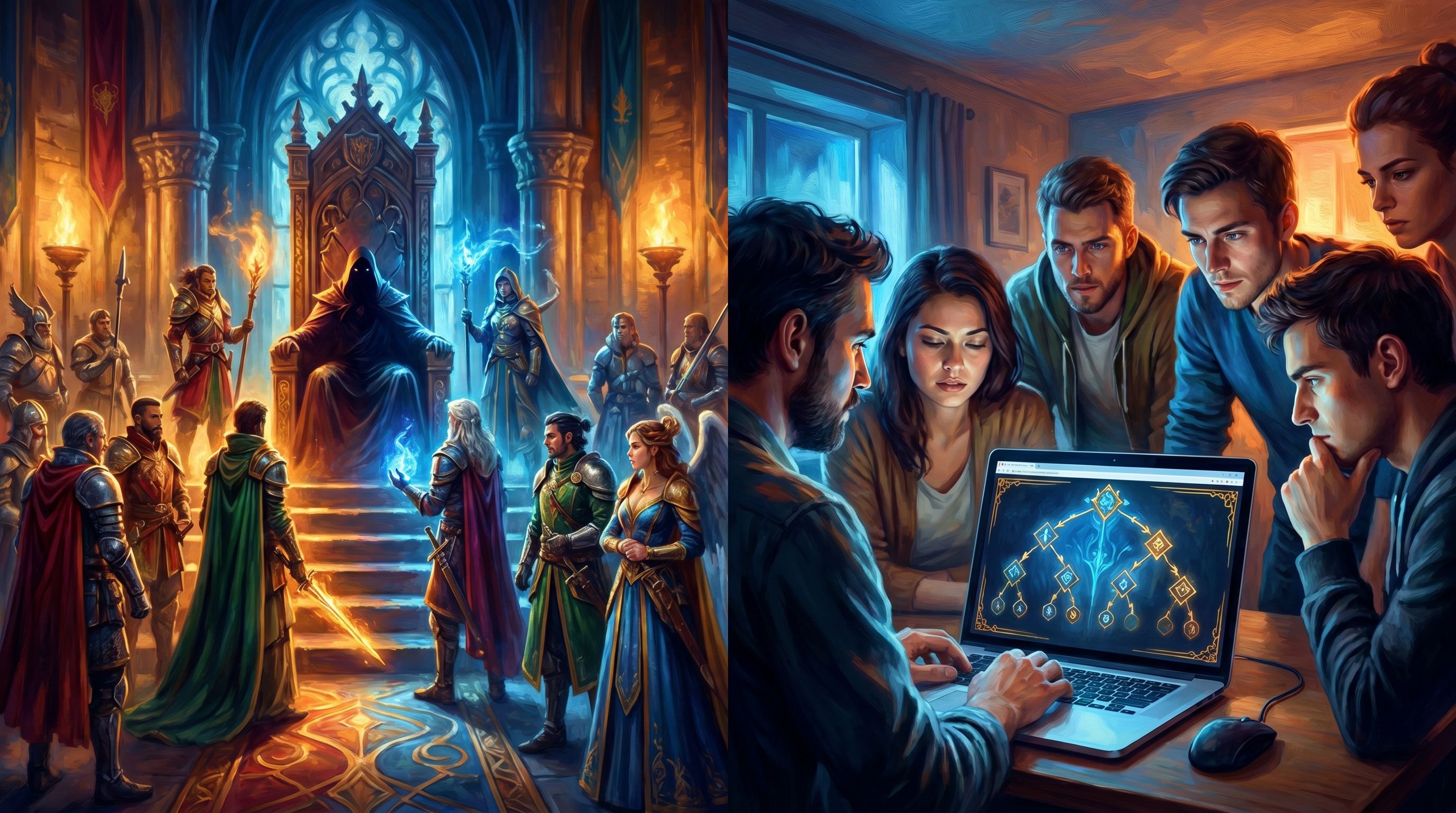
The biggest risk in hybrid play is continuity drift—when what happens in one mode doesn’t quite sync with the other. A few habits can keep your story tight.
Use shared "canon notes"
Keep a single source of truth (Notion, Google Doc, Obsidian, etc.) with:
- Current world state (who’s alive, who’s allied, who’s missing)
- Major flags from Questas runs (e.g., “The party spared the bandit leader; he owes them a favor.”)
- Open questions or mysteries
Update this after every session and after any significant Questas sequence.
Design explicit handoff moments
When you move from table to Questas or back, make that transition clear:
- “Okay, that’s where we’ll pause the live scene. I’m going to send you all a link to the infiltration tonight; complete it before next session.”
- “You finish your downtime stories and regroup at the tavern. Let’s start the session with each of you sharing one thing that went differently than you expected.”
Let players see the consequences
Hybrid play shines when players feel the impact of their choices across modes:
- A decision made at the table changes which Questas story branch they can access.
- A risky choice in a solo Questas vision leads to a new NPC or complication in the next live session.
The more you echo these consequences in both spaces, the more cohesive the world feels.
Practical Tips for a Smooth Hybrid Experience
A few small practices go a long way:
- Start small. One hybrid arc is plenty for your first experiment.
- Get consent. Some players love solo content; others don’t. Ask what they’re excited about.
- Mind accessibility. Make sure everyone can access Questas on their device and that text is readable.
- Use session recaps. Begin each table session with a brief recap that includes key outcomes from any Questas stories.
- Invite feedback. Ask, “Which parts felt better live? Which felt better in Questas?” and adjust.
If you want a deeper dive into how to observe and iterate based on player behavior, The Visual Feedback Loop: Using Player Screenshots and Replays to Iteratively Refine Your Questas Worlds offers a lot of techniques you can adapt to your home game.
Bringing It All Together
Hybrid GMing isn’t about being more “high tech.” It’s about:
- Giving your best scenes the visuals and structure they deserve.
- Making space for rich, async side stories without burning yourself out.
- Turning your campaign into a living, replayable storyworld that can grow over time.
When you let the table do what it does best—improv, emotion, connection—and let Questas handle structure, visuals, and branching logic, you get the best of both worlds.
Where to Start This Week
If you’re curious but unsure how to begin, here’s a simple first experiment you can run before your next session:
- Pick one upcoming moment that could work in Questas: a dream, a flashback, a small investigation, or a downtime choice.
- Build a 3–5 scene micro‑story around it with:
- 2–3 meaningful choices
- 1 soft fail
- 1–2 AI‑generated images that match your campaign’s vibe
- Share it with your players as “bonus content” before or after a session.
- At the table, reference what happened in that story as if it were canon.
If it lands well, expand. If it doesn’t, you’ve only invested in a tiny experiment—and you’ve learned what your group actually wants.
Summary
Running a tabletop RPG partly in Questas and partly at the table gives you:
- Richer visuals and structured branching where it matters most
- Asynchronous side quests, visions, and downtime that feel meaningful
- Reusable, iteratable story modules you can refine over time
The key is to be intentional: decide which scenes belong where, design clear handoffs, and keep a shared canon so your world feels cohesive. Start with a single hybrid arc, gather feedback, and grow from there.
Take the First Step
You don’t need to rebuild your whole campaign to try hybrid GMing.
Open Questas, sketch a tiny 3–5 scene story that ties into your next session, and see how your players respond. From there, you can grow into origin stories, downtime systems, political simulations, and full hybrid arcs.
Your table already loves your world. A hybrid approach just gives them more ways to live in it—together, and between sessions.


