Beyond the Hero’s Journey: Non-Linear Story Structures That Shine in Questas


The hero’s journey is everywhere—movies, novels, even a lot of interactive fiction. It’s popular for a reason: it gives you a clear arc and a satisfying payoff.
But once you start building branching stories, the classic “call to adventure → ordeal → return” can start to feel like a straitjacket. Interactive stories aren’t just about what happens; they’re about what could have happened and what the player chose to make happen.
That’s where non-linear structures come in.
On a platform like Questas, where you can sketch branches visually, remix scenes, and generate AI-driven images and video on the fly, you’re no longer tied to a single, central arc. You can design quests that feel like:
- A web of shifting alliances
- A mosaic of perspectives
- A looping time experiment
- A sandbox of cause-and-effect
This post is about those structures—the ones that really start to sing once you’re working with branching logic instead of a single timeline.
Why Think Beyond the Hero’s Journey?
Before we dive into specific patterns, it’s worth asking: why leave such a reliable template behind in the first place?
Interactive stories have different strengths than linear stories. They’re especially good at:
- Exploration over destination – Players want to poke at the edges, replay routes, and see what they missed.
- Agency and identity – Choices reveal who the player is and what they value, not just how clever your plot is.
- Systems and consequences – Branching lets you dramatize how complex systems behave: politics, markets, relationships, crises.
Classic three-act structure can still work, but it tends to treat branches as detours from a “true” path. Non-linear structures flip that: the network itself is the story.
If you’re designing learning scenarios, sales simulations, crisis drills, or fandom storyworlds, this shift is powerful. It’s the same move we explore in posts like “Designing Emotional Arcs in Branching Stories: How to Make Every Path Feel Like a Real Journey”: you stop forcing every route into the same shape, and instead design families of journeys that feel coherent, but not identical.
Structure #1: The Hub-and-Spoke Storyworld
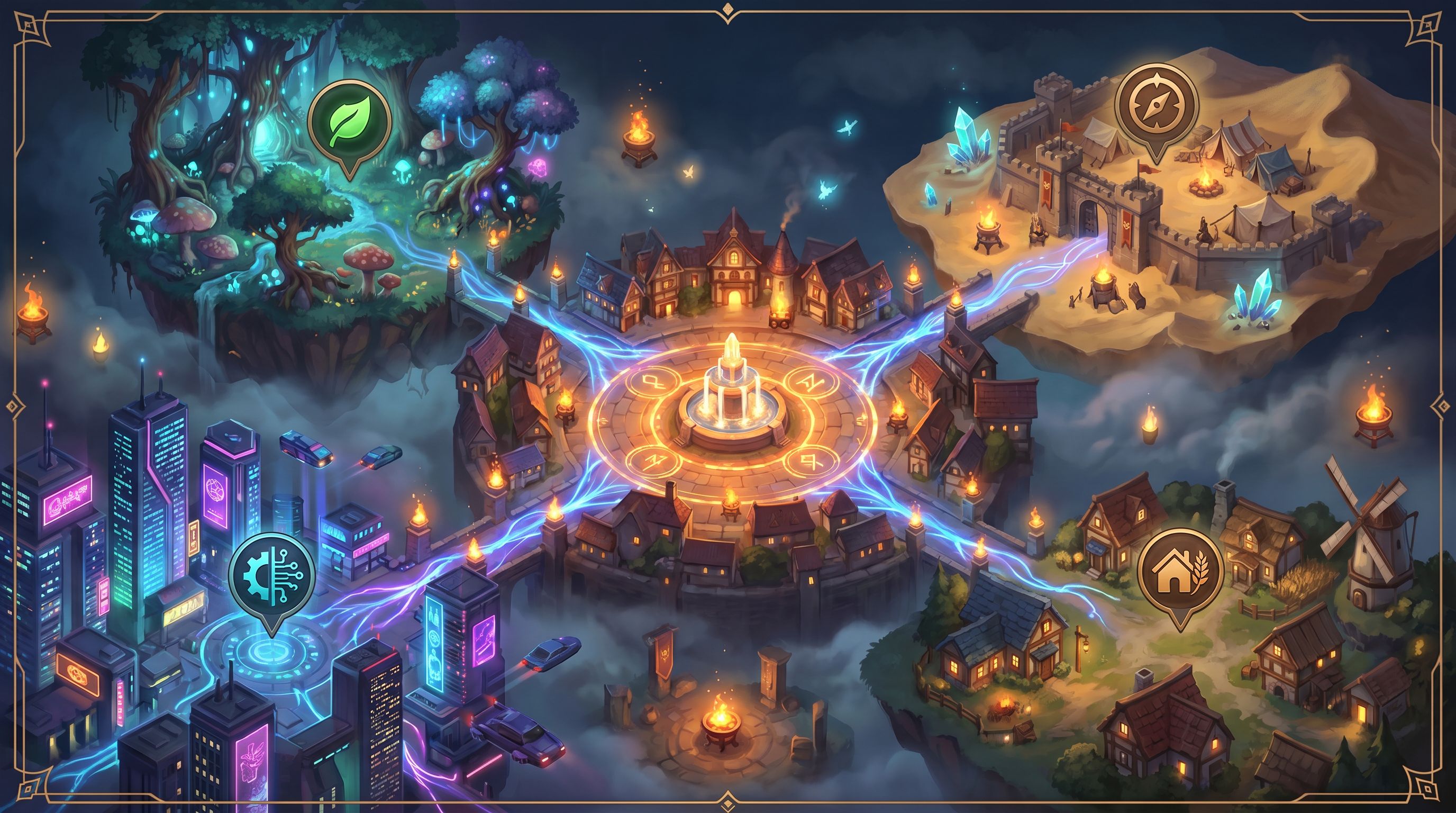
Think of a hub-and-spoke structure as a story airport:
- The hub is a recurring location, time, or situation.
- Each spoke is an excursion—a mission, episode, or perspective that leaves the hub and eventually returns.
This is a natural fit for Questas because the visual editor makes it easy to:
- Reuse hub scenes with slight variations
- Gate spokes behind prior choices
- Track variables (reputation, resources, relationships) that change how the hub behaves next time
When to use it
- Ongoing series: leadership labs, recurring sales sims, episodic fandom stories.
- Training with modules: each spoke covers a different scenario, but the hub is the same team, office, or mission control.
- Worldbuilding: the hub is your city, starship, guild hall, or online community.
How to build a hub-and-spoke in Questas
-
Define your hub clearly.
- Where are we when “nothing special” is happening?
- Who’s always present here?
- What can change about this place over time?
-
Draft 3–5 spokes, not 20.
- Give each spoke a distinct focus: one about ethics, one about strategy, one about relationships, etc.
- In “The 5-Scene Story Lab: Rapidly A/B Testing Branches, Endings, and Visual Styles in Questas”, we talk about testing tiny arcs first—apply that here. Prototype one spoke at a time.
-
Let the hub remember.
- Use variables (e.g.,
trust_with_mentor,budget_remaining) that update in each spoke. - On return to the hub, surface those changes in dialogue, visuals, and options.
- Use variables (e.g.,
-
Use AI visuals to mark progress.
- Early hub scenes might look clean and calm.
- Later, you prompt Questas’s AI for more clutter, damage, or trophies—visual shorthand for how the storyworld has evolved.
Design tip: Don’t make every spoke mandatory. Part of the fun is letting players choose which “episodes” to visit and in what order.
Structure #2: The Web of Perspectives
Another way to go beyond the hero’s journey is to stop having one hero at all.
In a multi-perspective web, players jump between different characters, factions, or timelines. Each route is less about “beating the story” and more about understanding the whole picture.
This pattern is especially strong for:
- Research and journalism pieces where you want players to inhabit conflicting viewpoints (see also “Beyond Story Games: Unexpected Questas Use Cases in Research, Journalism, and Civic Design”).
- Organizational simulations where executives, frontline staff, and customers experience the same event differently.
- Fandom storyworlds where players can play as rival characters or ships.
Core moves for a perspective web
-
Anchor with a single event.
- A product launch, a crisis, a festival, a heist.
- Every perspective experiences that event, but with different stakes and information.
-
Limit perspectives to 3–4.
- Any more and players lose track of who’s who.
- Give each viewpoint a clear, contrasting goal and tone.
-
Cross-pollinate choices.
- Decisions in one route quietly change conditions in another.
- Example: As the CISO, you under-report an incident. Later, as the PR lead, you face limited options because the truth was buried.
-
Use visuals to differentiate POV.
- One character’s scenes might be rendered in cool, clinical lighting; another’s in warm, chaotic frames.
- You can even shift aspect ratios or composition (tight close-ups vs. wide shots) to signal whose eyes we’re looking through.
-
Reward replay with insight, not just endings.
- The goal is: “Oh, that’s why they did that,” not just “New badge unlocked.”
Implementation in Questas:
- Use the visual node graph to group scenes by character.
- Add a “select a perspective” gateway near the start, then unlock new perspectives after finishing one.
- Consider a final “synthesis” scene that only appears after players have seen at least two routes.
Structure #3: Time Loops and Sliding Doors
Time loops and “what if this one moment went differently?” stories are practically built for branching platforms.
In a looping structure, players repeat a core sequence with variations, carrying forward knowledge (and sometimes variables) from prior runs.
In a sliding doors structure, you fork hard at a single pivotal choice, then explore radically different timelines.
Why loops shine in interactive form
- They make replayability part of the fiction, not just a meta feature.
- They’re perfect for skill-building: players try different approaches, see consequences, and iterate.
- They align with simulation-heavy use cases—risk management, crisis drills, negotiation practice—where you want people to run the scenario again with new strategies.
Building a loop in Questas without confusing players
-
Define the core cycle.
- Keep it short: 5–7 scenes that form the “day,” “mission,” or “meeting.”
- Each cycle should take only a few minutes to play.
-
Track what the player knows.
- Use flags like
knows_about_leakormet_informant. - On subsequent loops, unlock new dialogue and options based on those flags.
- Use flags like
-
Change visuals each loop.
- Slightly shift camera angles, lighting, or props to show that the loop is “glitching” or evolving.
- With Questas’s AI image generation, you can create these variations quickly: same prompt, plus modifiers like “subtle motion blur,” “dusk instead of noon,” or “room slightly more disheveled.”
-
Give players explicit goals per loop.
- First loop: “Just survive the day.”
- Second loop: “Gather intel on three key characters.”
- Third loop: “Attempt the perfect run based on what you’ve learned.”
-
Decide when loops end.
- Maybe after X loops, or when certain conditions are met.
- Avoid infinite groundhog days; closure matters.
Sliding doors variant:
- Start with a single, clearly framed, high-stakes choice.
- Branch hard into two or three timelines that do not recombine.
- Reuse some locations and characters, but let their circumstances and relationships diverge wildly.
This is a great pattern when you want to show trade-offs, not just “good vs. bad” paths—something we also explore in “Designing ‘Soft Fails’ in Questas: Letting Players Mess Up Without Breaking the Story”.
Structure #4: The Lattice of Constraints
Many real-world problems—negotiations, policy design, product strategy—aren’t about one grand adventure. They’re about navigating constraints:
- Limited budget
- Conflicting stakeholder goals
- Legal and ethical boundaries
A lattice structure treats your story as a grid of trade-offs rather than a single escalating arc.
How a lattice feels to players
- Instead of “beat the boss,” it’s “find a viable route through this maze of constraints.”
- Multiple paths can be valid, but each comes with different costs.
- Players are nudged to replay to see if they can achieve a better balance of outcomes.
Designing a lattice in Questas
-
Pick 2–3 key metrics.
- For example:
customer_trust,profit_margin,team_morale. - Make them visible to the player with simple UI or narrative cues.
- For example:
-
Tag choices with trade-offs.
- Each decision should clearly help one metric while hurting another.
- You can implement this with simple variable adjustments in Questas’s logic.
-
Create “checkpoints,” not endings.
- At certain nodes, evaluate the metrics and branch into different scenes.
- Avoid sharp “game over” states unless the player truly hits an extreme.
-
Offer multiple “good enough” outcomes.
- Maybe one route maximizes trust, another profit, another resilience.
- Let players decide which success they’re aiming for.
-
Use visuals to externalize constraints.
- Boardroom full of tense faces when trust is low.
- Overworked team in cramped, dim offices when morale is low.
- Sleek new HQ with protestors outside when profit is high but public perception is damaged.
This structure is especially potent for enterprise use cases, like the simulations described in “Branching for B2B: Designing Questas Scenarios That Actually Move Enterprise Deals Forward” (/branching-for-b2b-designing-questas-scenarios-that-actually-mov), where the goal is to help people feel how trade-offs work—not just read about them in a slide deck.
Structure #5: The Mosaic Anthology
Not every quest needs a single protagonist or timeline. Sometimes, the most powerful structure is an anthology: a collection of short, self-contained vignettes that echo and resonate with each other.
In a mosaic anthology, players move through small stories that share:
- A theme (e.g., courage, burnout, corruption)
- A setting (e.g., the same city at different times)
- A mechanic (e.g., always choosing between three moral priorities)
Why anthologies work so well in Questas
- They’re modular: easy to expand, reorder, or retire.
- They’re creator-friendly: different team members can own different vignettes.
- They’re player-friendly: you can dip in for one 5-minute story or binge a whole set.
Building a mosaic without losing coherence
-
Decide your unifying thread.
- A recurring symbol, location, or question.
- Example: Every story ends with the player answering, “What did you protect?”
-
Keep vignettes short and sharp.
- 3–7 scenes each.
- One central dilemma, 2–3 meaningful outcomes.
-
Let choices echo across stories (lightly).
- Completing one vignette might unlock a “mirror” vignette from another angle.
- Variables can carry across, but don’t overcomplicate it.
-
Use visuals as your glue.
- Shared color palette, character design language, or visual motif.
- Tools and techniques from posts like “From Style Guide to Shot List: Building Reusable Visual Systems for Ongoing Questas Series” (/from-style-guide-to-shot-list-building-reusable-visual-systems) and “Prompt Libraries That Scale: Building Reusable AI Image Systems for Long-Running Questas Series” (/prompt-libraries-that-scale-building-reusable-ai-image-systems) are perfect here.
-
Offer multiple paths through the anthology.
- Chronological, thematic, or “random draw” modes.
- In Questas, you can create a simple menu scene that routes players to different vignettes and tracks which they’ve completed.
Practical Workflow: Choosing the Right Structure for Your Next Quest
It’s easy to get excited about structures and end up overbuilding. To keep things grounded, use this quick decision guide.
Ask yourself three questions:
-
What’s the primary player emotion I care about?
- Curiosity and discovery → Hub-and-spoke or mosaic anthology
- Empathy and perspective-taking → Web of perspectives
- Mastery and iteration → Time loops / sliding doors
- Strategic thinking and trade-offs → Lattice of constraints
-
How long should a single playthrough be?
- 5–10 minutes → Mosaic vignette, short loop, single spoke.
- 20–40 minutes → Full hub cycle, multi-perspective run, deeper lattice.
-
How much maintenance can I handle?
- Limited time → Start with one spoke, one loop, or 3–4 anthology vignettes.
- Ongoing series → Invest in a hub or lattice that can grow over time.
Then, prototype ruthlessly small.
- Use the “5-scene lab” mindset from “The 5-Scene Story Lab: Rapidly A/B Testing Branches, Endings, and Visual Styles in Questas” (/the-5-scene-story-lab-rapidly-ab-testing-branches-endings-and-v).
- In Questas, sketch your structure with placeholder text and quick AI images.
- Put it in front of 3–5 players and watch where they:
- Hesitate or get lost
- Feel delighted
- Immediately hit replay
Iterate on the structure before you pour time into polishing dialogue or visuals.
Bringing It All Together
Non-linear structures aren’t just clever diagrams on a whiteboard. They’re how you:
- Make every replay feel intentional, not repetitive
- Turn “content” into a living system players can explore
- Align your story shape with your real goal—whether that’s empathy, strategy, practice, or pure wonder
Platforms like Questas make these structures practical:
- Visual, no-code editing means you can rearrange nodes until the structure feels right.
- AI-generated images and video let you visually signal loops, perspectives, and evolving hubs without a huge art budget.
- Variables and conditions give you the levers to implement lattices, loops, and webs without writing custom code.
Once you stop forcing every quest into a hero’s journey, you unlock a much wider design space—one that’s better suited to the messy, branching realities you’re trying to represent.
Where to Go Next
If you’re ready to experiment with these structures, here’s a simple starting plan:
- Pick one structure from this post that matches your current project.
- Outline a 5-scene prototype in a notebook or doc.
- Open Questas and:
- Create placeholder scenes for each node.
- Wire the branches according to the structure.
- Generate quick, indicative AI images for key beats.
- Invite 2–3 people to playtest and ask them:
- “Where did you feel most in control?”
- “Where did you feel lost or railroaded?”
- “What path are you curious to try next?”
- Iterate on the structure first, then deepen content and visuals.
Summary
- The hero’s journey is a powerful template, but branching stories often need different shapes to shine.
- Structures like hub-and-spoke, web of perspectives, time loops and sliding doors, lattices of constraints, and mosaic anthologies align better with what interactive stories do best: exploration, agency, and systems thinking.
- Questas gives you the tools—visual editing, AI visuals, and conditional logic—to experiment with these patterns without code.
- Start small, prototype quickly, and let player behavior guide which structures you double down on.
Take Your First Step
If you’ve been sketching linear outlines and then “bolting on” branches, this is your invitation to flip the process.
Open Questas, pick one non-linear structure from this post, and build the smallest possible version of it—a 5–7 scene experiment you can share with a friend or colleague this week.
You don’t need a trilogy-length saga to explore new shapes. You just need one small quest that treats structure as a design choice, not an afterthought.
Adventure awaits—this time, in more than one direction.