Designing Emotional Arcs in Branching Stories: How to Make Every Path Feel Like a Real Journey


Interactive stories live or die on emotion.
You can have clever twists, intricate logic, and gorgeous visuals—but if players don’t feel anything as they move through your branches, they’ll remember your quest as a puzzle, not a journey.
Designing emotional arcs in branching narratives is tricky. Linear stories get one timeline, one build of tension, one payoff. Branching stories multiply that challenge across dozens of possible paths. The good news: with a clear emotional blueprint and the right tools, you can make every route through your story feel coherent, meaningful, and satisfying.
That’s exactly where platforms like Questas shine: they give you a visual, no‑code way to map choices, weave emotional beats into each branch, and support them with AI‑generated images and video that deepen what players feel—not just what they see.
Why Emotional Arcs Matter More in Branching Stories
In a branching story, players are doing more than “reading.” They’re:
- Projecting themselves into the protagonist (or stepping into a role you’ve defined).
- Making decisions that reveal their values, fears, and curiosity.
- Testing alternate futures—for themselves, their teams, or their characters.
If those decisions don’t change how they feel, your experience becomes a glorified flowchart.
Strong emotional arcs in branching stories:
- Increase replayability. Players come back to see “how it feels” to choose differently, not just to unlock a new text block.
- Improve learning and retention. Emotion is a powerful memory anchor—critical if you’re using interactive stories for training, research, or education.
- Reveal deeper insights. When you watch which emotional beats people chase or avoid, you learn far more than from a static survey. (This is exactly why researchers and civic designers are adopting interactive narratives—see how they do it in Beyond Story Games: Unexpected Questas Use Cases in Research, Journalism, and Civic Design.)
- Support non‑entertainment goals. Whether you’re building a leadership sim, a playable persona, or a market research scenario, emotion is what makes the experience stick.
The challenge is making sure every path feels like a journey, not just the “main” one you secretly care about most.
Step 1: Start with an Emotional Map, Not a Plot Diagram
Most creators begin with plot:
Scene 1 → Choice A/B → Scene 2a / 2b → Big twist → Ending.
Instead, start with emotion over time.
Ask yourself:
- What do I want players to feel at the start?
- Curious? Anxious? Empowered? Lost?
- What emotional journey fits the theme?
- From overconfident → humbled → wiser.
- From skeptical → intrigued → committed.
- From fearful → brave → responsible.
- What flavors of that journey fit different branches?
- A “cautious” route might be slower, more reflective.
- A “reckless” route might be intense, high‑stakes, and messy.
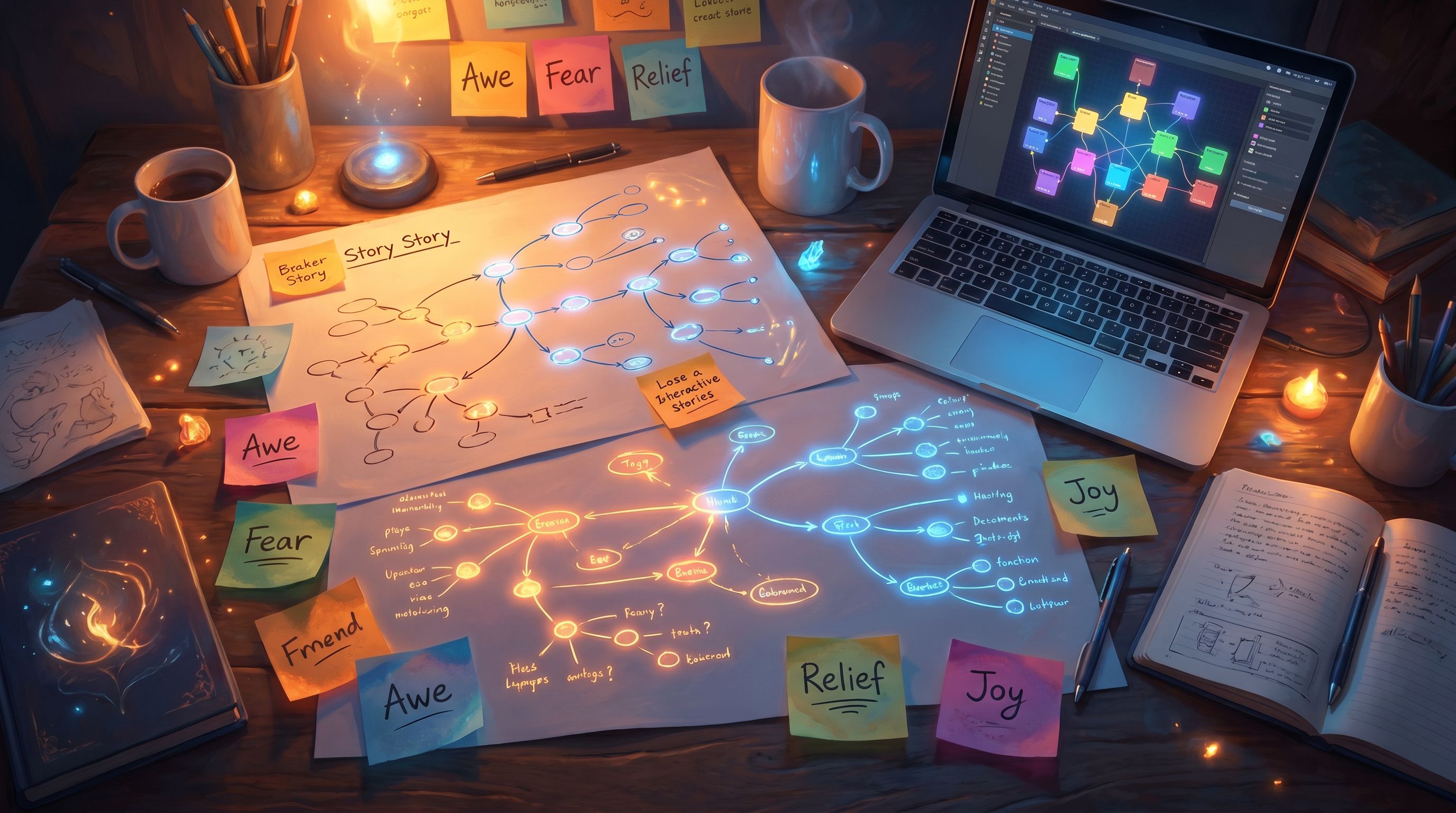
A simple way to sketch this is with emotional arcs per path:
- Draw a horizontal line for each major branch (A‑path, B‑path, C‑path).
- Mark key beats: inciting incident, first big choice, midpoint reversal, low point, climax, resolution.
- Label each beat with the dominant emotion you want: surprise, dread, relief, pride, regret, awe.
Once you’ve done this, you’re not just writing scenes—you’re engineering feelings.
Pro tip: In Questas, you can mirror this map directly in the visual editor: name nodes after their emotional purpose (e.g.,
Midpoint_Reversal_Dread) instead of just their plot content. It keeps you honest about what each scene is supposed to do.
Step 2: Design “Emotional Checkpoints,” Not Just Plot Nodes
In a branching story, it’s unrealistic (and unnecessary) for every path to hit the exact same beats. But you can design shared emotional checkpoints that each branch visits in its own way.
Think of these as:
- Moments of commitment – where the player doubles down on a value or strategy.
- Moments of doubt – where previous choices feel shaky.
- Moments of consequence – where the cost of earlier decisions shows up.
- Moments of grace – where forgiveness, learning, or second chances appear.
For each checkpoint, ask:
- What’s the emotional question here? (e.g., “Was I right to trust this ally?”)
- What are 2–3 different ways to reach that question? (through success, failure, or ambiguous outcomes)
- What are 2–3 different ways to answer it? (reassurance, painful truth, partial resolution)
Then, when you build your branches in Questas, make sure every major path touches each checkpoint once—even if the scenes and circumstances differ.
This is how you avoid “orphan” branches that feel like side quests with no emotional payoff.
Step 3: Use Choice Design to Shape Feelings, Not Just Outcomes
A choice isn’t just a fork in the plot. It’s a mirror for the player’s internal state.
To design emotionally rich choices:
1. Make trade‑offs emotional, not purely mechanical
Instead of:
- “Take the shortcut (save time) / Take the long route (lose time)”
Try:
- “Risk your team’s safety to arrive first” vs. “Arrive late but protect your team from danger.”
Now the choice exposes values (speed vs. care), which will color how players feel about whatever happens next.
2. Name the why, not just the what
Choice labels can carry emotional subtext:
- “Confront them directly” vs. “Drop a subtle hint” vs. “Avoid the topic for now.”
Each option implies a personality trait or coping style. Players often pick the one that feels closest to how they would act, which deepens identification.
3. Foreshadow feelings, not just consequences
Hint at the emotional cost or reward:
- “You might win their trust—or their resentment.”
- “This could be your last chance to apologize.”
By signaling emotional stakes, you help players anticipate how the story might feel, not just how it might end.
On Questas, you can support this with micro‑copy around choices and with AI‑generated visuals that hint at mood—like a dim hallway for a risky option versus a sunlit office for a safer one. For more on using visuals to support narrative intent, check out From Moodboard to Mission: Using AI Style Boards to Lock In the Look of Your Next Questas World.
Step 4: Let Visuals and Micro‑Video Carry Emotional Weight
Words do a lot of work—but in interactive stories, images and video can do the heavy lifting for emotion.
Here’s how to use AI‑generated media strategically:
1. Consistent style, evolving mood
- Keep your visual style consistent so players feel grounded in one coherent world.
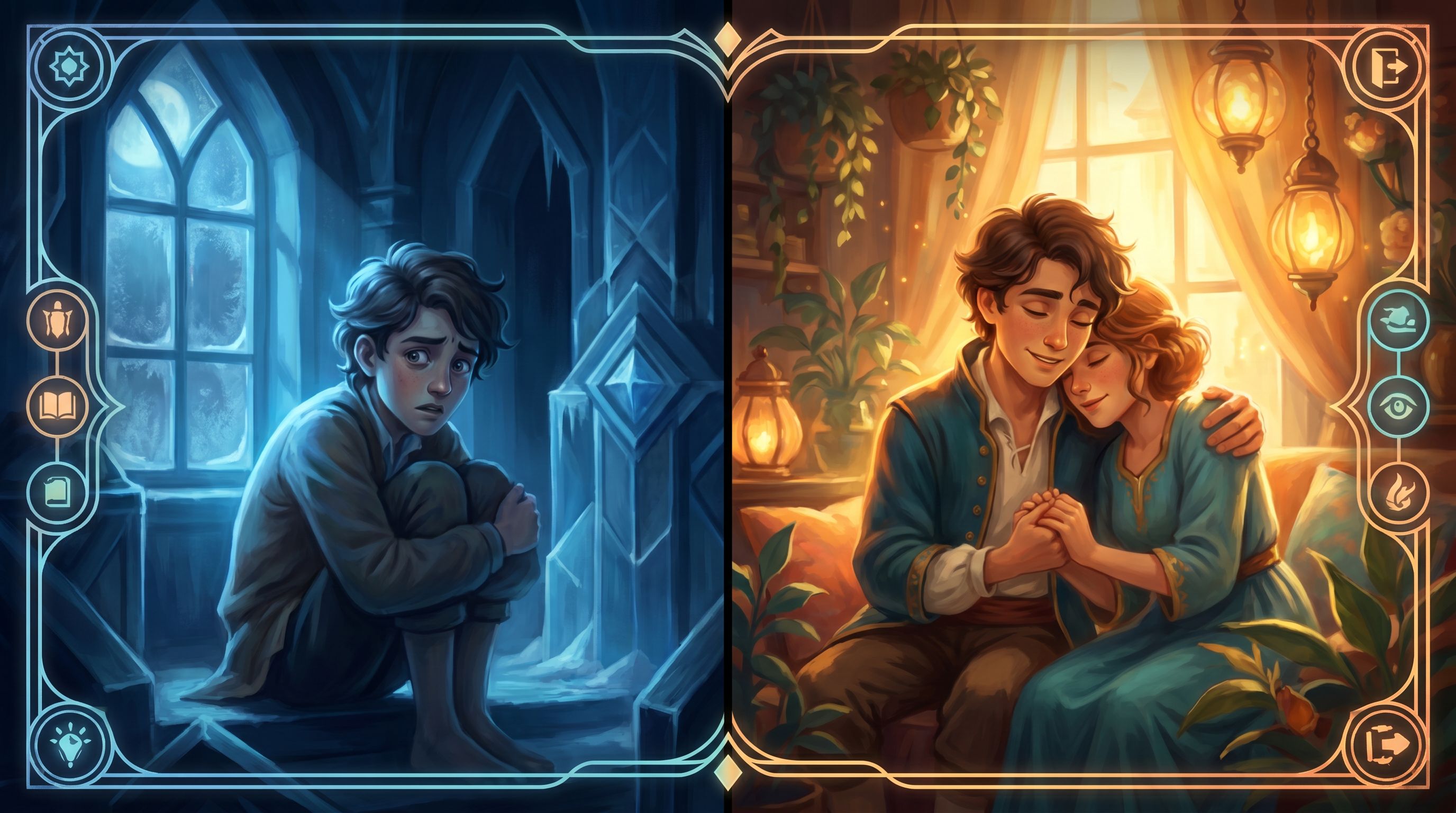
- Shift lighting, color, and composition to match emotional beats:
- Cool, desaturated palettes for uncertainty or regret.
- Warm, high‑contrast scenes for triumph or connection.
- Tight close‑ups for intimacy or tension; wide shots for loneliness or awe.
If you’re building a series or a large quest, you’ll save time and keep emotional tone aligned by building a reusable prompt system—see how in Prompt Libraries That Scale: Building Reusable AI Image Systems for Long-Running Questas Series.
2. Micro‑video for turning points
Short AI‑generated video moments can:
- Stretch a moment before a big decision (a door slowly closing, a character hesitating).
- Underline a consequence (lights flickering out after a risky choice, a crowd’s reaction to your announcement).
- Shift pacing—a quick cut can shock; a lingering pan can build dread.
In Questas, you can drop these micro‑videos directly into nodes that precede or follow important choices, turning them into emotional punctuation marks.
Step 5: Give Every Path a Real Ending (Even the “Bad” Ones)
Nothing flattens emotion faster than an abrupt: “You failed. The end.”
Even if your story includes failure states, treat them as complete emotional resolutions, not dead screens.
For each ending—“good,” “bad,” or ambiguous—ask:
- What did the player learn about themselves?
- Did they discover they’re risk‑averse, loyal, ruthless, idealistic?
- What emotional note do you want to leave them on?
- Regret, but with clarity.
- Bittersweet pride.
- Hope after loss.
- What reflection or echo can you offer?
- A character commenting on their pattern of choices.
- A short montage of key decisions and their ripple effects.
- A final question back to the player: “If you could choose again, what would you do differently?”
Mechanically, you can:
- Tag ending nodes in Questas with metadata like
theme: sacrificeoremotion: bittersweetto keep track of your tonal spread. - Ensure that even short branches get some form of reflection—one or two extra beats can turn a “game over” into a memorable, meaningful moment.
Step 6: Use Playtesting to Tune Feelings, Not Just Fix Bugs
Creators often use playtests to catch broken links or confusing choices. That’s necessary—but if you stop there, you miss the richest data: how people actually feel as they play.
During early playtests, focus on:
- Moment‑to‑moment emotion. Ask players to narrate how they’re feeling out loud or use quick emoji/check‑in prompts at key nodes.
- Emotional whiplash. Look for branches where tone lurches unexpectedly (e.g., slapstick humor right after a tragic reveal) unless that contrast is intentional.
- Flat spots. Identify sequences where players feel like they’re “just clicking” without caring.
Useful questions:
- “Where did you feel most invested in what happened next?”
- “Which choice felt hardest to make—and why?”
- “Where did you stop caring about the outcome?”
In Questas, you can pair this qualitative feedback with basic analytics—like which branches are rarely chosen or where people tend to drop off. For a deeper dive into turning messy notes into something you can act on, see From Playtest Notes to Narrative Analytics: What to Measure (and Ignore) in Your Early Questas Builds.
Then iterate:
- Strengthen emotional foreshadowing where surprises feel cheap.
- Add or trim scenes where tension sags.
- Clarify choice text where players feel railroaded or confused.
Over a few cycles, you’re not just debugging—you’re tuning the emotional instrument of your story.
Step 7: Keep Scope Manageable Without Flattening Emotion
Branching stories can balloon quickly. More branches don’t automatically mean richer emotion. In fact, too many shallow paths often feel worse than a few deep ones.
To keep things sustainable:
- Limit “true” branches. Let many choices reconverge on shared emotional checkpoints, even if the flavor text differs.
- Design a “minimal viable quest.” Start with a compact structure (for example, three key decisions, each with two options) and make those choices emotionally dense before expanding. If you’re new to this, the patterns in The Minimal Viable Quest post are a great starting point.
- Reuse emotional scaffolding. Once you’ve designed a strong “doubt” moment or “reckoning” scene, you can adapt its structure for alternate paths instead of inventing entirely new beats.
Tools like Questas help here because you can visually see where branches explode and where they converge, then refactor your flow without touching code.
Bringing It All Together
To make every path in your branching story feel like a real journey:
- Start with emotional arcs, not just plot. Decide how you want players to feel across different paths.
- Anchor your branches in shared emotional checkpoints. Let each route visit commitment, doubt, consequence, and grace in its own way.
- Design choices as emotional mirrors. Make trade‑offs about values, not just mechanics.
- Use visuals and micro‑video as emotional amplifiers. Keep style consistent while letting mood evolve.
- Treat every ending as a real resolution. Even failures can end with insight, not just a blank wall.
- Playtest for feelings. Listen for where players lean in, check out, or feel whiplash—and tune accordingly.
- Control scope with smart reconvergence. Fewer, deeper branches beat dozens of shallow ones.
When you approach branching design this way, you stop thinking of “paths” as alternate versions of the same story. Each path becomes its own emotional truth about the world, the characters, and the player.
Ready to Build a Journey Worth Replaying?
You don’t need a game engine or a dev team to craft emotionally rich branching stories. With a visual, no‑code platform like Questas, you can:
- Sketch emotional arcs directly into your node map.
- Pair each beat with AI‑generated images and micro‑videos that reinforce the mood.
- Playtest, tweak, and iterate until every path feels like a complete, satisfying journey.
If you’ve been sitting on an idea—a leadership sim, a classroom scenario, a playable research report, or a pure fiction saga—this is your nudge:
- Pick one emotional journey you want players to experience.
- Draft three pivotal choices that will shape that journey.
- Open Questas and build a tiny prototype path.
Your first version doesn’t have to be perfect. It just has to feel like something.
From there, you can branch.
Summary
Designing emotional arcs in branching stories is about more than managing complexity—it’s about giving every path a beating heart. By starting with emotion, designing around shared checkpoints, using choices as mirrors, and supporting your narrative with purposeful visuals and playtesting, you can create interactive experiences that people don’t just click through—they remember.
And with tools like Questas, you can do all of that without writing a single line of code—just a clear emotional map, a handful of strong choices, and the courage to let your players shape their own journeys.