The Quiet Choice: Using Low-Stakes Branches to Build Empathy, Not Just Drama, in Questas


Most creators reach for big, dramatic forks in the road when they start building interactive stories:
- Do you save the village or chase the villain?
- Do you report the misconduct or stay silent?
- Do you launch the product or delay and risk the quarter?
Those moments matter. They create tension and replay value. But if every choice in your story is a cliff edge, you miss one of the most powerful things branching narratives can do: quietly grow empathy.
Low-stakes branches—small, “safe” decisions that don’t blow up the plot—are where players learn who they are in your world. They’re where you can:
- Reveal values and biases without shaming people.
- Let players experiment with perspectives.
- Build emotional investment long before the big crisis hits.
On a platform like Questas, where you can rapidly spin up scenes, tweak choices, and generate AI visuals without code, those subtle branches are incredibly cheap to build—and disproportionately powerful.
This post is about designing those quiet choices on purpose so your quests don’t just deliver drama; they build understanding.
Why Small Choices Matter More Than You Think
When people talk about impactful interactive stories, they often point to the “big twist” decisions. But research on behavior change and learning tells a different story: repeated, low-pressure practice is what actually shifts attitudes and skills over time.
In fields like healthcare, leadership, and DEI, scenario-based learning has been shown to improve empathy and perspective-taking by letting people safely explore situations from multiple viewpoints and see the human consequences of their choices. Interactive case studies, branching dialogues, and simulations are especially effective because they create a sense of presence and accountability without real-world risk.
Low-stakes branches are the narrative equivalent of those micro-scenarios:
- They normalize reflection. When a choice isn’t “life or death,” players are more willing to try something unfamiliar or uncomfortable.
- They accumulate. Ten small choices about how you greet a coworker, handle a minor inconvenience, or react to a misunderstanding paint a much richer picture of a character’s values than one giant moral dilemma.
- They humanize side characters. Quiet decisions about who you talk to, what you ask, or whether you listen can turn NPCs from exposition machines into people players genuinely care about.
In Questas, you can use these branches to shape how players feel, not just what they do.
What Counts as a “Low-Stakes” Branch?
A low-stakes branch is any decision where:
-
The core plot doesn’t hinge on the outcome.
The villain is still at large, the project is still due, the ship is still heading to the same star. -
The emotional or relational impact is the real payload.
The choice changes how someone feels about you, what you learn, or how you interpret events. -
The player can’t really “lose,” but they can learn.
Even a clumsy choice leads to insight rather than a hard fail.
Examples:
- Choosing how to apologize, not whether to apologize at all.
- Deciding which colleague to sit next to during a quiet train ride.
- Picking which question to ask a refugee about their past.
- Selecting a tone for your email: blunt, diplomatic, or playful.
These choices seem trivial in isolation, but when you weave them through a quest, they:
- Build a trail of micro-consequences (who trusts you, who opens up, who stays distant).
- Prime players to notice subtext, not just explicit plot beats.
- Make later high-stakes decisions feel earned, because the relationships behind them have a history.
If you’re used to designing only big forks, think of low-stakes branches as the connective tissue between your major beats—something we explore from a pacing angle in From Branch Map to Beat Sheet: Structuring Scene Pacing in Complex Questas Stories.
Designing Empathy-Focused Branches in Questas
Here’s a practical way to design low-stakes branches that deepen empathy instead of just adding noise.
1. Start With a Relationship, Not a Plot Twist
Pick one relationship you want players to care about:
- A junior teammate who’s nervous but talented.
- A local shopkeeper in your fantasy town.
- A customer in a support simulation.
- A sibling in a slice-of-life story.
Then ask:
“What are three tiny moments where this person could feel seen—or ignored?”
Turn each of those into a branch:
- Do you notice they’re quiet and ask a gentle follow-up, or plow ahead with your agenda?
- Do you compliment their idea publicly, or take the credit by accident?
- Do you remember a detail from a previous conversation, or treat this like a first meeting every time?
In Questas, you can:
- Create a simple variable (e.g.,
trust_Asha) that increments based on these micro-choices. - Use that variable later to unlock a confidante scene, a warning, or just a different emotional tone in dialogue.
You haven’t changed the main plot—but you’ve changed how it feels to move through it.

2. Make Choices About Perspective, Not Just Action
Empathy grows when players are nudged to consider another point of view. Low-stakes branches are perfect for this.
Instead of only offering action choices like:
- “Confront the manager” vs. “Say nothing,”
Try choices that are about interpretation:
- “Assume the manager is under pressure from above.”
- “Assume the manager doesn’t care.”
- “Stay curious and withhold judgment for now.”
In Questas, you can:
- Use conditional text to reflect the player’s chosen lens: the same scene can feel hostile, chaotic, or just messy depending on their interpretation.
- Let later scenes challenge or confirm that lens, inviting reflection without a lecture.
This technique is especially powerful if you’re adapting existing conversational flows—like chatbots or FAQ scripts—into visual, branching experiences. If that’s your context, From Chatbot to Quest Guide: Turning Conversational Flows into Visual, Branching Questas Experiences walks through how to translate linear Q&A into meaningful narrative choices.
3. Use “Soft Fails” as Empathy Engines
A low-stakes branch doesn’t have to go smoothly to be valuable. In fact, slightly awkward outcomes can be more memorable.
Design soft fails where:
- The player misreads someone’s mood.
- A joke lands badly.
- A well-intentioned question touches a nerve.
Instead of punishing them with a dead end, let the world respond:
- The character pulls back a bit but later explains why.
- Another character gently calls out the misstep.
- The player gets a chance to repair the moment with a follow-up choice.
This “bend, don’t break” philosophy is explored more deeply in Designing ‘Soft Fails’ in Questas: Letting Players Mess Up Without Breaking the Story, but the key idea here is:
Use soft fails to model how repair and growth work in real relationships.
When players see that missteps are recoverable, they’re more willing to:
- Try bolder, more empathetic options later.
- Reflect on their own habits without shutting down.
4. Let Visuals Carry Emotional Subtext
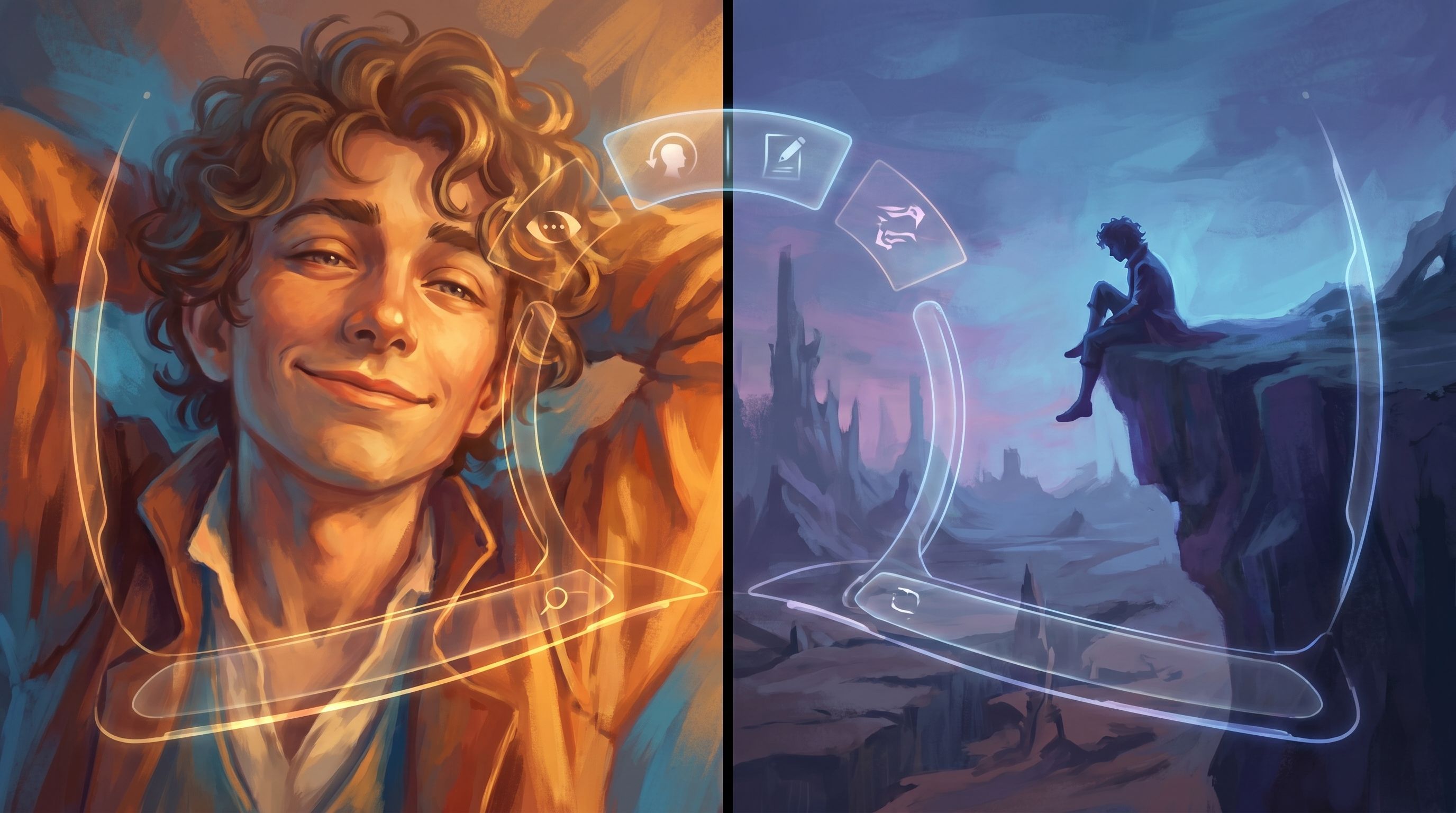
Because Questas can generate images and micro-videos for each scene, you’re not limited to text to convey empathy. Low-stakes branches are a natural place to let visuals do quiet work.
For example:
- A choice to stay and listen to a character could cut to a close-up of their hands unclenching, or their shoulders relaxing.
- A choice to rush off might show them left alone in a wide shot, small in the frame, surrounded by a busy environment.
Tips for using visuals in empathy-building branches:
- Stay consistent with character design. If you’re running a series or anthology, align your prompts and style choices so players recognize faces and body language across episodes. The ideas in AI as Art Director: Building Cohesive, On-Brand Visual Languages for Your Questas Series can help you build that consistency at scale.
- Favor body language over spectacle. Low-stakes moments don’t need explosions; they need subtle shifts in posture, gaze, and distance.
- Use framing as commentary. Tight close-ups for intimacy, over-the-shoulder shots to align with a character’s POV, wide shots to emphasize isolation.
These details help players feel the impact of a choice like “ask one more question” even when the plot stakes are tiny.
5. Design Micro-Arcs Inside Your Branches
Low-stakes branches shouldn’t feel random or throwaway. Treat each one as a micro-arc with a beginning, middle, and end:
- Setup – A small tension or question: someone seems off, a meeting feels awkward, a friend is quieter than usual.
- Choice – The player picks a way to respond: ignore, probe, deflect, support.
- Immediate Response – A short, grounded reaction: a look, a line, a small shift in behavior.
- Echo – Later, something tiny changes because of it: a tip shared, a warning given, an invitation extended—or withheld.
In Questas, this can be as simple as:
- A two-node branch with a variable toggle.
- A callback scene 3–5 beats later that checks the variable and swaps a few lines of dialogue or a visual.
The player never sees the wiring, but they feel the continuity.
6. Keep the Map Manageable
The biggest fear with adding lots of quiet branches is that your story map will explode. That’s a real risk—but it’s manageable if you:
- Favor re-convergence. Let branches diverge briefly to show a different emotional beat, then rejoin the main path quickly.
- Reuse scenes with conditions. Instead of building two entirely separate routes, use one shared scene with conditional text and visuals based on previous choices.
- Limit your empathy variables. Track a handful of key relationships or lenses, not every micro-state.
If you’re worried about complexity, pair this approach with techniques from From Idea to Interactive: A Step‑By‑Step Workflow for Building Your First Questas Story and The 5-Scene Story Lab: Rapidly A/B Testing Branches, Endings, and Visual Styles in Questas. You can prototype a few low-stakes empathy branches in a tiny build before rolling them into a larger quest.
Example Patterns You Can Steal
Here are plug-and-play patterns you can drop into almost any Questas story.
The Commuter Seat
Context: A daily commute, shuttle ride, or elevator scene.
Choice:
- Sit next to the same person as yesterday.
- Sit next to someone new.
- Stand and scroll your phone.
Empathy outcome:
- Repeat seats deepen one relationship over time.
- New seats broaden your understanding of the world.
- Phone-scrolling keeps you informed on plot events but emotionally distant.
The Debrief
Context: After a tense meeting or mission.
Choice:
- Ask your teammate, “How did that feel for you?”
- Vent about your own experience.
- Change the subject and move on.
Empathy outcome:
- Teammate opens up and shares context you missed.
- You bond over shared frustration but miss a deeper issue.
- Resentment simmers quietly and surfaces later.
The Name Remembered
Context: Returning to a location you’ve visited before.
Choice:
- Greet the NPC by name.
- Greet them generically.
- Ignore them and go straight to business.
Empathy outcome:
- Named greetings unlock warmth, favors, or small discounts.
- Generic greetings keep things neutral.
- Coldness leads to slower help or reluctant cooperation.
Each of these can be implemented with:
- 1–2 extra nodes in Questas.
- A single relationship variable.
- A callback scene that pays off the pattern.
Bringing It All Together
Low-stakes branches are where your quests quietly teach players what kind of world they’re in—and what kind of person they want to be there.
When you:
- Focus on relationships instead of only plot twists,
- Offer choices about perspective as well as action,
- Embrace soft fails and repair instead of binary success/failure,
- Let visuals carry subtle emotional cues, and
- Keep your structure lean with micro-arcs and re-convergence,
…you turn every “small” decision into a chance to practice empathy.
The result isn’t just a more engaging story. It’s an experience that lingers—because players remember how they made people feel, not just whether they “won.”
Where to Go Next
If this has your wheels turning, here’s a simple way to start today:
- Open an existing Questas project (or spin up a new 5-scene prototype).
- Pick one relationship you want to deepen.
- Add two low-stakes branches that:
- Don’t change the main plot, but
- Do change how that character reacts later.
- Use a single variable to track those choices and a callback scene to pay them off.
You don’t need to rebuild your entire quest. Just layer in a few quiet choices and see how your playtesters talk about the characters afterward.
Your players will still remember the high-stakes moments. But the reason they care about those moments—the reason they lean forward, hesitate, and maybe replay—is almost always hidden in the smaller choices you gave them along the way.
Ready to experiment with empathy-first branching? Log into Questas, pick one character, and give them three new quiet moments. Let the small choices do their quiet work—and watch how your whole story deepens around them.