Ethical AI Worldbuilding: Setting Guardrails for Safer, Fairer Questas Story Universes


Interactive stories don’t just entertain; they teach players what’s normal, what’s possible, and who gets to be a hero. When you’re building with Questas, you’re not only designing branching plotlines—you’re effectively running a miniature society in your browser.
That’s a lot of power. And with AI doing more of the heavy lifting—generating characters, locations, and even micro‑videos—it’s easier than ever to accidentally bake in bias, harmful tropes, or confusing, unsafe situations.
Ethical AI worldbuilding is about getting ahead of that. It’s the practice of setting clear guardrails so your Questas story universes feel:
- Safe – Players aren’t blindsided by traumatic content or manipulative design.
- Fair – Characters from different backgrounds get real agency, not token roles.
- Transparent – Players understand where AI is involved and what’s “real” vs. simulated.
- Accountable – You can explain (and if needed, fix) how your world behaves.
If you’re building quests for learning, journalism, research, fandom, or brand work, these questions aren’t optional—they’re table stakes.
Why Ethical Guardrails Matter for Interactive Worlds
When you move from static content to branching experiences, two things change:
- Players make more emotionally loaded decisions. They’re not just reading about a layoff, a protest, or a relationship conflict—they’re choosing what to do.
- AI multiplies your content. A single prompt can spin out dozens of faces, bodies, and scenes. If your prompts are vague or biased, those issues scale with you.
Consequences:
- Bias scales silently. If your “default” CEO prompt keeps generating white men in suits, that becomes the visual canon of power in your world.
- Harmful scenarios can feel endorsed. If a player is nudged toward harassment, discrimination, or self‑harm with no meaningful pushback from the story, it can feel like the world is saying, “This is fine.”
- Learners and players may disengage. People from marginalized groups are quick to spot when a world wasn’t built with them in mind—and they’ll quietly opt out.
The flip side: when you design with ethics in mind, you get huge benefits:
- Deeper trust. Players are more willing to explore hard topics if they trust your boundaries.
- Better learning outcomes. In training or education quests, ethical framing supports psychological safety—which improves reflection and retention.
- Richer stories. Guardrails don’t limit creativity; they push you toward more thoughtful conflicts, nuanced characters, and genuinely interesting dilemmas.
If you’re already experimenting with non‑linear structures, posts like “Beyond the Hero’s Journey: Non-Linear Story Structures That Shine in Questas” show how narrative craft scales. Ethical guardrails are the complementary layer that keeps those structures safe and respectful.
Start With an Ethics Brief for Your World
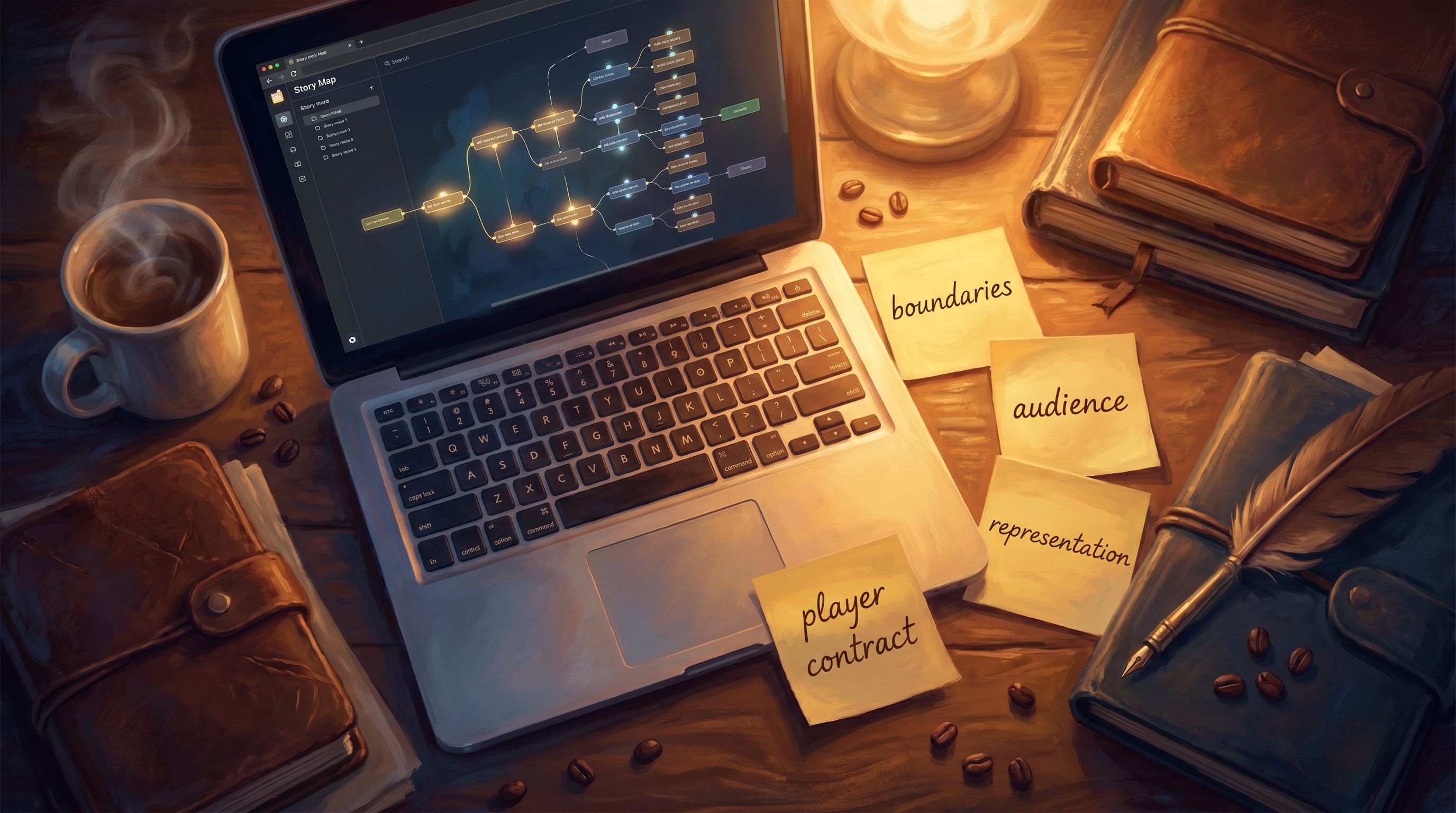
Before you open the Questas editor, write a one‑page ethics brief for your project. Treat it like a mini creative brief, but focused on player well‑being and fairness.
Include:
-
Purpose of the world
- What is this quest for (entertainment, training, research, civic engagement, fandom)?
- What do you not want it to be used for?
-
Intended audience & sensitivities
- Age range, professional context, cultural context.
- Any likely sensitivities (e.g., frontline workers, trauma survivors, minors, marginalized communities).
-
Content boundaries
Define what’s in‑bounds, on‑the‑line, and out‑of‑bounds:- In‑bounds: workplace tension, ethical dilemmas, mild peril, non‑graphic violence.
- On‑the‑line: layoffs, discrimination, relationship conflict, political extremism.
- Out‑of‑bounds: graphic sexual content, hate speech, glorified self‑harm, doxxing, real‑world extremist propaganda.
-
Representation goals
- How diverse should your cast be (race, gender, disability, age, body type, etc.)?
- How will you avoid stereotyping in both text and visuals?
-
Player contract
- What can players expect from the world? (No jump scares, no graphic gore, clear content warnings, etc.)
- How will you communicate this up front—in your quest description, intro scene, or onboarding screen?
Return to this brief whenever you’re making a tricky call about a branch, image, or ending.
Design Choices, Not Traps
Ethical worldbuilding doesn’t mean removing all risk. It means designing risk intentionally.
In branching stories, the line between a meaningful decision and a manipulative trap is thin. To stay on the right side of it, focus on three principles:
1. Make Choices Legible
Players should understand, at least roughly, what kind of action they’re taking.
- Avoid: “Option A / Option B / Option C” with cryptic labels.
- Prefer: Choices that clearly signal tone and stakes, e.g.:
- “Confront your manager about the unfair comment.”
- “Let it slide and focus on finishing the project.”
- “Ask a trusted colleague for advice first.”
If you’re experimenting with different types of choices—risky, reflective, routine—there’s a deeper dive in “From Mood to Mechanic: Designing Choice Types (Risky, Reflective, Routine) in Your Questas Stories”.
2. Avoid No‑Win Scenarios (Except When You Mean It)
A classic ethical failure: every branch leads to harm, humiliation, or punishment, with no way for the player to act with integrity.
- Reserve true no‑win scenarios for stories that are about systemic failure or tragedy—and frame them as such.
- In most quests, ensure there are:
- At least one path where acting ethically leads to a reasonably positive outcome.
- Soft fails where mistakes teach rather than annihilate. (For more on this technique, see “Designing ‘Soft Fails’ in Questas: Letting Players Mess Up Without Breaking the Story”.)
3. Separate Exploration From Endorsement
If you include harmful behaviors (harassment, bigotry, exploitation), your world should respond in a way that makes your stance clear.
Consider:
- Consequences in‑world – Characters push back, social or professional consequences follow, or the story labels the action as harmful.
- Reflective debriefs – After a tough branch, insert a short reflection scene:
- “How did that choice feel?”
- “Who was harmed?”
- “What might you try differently on a replay?”
This is especially important in training, journalism, and civic quests, where your scenario might be mistaken for a recommendation.
Build Representation Into Your AI Prompts
AI‑generated visuals are powerful—and opinionated. If your prompts are vague, they’ll often default to biased patterns (e.g., doctors as men, nurses as women, leaders as white, tech workers as young and slim).
To counter that, bake representation goals directly into your prompts and visual systems.
1. Write Inclusive Character Specs
For each recurring character, define:
- Demographics: age, race/ethnicity, gender identity, body type, disability or assistive devices if relevant.
- Role & power: job title, social status, expertise level.
- Personality & vibe: posture, facial expressions, clothing style.
Then, translate that into your prompts for Questas image generation. Instead of:
“A manager giving feedback in an office”
Try:
“A Black woman in her 50s with natural gray hair, wearing a navy blazer and glasses, giving thoughtful feedback to a younger colleague in a modern open office, calm expression, cinematic lighting.”
Over time, collect these prompts into a reusable library so your characters stay consistent across branches and episodes. Posts like “Prompt Libraries That Scale: Building Reusable AI Image Systems for Long-Running Questas Series” go deeper on how to do this at scale.
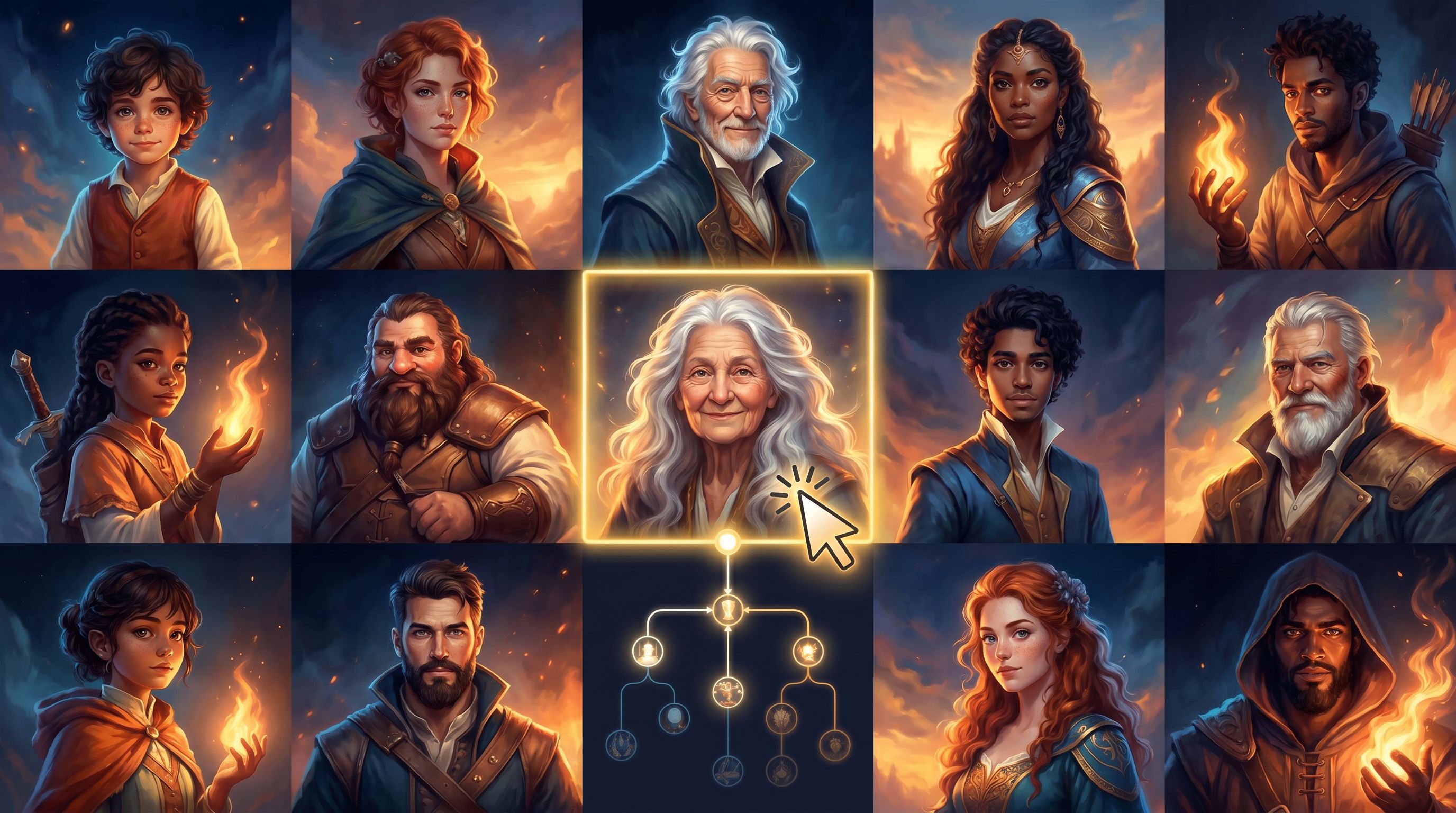
2. Diversify Background Characters and Crowds
It’s not just your leads that matter. Background characters send strong signals about who “belongs” in your world.
- In classrooms, mix ages, races, body types, and visible disabilities.
- In corporate settings, avoid the sea of identical suits.
- In civic or protest scenes, reflect real‑world diversity without exoticizing or flattening groups.
3. Watch Out for Visual Stereotypes
Even with detailed prompts, AI can drift into harmful tropes:
- Over‑sexualized bodies when you didn’t ask for it.
- Darker‑skinned characters lit or framed in ways that obscure their features.
- “Villain” characters automatically given scars, facial differences, or certain ethnic markers.
Practical habits:
- Batch review images before publishing a quest.
- Flag & replace any visuals that lean on disability, race, or gender as shorthand for “bad” or “less than.”
- Document patterns you see so you can adjust prompts and style guides.
Calibrate Content Intensity and Safety Tools
Ethical worldbuilding isn’t about avoiding hard topics. It’s about scaling intensity responsibly and giving players control.
1. Use Clear Content Labels and Onboarding
Right at the start of your quest, include:
- Content notes (e.g., “This scenario includes workplace conflict, layoffs, and mild verbal aggression.”)
- Estimated playtime and emotional tone (e.g., “reflective,” “tense but hopeful,” “dark comedy”).
- Player options where appropriate:
- “Skip intense branches when possible.”
- “Enable reflective debriefs after key decisions.”
In Questas, this can live in your intro scene or a short pre‑scene that sets expectations and lets players opt into extra support.
2. Offer Off‑Ramps and Safety Choices
For heavier content, design explicit off‑ramps:
- A choice like “I don’t want to continue this path” that routes to a summary and a safer branch.
- A “Zoom out and debrief” option that steps out of character for a moment.
This is especially useful in:
- Crisis simulations (e.g., turning crisis playbooks into quests).
- Civic or political scenarios where stakes are personal.
- Research or journalism quests, such as those described in “Beyond Story Games: Unexpected Questas Use Cases in Research, Journalism, and Civic Design”.
3. Design Debriefs and Reflection Scenes
After intense branches, insert short scenes that:
- Name what just happened.
- Invite the player to reflect on their feelings and reasoning.
- Offer alternative perspectives or resources.
Examples:
- “In this branch, your decision led to the whistleblower being sidelined. How might that feel from their perspective?”
- “Many people in your role feel torn between protecting their team and following policy. Here are two common approaches…”
These scenes don’t have to be long—they just need to signal that the experience is guided, not chaotic.
Make AI’s Role Visible and Accountable
Ethical AI worldbuilding also means being honest about where AI is in the loop.
1. Tell Players When They’re Seeing AI Output
In your quest description or intro, briefly explain:
- That images and micro‑videos are AI‑generated.
- That characters are fictional composites, not real individuals.
- That any resemblance to real people is unintentional.
This matters in:
- Journalistic quests, where players might wonder if a photo depicts a real event.
- Corporate training, where employees might assume images represent actual colleagues or customers.
2. Keep a Change Log for Sensitive Worlds
For quests that touch on ethics, compliance, or civic issues, maintain a simple change log:
- Which scenes or images you updated.
- Why you changed them (e.g., “Removed image that stereotyped protesters as violent.”).
- Who signed off.
Even a lightweight log in your project notes makes it easier to:
- Respond if someone raises a concern.
- Show stakeholders you’re taking responsibility seriously.
3. Invite Feedback and Co‑Creation
Finally, ethical worlds get better when you co‑build them with the people they affect.
Consider:
- Closed playtests with members of the communities you’re depicting.
- In‑quest feedback prompts (“Did this scene feel fair and respectful?” with a link to a short form).
- Collaborative building sessions, where subject‑matter experts and community members help shape branches and visuals live.
The collaborative model described in posts like “The Collaborative Quest Room: How Distributed Teams Co‑Write, Co‑Prompt, and Co‑Playtest Questas in Real Time” pairs naturally with ethical review.
Putting It All Together in Questas
Let’s translate this into a concrete workflow you can follow for your next Questas build.
-
Draft your ethics brief.
- Purpose, audience, boundaries, representation goals, player contract.
-
Outline your branches with ethics in mind.
- Mark where high‑stakes or sensitive choices appear.
- Add notes for debrief scenes and safety off‑ramps.
-
Design characters and prompts for representation.
- Create a character bible and prompt library.
- Generate test images and refine until you have a coherent, inclusive look.
-
Implement safety features in your scenes.
- Content notes in the intro.
- Clear, legible choice text.
- Soft fails instead of hard “Game Over” where possible.
-
Playtest with diverse players.
- Watch where people feel confused, cornered, or uncomfortable.
- Note any images or branches that land differently than you expected.
-
Iterate and document changes.
- Update your prompts, scenes, and endings based on feedback.
- Capture key decisions in a simple change log.
-
Ship with transparency.
- Tell players what to expect, where AI is involved, and how to share feedback.
This loop doesn’t have to be heavy or bureaucratic. Once you’ve done it once or twice, it becomes part of how you think about worldbuilding—just like pacing, character arcs, or visual style.
Summary
Ethical AI worldbuilding is not a separate add‑on to your Questas projects; it’s part of making worlds that work.
By:
- Writing a simple ethics brief for each world,
- Designing choices that are legible, meaningful, and not secretly rigged,
- Baking inclusive representation into your AI prompts and visual systems,
- Calibrating content intensity with labels, off‑ramps, and debriefs, and
- Being transparent about AI’s role and open to feedback,
…you create quests that are safer, fairer, and more emotionally resonant—without sacrificing depth or drama.
The reward isn’t just avoiding harm. It’s building story universes that players trust enough to explore fully, replay often, and share with others.
Your Next Step
If you’re already drafting your next interactive story, now is the perfect moment to add an ethical layer.
- Pick one quest—new or existing—that feels important.
- Spend 20–30 minutes drafting an ethics brief for that world.
- Open Questas and walk through your scenes with the brief beside you. Where do you need:
- Clearer choices?
- Better representation in images?
- Content notes, off‑ramps, or debriefs?
Make one small improvement per pass. You don’t have to fix everything at once; you just have to start.
Adventure awaits—but so does responsibility. The worlds you build will teach your players something about power, identity, and consequence. With the right guardrails, you can make sure they learn the lessons you meant to teach.