From Mood to Mechanic: Designing Choice Types (Risky, Reflective, Routine) in Your Questas Stories


Interactive stories live or die on their choices. Not how many choices you add—but how those choices feel.
Are players sweating over a risky decision? Quietly considering what kind of person they want to be? Or just gliding through familiar, low-stakes steps that make the world feel solid and lived-in?
When you’re building on Questas, you already have the scaffolding: branching scenes, AI-generated images and video, and a visual, no‑code editor. The next level is being intentional about choice types—especially three core categories:
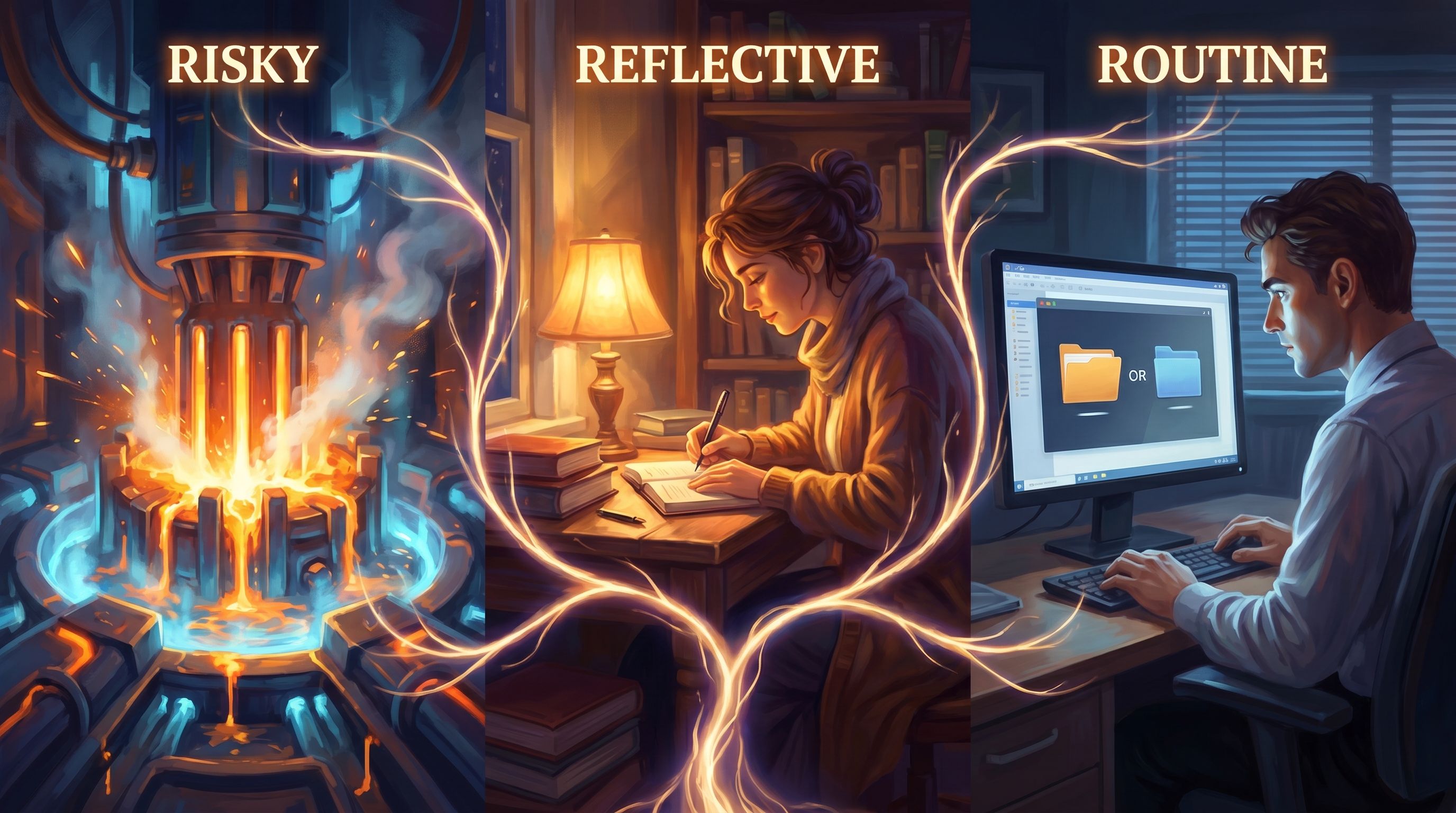
- Risky choices – high stakes, uncertainty, visible consequences.
- Reflective choices – values, identity, interpretation, self-awareness.
- Routine choices – everyday actions, procedures, habits that ground the world.
Designing with these three in mind turns your quest from a generic “click to continue” experience into a layered journey where mood and mechanic reinforce each other.
This post walks through how to:
- Understand what each choice type does to your player’s emotions and attention.
- Design risky, reflective, and routine choices on purpose (not by accident).
- Use Questas features—branching logic, AI images, micro-video—to make each type land.
- Mix the three into satisfying patterns that keep players engaged without overwhelming them.
Why Choice Types Matter More Than Choice Count
It’s easy to measure your quest by surface metrics:
- How many scenes?
- How many endings?
- How many branches per node?
Those numbers matter for scope—but they don’t tell you whether players feel anything.
Choice types matter because they directly shape:
- Emotional pacing – Risky choices spike tension; reflective choices slow things down; routine choices let players breathe.
- Cognitive load – Too many risky decisions in a row exhaust people; too many routine ones bore them.
- Replayability – Different paths of risky vs reflective choices can make the same story feel fresh on a second or third run.
- Insight – If you’re using Questas for research, training, or strategy, the kind of choices you present determines what you actually learn from player behavior.
If you’ve explored how emotional structure works in branching experiences, you’ve already seen how important this is in posts like “Designing Emotional Arcs in Branching Stories: How to Make Every Path Feel Like a Real Journey”. Choice types are a practical way to implement those arcs at the scene level.
A Quick Vocabulary: Risky, Reflective, Routine
Before we go deeper, let’s define these in concrete, design-friendly terms.
Risky Choices
A risky choice is one where:
- The stakes are visible (you could lose something, hurt someone, fail publicly, break a rule).
- The outcome is uncertain (you can’t fully predict what will happen).
- The player can’t easily undo it in-story.
Examples:
- “Do you leak the internal memo to the press or stay silent?”
- “Do you cut power to the failing reactor or keep it running to save the colony?”
- “Do you confront your manager in front of the team or wait for a private 1:1?”
In Questas, risky choices are where you often:
- Branch more dramatically.
- Show strong visual changes (ruined city vs intact skyline, smiling team vs tense silence).
- Use micro-video to punctuate the moment (a flicker of lights, a door slamming, a phone buzzing with a notification).
Reflective Choices
A reflective choice is one where:
- The stakes are internal (identity, values, interpretation, priorities).
- The outcome is less about win/lose and more about who the character becomes.
- The player needs a moment to think or feel, not just react.
Examples:
- “What do you apologize for first?”
- “Which memory do you share with your sibling?”
- “How do you explain the failed project to your team?”
These are powerful in:
- Leadership sims and playable personas.
- Learning and development scenarios.
- Narrative-heavy fiction where character growth matters.
Routine Choices
A routine choice is one where:
- The stakes are low or mostly cosmetic.
- The player is performing everyday actions or standard procedures.
- The main purpose is immersion, pacing, or teaching a system.
Examples:
- “Which tool do you reach for first?”
- “Do you scan the room, check your messages, or grab coffee?”
- “Which exhibit do you visit next in the museum?”
Routine choices shine when you want to:
- Let players explore without pressure.
- Teach them how a process works before raising the stakes.
- Make the world feel like it continues between big moments.
Mapping Mood to Mechanic Before You Build
If you start writing scenes without a plan, you’ll probably accidentally mix these choice types. Sometimes that works. Often it leads to:
- Long stretches of routine choices that feel like busywork.
- Emotional whiplash: huge risky decision → trivial cosmetic choice → huge risky decision.
- Reflective moments that appear out of nowhere and stall the story.
A better approach is to outline your emotional beats first, then assign choice types to support that flow.
Step 1: Sketch a Simple Emotional Spine
For each main path (or for your core “golden path”), jot down a rough curve:
- Calm → rising tension → peak → fallout → resolution
- Or: curiosity → confusion → insight → decision → consequence
This doesn’t need to be fancy. A five-line scribble is enough.
Step 2: Assign Choice Types to Each Phase
A simple pattern that works well in many Questas builds:
- Onboarding / entry – Mostly routine choices.
- Rising tension – Mix of routine and reflective choices.
- Climax / decision point – One or two major risky choices.
- Fallout / learning – Reflective choices that help players make sense of what happened.
- Denouement / exit – Light routine choices, maybe a final reflective prompt.
You can see similar thinking applied to visual pacing in posts like “Storyboard to Screen: Using AI-Generated Micro-Video to Pace Tension and Reveal in Your Questas”.
Step 3: Mark Choice Types Directly in Your Outline
When you outline scenes, literally label each decision:
Scene 3 – Doorway choice (ROUTINE)Scene 7 – Leak the memo? (RISKY)Scene 9 – How do you justify your decision? (REFLECTIVE)
Now you can visually scan for:
- Too many risky choices clustered together.
- Long stretches with only routine choices.
- Reflective moments that don’t connect to previous events.
Designing Strong Risky Choices in Questas
Risky choices are where your quest’s heartbeat spikes. To make them land, you need alignment between narrative, visuals, and interface.
1. Make Stakes Concrete and Visible
Vague stakes (“This might be bad”) don’t create real tension.
Instead:
- Name what’s on the line. Time, money, safety, reputation, relationships.
- Show it visually. Use AI images in Questas to depict:
- The crowded newsroom waiting for a leak.
- The reactor core glowing an ominous red.
- The team’s anxious faces on a video call.
- Echo it in micro-copy. Under the choice, add a short hint like “(You’ll be held responsible either way.)”
2. Limit Options, Expand Consequences
Risky choices work best when:
- There are 2–3 clear options, not 7.
- Each option leads to meaningfully different outcomes.
In the Questas editor:
- Create separate branches, not just cosmetic variations of the same result.
- Use conditional logic or flags so later scenes remember what happened.
3. Use Timing and Framing to Build Tension
Even without real-time timers, you can simulate urgency:
- Pre-load tension in the previous scene (alarms blaring, countdown displayed, characters shouting conflicting advice).
- Use camera-like framing in your AI images—tight close-ups on sweating faces, a trembling hand over a button. For more ideas, see “Camera Moves Without a Camera: Simulating Pans, Zooms, and Cuts with AI Images in Questas”.
- Consider a short AI-generated micro-video clip (sparks flying, a notification popping up) right before the choice.
4. Don’t Overuse Them
Too many risky choices in a row:
- Exhaust players.
- Dilute the impact of each decision.
A practical rule of thumb:
- Anchor each major risky choice with at least 1–2 routine or reflective scenes around it.
Crafting Reflective Choices That Actually Prompt Reflection
Reflective choices are where players make meaning. They’re also easy to mishandle—turning into survey questions or bland “How do you feel?” prompts.
1. Tie Reflection to a Specific Event
Reflection needs context.
Instead of:
“How do you feel about leadership?”
Try:
“After your manager undermined you in front of the client, what do you focus on in your debrief?”
Then offer options that reveal values and priorities:
- “I focus on repairing trust with the client first.”
- “I focus on setting boundaries with my manager.”
- “I focus on documenting what happened for HR.”
2. Let Reflective Choices Shape Future Scenes
If reflective choices don’t change anything, players will learn to ignore them.
In Questas:
- Use flags to track reflective decisions (e.g.,
debrief_focus = client / manager / hr). - Later scenes can:
- Change dialogue lines.
- Show different AI images (a calm client vs a skeptical one).
- Unlock or hide certain options.
3. Use Visuals to Externalize Inner States
Reflection is internal, but your quest is visual.
- Show the character alone on a rooftop, staring at the city.
- Use lighting and color to signal mood (cool blues for introspection, warm golds for hope, harsh contrast for guilt).
- Subtle background details—a torn photo, a full inbox, a closed office door—can hint at what’s weighing on them.
4. Keep Text Lean but Specific
Reflective prompts don’t need to be long.
Aim for:
- 1–2 sentences of setup.
- 2–4 concise options that each represent a distinct inner narrative.

Making Routine Choices Feel Meaningful, Not Filler
Routine choices are your secret weapon for:
- Teaching systems.
- Controlling pacing.
- Making the world feel inhabited.
But they can easily slide into “click next” territory if you’re not careful.
1. Use Routine Choices to Teach Before You Test
If you’re building a training sim, research scenario, or complex fictional world:
- Start with routine choices that walk players through procedures.
- Later, turn those same steps into risky decisions under pressure.
Example:
- Early game: “Which checklist do you open first?” (low stakes, gentle feedback).
- Later: “You have 90 seconds. Which step do you skip?” (stakes now attached).
2. Layer Small Payoffs Into Routine Actions
Routine doesn’t have to mean boring.
- Add tiny discoveries: an Easter egg image, a surprising line of dialogue, a hidden note.
- Track micro-choices (e.g., always choosing the same coffee shop) and pay them off later with a familiar NPC who helps in a pinch.
3. Keep Routine Branches Shallow
To avoid scope creep:
- Let routine choices fan out briefly but reconverge quickly.
- Use them to change flavor text, visuals, or minor resources, not the entire plot.
4. Use Routine to Reset After Intensity
After a heavy risky or reflective scene:
- Offer a simple, grounded routine moment: cleaning up a workspace, walking home, choosing music.
- Use calmer visuals and slower “camera” framing to signal that the player can breathe.
Mixing Choice Types Into Satisfying Patterns
Once you’re comfortable with each type on its own, the real magic is in how you sequence them.
Here are a few patterns that work well in Questas builds across fiction, training, and research.
Pattern 1: The Ladder (Routine → Reflective → Risky)
Use when you want to build up to a big decision.
- Routine – Set the scene, establish habits.
- Reflective – Ask the player what they think or value about the situation.
- Risky – Present the high-stakes choice that forces them to act on that reflection.
This pattern makes risky choices feel earned and understandable.
Pattern 2: The Aftershock (Risky → Routine → Reflective)
Use when you want to process a big decision.
- Risky – The big moment: the leak, the confrontation, the rescue attempt.
- Routine – Immediate aftermath: paperwork, clean-up, a commute home.
- Reflective – A quieter scene where the character (and player) makes sense of what happened.
This sequence is especially powerful if you’re planning to analyze player behavior later, as explored in “From Playtest Notes to Narrative Analytics: What to Measure (and Ignore) in Your Early Questas Builds”.
Pattern 3: The Loop (Routine ↔ Risky)
Use when you want to show escalating pressure in a system.
- Players repeat a routine pattern (daily shift, weekly meeting, patrol route).
- Each loop introduces a slightly more risky variation:
- A small rule bend.
- A corner cut.
- A warning ignored.
Over time, the contrast between familiar routine and creeping risk tells its own story.
Pattern 4: The Mirror (Risky → Reflective, multiple times)
Use when you want to explore character development.
- Present a risky choice.
- Follow it with a reflective moment.
- Repeat pattern later with a similar risky choice, and see if the player now chooses differently.
In Questas, you can:
- Use flags to remember earlier decisions.
- Change reflective options the second time around to acknowledge growth or entrenchment.
Prototyping and Tuning Choice Types With Real Players
You’ll learn more about your choice design from one good playtest than from ten rewrites.
Some practical tips:
- Tag choice types in your build. Even if it’s just a note in your node titles, mark RISKY / REFLECTIVE / ROUTINE.
- Watch where players hesitate. Long pauses before routine choices might mean they’re overloaded or the stakes are unclear. Instant clicks on risky choices might mean the stakes aren’t landing.
- Capture screens and replays. Seeing what players actually see at each decision point is invaluable. For a deeper dive into this practice, check out “The Visual Feedback Loop: Using Player Screenshots and Replays to Iteratively Refine Your Questas Worlds”.
- Ask one question per playtest. For example: “Where did you feel the most pressure?” or “Which moment made you think hardest about the character’s values?”
Use that feedback to:
- Upgrade flat routine choices into subtle teaching moments.
- Sharpen or simplify risky choices.
- Insert reflective choices where players are already pausing to think.
Bringing It All Together
When you look at your quest through the lens of risky, reflective, and routine choices, you’re really asking:
What do I want players to feel and learn at each step—and how do my mechanics support that?
A quick recap:
- Risky choices drive tension and consequence. Use them sparingly, make stakes visible, and support them with strong visuals and branching.
- Reflective choices turn events into meaning. Tie them to specific moments, let them shape future scenes, and visualize inner states.
- Routine choices ground the world, teach systems, and control pacing. Keep them shallow but flavorful, and use them to set up and cool down from bigger beats.
- Patterns matter. Think in sequences—Ladder, Aftershock, Loop, Mirror—so your quest feels like a coherent journey, not random decisions.
- Playtesting is your compass. Tag your choice types, watch players move, and iterate using the tools Questas gives you for visual feedback and branching logic.
Designing with choice types is less about adding complexity and more about adding clarity. You’re giving yourself a shared language to reason about mood, stakes, and structure.
Your Next Step: Build a Tiny, Three-Choice Experiment
You don’t need a sprawling saga to start using these ideas.
Here’s a simple challenge you can tackle in an afternoon on Questas:
- Create a micro-quest with exactly three decisions:
- One routine.
- One reflective.
- One risky.
- Map them into a pattern. For example, Ladder (Routine → Reflective → Risky).
- Generate visuals that match the mood of each choice type.
- Share it with 3–5 people and ask:
- “Where did you feel most on edge?”
- “Where did you think the hardest?”
- “Where did it feel like you were just ‘doing stuff’?”
Once you’ve seen how different those three moments feel in a tiny build, you’ll never look at a generic choice list the same way again.
Your players are already telling you how they want to engage—through where they hesitate, where they rush, and where they replay. Use risky, reflective, and routine choices as your design vocabulary, and let your next quest become not just a story they click through, but a journey they remember.