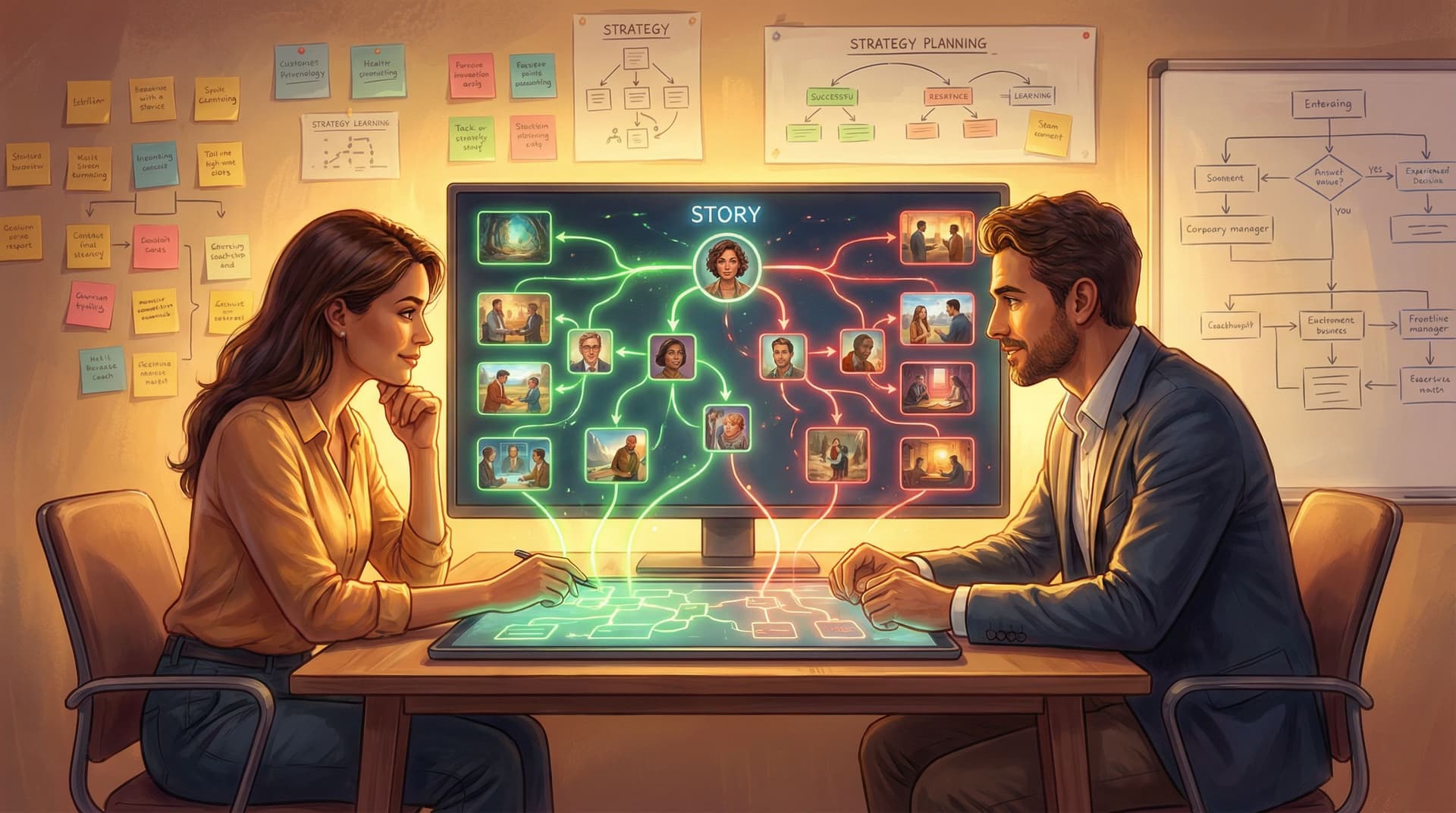
From Case Study to Character Arc: Turning Real Customer Stories into Branching Questas Journeys


Customer stories are everywhere: win reports, NPS comments, support tickets, sales call notes, community posts, internal Slack threads. But most of that gold ends up as one of two things:
- A polished case study that only a handful of prospects ever read closely
- A slide or two in a quarterly business review that gets skimmed and forgotten
What if, instead of flattening those stories into PDFs and decks, you turned them into playable journeys—where your audience steps into a real customer’s shoes, makes the hard calls, and feels the consequences?
That’s where branching experiences built with Questas shine. When you transform real customer narratives into interactive adventures, you:
- Help prospects feel what it’s like to succeed with your product
- Give teams a safe space to practice judgment, not just memorize talking points
- Turn static case studies into evergreen assets that keep teaching and persuading
This post walks through how to go from raw customer story → structured case study → rich character arc → fully branching Questas journey—without code, and without needing a film crew.
Why turn case studies into branching journeys at all?
Before we dive into workflow, it’s worth asking: why not just keep writing PDFs and one-sheeters?
1. Case studies describe; journeys immerse
A traditional case study tells you what happened. A branching story lets you:
- Make the risky decision
- See what breaks
- Rewind and try the alternative
That loop of choice → consequence → reflection is what makes lessons stick—whether you’re selling to customers, training employees, or aligning internal stakeholders.
If you’re interested in the ethics and nuance of real-world decisions, you might also like our post on using branching stories for grey-area dilemmas: Beyond Branching Dialogues: Using Questas to Prototype Ethical Dilemmas, Tradeoffs, and Grey-Area Choices.
2. Real customers make the best protagonists
The most compelling interactive stories don’t start from abstract personas; they start from specific humans with:
- Contradictory pressures
- Imperfect information
- Constraints they can’t wish away
Your existing customer stories already have this baked in. You just need to:
- Extract the conflicts and tradeoffs
- Map the moments of decision
- Frame them as playable scenes instead of bullet points
3. Branching journeys reveal how success happens
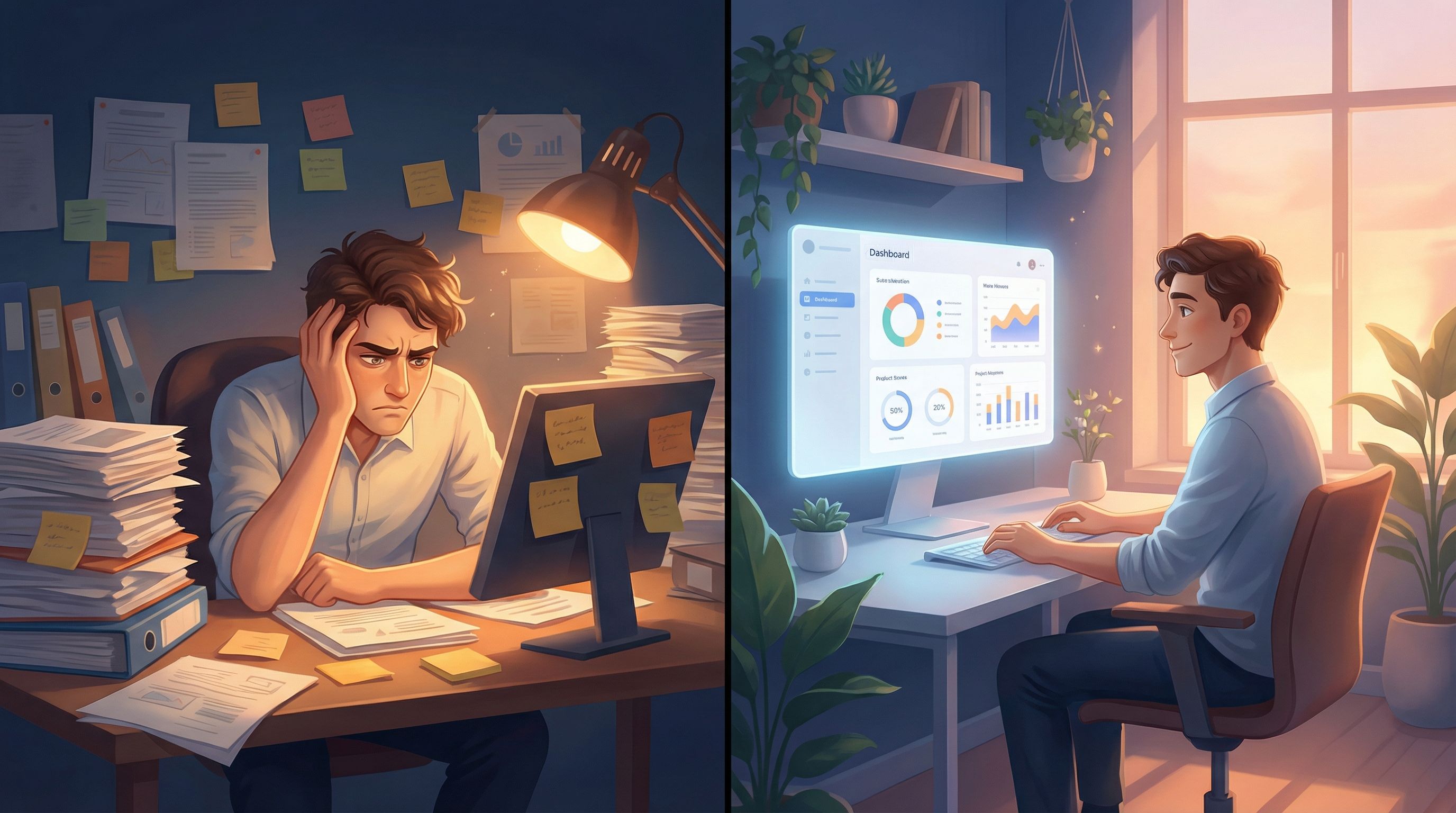
Most case studies compress the messy middle: “We evaluated several vendors, chose X, and saw Y% improvement.”
A branching Questas experience lets you:
- Show the dead ends and missteps
- Contrast good-enough choices with truly excellent ones
- Surface the habits, mindsets, and micro-decisions that separate top performers from the rest
That’s invaluable for:
- Sales enablement (what great reps actually do in the field)
- Customer education (how power users think through complex setups)
- Internal alignment (what “doing it right” really looks like, moment by moment)
Step 1: Choose the right customer story to adapt
Not every case study wants to be a branching narrative. You’re looking for stories with tension and forks in the road, not just smooth success.
Look for:
-
Multiple stakeholders with different goals
e.g., A security lead who wants control vs. a product lead who wants speed. -
Real risk or urgency
e.g., A launch date that can’t move, a churn threat, a regulatory deadline. -
Clear alternative paths
e.g., They almost chose a competitor, or seriously considered building in-house. -
Surprising tradeoffs
e.g., They accepted short-term pain (migration, retraining) for long-term wins.
Red flags that a story might not be ideal for branching:
- Everything went smoothly with no real conflict
- The outcome was predetermined (e.g., they were mandated to buy from you)
- There are no meaningful decisions—just implementation steps
If you’re working with internal knowledge (not just external case studies), you can also mine internal docs and wikis for candidate stories. For more on that approach, see: From Notion Docs to Narrative Hubs: Turning Internal Knowledge Systems into Questas-Powered Storyworlds.
Step 2: Strip the story down to its decision spine
Once you’ve picked a customer story, your next job is to find the decision spine—the sequence of key moments where someone had to choose between real options.
A simple way to do this:
-
Timeline it
Write down the story as a linear set of events:- Trigger: What kicked this off?
- Investigation: What did they explore or research?
- Decision: What did they commit to?
- Implementation: How did they roll it out?
- Outcome: What changed, and for whom?
-
Circle the decision points
For each phase, ask:- What were at least two plausible options here?
- What did they actually choose, and why?
- What would a reasonable but less effective choice have been?
-
Name the stakes
For every decision point, write a one-line stakes summary:- “If they delay, they might miss the seasonal demand spike.”
- “If they over-customize, maintenance costs will explode later.”
- “If they rush rollout, support volume may overwhelm the team.”
-
Identify your pivot moments
You don’t need every tiny fork. Focus on 3–7 pivotal decisions where:- Different choices would have created meaningfully different futures
- The reasoning process is teachable and replayable
Those pivot moments will become your major branches in Questas.
Step 3: Turn your “customer” into a protagonist with a real arc
Most case studies treat the customer as a logo. Your interactive story needs a person.
Define, at minimum:
-
Role and responsibility
Who are we playing as? A VP of Ops? A frontline manager? A solo founder? -
Objectives
What are they trying to achieve beyond “success with the product”? -
Constraints
Budget, time, politics, technical debt, team bandwidth. -
Fears and failure modes
What are they afraid of looking like? Incompetent? Reckless? Obstructionist? -
Growth arc
How do they change if the story goes well? What do they learn if it doesn’t?
Then, write a short character arc for the true path (what actually happened with your customer):
- Beginning: Overwhelmed, skeptical, or stuck
- Middle: Makes hard tradeoffs, learns to trust new approaches
- End: More confident, more strategic, better equipped
In Questas, you can reinforce this arc visually with AI-generated images and video: show posture, environment, and expression evolving as the protagonist grows.
Step 4: Map branches as “what-if” riffs on reality
You don’t have to invent wild alternate universes. Start from what actually happened, then riff.
A practical pattern:
-
Canon path (what really happened)
This is your “golden” route—how the real customer navigated their journey. -
Adjacent missteps
Near misses the customer considered or briefly tried:- Delaying a key decision
- Over-scoping the first rollout
- Ignoring a skeptical stakeholder
-
Exaggerated extremes
Push plausible mistakes a bit further to clarify consequences:- Over-optimizing for cost at the expense of reliability
- Chasing every feature request instead of focusing on core value
For each branch, outline:
- What the protagonist believes they’re optimizing for
- What they’re actually trading away
- Short-term feelings vs. long-term results
This is where your story starts to look more like the complex, grey-area scenarios we cover in Beyond Branching Dialogues: Using Questas to Prototype Ethical Dilemmas, Tradeoffs, and Grey-Area Choices. You’re not punishing “wrong” answers—you’re illuminating consequences.
Step 5: Design scenes as lived moments, not bullet points
Each node in your Questas journey should feel like a scene your player can inhabit, not a slide in a deck.
For each pivotal decision, define:
-
Setting
Where are we? War room, Zoom call, warehouse floor, customer’s office? -
Cast
Who’s present, and what do they want? Think in terms of tension:- The champion who wants your solution
- The skeptic who fears disruption
- The executive who only sees the budget line
-
Triggering event
What just happened that forces a choice?- A pilot failed
- A competitor made a surprise offer
- A new constraint landed from leadership
-
Decision options
2–4 options that are all defensible in some way. Avoid obvious “good vs bad” splits. -
Immediate feedback
What changes within minutes, hours, or days of the choice? -
Downstream impact
How does this choice alter later scenes, relationships, and outcomes?
Use AI-generated visuals inside Questas to:
- Show body language shifts between scenes
- Visualize dashboards, whiteboards, or product interfaces as in-world props
- Highlight risk and reward visually, not just in text (for more on this, see Visual Fail States: Using AI Imagery to Signal Risk, Reward, and Consequences in Questas).

Step 6: Build the journey in Questas’ visual editor
Once your spine, character, and branches are sketched, it’s time to build.
A simple workflow inside Questas:
-
Create your core path first
- Lay out scenes for the “canon” version of the customer story
- Add minimal branching—just 1–2 key decisions to start
-
Layer in branches gradually
- For each decision, add one adjacent misstep branch
- Reuse scenes where possible, changing only outcomes or context text
-
Enrich with visuals and media
- Generate consistent character portraits across scenes
- Use AI to create environments (offices, warehouses, dashboards)
- Add short video clips for high-impact beats (launch day, crisis moments)
-
Weave in reflective commentary
After major scenes, consider:- A brief inner monologue from the protagonist
- A “coach” voiceover explaining the tradeoff
- A comparison to what the real customer did and why
-
Tag and track key choices
- Use variables or tags to track risk appetite, collaboration, or customer-centricity
- Surface these patterns in the ending summaries: “You tended to prioritize speed over alignment, which led to…”
If you’re building for learning and development, you can pair this with the coaching techniques in Beyond Training Modules: How L&D Teams Can Use Questas for Scenario-Based Coaching and Feedback.
Step 7: Respect privacy, accuracy, and ethics
You’re working with real customer stories, which means you have responsibilities.
Protect identities and sensitive details
- Change names, industries, or regions where needed
- Mask or fictionalize any data that could be traced back to a specific company
- Avoid reproducing proprietary screenshots or internal documents without permission
Stay true to the spirit of the story
- Don’t turn your customer into a caricature or a punching bag
- Make sure “failure” paths feel like plausible outcomes, not moral judgments
- When in doubt, emphasize learning over winning
Get buy-in when appropriate
- For marquee accounts or highly specific stories, share a draft with the customer
- Offer to highlight them as a “featured protagonist” if they’re comfortable
Step 8: Test with real players and refine the arc
The first version of your branching journey is a prototype, not a monument.
Run lightweight playtests:
- With sales reps, to see if the story reflects real objections and decision patterns
- With customers, to check if they recognize themselves in the protagonist
- With internal stakeholders, to align on what “good judgment” looks like in your context
Watch for:
- Branches nobody chooses (maybe they’re not believable)
- Choices everyone chooses (maybe your alternatives aren’t compelling)
- Endings that feel abrupt or preachy
Then iterate:
- Add more texture to underused branches
- Clarify stakes where players feel confused
- Tighten or expand scenes based on where attention drops
For deeper techniques on getting beyond raw metrics and into why players behave as they do, check out Beyond Clicks and Completion Rates: Qualitative Playtesting Methods for Deeply Improving Your Questas Stories.
Step 9: Put your branching journeys to work
Once your customer-story-turned-quest feels solid, it becomes a versatile asset.
Sales & marketing
- Use it as an interactive “anchor” in ABM campaigns
- Let prospects play through a story that mirrors their own situation
- Arm reps with a shared narrative they can reference in calls
Customer education & onboarding
- Show new customers common pitfalls and best practices
- Help them see themselves as the protagonist of a success story
Internal training & alignment
- Train new hires on real customer contexts, not abstract personas
- Align teams around what “good” looks like in complex situations
Because Questas is visual and no-code, you can keep these journeys living documents—updating branches as your product, market, or best practices evolve.
Recap: From case study to character arc
To turn real customer stories into branching Questas journeys that people actually remember:
- Pick stories with tension and real tradeoffs, not just smooth wins.
- Extract the decision spine—the handful of moments where things could have gone differently.
- Elevate a real person into a protagonist with goals, fears, and a growth arc.
- Design branches as what-if riffs on reality, not random tangents.
- Build lived scenes, not bullet points, grounded in specific settings and characters.
- Use Questas’ visual, no-code editor to map branches, add AI-generated media, and track key choices.
- Respect privacy and ethics, fictionalizing details where needed.
- Playtest and refine, using real feedback to tune stakes and clarity.
- Deploy across sales, onboarding, and training, so your stories keep working for you.
Your next move
You already have the raw material: case studies, win stories, support logs, internal postmortems. The leap is deciding that these don’t have to stay trapped in PDFs and slide decks.
Pick one real customer story this week:
- Sketch the protagonist and 3–5 key decisions they faced
- Open Questas in a browser tab
- Build just the core path and one branching decision
You don’t need to ship a masterpiece on day one. You just need to build the first playable chapter of a journey where your customers—and your teams—get to practice better decisions in a world that looks a lot like their own.
Adventure awaits. Your case studies are ready to become quests.