From Fandom to Fiction: Turning Your Favorite IP (Legally!) into Questas-Inspired Adventure Worlds

Every creator knows the itch: you finish a season of your favorite show, close the last page of a beloved series, or log off a game you’ve sunk 200 hours into—and your brain immediately starts spinning what if scenarios.
What if the side character got their own quest?
What if the final battle went the other way?
What if you could play through the fan theories instead of just reading them?
Interactive stories are a perfect outlet for that energy, and platforms like Questas make it possible to build branching, visual adventures without writing a line of code. But there’s a big, unavoidable question:
How do you channel your fandom into story worlds without stepping on someone else’s intellectual property?
This guide is all about that line—and how to dance right up to it, legally and creatively, while building Questas-inspired adventures that feel fresh, familiar, and completely yours.
Why This Matters for Fan Creators
If you’re a fan creator, this topic isn’t just about avoiding lawsuits. It’s about:
- Protecting your time. You don’t want to pour 60 hours into a sprawling interactive epic only to discover you can’t safely share or monetize it.
- Future-proofing your work. Original-but-inspired worlds can grow into long-running series, collaborations, or even commercial projects.
- Respecting the creators you love. Staying on the right side of IP isn’t just a legal checkbox; it’s part of healthy fandom.
- Unlocking more creativity. Constraints (like "don’t copy this exact character") often push you toward more interesting, surprising designs.
When you build on Questas, you’re already thinking in systems—branches, scenes, reusable templates, AI-generated visuals. That mindset is perfect for transforming raw fandom energy into original story engines.
The Legal Basics (In Plain Language)
Quick disclaimer: this isn’t legal advice, and if you’re planning a serious commercial project, talk to an IP attorney. But as a creator, you should at least understand the broad categories you’re playing with.
1. Copyright vs. Trademark vs. Patents
For story creators, the big two are:
- Copyright – Protects expressive works: specific characters, plots, dialogue, art, music, etc.
- Trademark – Protects brands: logos, names, symbols that identify the source of goods/services.
Patents rarely matter for narrative fan projects, so we’ll set those aside.
2. What You Can’t Safely Copy
In general, you cannot directly lift:
- Character names and highly distinctive traits (e.g., “a boy wizard with a lightning scar who attends a British magic boarding school”).
- Exact dialogue, scenes, or plot structures that are clearly recognizable.
- Iconic locations that are central and trademarked (e.g., using the exact name of a famous fantasy city or space station).
- Logos, title fonts, and other brand identifiers.
3. What’s Safer Territory
You’re on firmer ground when you work with:
- Themes and vibes – “Found family on a spaceship,” “teens discovering hidden magic in their town,” “political intrigue in a crumbling empire.”
- Genre conventions – Heists, tournaments, time loops, detective mysteries, etc.
- Archetypes – The reluctant hero, the scheming mentor, the rival-turned-ally.
The key idea: take inspiration from the feeling of the IP, not the surface details.
Step 1: Identify What You Actually Love About the IP
Before you open Questas and start dropping scenes on the canvas, pause and interrogate your fandom.
Ask yourself:
- What moments from the original story live rent-free in your head?
- Which relationships or dynamics do you keep thinking about?
- What fantasy does this IP fulfill for you? (Power fantasy? Cozy escape? Moral complexity?)
- What questions did the story never fully answer that you’d love to explore?
Write down 5–10 answers. Then translate each into something more abstract and portable.
Example
You love a space opera series where:
- The crew is a found family of misfits.
- The government is corrupt but not cartoonishly evil.
- There’s an ancient alien tech mystery lurking behind the main plot.
Abstracted, that becomes:
- A small team of specialists with clashing motives.
- A morally gray institution with competing factions.
- A mystery that predates everyone involved and keeps reshaping the stakes.
Those abstractions are the DNA of your own world.
Step 2: File Off the Serial Numbers (Without Losing the Magic)
“File off the serial numbers” is fan shorthand for transforming recognizable IP into something original. In practice, it means changing enough surface detail that your world stands on its own.
Here’s a practical checklist for doing that inside a new Questas project.
Change the Power Source
If the original IP uses:
- Magic wands → Try biotech implants, ritual music, or social reputation as the “power.”
- Space crystals → Try AI cores, fungal networks, or reality glitches.
- Super-serum → Try generational oaths, nanobot swarms, or cursed artifacts.
Tip: In AI Visual Styles 101: Matching Your Questas Imagery to Genre, Tone, and Audience, we talk about using visuals to signal how power works. Align your image prompts with your new power system so it feels coherent from scene to scene.
Shift the Setting Axis
Take the familiar and tilt it:
- From high fantasy kingdom → to post-collapse city-states built in the skeletons of skyscrapers.
- From galactic empire → to interdimensional trade guilds.
- From magic school → to corporate apprenticeship tower, underground hacker collective, or pilgrim caravan.
Ask: If I changed the map, how would the same emotional beats play out?
Rebuild Character Dynamics
Instead of copying characters, copy roles and tensions:
- The stern mentor who secretly believes in you → becomes a rival influencer forced to collaborate.
- The wise-cracking rogue → becomes a burned-out analyst who uses humor as armor.
- The Chosen One → becomes the only person willing to take responsibility for a cursed decision.
In The New Story Bibles: Organizing Lore, Timelines, and Character Arcs for Large Questas Universes, we dig into keeping those character arcs consistent as your universe grows.
Step 3: Design a “Legally Clean” Story Frame
Before you get fancy with branches, build a simple, original frame that can host lots of adventures.
A strong frame usually includes:
-
A clear premise
- "You’re a junior fixer in a city where memories are traded like currency."
- "You’re the newest recruit on a disaster-response starship that answers distress calls across fractured timelines."
-
A recurring hub or home base
- A bar between dimensions.
- A rotating council chamber.
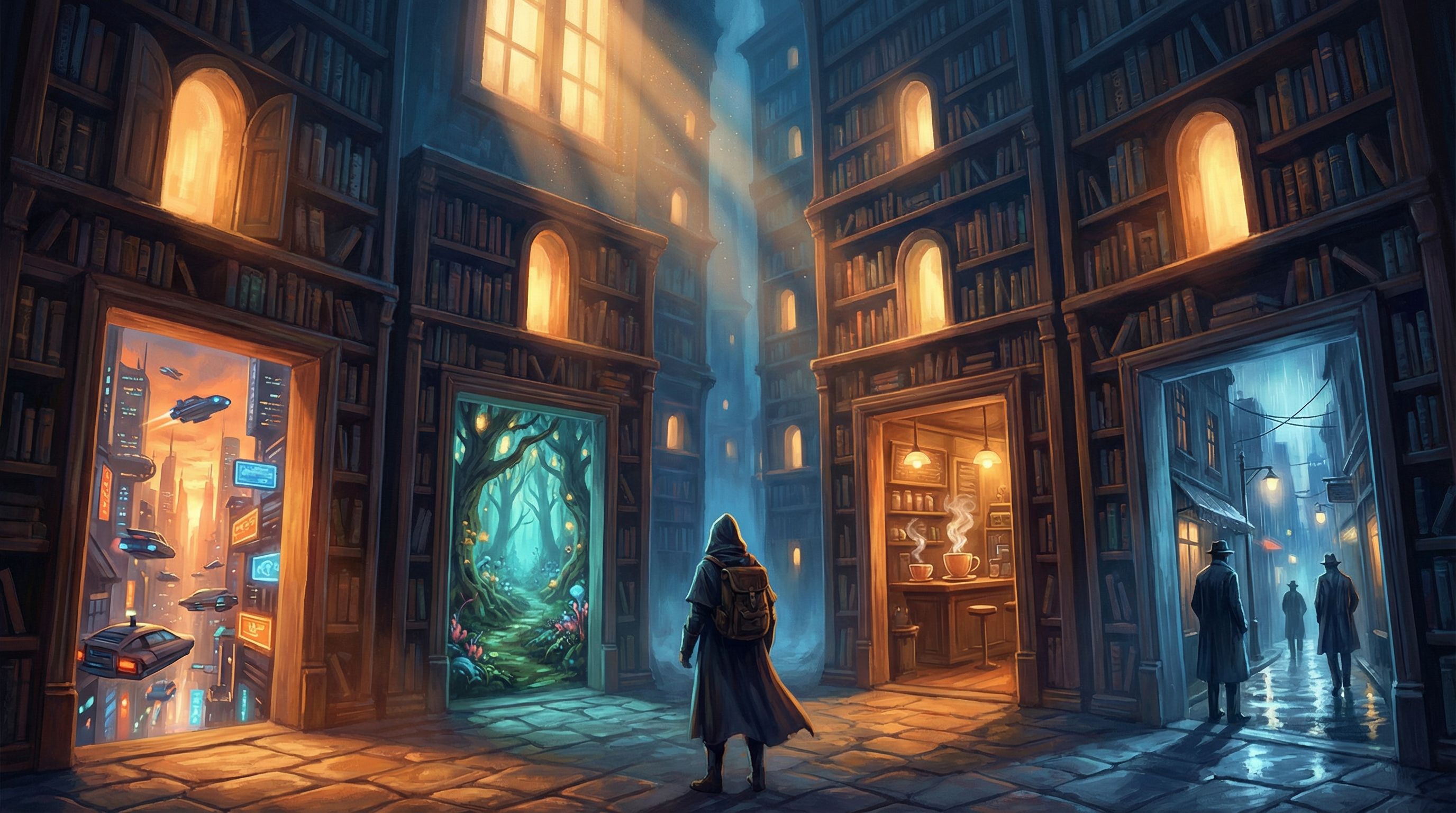
- A haunted library where each door is a different mission.
-
A mission generator
- Every episode, a new memory deal goes wrong.
- Each call is a different timeline’s version of the same event.
- Each door in the library leads to a story that echoes your favorite IP’s themes—but with your own lore.
This frame is your sandbox. Once it’s in place, No-Code Narrative Systems: Designing Reusable Templates and Story Blueprints in Questas shows how to turn it into reusable templates so you can spin up new adventures fast.
Step 4: Map Branches That Echo—Not Copy—Your Favorite Moments
Interactive stories shine when players feel like they’re steering the big turning points. Think back to the IP you love and list 3–5 types of pivotal moments:
- The betrayal that changes everything.
- The “join us or fight us” recruitment scene.
- The impossible choice between saving one person or many.
- The reveal that the mentor was lying (for reasons).
Now, build structurally similar beats in your own frame.
Example: The Recruitment Ultimatum
In the original IP:
A rebel leader offers your hero a spot on the ship if they walk away from their old life.
In your Questas story:
- Setup scene: Your fixer uncovers a memory-smuggling ring tied to the city’s elite.
- Choice node: A shadowy archivist offers to cover up your involvement if you join their secret order.
- Branches:
- Join them → You gain access to forbidden memories but lose credibility with your old crew.
- Refuse → You keep your independence but become a target.
- Stall → You try to play both sides and risk getting caught.
On Questas, you can:
- Represent that node visually in the editor.
- Attach different AI-generated images or video loops to each branch to reinforce how high the stakes are. For more on using motion to signal consequences, see Storytelling with AI Video Loops: How to Use Micro-Cutscenes to Signal Stakes and Consequences in Questas.
The emotional rhythm echoes the original fandom moment—but the specifics are yours.
Step 5: Use AI Visuals to Reinforce Originality
When you’re riffing on existing IP, visuals are where you can accidentally slide too close. Lean on AI, but be intentional.
Set a Visual Style Guide Early
Decide on:
- Art style: painterly, cel-shaded, retro pixel, graphic novel, watercolor, etc.
- Color palette: neon synth, muted earth tones, monochrome with accents.
- Motifs: recurring symbols, architecture types, costume details.
Write a short, reusable prompt like:
"Cinematic illustration of [scene], in [chosen art style], with [palette] and recurring motif of [symbol]."
Then keep using it. Consistency is your friend. If your favorite IP is glossy space opera, maybe your world leans into grainy documentary-style starship interiors instead.
For more on avoiding on-model drift and unintentional resemblance, check out AI Art Pitfalls and Fixes: Keeping Your Questas Visuals On-Model, On-Brand, and Not Weird.
Avoid Direct Visual References
Steer clear of:
- Specific character costumes or armor designs.
- Recognizable ships, castles, or logos.
- Signature weapons or artifacts.
Instead, ask: What’s the emotional function of this design?
If you love a certain starship because it feels like a scrappy underdog, design your own vessel that communicates “held together with duct tape and hope,” not a near-clone of the original.
Step 6: Build for Rhythm and Replay, Not Just Homage
Fandom-inspired projects can slip into “tour mode”: you recreate all your favorite beats, but the experience feels flat. Interactive stories need rhythm.
When you’re mapping your Questas story:
- Alternate tension and relief. Follow intense decision points with quieter scenes where players can explore, banter, or reflect.
- Vary branch depth. Some choices should lead to short, punchy detours; others to full subplots.
- Reward replays. Hide lore, secret alliances, or alternate fates behind less obvious choices.
From Branches to Beats: Using Story Rhythm to Keep Players Clicking in Long Questas is a great companion here—it shows how to structure choices and payoffs so your homage isn’t just accurate, it’s addictive.
Design “Soft Fails” for Curious Fans
Your most engaged players will deliberately try the “wrong” options to see what happens. Instead of punishing them with dead ends:
- Let a bad decision create complications, not instant failure.
- Offer in-world ways to recover (calling in a favor, sacrificing a resource, etc.).
- Use these detours to reveal new angles on your world.
For a deeper dive, read Designing ‘Soft Fails’: How to Let Players Backtrack, Reroute, and Recover Inside Questas Adventures.
Step 7: Decide How Public and Commercial You Want to Be
Your legal risk profile changes depending on what you do with your project.
Lower risk (but not zero):
- Private or small-group sharing.
- Non-monetized passion projects.
- Clearly labeled “inspired by” works with distinct characters, settings, and visuals.
Higher risk:
- Using recognizable names, logos, or visuals from the IP.
- Selling access, charging for play, or using the IP to promote a product.
- Presenting your work as official, endorsed, or affiliated.
If you’re aiming for:
- Portfolio pieces – Keep everything legally clean and original so you can confidently show it to collaborators, studios, or clients.
- Commercial releases – Treat the original IP purely as a mood board. When in doubt, change more.
Putting It All Together: A Mini Workflow for Questas Creators
Here’s a concrete process you can use this week:
-
Deconstruct your fandom.
Spend 30 minutes listing what you love about a specific IP in terms of themes, relationships, and pivotal moments. -
Draft a fresh frame.
Write a 2–3 sentence premise, define a hub location, and sketch a mission generator. -
Outline 3–5 key choice moments.
Map them as nodes in a new Questas project: recruitment, betrayal, revelation, sacrifice, etc.—all re-skinned for your world. -
Set your visual rules.
Decide on art style, palette, and motifs. Draft a base prompt you’ll reuse for AI images. -
Build a short, replayable pilot.
Aim for 10–20 scenes with at least two major branches and one “soft fail” path. -
Playtest with fellow fans.
Ask them:- What IP(s) does this remind you of?
- Does it feel too close to anything specific?
- Which moments felt most original and surprising?
-
Iterate toward originality.
Wherever people name a specific franchise, push that element further away—rename, re-theme, or redesign until the resemblance is loose and tonal.
Summary: From Fan to Architect of Your Own Worlds
Channeling your favorite IP into interactive adventures isn’t about copying—it’s about:
- Understanding what you actually love (themes, dynamics, questions).
- Abstracting that love into portable story DNA.
- Designing original settings, characters, and systems that can host those feelings in new ways.
- Using tools like Questas to turn that DNA into playable, branching experiences with consistent visuals and satisfying rhythm.
- Respecting legal and ethical boundaries so your work can grow, be shared, and maybe even go commercial someday.
When you approach fandom this way, you’re not just a fan—you’re a worldbuilder, architecting story spaces that others can explore again and again.
Your Next Step: Turn One Obsession into a Playable Pilot
Don’t wait for the “perfect” original idea. Use the obsession you already have.
- Pick one IP you can’t stop thinking about.
- Spend a single evening abstracting its themes and designing a new frame.
- Open Questas, drop a few scenes on the canvas, and build a tiny, branching pilot that echoes your favorite moments without copying them.
By the end of a weekend, you can have:
- A legally safer, fandom-fueled story world that’s fully yours.
- A playable prototype you can share with friends or your community.
- The foundation for a whole series of adventures built on the same original universe.
Adventure awaits—and this time, it’s not just your favorite canon you’re exploring. It’s your own.