From War Games to Scenario Planning: What L&D and Strategy Teams Can Learn from Playable Futures


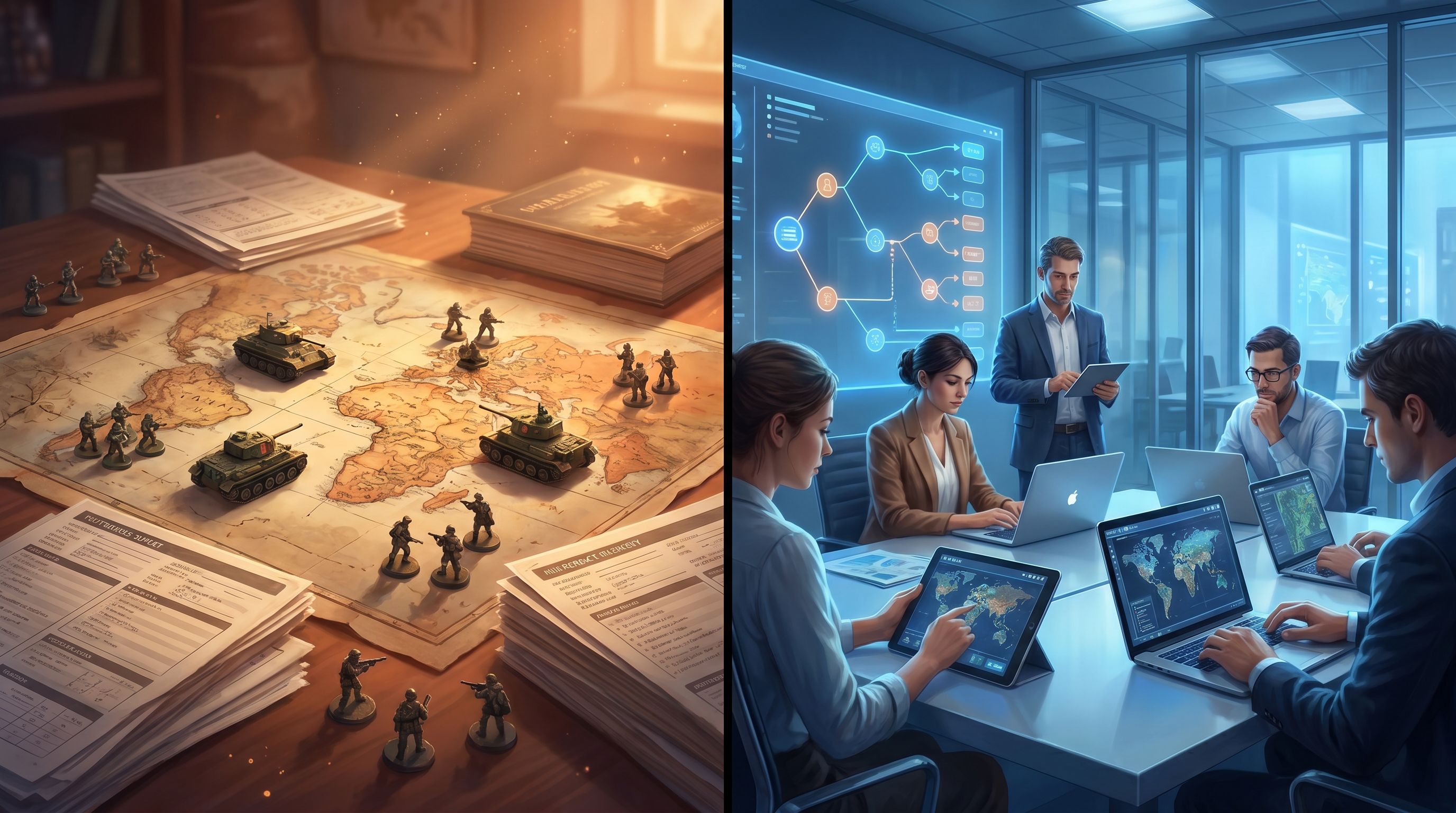
Corporate strategy and learning have borrowed from war games for decades. Scenario planning itself grew out of military exercises at RAND in the 1950s, then moved into the boardroom through pioneers like Royal Dutch Shell in the 1970s, who used scenarios to prepare for oil shocks and geopolitical upheaval.
What’s changing now is how we can put those ideas into practice.
You no longer need a defense think tank, a consulting firm, or a week-long offsite to run a meaningful strategy game. With interactive, branching story tools like Questas, L&D and strategy teams can turn “what if?” conversations into playable futures: lightweight simulations that people can actually step into, explore, and replay.
This shift matters because:
- Strategy is increasingly about navigating uncertainty, not just optimizing a plan.
- L&D is under pressure to prove behavior change and decision quality, not just course completions.
- Leaders and learners alike are overloaded with slides and PDFs and need experiences, not more content.
Playable futures sit at the intersection of war games, scenario planning, and interactive storytelling. Done well, they become a shared sandbox where teams can test moves, stress‑test assumptions, and rehearse high‑stakes decisions—without risking the real business.
From sand tables to story branches: a quick lineage
Before we talk tactics, it’s useful to understand where these ideas come from and why they work.
War games: decisions under pressure
Military war games were designed to answer questions like:
- How will our opponent react if we move first?
- Where are our blind spots and bad assumptions?
- What happens when the plan meets reality?
They combine three ingredients:
- A model of the world (map, units, rules).
- Opposing teams making moves with imperfect information.
- Facilitated reflection on what happened and why.
Corporate versions of this—often called business war games—adapt those mechanics to markets:
- One team plays your company.
- Other teams play key competitors, regulators, or disruptive entrants.
- A control team injects events: supply shocks, regulatory changes, customer behavior shifts.
Consultancies like McKinsey have documented how well‑designed war games help leaders make better decisions and surface strategic vulnerabilities that were invisible in static analyses.
Scenario planning: multiple futures, not one forecast
Scenario planning emerged as a complement to war games. Instead of simulating moves on a board, it asks:
- What are the critical uncertainties that could reshape our environment?
- What plausible futures emerge when those uncertainties play out in different ways?
- How would our strategy perform across those futures?
Shell’s classic scenarios in the early 1970s didn’t predict the exact timing of the 1973 oil crisis—but they did prepare leadership for a world where oil prices spiked and supply was constrained. That mental rehearsal meant Shell could respond faster and more coherently than peers.
At their best, scenarios:
- Stretch mental models beyond “business as usual.”
- De‑risk strategic bets by testing them across multiple worlds.
- Align leadership around a shared language for uncertainty.
Playable futures: putting people inside the scenario
Traditional war games and scenario planning are powerful, but they’ve had real barriers:
- High design and facilitation cost.
- Limited to small groups of senior leaders.
- Hard to reuse or adapt without outside help.
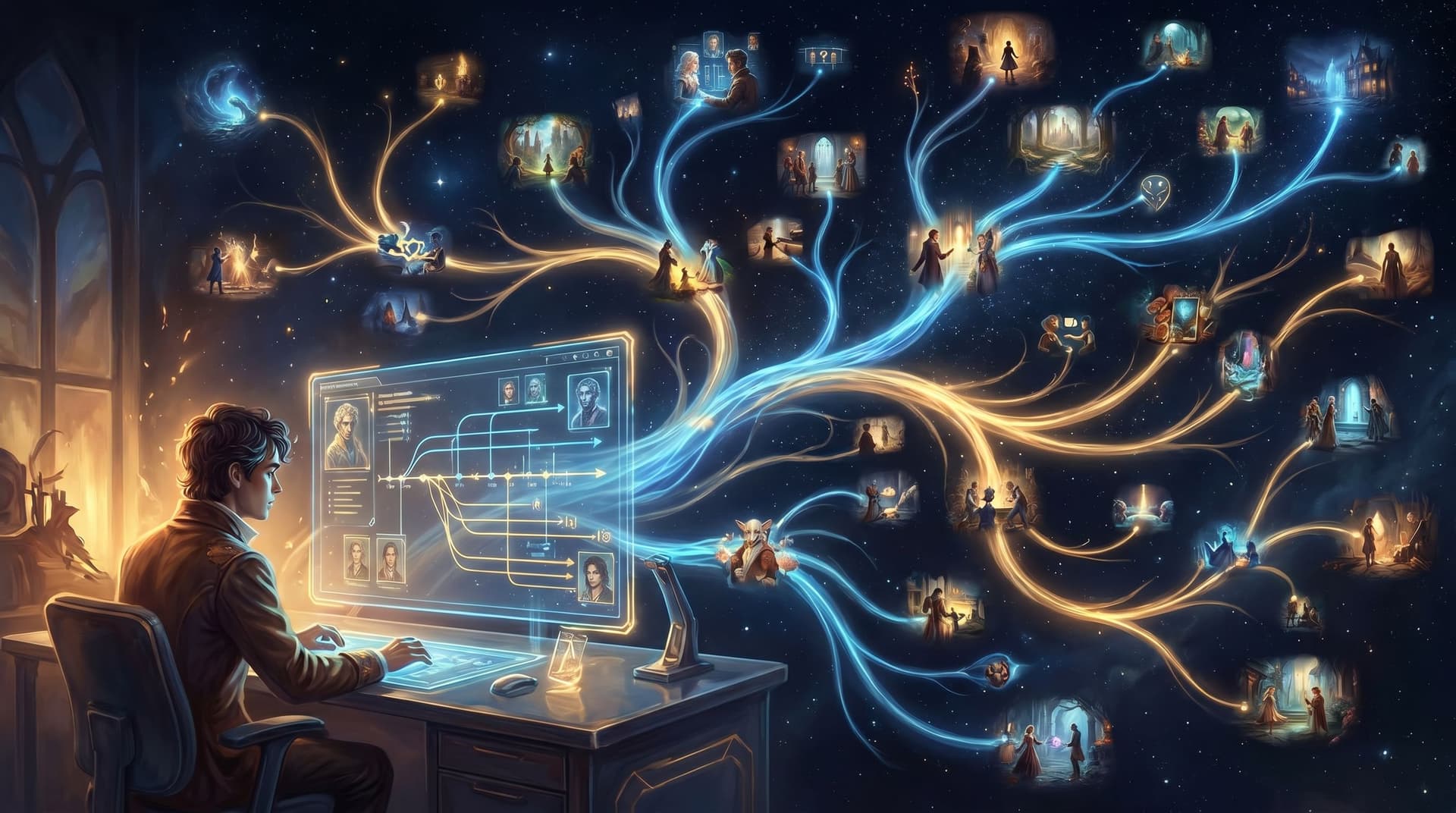
Playable futures keep the strategic intent but borrow interaction patterns from games and interactive fiction:
- Branching narratives instead of static case studies.
- Choices with visible and hidden consequences.
- AI‑generated visuals and micro‑videos to make situations feel concrete.
Platforms like Questas make it possible for L&D and strategy teams to build these experiences themselves in a visual, no‑code editor—turning scenario planning into something you can run with a cohort, share as a link, or embed into a leadership program.
Why playable futures are a gift to L&D and strategy teams
Whether you sit in L&D, strategy, or a hybrid “people and performance” function, playable futures unlock several advantages.
1. They turn abstract risk into felt experience
Reading about “supply chain disruption” or “AI‑driven competitors” is one thing. Making a choice inside a story where:
- Your key supplier goes offline.
- A new entrant undercuts your pricing.
- A regulator demands data you don’t have.
…forces people to feel the trade‑offs, not just intellectualize them.
That’s crucial for:
- Leadership development: practicing judgment in ambiguous situations.
- Risk and compliance: exploring rare but high‑impact events.
- Change management: letting people rehearse the future state before it arrives.
If you’re already using branching for safety or compliance, you’ve seen this logic in action. Our post on turning procedures into rehearseable scenarios digs deeper into that pattern.
2. They generate data, not just discussion
Classic scenario workshops often end with sticky notes and a sense that “we had a great conversation.” Playable futures add:
- Path analytics: Which branches do people choose? Where do they hesitate or backtrack?
- Outcome patterns: How often do groups land in resilient vs. fragile futures?
- Role differences: Do sales, finance, and operations see risks differently?
Because tools like Questas track choices automatically, every playthrough becomes a dataset you can mine for:
- Misaligned assumptions between teams.
- Common failure modes or blind spots.
- Readiness gaps that should shape your roadmap.
3. They scale beyond the offsite
War games and scenario workshops have historically been reserved for senior leaders. Playable futures let you:
- Run live, facilitated sessions with intact teams.
- Share the same scenario as an asynchronous micro‑sim for a broader audience.
- Reuse and adapt scenarios across regions, business units, or levels.
If you’re curious how to move from a one‑off workshop to reusable story assets, this post on the “multiplayer question” explores how to turn single‑player stories into shared experiences.
4. They make complexity manageable
One fear teams have is that scenario work will explode in scope: too many variables, too many branches. But you don’t need a 50‑ending epic to get value.
A tiny, three‑choice scenario can:
- Surface a critical tension (e.g., short‑term profit vs. long‑term resilience).
- Reveal how different roles perceive the same situation.
- Create a shared story you can reference for months.
If that resonates, you’ll like our piece on Minimal Viable Quests, which shows how small interactive experiences can deliver outsized insight.
Designing your first playable future: a practical blueprint
Let’s make this concrete. Here’s a step‑by‑step way to go from “we should do more scenario planning” to a playable future you can put in front of learners or leaders.
Step 1: Anchor on a real strategic tension
Start with a question that actually keeps someone up at night. For example:
- “How do we grow aggressively without burning out our frontline teams?”
- “What happens if a key market suddenly tightens its regulations?”
- “How do we respond if a low‑cost AI competitor undercuts our core product?”
Good prompts share three traits:
- High stakes: The answer materially affects revenue, risk, or reputation.
- True uncertainty: There’s no single “right” answer yet.
- Multiple plausible paths: Reasonable people could disagree on the best move.
If you’re in L&D, co‑design this tension with your strategy or business partners. That alignment up front will make it much easier to show impact later.
Step 2: Map 2–3 divergent futures, not 20
Avoid the temptation to boil the ocean. Sketch just a few futures based on 2 critical uncertainties, such as:
- Demand: grows vs. contracts.
- Regulation: loosens vs. tightens.
This gives you four quadrants, but you don’t need to fully build all of them. Instead:
- Pick 2–3 futures that feel:
- Plausible enough to take seriously.
- Different enough to stretch thinking.
- For each, write a short “day in the life” paragraph from the perspective of your company, a customer, or a frontline employee.
These paragraphs become the anchor scenes in your interactive story.
Step 3: Turn futures into scenes and choices
Now translate those futures into a branching structure. In a tool like Questas:
- Create an opening scene that sets up the core tension and initial context.
- Add a first decision point that forces a real trade‑off, such as:
- Cut costs now vs. invest in resilience.
- Double down on a core segment vs. diversify.
- From each choice, branch into consequence scenes that:
- Advance the timeline (e.g., 6 months later).
- Show how your choice interacts with one of your futures.
- Introduce a new twist or external shock.
A simple but powerful pattern:
- Act I – Setup: Introduce the world and the initial strategic choice.
- Act II – Consequences: Show near‑term effects and a second, harder choice.
- Act III – Outcomes: Land in one of a few named futures (e.g., “Fragile Growth,” “Resilient Niche,” “Stalled Giant”).
You don’t need dozens of endings. Three or four distinct outcomes, each with a clear label and debrief, are more than enough to spark rich discussion.
Step 4: Use AI visuals to make it concrete
One advantage of building in Questas is that you can attach AI‑generated images and micro‑videos to each scene. For strategy and L&D scenarios, visuals can:
- Make abstract concepts tangible (e.g., a warehouse with idle robots, a customer support queue overflowing, a board meeting in crisis).
- Reinforce emotional beats (optimism, anxiety, urgency).
- Help players remember key scenes and decisions.
You don’t need cinematic art direction. Aim for simple, evocative snapshots:
- A CFO staring at a dashboard full of red metrics.
- A customer on a video call, clearly frustrated.
- A factory floor with new automation equipment sitting idle.
If you’re curious about using AI visuals strategically rather than decoratively, our post on AI as Location Scout explores how images can drive story design.
Running the experience: solo, team, or live event
Once you’ve built a prototype, you can run it in several modes, each with its own benefits.
Solo play for reflection and assessment
- Share the scenario as a link in your LMS or leadership portal.
- Ask participants to play through once without backtracking, making the best choices they can.
- Follow up with reflection prompts:
- Which moment felt most uncomfortable?
- What information did you wish you had but didn’t?
- How does this map to real decisions you’re facing now?
This mode is ideal for:
- Pre‑work before a leadership workshop.
- Ongoing development in manager or high‑potential programs.
- Asynchronous global audiences.
Small‑group play for alignment and debate
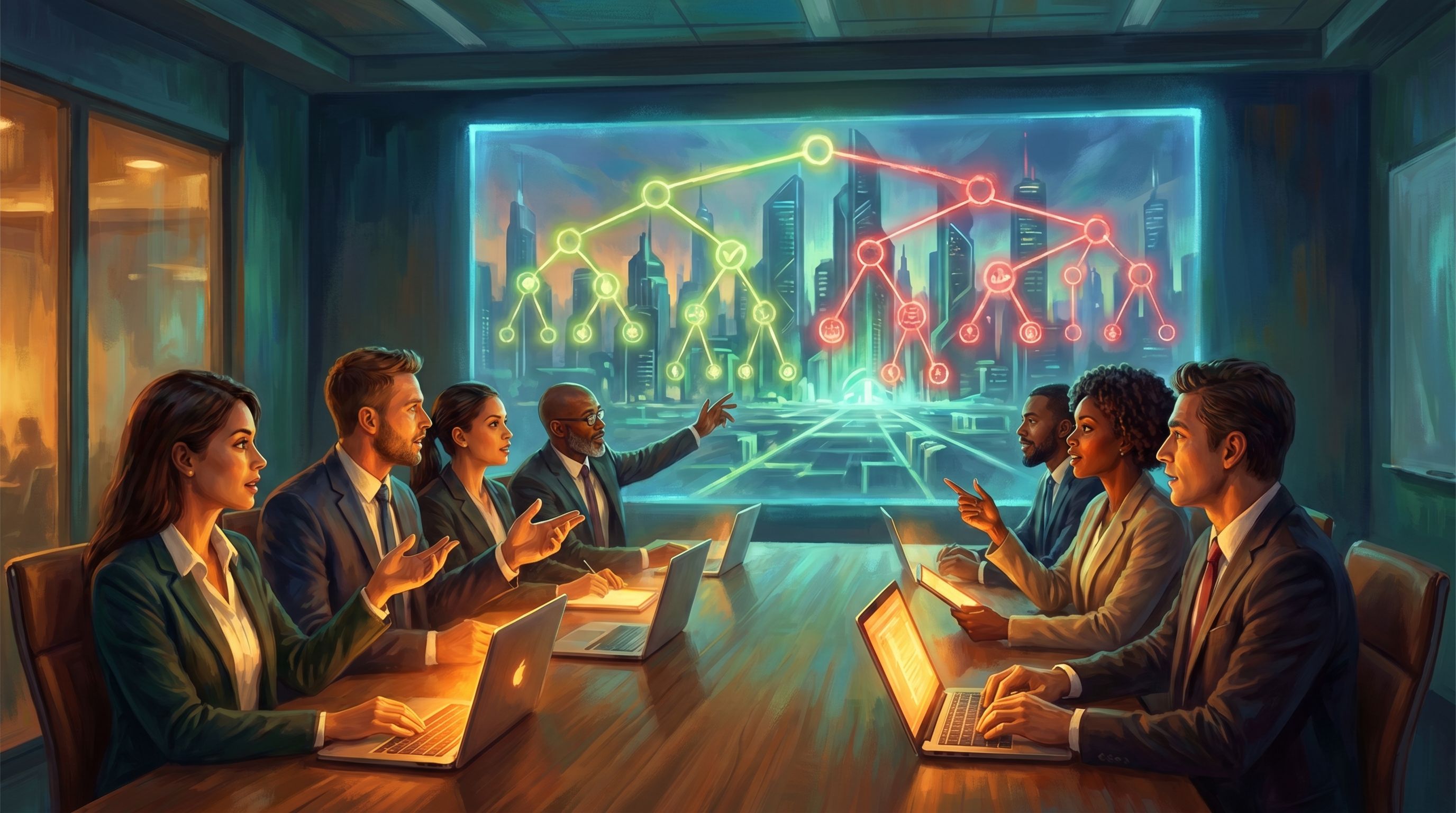
- Put 3–6 people around one screen.
- Ask them to make each choice by consensus, talking through trade‑offs.
- Have someone capture the reasoning behind each decision.
This format:
- Surfaces hidden assumptions and mental models.
- Reveals where functions or regions see risk differently.
- Builds a shared vocabulary around key tensions.
You can rotate who “drives” the scenario, or let different groups play different paths, then compare outcomes.
Live event play for energy and insight
For offsites, summits, or company‑wide events, you can:
- Run the scenario as a live, facilitated experience, projecting key scenes and using polls or breakout groups to choose paths.
- Let different tables play different branches, then share their endings.
- Capture themes across the room: where did people converge or diverge?
If you’re interested in turning events into playable narratives more broadly, check out our piece on running conferences and offsites as Questas storylines.
Measuring impact: from “that was cool” to “this changed how we decide”
To move playable futures from novelty to core capability, you’ll want to show impact beyond smiles and completion rates.
Here are practical ways to do that:
1. Define a before/after question
Before anyone plays, align on what you’re trying to shift. For example:
- “Leaders can name at least three distinct futures for our market and how our strategy holds up in each.”
- “Sales managers can articulate two backup plays if our flagship product faces a price war.”
- “Regional leaders can identify early warning signals that a scenario is unfolding.”
Design a few quick survey or knowledge‑check items around these outcomes, then measure before and after the experience.
2. Track behavioral indicators
Look for leading indicators that the scenario is changing conversations, such as:
- Strategy decks explicitly referencing scenario names or futures from the game.
- Teams using language like “we’re drifting toward the ‘Fragile Growth’ ending—how do we shift?”
- Risk registers or decision templates incorporating scenario‑inspired questions.
3. Use scenario analytics as insight, not just reporting
Because branching tools capture detailed path data, you can:
- Compare choices across cohorts (e.g., new managers vs. senior leaders).
- Identify scenes where many players make a choice you consider risky or misaligned.
- Use those hotspots to shape follow‑up workshops or coaching.
Over time, you can build a library of playable futures around recurring strategic themes—each one a reusable asset that informs both learning and planning.
Bringing it all together
Playable futures sit at a powerful intersection:
- From war games, they inherit the discipline of testing moves against intelligent opposition.
- From scenario planning, they inherit the humility of planning for multiple plausible worlds.
- From interactive storytelling, they inherit the engagement of making choices and seeing consequences.
For L&D and strategy teams, that combination offers a way to:
- Move beyond slide‑only strategy reviews.
- Turn abstract risk into concrete, memorable experiences.
- Generate data and stories that shape real decisions.
You don’t need to start big. A single, focused, three‑choice interactive built in Questas can:
- Spark new conversations in your leadership team.
- Expose hidden assumptions about your market.
- Give learners a safe space to rehearse the future.
From there, you can expand into series, multiplayer formats, and live‑facilitated events as your confidence grows.
Where to go next
If this post has your wheels turning, here’s a simple first move:
- Pick one strategic tension your organization is wrestling with.
- Draft a one‑page scenario: a short opening scene, two key choices, and three possible endings.
- Build it as a small interactive in Questas, using simple AI visuals to bring each moment to life.
- Run it with one real team—a leadership group, a region, or a function—and listen closely to the conversation it triggers.
You’ll learn more from that first, imperfect playable future than from another month of talking about “doing more scenario planning.”
Adventure awaits—not just in your stories, but in the futures your teams are ready to rehearse. The first step is simply choosing to play.