The Anti-Railroad Quest: Letting Players Go ‘Off Script’ Without Breaking Your Story

Interactive storytellers share a secret fear: what happens when a player does something you didn’t plan for?
In tabletop RPGs, that’s the moment someone says, “We ignore the king’s quest and open a bakery instead.” In training scenarios, it’s the learner who wants to ask a question your flowchart never anticipated. In story-driven marketing, it’s the customer who keeps choosing the “weird” option.
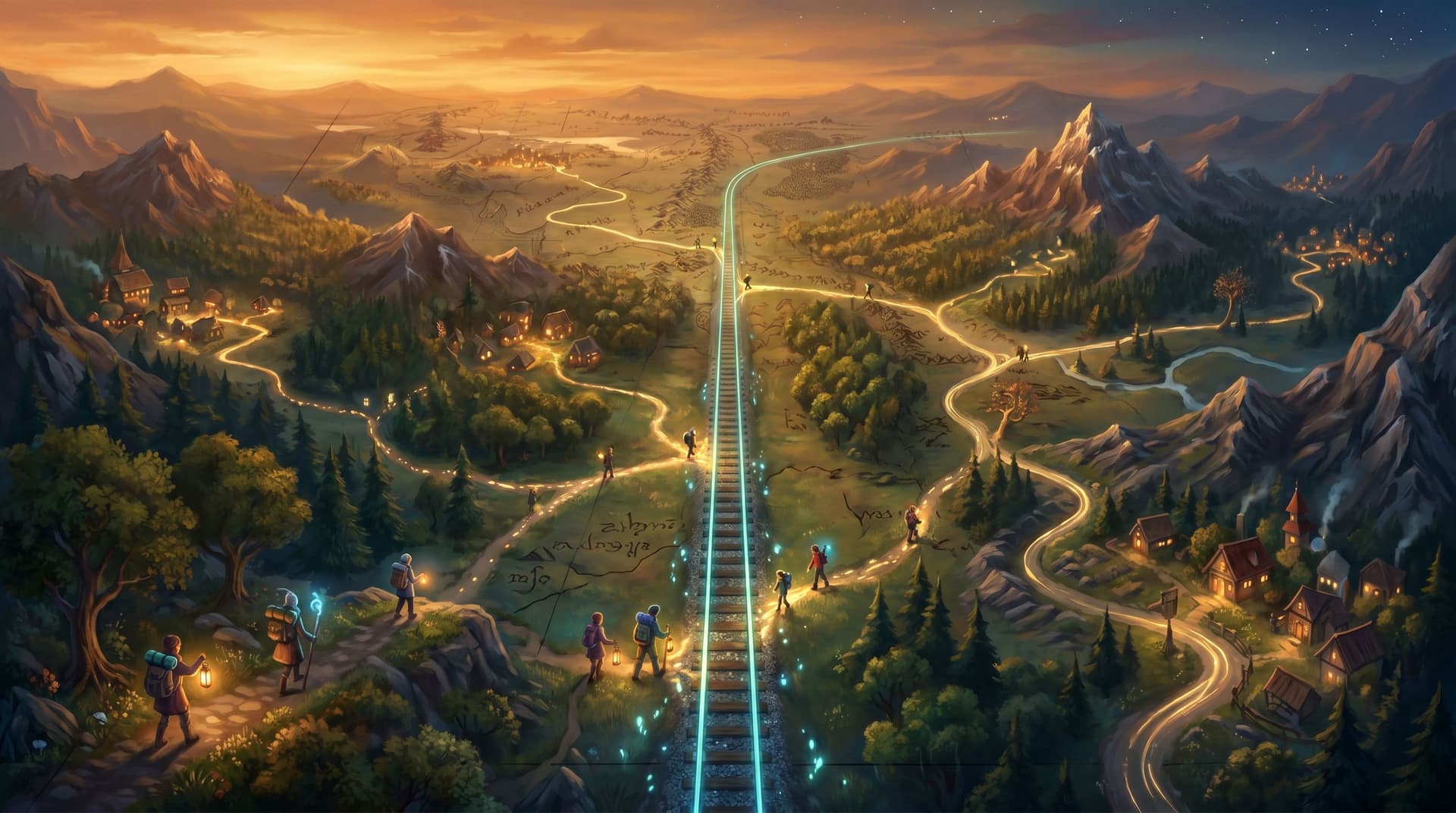
If your story only works when everyone stays on the rails, it’s fragile. The more you try to lock players into a single path, the more they feel like passengers instead of protagonists.
This is where the anti-railroad quest comes in: a design mindset and toolkit that lets players wander, improvise, and poke at the edges without your story collapsing into chaos.
On platforms like Questas, where you can rapidly spin up branching paths with AI-generated visuals and video, this mindset is the difference between a brittle maze and a living world.
Why “Anti-Railroading” Matters for Interactive Creators
Letting players go “off script” isn’t just a nice-to-have. It directly improves how your quests feel and perform.
1. Players feel respected, not herded
When every choice leads back to the same outcome, players notice. They may not map your nodes, but they sense when agency is an illusion. Anti-railroad design:
- Acknowledges unusual choices instead of ignoring them.
- Allows small detours that change flavor, information, or emotional tone.
- Makes players feel like co-authors, not test-takers.
2. You get richer data and insight
For educators, trainers, and marketers, “off script” behavior is gold. It shows:
- Misconceptions learners actually hold.
- Edge cases your policy or product doesn’t handle well.
- Emotional responses (hesitation, defiance, curiosity) that never show up in a multiple-choice quiz.
This is the same logic behind turning lectures into playable scenarios: you learn more from what people do than what they say they understand. If that resonates, you’ll probably enjoy how we approach this in From Lecture to Lab: Turning Expert Talks and Webinars into Hands-On Questas Scenarios.
3. Your story becomes more replayable
If players suspect there are hidden paths, optional scenes, or alternate approaches, they’re more likely to:
- Replay to see what happens if they push harder against the boundaries.
- Share your quest with others (“Try saying yes to the sketchy offer in chapter 2”).
- Treat your storyworld as a place to explore, not a quiz to clear.
Anti-railroad design doesn’t mean infinite branching. It means smartly placed flex points that make the world feel open while your structure stays manageable.
The Core Idea: Flex at the Edges, Anchor at the Spine
Think of your quest as having two layers:
- The spine: the essential beats you must hit for the story to make sense (e.g., the heist briefing, the first obstacle, the twist, the finale).
- The edges: the moments where players test the world—asking unusual questions, trying odd tactics, or refusing the obvious path.
Anti-railroad design is about:
- Protecting the spine so your core arc stays coherent.
- Softening the edges so players can lean, wander, and experiment without falling off the map.
You don’t need to predict everything. You just need prepared responses to categories of “off script” behavior.
Step 1: Decide Where You’re Willing to Be Surprised
Before you open Questas or any editor, ask:
“Where am I comfortable letting players bend the story, and where do I need to stay firm?”
Create a simple table:
| Story Area | Flexible? | Notes | |-----------|-----------|-------| | Tone of conversation | High | Players can be polite, rude, sarcastic. | | Order of sub-goals | Medium | They can visit locations A/B/C in any order. | | Core twist (who betrayed them) | Low | This must stay fixed. | | Ending state | Medium | 3–4 variations, but same major event happens. |
Design implications:
- High flexibility areas get more branches and alternate responses.
- Low flexibility areas get guardrails: redirects, clarifying scenes, and consequences that gently steer players back.
This upfront clarity keeps you from over-building branches where they don’t add value.
Step 2: Use “Soft Walls,” Not Hard Stops
A hard stop is when the story says, “You can’t do that,” and dumps the player back on the main track with no acknowledgment.
Soft walls, by contrast, recognize the attempt, give it weight, and then redirect.
Common Soft Wall Patterns
1. The Reflective Rejection
Instead of: “You can’t go there.”
Try: “You could storm the CEO’s office right now… but security would shut you down before you reached the elevator. Maybe there’s a quieter way in.”
This pattern:
- Validates the player’s impulse.
- Explains why it won’t work (world logic).
- Offers a new, in-world option.
2. The Costly Detour
Let the player do the wild thing—but attach a cost:
- Time lost (a timer or countdown advances).
- Resources spent (money, trust, health, political capital).
- Information missed (they skip a clue or ally).
If you’re curious how to structure these systems without code, No-Code Narrative Systems: Building Timers, Cooldowns, and Limited Resources Inside Questas goes deep on that toolkit.
3. The Partial Success
The off-script choice kind of works, but not as well as a more aligned path:
- They bluff past the guard but leave a bad impression that echoes later.
- They skip the tutorial but miss a mechanic that makes a later scene harder.
This keeps the world responsive without exploding into a totally new branch.
Step 3: Design “Catch Nodes” for Off-Script Choices
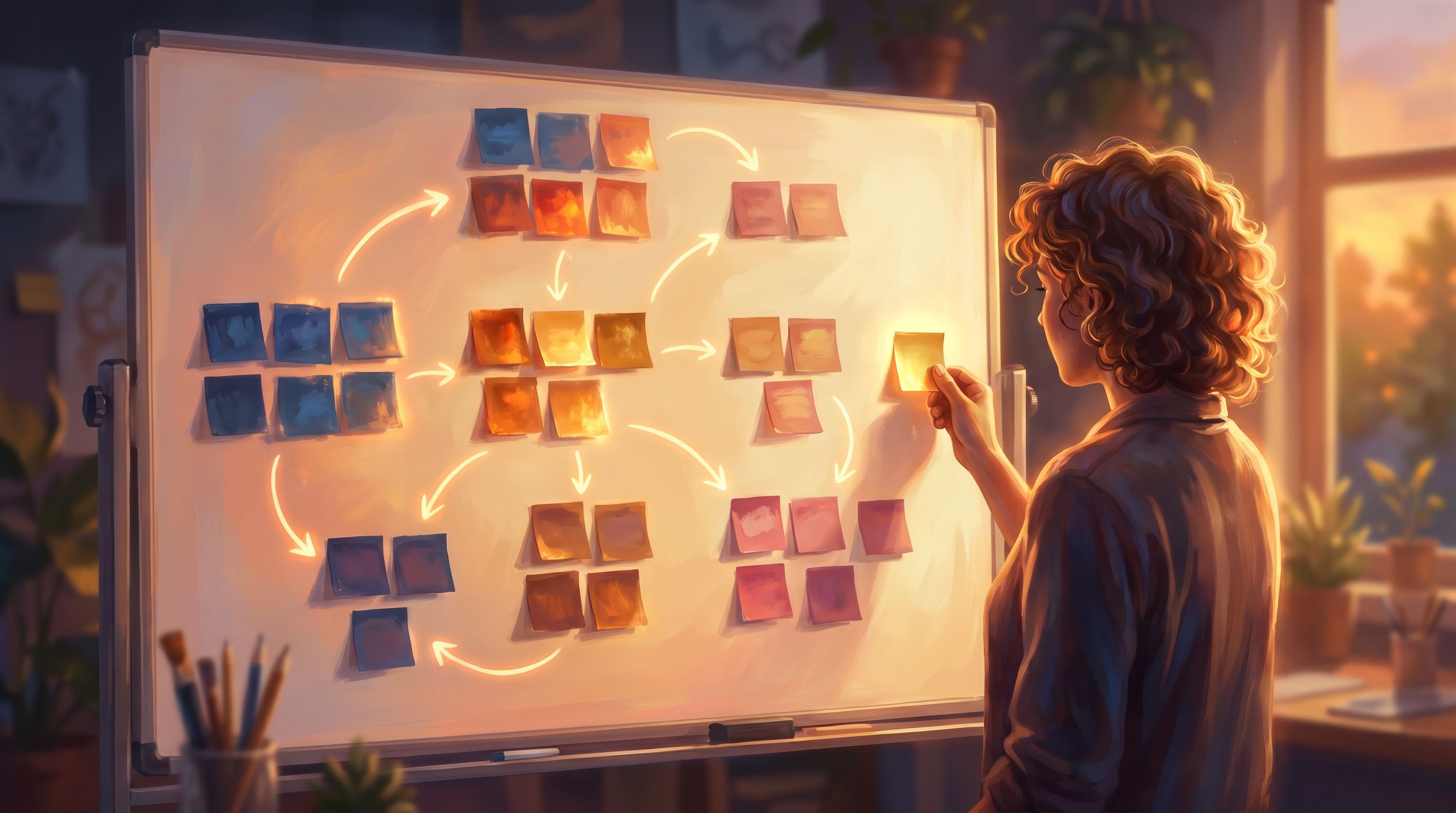
Instead of trying to anticipate every weird idea, design catch nodes—scenes built to absorb a category of behavior.
Think in terms of intent, not exact wording.
Examples of intents:
- “Refuse authority” (ignore the quest, question the boss, mock the trainer).
- “Delay the main task” (explore side rooms, chat with NPCs, scroll through policies).
- “Escalate conflict” (threaten, insult, go nuclear).
For each intent, create a catch node that:
- Acknowledges the behavior in-character.
- Shows a believable consequence.
- Either:
- Routes back to the spine after a beat, or
- Opens a short side branch that ends at a spine-adjacent point.
In Questas, this often looks like:
- Multiple different choices all pointing to the same catch node.
- Catch nodes tagged or color-coded so you can see your “off script net” at a glance.
This is also where “bad endings” can shine as teaching tools. If you want to lean into that, Designing Failure on Purpose: How to Use ‘Bad’ Endings to Teach, Not Punish, in Questas is a natural companion to anti-railroad design.
Step 4: Keep Your Canon Tight, Your Variations Loose
One reason creators fear off-script play is continuity: if players wander, how do you keep later scenes coherent?
The trick is to separate canonical facts from variable details.
Canonical facts are things that must be true across almost all routes:
- The reactor did malfunction.
- The customer didn’t receive their order.
- The city council vote is happening tonight.
Variable details are how players got there:
- Who they angered or impressed.
- What evidence they saw (or missed).
- How much time or trust they have left.
Design guidelines:
- Lock canonical facts early in your planning. Treat them as non-negotiable.
- Let variable details color dialogue, visuals, and difficulty, not the entire plot.
- Use simple variables or flags (e.g.,
angered_boss = true) to swap lines or images.
On a platform like Questas, this can be as simple as:
- Duplicating a scene and lightly editing the tone or art based on a flag.
- Using conditionals to show different responses depending on past behavior.
The result: players feel like their off-script choices matter, while your core story logic stays intact.
Step 5: Offer Lateral Choices, Not Just Forward Ones
Railroading often shows up as a single question: “Do you move forward the way I want, or stall out?”
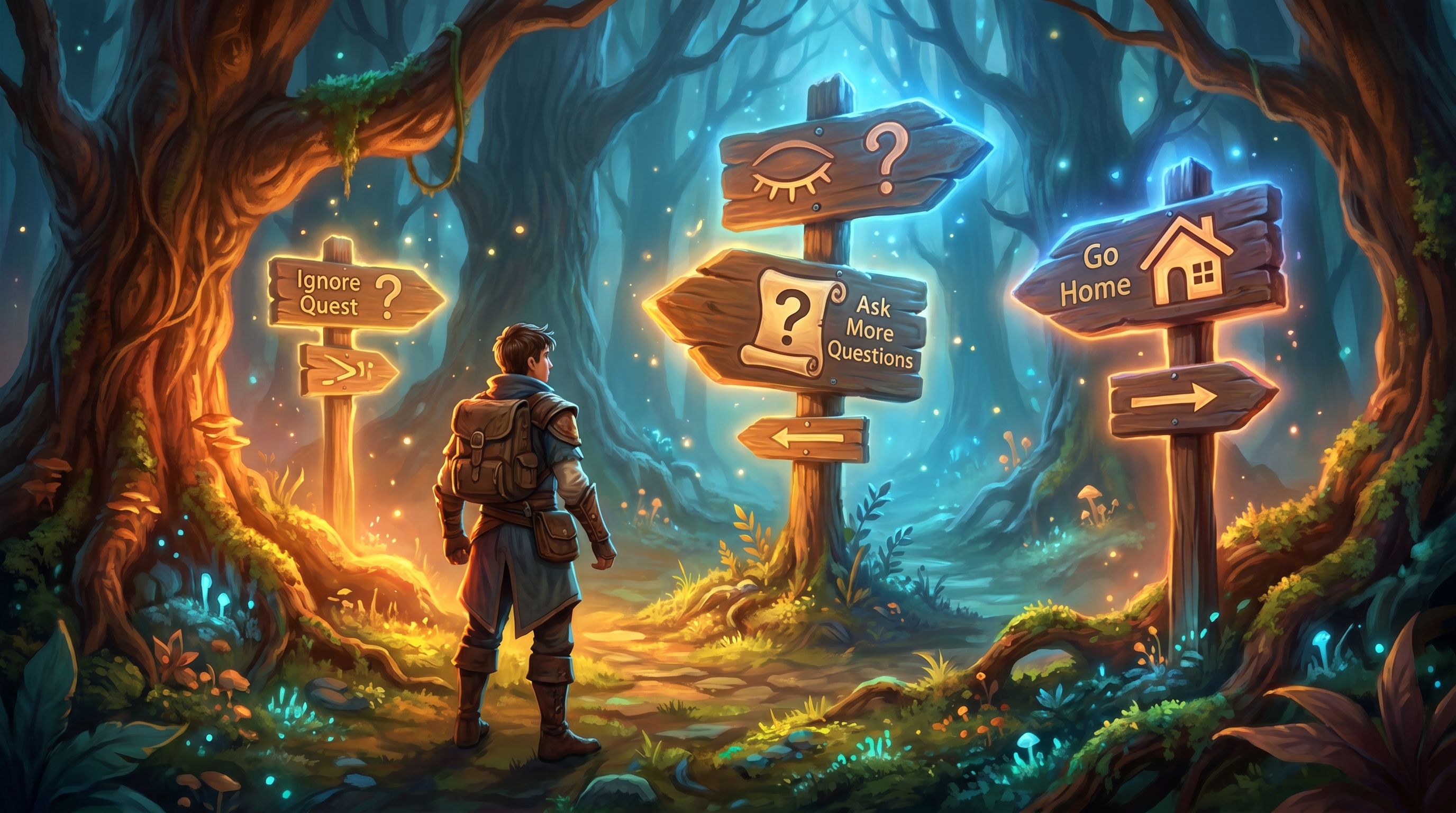
Anti-railroad design introduces lateral choices—options that don’t move the plot “forward” but deepen the world.
Examples:
- Ask more questions before agreeing to a risky plan.
- Investigate a side character who seems suspicious.
- Revisit a previous location to see if anything changed.
These choices are fantastic places to park off-script energy:
- Curious players get rewarded with extra context or secrets.
- Cautious players get reassurance before committing.
- Impulsive players can still charge ahead—but know they could have dug deeper.
You can structure these as short loops that always return to a main decision point, preserving your spine while allowing genuine exploration.
Step 6: Script Reactions, Not Just Actions
Most creators script what players can do. Anti-railroad creators also script how the world reacts, especially when players push boundaries.
Think in layers:
-
Immediate reaction
- An NPC raises an eyebrow at a rude comment.
- A system message notes that “IT logs this unusual access attempt.”
-
Short-term echo
- The same NPC is cooler toward the player later.
- Security checks are tighter in the next scene.
-
Long-term payoff
- In the finale, someone references the player’s earlier defiance or curiosity.
- A door that would’ve been open is now locked—or vice versa.
You don’t need dozens of these. Even two or three well-placed echoes can make the world feel responsive and justify why certain “off script” paths loop back or close off.
Step 7: Test With “Edge-Case Players” First
When you playtest, don’t start with people who want to “win” your story. Start with people who:
- Always pick the most chaotic option.
- Try to say “no” to every request.
- Click every link and read every tooltip.
Ask them to actively try to break the story. Watch for:
- Places where their behavior produces dead air (no meaningful response).
- Moments where they feel scolded or shut down.
- Loops that feel like punishment rather than consequence.
Each time they find a rough edge, you have three options:
- Turn it into a soft wall.
- Route it into an existing catch node.
- Promote it into a new, intentional branch if it’s genuinely interesting.
Over time, this process gives you a library of reusable patterns for handling off-script behavior across quests.
Making This Work Inside Questas
If you’re building on Questas, you can bake anti-railroad thinking into your workflow:
- Use color-coding or labels for catch nodes and soft-wall scenes so you can see your “off script net” on the map.
- Group lateral choices into compact clusters that all route back to a shared decision beat.
- Clone and tweak key scenes to reflect different variable states instead of writing entirely new branches.
- Leverage AI visuals to reinforce consequences—e.g., a character’s office looks messier or more fortified depending on earlier choices.
If you’re new to branching structure, Branch Smart, Not Wide: Blueprint Patterns for Scalable Questas Stories pairs beautifully with anti-railroad design. Together, they help you keep both freedom and sanity.
Bringing It All Together
Letting players go “off script” doesn’t mean surrendering control of your story.
It means:
- Choosing where you’re flexible and where you’re not.
- Replacing hard walls with soft, in-world responses.
- Designing catch nodes that absorb whole categories of wild behavior.
- Keeping canon tight while letting details and tone flex.
- Adding lateral choices so curiosity has somewhere to go.
- Scripting reactions and echoes that make the world feel alive.
- Playtesting with edge-case players to harden your design.
Do this well, and your quests stop feeling like a train ride and start feeling like a world—one that can handle surprise.
Your Next Step: Build One Off-Script Moment
You don’t need to redesign your entire story overnight. Start small:
- Pick one scene where players make an important decision.
- Ask, “What’s the most annoying, unexpected, or chaotic thing a player might try here?”
- Turn that into a named intent (refuse, delay, escalate, detour).
- Build a catch node that acknowledges it, shows a consequence, and then loops back or branches briefly.
- Add a small echo of that choice later in the quest.
If you’re already working in Questas, open your latest quest and try this pattern on a single beat. If you haven’t started yet, this is a perfect lens to bring to your first build.
Your players are going to do weird, brilliant, sideways things. You can fight that—or you can design for it.
Adventure awaits when you let them leave the rails.