Branch Smart, Not Wide: Blueprint Patterns for Scalable Questas Stories


If you’ve ever zoomed out on a sprawling branch map and felt your stomach drop, you’re not alone.
You start with a simple premise: a few choices, a couple of endings. Then you add one more fork. And another. Suddenly your story graph looks like a plate of spaghetti, your revision notes are a mess, and you’re wondering how you’ll ever keep art, logic, and pacing consistent.
Branching isn’t the problem. Unstructured branching is.
This is where branching “blueprints” come in—reusable structural patterns you can lean on so your Questas stories grow deeper, not just wider. When you branch smart, you get:
- Replay value without runaway scope
- Clearer pacing across routes
- Manageable art and logic budgets
- Stories you can extend later without breaking everything
This post walks through practical blueprint patterns you can apply directly inside Questas’ visual editor, with examples, trade‑offs, and tips for scaling your stories over time.
Why “Smart Branching” Matters for Questas Creators
Most new creators hit one of two extremes:
- Over-branching: Every choice explodes into three more, each with unique scenes, visuals, and endings. It’s exciting… until you try to revise a core premise or update one scene’s art style.
- Under-branching: Choices feel cosmetic. Branches reconverge so quickly that players notice their decisions don’t really matter.
Smart branching is the middle path:
- Choices feel meaningful because they change context, stakes, or information.
- The story stays maintainable because you reuse scenes, locations, and variables.
- You can add new content later without refactoring the entire graph.
If you’ve already experimented with pacing structures in From Branch Map to Beat Sheet: Structuring Scene Pacing in Complex Questas Stories, blueprint patterns are your next layer: they define how routes fan out and fold back in.
Core Principle: Depth Over Raw Branch Count
Before we get into patterns, it helps to reframe what “complexity” means.
Complexity that scales well tends to come from:
- State, not scenes. A single scene can play very differently depending on flags, resources, and prior choices.
- Reused locations. You revisit places with new stakes or information.
- Perspective shifts. Different characters or roles encounter the same situation from new angles.
By contrast, complexity that breaks you usually comes from:
- Dozens of totally unique scenes that never recur
- One-off art for every branch
- Endings that never share any setup, making revisions painful
When you’re building in Questas, think of your story like a modular kit:
- A limited set of hubs and key scenes
- A clear spine (main beats everyone hits)
- Optional detours that change what players know or carry, even if they reconverge later
The patterns below are all ways of arranging that kit.
Blueprint 1: The Braided Spine
Best for: narrative-heavy quests where you want multiple distinct routes but a shared climax.
In a braided spine, your story has:
- Common opening – Everyone starts at the same inciting incident.
- Divergent middle routes – Players follow different threads (e.g., political, personal, investigative).
- Rebraided climax – Routes weave back into a shared endgame, but how it plays out depends on what happened in the middle.
Why it scales well:
- You only maintain one major climax arc, not five.
- You can add new mid‑route “strands” later that still plug into the same finale.
How to build it in Questas:
- Sketch the spine first. Define 3–5 non‑negotiable beats everyone reaches (e.g., Call to action → Midpoint twist → Final confrontation).
- Add braided routes between beats. Between Beat 1 and Beat 2, create 2–3 distinct paths that explore different aspects of your world.
- Use variables to track what each route unlocks. For example:
hasEvidence = true/falseallyTrustLevel = 0–3
- Design the climax to read those variables. The final confrontation node doesn’t need separate versions per route; it just checks state:
- If
hasEvidenceis true → unlock extra dialogue options. - If
allyTrustLevel≥ 2 → ally intervenes in a critical moment.
- If
Branch smart tip:
- Whenever you’re about to create a new “final battle” scene for a branch, ask: Could this be the same scene with different preconditions and outcomes?

Blueprint 2: Hub-and-Spoke with Memory
Best for: exploratory stories, training scenarios, customer journeys, and sandboxy worlds.
In a classic hub‑and‑spoke, players return to a central hub after exploring “spokes.” The risk is that it can feel like a menu of disconnected mini‑quests.
The fix: give your hub a memory.
Structure:
- Hub scene – A home base, office, control room, town square, or dashboard.
- Spokes – Self‑contained missions, conversations, or errands.
- Evolving hub – Each completed spoke changes the hub’s state.
Why it scales well:
- You can add new spokes over time without rewriting existing ones.
- Players feel impact as the hub visually and narratively evolves.
How to build it in Questas:
- Create a central hub node with choices like:
- Talk to the mentor
- Review surveillance footage
- Visit the market
- For each spoke, create a mini‑arc that:
- Sets or updates a variable (e.g.,
mentorMood,budgetRemaining,publicSupport). - Optionally unlocks a new choice in the hub.
- Sets or updates a variable (e.g.,
- Return players to the same hub node, but gate options with conditions:
- Only show “Launch risky mission” if
publicSupport ≥ 2. - Change dialogue based on
mentorMood.
- Only show “Launch risky mission” if
- Update visuals based on state. With AI images in Questas:
- Generate alternate art for the same hub (e.g., crowded vs. deserted market) and swap them based on variables.
If you’re designing simulations or policy journeys, this pattern pairs nicely with the ideas in From Worldbuilding Docs to Playable Sandbox: Letting Teams Stress-Test Policies Inside Questas.
Branch smart tip:
- Restrain yourself to one primary hub per episode. Multiple hubs multiply complexity quickly.
Blueprint 3: The Forked Funnel
Best for: thought leadership pieces, explainers, onboarding stories, and editorial quests where you want people to explore viewpoints but still reach a shared reflection.
In a forked funnel, branches fan out early to let players explore different approaches, then converge into a reflection or debrief.
Structure:
- Wide early fork – Players pick a stance, strategy, or persona.
- Short, distinct routes – Each path surfaces trade‑offs and consequences.
- Shared debrief funnel – Everyone arrives at a common analysis or “what we learned” section that adapts to their prior route.
Why it scales well:
- You only maintain one debrief section, with conditional text.
- You can bolt on new early forks later (e.g., a new strategy) that lead into the same funnel.
How to build it in Questas:
- Define 2–4 clear early choices that embody different philosophies.
- Keep each route short but punchy (3–5 scenes) with concrete outcomes.
- Tag key decisions with variables, like
routeType = "short-term" | "long-term" | "status-quo". - Route everyone into a shared analysis scene that:
- Uses conditional paragraphs to mirror their path.
- Offers side‑by‑side comparisons of what could have happened on other routes.
This pattern is perfect if you’re turning essays or POV pieces into playable journeys, as explored in Branching Narratives for Thought Leadership: Turning Your POV into Playable Questas Essays.
Branch smart tip:
- Focus your writing energy on the debrief. That’s where the value compounds across all routes.
Blueprint 4: The Sliding Door Pair
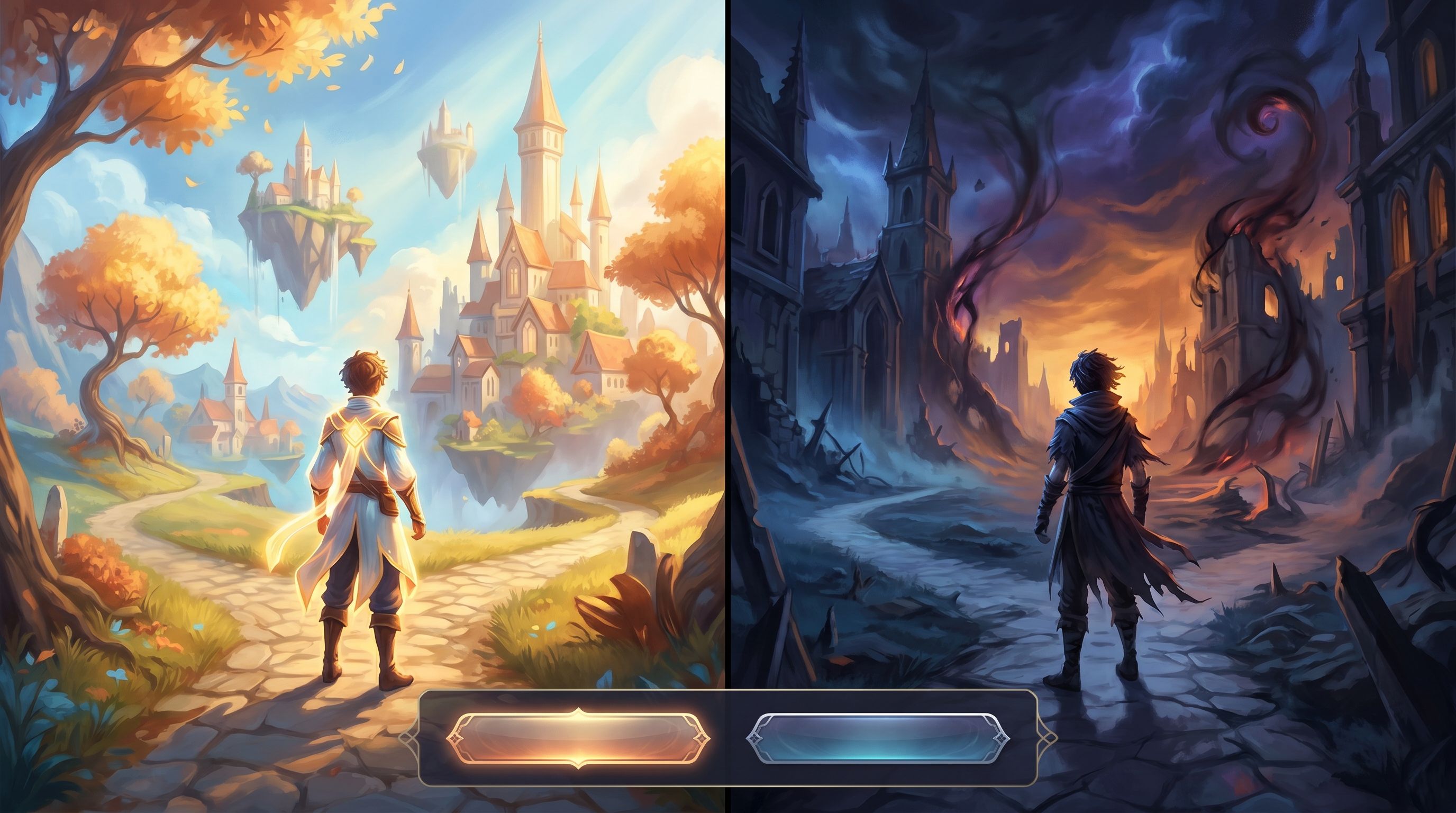
Best for: empathy-building, character studies, HR and DEI scenarios, and “what if” moments.
Instead of five branches, you design two deeply contrasted routes that diverge on a single key decision.
Structure:
- Shared setup – Everyone plays through the same lead‑up.
- One major fork – A clear A/B choice.
- Mirrored sequences – Both routes visit similar beats (e.g., same meeting, same deadline) but outcomes differ based on the choice.
Why it scales well:
- You’re essentially maintaining one story with two lenses, not two totally separate stories.
- Great for replay: players often immediately replay to see the other side.
How to build it in Questas:
- Create the shared act one up to the pivotal choice.
- Duplicate a few key scenes and rewrite them to reflect the different reality.
- Reuse visuals where possible, making subtle variations:
- Same office, but lighting and character expressions change.
- Offer an explicit replay hook at the end: “What if you had chosen differently?” with a quick restart.
For deeper emotional nuance, combine this pattern with the empathy techniques in The Quiet Choice: Using Low-Stakes Branches to Build Empathy, Not Just Drama, in Questas.
Branch smart tip:
- Resist adding more major forks. The power of this pattern is the clean contrast between two realities.
Blueprint 5: The Layered Loop
Best for: replay-heavy scenarios, skill practice, and systems‑driven stories with timers, resources, or cooldowns.
A layered loop lets players cycle through similar situations multiple times, but with increasing complexity and persistent consequences.
Structure:
- Core loop – A recurring situation (e.g., a sales call, a daily patrol, a shift at the clinic).
- Layered variants – Each loop adds new constraints, information, or stakes.
- Global state – Variables that persist across loops (e.g., reputation, resources, stress level).
Why it scales well:
- You reuse the same structural skeleton for each loop.
- Players naturally replay to “do better next cycle.”
How to build it in Questas:
- Design one clean iteration of your loop.
- Clone it for subsequent cycles, then:
- Gate certain choices based on global state.
- Introduce new complications in later loops.
- Use variables and simple logic for:
- Timers (
daysRemaining) - Limited resources (
budget,energy) - Cooldowns (
canUseSpecialOption)
- Timers (
For a deeper dive into building these systems visually, check out No-Code Narrative Systems: Building Timers, Cooldowns, and Limited Resources Inside Questas.
Branch smart tip:
- Limit yourself to 2–3 loop iterations per episode. You want growth, not grind.
How to Choose the Right Blueprint (or Mix Them)
You don’t have to pick just one pattern forever. Most robust Questas series blend them.
A quick decision guide:
- You’re telling a character‑driven saga → Start with a Braided Spine and sprinkle in Sliding Door Pairs for key moments.
- You’re building a sandbox or training sim → Use Hub-and-Spoke with Memory, possibly wrapped in a Layered Loop over multiple days.
- You’re adapting articles, reports, or thought pieces → Lean on the Forked Funnel so everyone meets the same core ideas.
When mixing patterns:
- Keep one primary pattern per episode to avoid confusion.
- Use variables as the glue between episodes, not massive branch webs.
Practical Guardrails: Keeping Scope Under Control
Even with smart patterns, scope creep is always lurking. A few practical rules:
1. Cap your unique endings.
Decide on a maximum (e.g., 3–5) and classify others as “variants” of those endings rather than completely separate conclusions.
2. Reuse locations and art aggressively.
When using AI visuals in Questas:
- Lock in a visual bible for key characters and settings.
- Generate multiple moods of the same location (day/night, crowded/empty) instead of net‑new places.
(If you’re building a whole series, the practices in AI as Art Director: Building Cohesive, On-Brand Visual Languages for Your Questas Series will save you countless hours.)
3. Treat each episode like a shippable slice.
Structure stories so you can publish a complete experience, then extend it later by:
- Adding a new spoke to a hub
- Introducing a new braided route between existing beats
- Layering another loop on top of your core cycle
4. Design for revision.
Assume you’ll want to tweak your premise, rebalance outcomes, or adjust tone. That’s much easier when:
- Major beats are centralized (shared nodes, not duplicated everywhere)
- Key logic lives in variables and conditions, not hard‑coded branches
A Simple Workflow for Applying Blueprints in Questas
Here’s a lightweight process you can use on your next build:
-
Clarify your story’s job.
Is this quest meant to entertain, teach, persuade, or simulate? Your answer points to a pattern. -
Pick a primary blueprint.
Choose one of: Braided Spine, Hub-and-Spoke with Memory, Forked Funnel, Sliding Door Pair, or Layered Loop. -
Draw the pattern first, without content.
On paper or directly in Questas, sketch nodes as roles (e.g., Hub, Spoke A, Spoke B, Climax) before you name them. -
Mark shared scenes in a distinct color or tag.
These are your spine or hub scenes. Treat them as protected: don’t casually duplicate them. -
Add variables early.
Decide what you need to track before you write:- Relationships
- Resources
- Key decisions
-
Write one route to completion.
Make sure it feels satisfying on its own. Then branch off that route using your chosen pattern, instead of writing every branch in parallel. -
Playtest for “felt” complexity, not node count.
Ask testers:- Did your choices feel like they mattered?
- Did you feel lost or overwhelmed?
- Do you want to replay—and why?
Bringing It All Together
Branching smart isn’t about limiting your creativity. It’s about channeling it so you can ship more stories, keep them coherent, and grow them over time.
By leaning on patterns like:
- Braided Spines for big sagas
- Hub-and-Spoke with Memory for sandboxes and sims
- Forked Funnels for thought pieces and explainers
- Sliding Door Pairs for empathy and contrast
- Layered Loops for practice and replay
you give yourself a repeatable way to plan, build, and extend your Questas projects—without drowning in branches.
Where to Go Next
If this is your first time working with structured branching, a good next step is to:
- Pick one blueprint from this article.
- Open Questas in a new tab.
- Sketch a tiny prototype—no more than 10–15 nodes—that follows that pattern.
Don’t worry about perfect prose or flawless art yet. Focus on shape: how routes fan out, reconverge, and remember what happened.
Once you’ve shipped that small quest, you’ll have a living template you can reuse and expand—your own personal blueprint library.
Adventure awaits. Start building the kind of branching stories your future self will actually enjoy maintaining.