Designing Failure on Purpose: How to Use ‘Bad’ Endings to Teach, Not Punish, in Questas


Most creators treat “bad” endings like landmines: step wrong, boom—game over. The player feels scolded, hits restart (if you’re lucky), or just closes the tab.
But when you’re building interactive stories in Questas—for learning, storytelling, customer journeys, or thought leadership—those same bad endings can become your best teaching tool.
Designed well, failure:
- Reveals consequences without shaming players.
- Invites reflection instead of rage-quitting.
- Boosts replay value, because people want to see how to do better.
- Builds skills and judgment, not just trivia recall.
This post is about turning failure into a feature, not a punishment, using the tools and structure you already have in Questas.
Why “Bad” Endings Are Secretly Your Superpower
Interactive stories are uniquely good at one thing: letting people safely test decisions and see what happens. That’s gold for:
- Educators and L&D teams designing scenarios where learners need to practice judgment.
- SaaS and product teams simulating onboarding, feature use, or “what if I do this wrong?” flows.
- Storytellers and game creators who want rich, emotionally resonant worlds with real stakes.
If every path leads to a neat, tidy success, players never feel true consequence. On the other hand, if every misstep drops them into a harsh “You failed” screen, they learn to fear experimentation.
The goal is a middle path:
Failure should feel informative, not humiliating.
When you design endings on purpose in Questas, you can:
- Show the impact of a choice (on characters, systems, or outcomes).
- Offer feedback and reflection prompts right inside the ending scene.
- Gently invite another run with a new strategy.
If you’re thinking about replay value more broadly, you may also want to explore how endings fit into your overall structure in Designing Replay Value on Purpose: Structuring Questas Stories So Players Actually Want a Second Run.
Step 1: Decide What Failure Is For in This Story
Before you design a single bad ending node, answer one question:
What should players learn or feel when they “fail” here?
Some common purposes:
- Skill-building – e.g., a sales scenario where mishandling an objection loses the deal, but the player learns better phrasing.
- Ethical reflection – e.g., a compliance story where ignoring a red flag leads to a realistic scandal.
- Systems thinking – e.g., a resource-management quest where over-investing in one area collapses another.
- Emotional storytelling – e.g., a character-driven drama where neglecting a relationship has lasting consequences.
Write down 1–3 clear intentions for your failure states, like:
- “Show that rushing through the checklist leads to missed risks.”
- “Highlight how ignoring a junior teammate’s concern can snowball.”
- “Make players feel the tension between short-term wins and long-term trust.”
These intentions become your north star when you’re tempted to add a “gotcha” ending just because it’s dramatic.
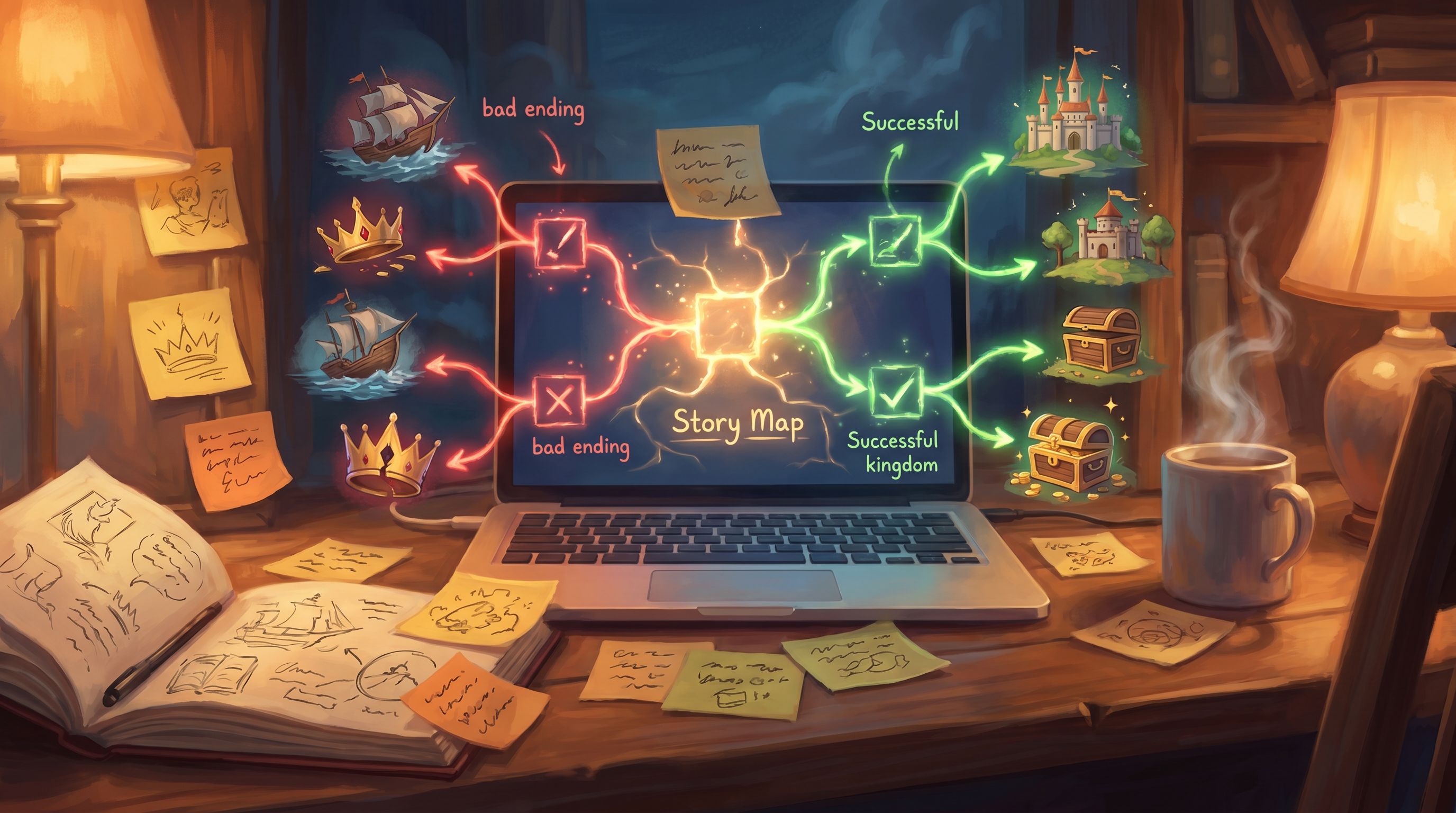
Step 2: Map Your Failure Types (Not Just Endings)
Not all failures are equal. In Questas, it helps to think in layers of failure, each with different design rules.
1. Soft Failures (Course Corrections)
These are non-terminal missteps:
- The conversation gets awkward.
- A resource meter dips.
- A character’s trust score drops.
You don’t end the story yet. Instead, you:
- Signal that something went wrong (visually, narratively, or via UI).
- Offer a chance to recover.
Soft failures are great for early scenes and low-stakes branches—very much in the spirit of what we explored in The Quiet Choice: Using Low-Stakes Branches to Build Empathy, Not Just Drama, in Questas.
2. Hard Failures (Terminal Endings)
These are the “bad endings” most people think of:
- The mission fails.
- The company folds.
- The relationship breaks.
The key is to end with meaning:
- Show the ripple effects of the decision.
- Offer a concise debrief.
- Invite replay with a clear hint or reflection.
3. Meta-Failures (Design & UX Traps)
These are failures of the experience, not the player:
- Confusing choices (“Option A” vs. “Option B” with no context).
- Invisible rules (players don’t know what matters until it’s too late).
- Abrupt cutoffs (“You died. Restart.”) with no explanation.
Your job is to eliminate meta-failures so that when players fail, it’s because of a meaningful decision—not because the interface or wording tricked them.
Step 3: Make Failure Feel Fair (Clarity Before Consequence)
Players will accept harsh outcomes if they feel earned.
To make failure feel fair in Questas:
-
Foreshadow the risk.
- Use dialogue, narration, or UI cues to hint: “This might be risky.”
- Example: A mentor character warns, “Rushing this report will come back to haunt you.”
-
Clarify what’s at stake.
Before a big decision, briefly restate the tension:- “If you push the release, you’ll hit this quarter’s targets but risk long-term trust.”
- “If you delay, you protect quality but might lose investor confidence.”
-
Avoid trick questions.
- Don’t hide critical info behind arbitrary wording.
- Make sure each option reflects a plausible real-world choice.
-
Use visual cues for risk.
With AI-generated images and video, you can:- Darken the mood or color palette as stakes rise.
- Show subtle deterioration (a messy office, tense body language) when players are on a risky path.
When players can look back and say, “I should have seen that coming,” they’re more likely to try again—and to remember the lesson.
Step 4: Turn Bad Endings into Mini Debriefs
A bad ending shouldn’t be a dead wall; it should be a teachable moment.
In Questas, treat each failure ending as a micro-workshop:
-
Show the outcome in detail.
Don’t just say, “You lost the client.” Show:- The client’s email explaining why.
- A quick scene of the team reacting.
- A short time jump: “Three months later, the competitor owns the account.”
-
Name the key decision(s) that led here.
Add a short summary:- “This outcome flowed from:
- Ignoring the early warning from Support.
- Prioritizing speed over validation.
- Choosing not to involve Legal when the contract changed.”
- “This outcome flowed from:
-
Offer 1–2 alternative paths.
Without spoiling everything, hint at better routes:- “What if you had looped in the junior analyst?”
- “Next time, consider how the customer’s long-term risk profile shapes your pitch.”
-
Invite reflection or journaling.
Especially for learning scenarios:- “If this happened in your real role, what would you do differently?”
- “Which part of this outcome surprised you most?”
-
Give a clear next action.
- “Replay from the last major decision.”
- “Restart with a focus on building trust first.”
You can implement this structurally by giving each bad ending node a consistent template:
- Short cinematic scene (visual + text).
- Bullet-point breakdown of contributing choices.
- Reflection prompt.
- Button/choice: “Try again with a different approach.”
Step 5: Use Variables to Track and Surface Mistakes
One of the biggest advantages of Questas over static fiction is that you can track player behavior across scenes.
Even without code, you can:
- Add variables for things like:
trust_with_teamrisk_tolerancecompliance_flagscustomer_satisfaction
- Increment or decrement them based on choices.
- Check them at key beats to decide which version of a scene (or ending) to show.
This lets you design nuanced failure, such as:
- Slow-burn collapse – A series of small shortcuts gradually increases a
risk_indexuntil it tips into a crisis ending. - Mixed outcomes – The project succeeds (
project_success = true) butteam_moraleis low, unlocking an ending that’s “technically a win, emotionally a loss.” - Hidden strengths – A player who failed the main objective but built strong relationships still unlocks a hopeful “you’ll get another chance” epilogue.
If you’re curious about building more complex systems around timers, scarcity, or countdowns, you’ll find deeper patterns in No-Code Narrative Systems: Building Timers, Cooldowns, and Limited Resources Inside Questas.
The core idea: use variables to show that the story has been paying attention all along. When players hit a bad ending and see a breakdown like:
“Your rushed decisions increased the risk index to 9/10, while your relationship with Maya dropped to 2/5,”
…they understand exactly why they landed there.
Step 6: Calibrate Tone—Firm, Not Cruel
Tone is everything. The same ending can either:
- Motivate players to improve, or
- Make them feel mocked and walk away.
Some guidelines for writing failure scenes:
-
Avoid shaming language.
- Bad: “You completely blew it.”
- Better: “Your choice had serious consequences.”
-
Focus on decisions, not identity.
- Bad: “You’re a terrible manager.”
- Better: “This approach damaged trust with your team.”
-
Use neutral, observational narration.
- “Over the next week, the team stops bringing you bad news.”
-
Allow some emotional punch.
Failure should sting a little—that’s what makes it memorable—but it shouldn’t feel like a personal attack. -
Balance darkness with possibility.
- “This chapter ends badly. But you’ve seen where this path leads. Ready to try again?”
For younger audiences or sensitive topics, you may also want to align with the guardrails and content practices we explore in Ethical AI Worldbuilding: Setting Guardrails for Safer, Fairer Questas Story Universes.
Step 7: Use Visuals to Deepen, Not Just Decorate, Failure
Because Questas includes AI-generated images and video, your bad endings can be visually instructive, not just text summaries.
Consider using visuals to:
-
Show before/after contrasts.
- Early scene: a bright, bustling office.
- Failure ending: the same office, half-empty, with boxes and dim lighting.
-
Highlight emotional impact.
- Close-ups of characters’ faces: disappointment, fatigue, relief.
-
Make abstract consequences concrete.
- A news headline image about the scandal.
- A graph on a screen showing plummeting metrics.
-
Signal branches visually.
- Different color palettes or framing for hopeful vs. bleak endings.
Because visuals are generated quickly, you can afford to iterate:
- Test a stark, high-contrast style for failure scenes.
- Try a more subdued, documentary feel for realistic training scenarios.
Ask: Does this image help the player understand what their choice did? If not, refine it.

Step 8: Place Failure Strategically in Your Structure
Not every branch needs a bad ending. Overloading your quest with failure points can feel exhausting.
Some structural tips:
-
Front-load learning, back-load consequences.
- Early acts: more soft failures, opportunities to course-correct.
- Later acts: higher-stakes decisions that can trigger terminal endings.
-
Cluster endings around thematic questions.
For example, in a leadership scenario:- Endings that explore “short-term vs. long-term” trade-offs.
- Endings that explore “results vs. relationships.”
-
Limit total endings, deepen each one.
Instead of 20 shallow bad endings, aim for 3–6 rich, distinct failure routes that:- Tell a coherent mini-story.
- Highlight different patterns of mistakes.
If you’re wrestling with where to place those endings inside a complex branch map, you may find it helpful to pair this with the beat-based thinking in From Branch Map to Beat Sheet: Structuring Scene Pacing in Complex Questas Stories.
Step 9: Playtest Specifically for Failure
Most creators only test the “golden path.” To make failure work as a teaching tool, you need to deliberately play the “wrong” way.
Here’s a simple testing checklist:
-
Run at least three “reckless” playthroughs:
- Always choose the riskiest or most selfish option.
- Always choose the most cautious or conflict-avoidant option.
- Randomly pick without reading too carefully.
-
Ask testers:
- “Did the bad endings feel fair?”
- “Did you understand why you landed there?”
- “Did any ending feel like a slap in the face?”
- “Which failure taught you the most?”
-
Watch for drop-off points.
If analytics show that many players quit right after a particular ending:- Revisit the tone.
- Add more guidance or a stronger replay invitation.
-
Iterate quickly.
Because Questas uses a visual, no-code editor, you can:- Duplicate an ending node.
- Try alternate copy, visuals, and reflection prompts.
- A/B test with small groups.
Bringing It All Together
When you design failure on purpose in Questas, you’re not building a punishment machine. You’re building a safe lab for judgment, ethics, and experimentation.
To recap the core principles:
- Define the purpose of failure in your story before you add endings.
- Differentiate soft, hard, and meta-failures—and eliminate the last one.
- Foreshadow risk and clarify stakes so bad endings feel earned.
- Turn endings into mini debriefs with clear feedback and next steps.
- Use variables to track patterns and surface them in your endings.
- Write with a firm but respectful tone that critiques decisions, not players.
- Leverage visuals to make consequences concrete and emotionally resonant.
- Place endings strategically in your structure, then playtest the wrong paths on purpose.
Do that, and your “bad” endings become:
- The scenes players talk about afterward.
- The moments where learning actually sticks.
- The reason people hit “Play again” instead of closing the tab.
Your Next Step: Build One Great Failure Route
You don’t need to redesign your entire quest to start using failure well.
Here’s a simple challenge for your next build in Questas:
- Pick one pivotal decision in your story.
- Design one rich failure route from that choice:
- A clear, consequential outcome.
- A short debrief that names the key decisions.
- A reflection prompt and an invitation to replay.
- Add at least one variable that tracks behavior leading into this ending.
- Playtest that route with 2–3 people and refine.
Once you’ve seen how powerful a single well-designed bad ending can be, you’ll never treat failure as an afterthought again.
Adventure awaits—especially down the paths where things go wrong on purpose.