Adaptive Difficulty in Interactive Stories: Using Soft Gates, Hints, and Optional Paths in Your Questas

Interactive stories used to be pretty unforgiving.
Miss a clue? Game over. Choose the wrong door? Back to the start.
That kind of design can work for hardcore players—but it quietly pushes away everyone else: busy learners, casual readers, nervous trainees, or people just testing your story on their phone between meetings.
Adaptive difficulty gives you a better toolkit.
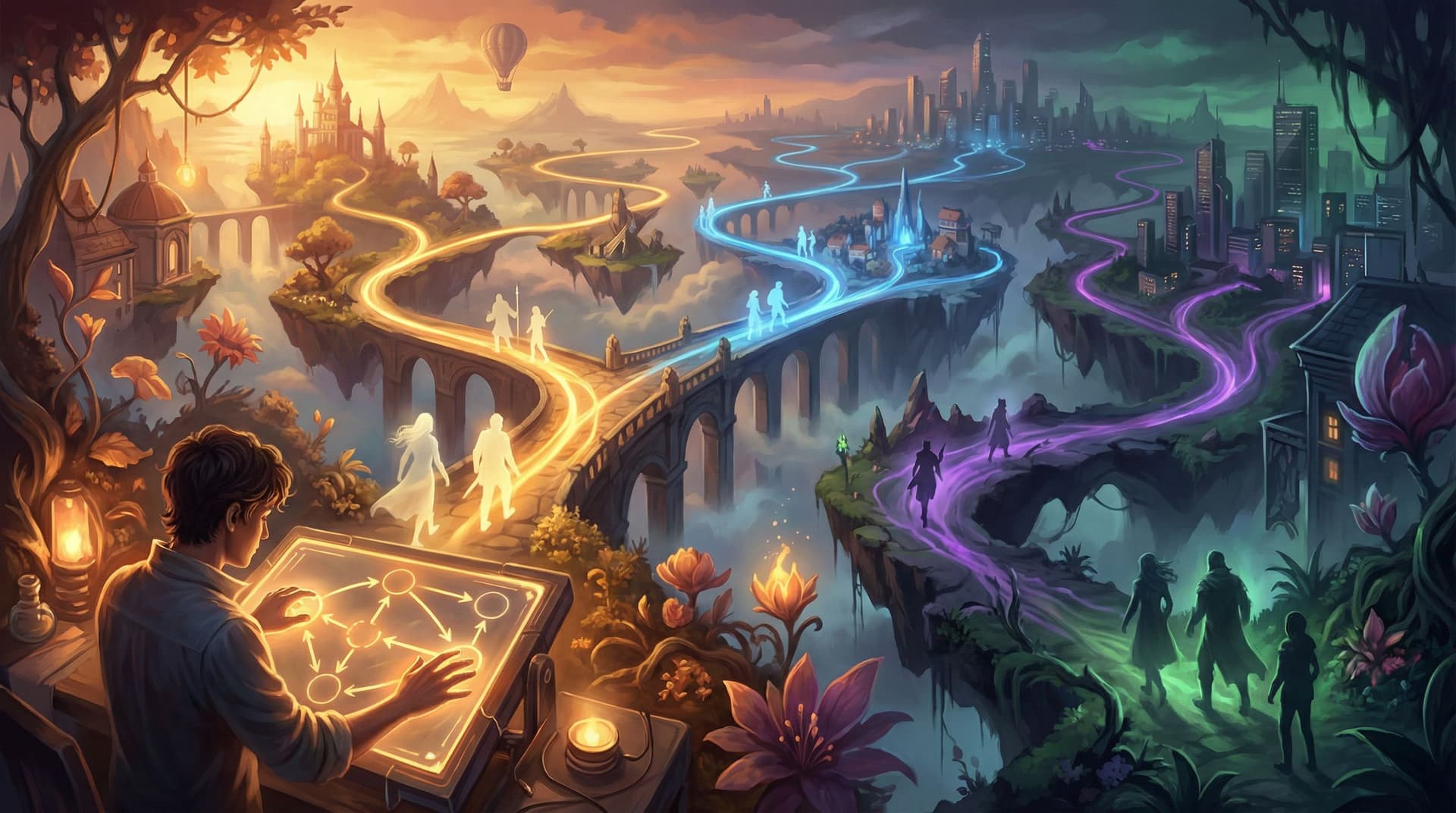
Instead of a single fixed challenge level, you design stories that respond to the player: offering hints when they’re stuck, bonus challenges when they’re cruising, and alternate routes when they need a different way through.
On a platform like Questas, where you can visually build branching stories with AI-generated images and videos—without code—adaptive difficulty is less about algorithms and more about smart structure: soft gates, hint systems, and optional paths.
This post is a practical guide to weaving all three into your next adventure, training scenario, or learning journey.
Why Adaptive Difficulty Matters for Your Story (and Your Audience)
Before we get tactical, it’s worth naming what’s at stake.
Adaptive difficulty isn’t just a “game design nice-to-have.” It directly affects:
- Completion rates – Players are far more likely to finish when they can recover from mistakes and get help when they’re stuck.
- Replay value – Optional branches and variable challenge levels give people reasons to come back and try again.
- Psychological safety – Critical for training use cases (sales, HR, coaching, therapy, leadership). People need to feel they can fail safely and still progress.
- Insight quality – If you’re using Questas for research or learning, like the micro-experiences described in Micro-Quests, Macro Insight: 10 Bite-Size Questas Formats for User Research, Polls, and Surveys, adaptive difficulty keeps participants engaged long enough to generate meaningful data.
When you get this right, players feel something subtle but powerful: “This story is meeting me where I am.”
Three Levers of Adaptive Difficulty
Think of adaptive difficulty in your Questas as three knobs you can turn:
- Soft gates – Moments where progress is slowed or redirected, but not blocked.
- Hints – Supportive nudges that help players succeed without spoiling the experience.
- Optional paths – Side routes that let players choose how hard (or exploratory) they want the journey to be.
You don’t need complex logic to use these. With a visual, node-based editor like Questas, you’re mostly adding a few extra branches and some smart copy.
Let’s unpack each lever.
Soft Gates: Slow Down Without Shutting Down
Hard gates say: “You failed. Start over.”
Soft gates say: “Not quite. Let’s regroup and try a different angle.”
They’re especially useful in:
- Training Questas (sales objections, compliance scenarios, leadership conversations)
- Skill-building stories (language learning, coding puzzles, medical decision-making)
- Narrative adventures where you want tension without total failure
You’ve probably seen soft gates in games as:
- A locked door that needs a code you can find nearby
- An NPC who won’t help until you’ve earned their trust
- A boss fight that sends you back to camp to gear up instead of wiping your save
How to Design Soft Gates in Questas
Use this simple pattern when planning your nodes:
-
Identify a key decision point.
This is where you want players to demonstrate understanding or make a meaningful choice. -
Define a “success” path and at least one “near miss” path.
- Success: Player understood the concept / made the wise choice.
- Near miss: Player’s reasoning is plausible but incomplete or risky.
-
Route the near miss into a soft gate node.
In that node, you:- Show the consequences of the choice (narratively or via feedback).
- Offer reflection (“You notice your client’s tone cools as you push for a discount…”).
- Provide options to recover, learn, or double down.
-
Allow recovery without erasing the mistake.
When the player chooses to course-correct, let them:- Reattempt the decision with new context.
- Take a different route that converges back into the main flow, but with a small tradeoff (lost time, strained relationship, lower score, etc.).
-
Track the outcome if you care about assessment.
Use variables or tags (if your tool supports them) to mark:- How many soft gates a player hit.
- Whether they learned on the second try.
This approach is especially effective in scenario-based training. For example, in Branching Narratives for Sales Teams: Using Questas to Rehearse Objections, Negotiations, and Closing Moves, soft gates can simulate a deal wobbling—but not yet lost—so reps practice recovery instead of just “failing the module.”

Hints: Support Without Spoilers
Hints are your safety net.
Used well, they:
- Reduce frustration at tricky nodes
- Keep momentum during live workshops or trainings
- Let you serve both beginners and advanced players in the same story
Used poorly, they:
- Feel condescending
- Give away the answer too quickly
- Interrupt immersion
The Three-Tier Hint Model
A practical pattern is to design three levels of hint, each a separate node or block of text you can route to when needed.
-
Nudge (Tier 1)
- Light, thematic, keeps immersion.
- Example in a fantasy heist:
“You remember the guildmaster warning you about ‘echoes in the marble.’ Maybe sound matters more than speed here.”
-
Clue (Tier 2)
- More direct, references specific elements on-screen.
- Example:
“The guard only reacts when metal touches stone. Look at what you’re carrying.”
-
Solution-Plus-Explanation (Tier 3)
- Gives the answer and the reasoning, so the player learns.
- Example:
“The quietest route is through the archives, where the floor is carpeted. Any path across bare marble will echo and trigger the alarm.”
Implementing Hints in Your Questas
Here’s a simple way to wire this up:
-
At a challenging decision node, add a choice: “Need a hint?”
- Route this to a Hint Tier 1 node.
-
From the Tier 1 hint node, offer:
- “Try again with this in mind” → back to the challenge node.
- “Still stuck? Give me a bigger hint” → Hint Tier 2 node.
-
From the Tier 2 node, offer:
- “Got it, let me retry” → back to the challenge node.
- “Just tell me the answer and why” → Tier 3 node.
-
From the Tier 3 node, route them forward as if they had solved it, but optionally:
- Add a note to the score or reflection summary.
- Include a short debrief: “In a real conversation, you’d have a few seconds to notice this pattern. Here’s what to listen for…”
This structure works beautifully in:
- Compliance or HR change journeys (see Beyond PDFs and Portals: How HR Teams Can Turn Policy Rollouts into Playable Questas Change Journeys), where you want people to actually learn the rule, not just guess it.
- Coaching and therapy rehearsal stories, where hints can mirror the kind of prompts a real coach might offer.
- Complex narrative puzzles or investigations, where players enjoy the satisfaction of “almost” solving it themselves.
Tone Tips for Great Hints
Keep your hint copy:
- Respectful – Assume the player is smart but missing a detail.
- Diegetic where possible – Delivered by an in-world character, device, or inner monologue.
- Optional – Never force a hint; always let players refuse help.
Optional Paths: Let Players Choose Their Own Challenge
Not everyone wants the same level of difficulty. Optional paths let you build multiple experiences inside one story:
- A main route that’s reasonably forgiving and story-driven
- Side routes that are harder, more complex, or more exploratory
- Shortcuts that reward mastery with faster or more dramatic outcomes
Types of Optional Paths
Here are a few patterns that work well in Questas:
-
Difficulty Lanes at the Start
Early in your story, offer:- “Guided run (recommended if you’re new)”
- “Standard run”
- “Expert run (harder choices, fewer hints)”
Behind the scenes, you:
- Use slightly different versions of key nodes.
- Limit or expand access to hints.
- Raise or lower the stakes of mistakes (e.g., how punishing a soft gate feels).
-
Optional Challenge Rooms
Borrowed from dungeon design (see AI as Dungeon Builder: Designing Replayable Dungeons, Raids, and Heists in Questas):- The main path is clear and doable.
- Along the way, players can opt into tougher encounters or puzzles that grant:
- Extra lore
- Alternate endings
- Higher scores or achievements
-
Branching Side Stories
- Offer optional character-focused or context-building branches.
- These might deepen emotional stakes but aren’t required to “win.”
-
Risk–Reward Forks
- Present a safe but slow option vs. a risky but rewarding one.
- Example in a sales training Questas:
- “Play it safe: Offer the standard discount.”
- “Take a risk: Hold the line on price and reframe value.”
Designing Optional Paths Without Overwhelming Yourself
The danger with optional paths is scope creep. A few guardrails:
- Limit yourself to 2–3 major optional branches in your first version. You can always add more later.
- Use convergence nodes. Optional paths should often rejoin the main storyline after delivering their unique beat.
- Re-use assets and characters. Especially if you’re also thinking about continuity across a story universe (see From Lore Bible to Living Wiki: Using Questas to Maintain Continuity Across Expanding Story Universes).
Putting It All Together: A Simple Design Blueprint
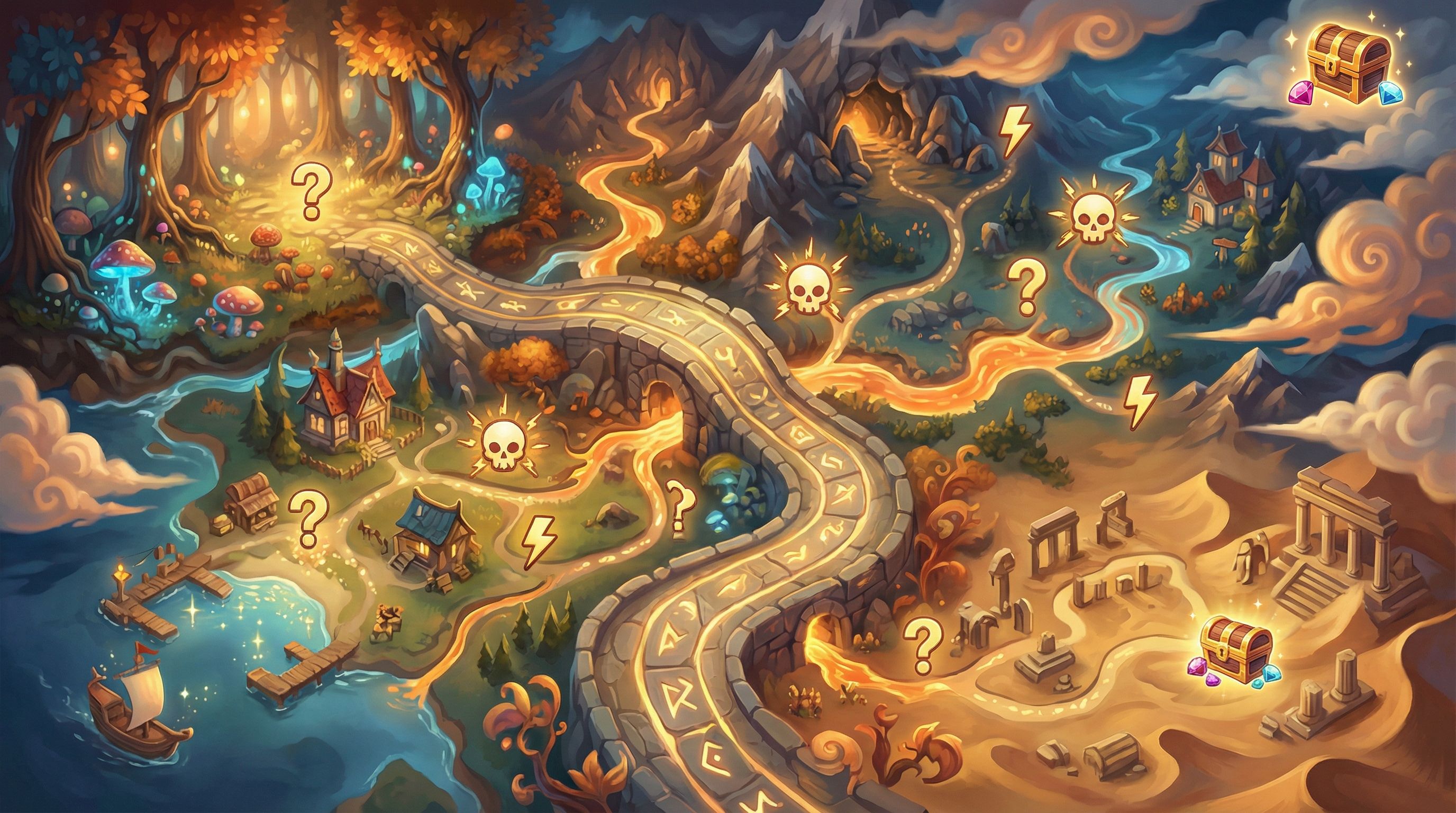
Here’s a step-by-step way to bake adaptive difficulty into your next Questas project from day one.
1. Define Your Core Experience First
Before thinking about difficulty, answer:
- Who is this for? (Learners, customers, fans, trainees?)
- What should they feel by the end? (Empowered, challenged, relieved, curious?)
- What must they absolutely experience? (Key scenes, decisions, or concepts.)
Sketch a minimal main path from start to finish that delivers this core.
2. Mark Your “Pressure Points”
On your main path, highlight nodes where:
- Players often get confused in real life (e.g., a tricky objection, a subtle ethical dilemma).
- You’re introducing a big concept or mechanic.
- A failure would be especially frustrating.
These are prime candidates for:
- Soft gates (to avoid dead-ends)
- Hints (to support learning)
- Optional paths (for advanced exploration)
3. Add Soft Gates at High-Stakes Moments
For each pressure point:
- Write a success node (they nailed it).
- Write a near-miss node (they almost got it).
- Route the near-miss into a soft gate that:
- Shows consequences.
- Offers reflection.
- Provides a path to recover.
4. Layer in a Hint System
At 2–3 of your trickiest nodes:
- Add a “Need a hint?” choice.
- Implement the three-tier model (nudge → clue → solution+explanation).
- Keep hints opt-in and respectful.
5. Introduce 1–2 Optional Challenge Paths
Choose places where:
- Extra difficulty would be fun or valuable.
- You have ideas for richer scenes or puzzles.
Add branches like:
- “Take on the extra challenge” vs. “Stay on the main path.”
- “Explore the side story” vs. “Keep moving.”
Have these paths rejoin the main flow later to avoid exponential complexity.
6. Playtest with Real People
Even a short playtest with 3–5 people will reveal:
- Where players are getting stuck without realizing hints exist.
- Which soft gates feel fair vs. punishing.
- Whether optional paths feel rewarding or distracting.
Ask specific questions:
- “Where did you feel most frustrated?”
- “Did you ever feel talked down to by a hint?”
- “Was there a moment you wanted more challenge?”
Use this feedback to tweak copy, add or remove hints, and rebalance your soft gates.
Common Pitfalls (and How to Avoid Them)
As you start designing adaptive difficulty, watch out for these traps:
- Too many gates in a row – Players feel like they’re constantly being stopped. Spread them out.
- Mandatory hints – If the only way forward is to click “Need a hint,” it doesn’t feel optional.
- Invisible difficulty differences – If your “expert route” doesn’t actually change stakes or complexity, it’ll feel like a label, not a real choice.
- Punishing curiosity – Optional paths should be challenging, not cruel. Reward exploration with something meaningful.
- Overcomplicated graphs – If your node map becomes unreadable, refactor: merge similar branches, use convergence nodes, and focus on a few strong adaptive moments instead of dozens of weak ones.
Wrapping Up: Adaptive Difficulty as Story Hospitality
At its heart, adaptive difficulty is a form of hospitality.
You’re inviting players into a world—and then doing the work to make sure they can actually stay there, learn there, and return there.
Soft gates keep the door open when they stumble.
Hints offer a hand without grabbing the wheel.
Optional paths let them choose how deep—and how hard—they want to go.
With a no-code, visual platform like Questas, you don’t need complex AI systems to pull this off. You just need:
- A clear main path.
- A few well-placed soft gates.
- A respectful, tiered hint system.
- A handful of optional branches that reward curiosity and mastery.
Do that, and your stories won’t just be playable—they’ll be replayable, teachable, and genuinely welcoming to a wider range of players.
Ready to Build Your First Adaptive Questas?
If you’re curious where to start, try this:
- Open your story map (or start a new one) in Questas.
- Draw a single, simple path from beginning to end.
- Add one soft gate, one hint system, and one optional path.
- Share it with a friend, teammate, or learner and watch how they move.
Once you’ve seen how much smoother the experience feels, you can layer in more complexity—or even time-box yourself with a process like the one in The One-Evening Story Sprint: Shipping a Complete Questas Prototype from Blank Page to Playtest to get a full adaptive prototype live in a single session.
Your audience is already making choices every day. Give them a story that respects those choices—one that adapts, supports, and challenges them just enough.
Adventure awaits. The next move is yours.