Branching Narratives in 2026: Trends Shaping the Future of Interactive Fiction and Story Games


Interactive fiction has quietly gone from niche hobby to mainstream format. Choice-based games top storefront charts, AI co-writers are becoming common, and classrooms, brands, and solo creators are all experimenting with branching stories.
That shift isn’t just about new tools. It’s about a new way of thinking about narrative: stories as systems—alive, replayable, and responsive.
In 2026, branching narratives are maturing fast. If you’re writing interactive fiction, building training scenarios, or prototyping story-driven games, understanding where things are headed will help you create work that feels current now and resilient a few years from now.
This guide breaks down the key trends, why they matter, and how you can start using them right away—especially with platforms like Questas, which let you design rich, visual, branching stories without code.
Why Branching Narratives Matter More Than Ever
Before we dive into trends, it’s worth grounding in why branching stories are gaining so much traction.
1. They match how people actually think
We don’t experience life as a single, perfect plotline. We imagine alternatives:
- What if I’d taken that job?
- What if the hero refused the call?
- What if the villain is right?
Branching narratives externalize that mental habit. They let players:
- Explore multiple perspectives
- Rehearse different decisions
- See consequences play out safely
That’s powerful whether you’re telling a horror story, teaching crisis response, or designing a marketing experience.
2. They unlock deeper engagement and replay
Interactive stories keep people leaning forward:
- Players linger on choices, weighing outcomes
- They replay to see what they missed
- They share paths with friends and communities
Studios and solo creators alike are leaning into this replay value. If you want to design for that on purpose, you’ll want to read Replay Value by Design: How to Plan Secrets, Unlockables, and Hidden Paths in Questas alongside this post.
3. They’re finally accessible to non-coders
Tools like Twine proved that you don’t need to be a programmer to build branching stories. Now, platforms such as Questas go further with:
- Visual node-based editors
- Built-in AI for images and video
- Easy sharing in a browser
That means writers, educators, and designers can all experiment with interactive formats without rebuilding a custom engine.
Trend #1: AI as Co-Designer, Not Just Content Generator
AI has moved from “neat toy” to core collaborator in interactive storytelling.
Researchers are exploring tools like Narrative Studio, which uses large language models plus search algorithms to explore many possible story branches at once, helping writers test “what if” paths visually instead of line by line in a chat window. Similar ideas are showing up in commercial tools where AI helps you:
- Brainstorm alternate branches
- Maintain continuity across routes
- Auto-expand underdeveloped paths
On platforms like Questas, this pairs directly with AI-generated images and videos, so you’re co-designing text and visuals together.
How to ride this trend:
-
Use AI for structure, not just sentences.
- Ask your AI assistant to propose branch maps: key choices, outcomes, and fail states.
- Then adapt those into your Questas story tree.
-
Let AI stress-test your branches.
- Have the AI “play through” your draft as different player types (reckless, cautious, completionist) and flag:
- Dead ends
- Repetitive beats
- Choices that feel fake or low-stakes
- Have the AI “play through” your draft as different player types (reckless, cautious, completionist) and flag:
-
Keep a human hand on tone and ethics.
- AI can suggest twists, but you decide what aligns with your story’s values. For a deeper dive on this, bookmark Ethical AI Worldbuilding: Guidelines for Responsible Imagery, Representation, and Choices in Questas.

Trend #2: Visual-First, Multimedia Branching Stories
Interactive fiction used to mean a lot of text and maybe a few static images. That’s changing quickly.
- AI image tools make it trivial to generate scene art and character portraits
- Short, looping video can turn a static choice into a cinematic beat
- Ambient audio and music are becoming standard even in browser-based stories
Platforms like Questas bundle these capabilities into a single workflow: you design a node, then attach AI-generated images or micro-videos so every branch feels like a panel from a graphic novel.
What this changes for creators:
- Pacing becomes visual. You can signal “this is a big choice” with framing, motion, or lighting—not just bold text.
- Tone becomes consistent (or intentionally not). With the right style guide, your world feels cohesive across dozens of branches.
- Accessibility improves. Visuals and audio can support readers with different needs, as long as you design thoughtfully.
Practical ways to lean into this:
-
Start with images, then write.
Try a visual-first workflow: generate a few key images in Questas, then build branches around them. For a full walkthrough, see Visual First Storytelling: Building Worlds in Questas by Starting with AI Images. -
Create a visual style guide.
- Define your palette, aspect ratios, character looks, and camera angles.
- Use consistent prompts for your AI images and video.
- This keeps your story from feeling like a random collage. Our post From Moodboard to Mission: Designing Visual Style Guides for Consistent Questas Adventures walks through this step by step.
-
Use micro-video and audio sparingly but purposefully.
- Reserve video for turning points: entering a new location, revealing a twist, or showing the impact of a big decision.
- Use subtle ambient loops (rain, ship engines, crowd murmur) to deepen immersion without distracting from reading. For more on that craft, check out Beyond Text and Images: Using Ambient Audio and Micro-Video to Deepen Immersion in Questas.
Trend #3: Safer, Structured Experiences for Younger Players
As AI chat tools have grown, so have concerns about safety—especially for teens. Some platforms are moving away from open-ended chat for minors and toward guided, choice-based formats where:
- Content is more predictable
- Choices are pre-authored and vetted
- Visual elements are curated rather than fully freeform
This is pushing interactive fiction toward:
- Scenario-based experiences (e.g., social situations, light drama, adventure)
- Clear content ratings and boundaries
- Built-in guardrails on what AI can and can’t generate
For educators and youth-focused creators, this is an opportunity, not a limitation.
How to design with this in mind:
-
Author the backbone yourself.
Use AI to help draft scenes, but keep the final say on:- What topics appear
- How conflicts resolve
- What values your story reinforces
-
Use structured branches instead of open chat.
In Questas, you can:- Predefine all player choices
- Gate mature routes behind explicit content warnings
- Keep AI generation focused on visuals and descriptive text rather than unconstrained dialogue
-
Design for teachable moments.
Branching stories are perfect for:- Social-emotional learning
- Media literacy
- Practicing difficult conversations
If you’re an educator, you might pair this with the framework in From Linear Lesson Plan to Branching Scenario: A Practical Framework for Educators Using Questas.
Trend #4: Hybrid Worlds – Between Game, Novel, and Simulation
The lines between visual novels, story games, and simulation are blurring.
We’re seeing experiments with:
- AI-powered game master systems that run solo tabletop-style adventures
- Interactive video environments where you move through AI-generated spaces
- Story platforms that mix chat, cards, and branching structures
For most creators, you don’t need bleeding-edge tech to take advantage of this. What matters is the mindset:
You’re not just writing a story. You’re designing a system of possibilities.
Ways to think more systemically about your branches:
-
Model your story as a state machine.
Instead of thinking in scenes only, think in states:- Trust level with a companion
- Resources (money, supplies, reputation)
- Knowledge flags (what the player has learned)
Each choice updates the state, and future scenes read that state to change dialogue, outcomes, or available branches.
-
Use soft gating, not just hard locks.
Rather than “you can’t go here,” try:- Different versions of a scene depending on past choices
- Extra options for players who discovered certain secrets
-
Lean into replay as part of the fiction.
- Let characters reference déjà vu or alternate timelines on repeat playthroughs.
- Add meta-routes that only unlock after a second or third ending.
In Questas, you can represent this visually in your story map, which pairs well with the techniques in Branching Without Chaos: Simple Story Mapping Techniques for Complex Questas Narratives.
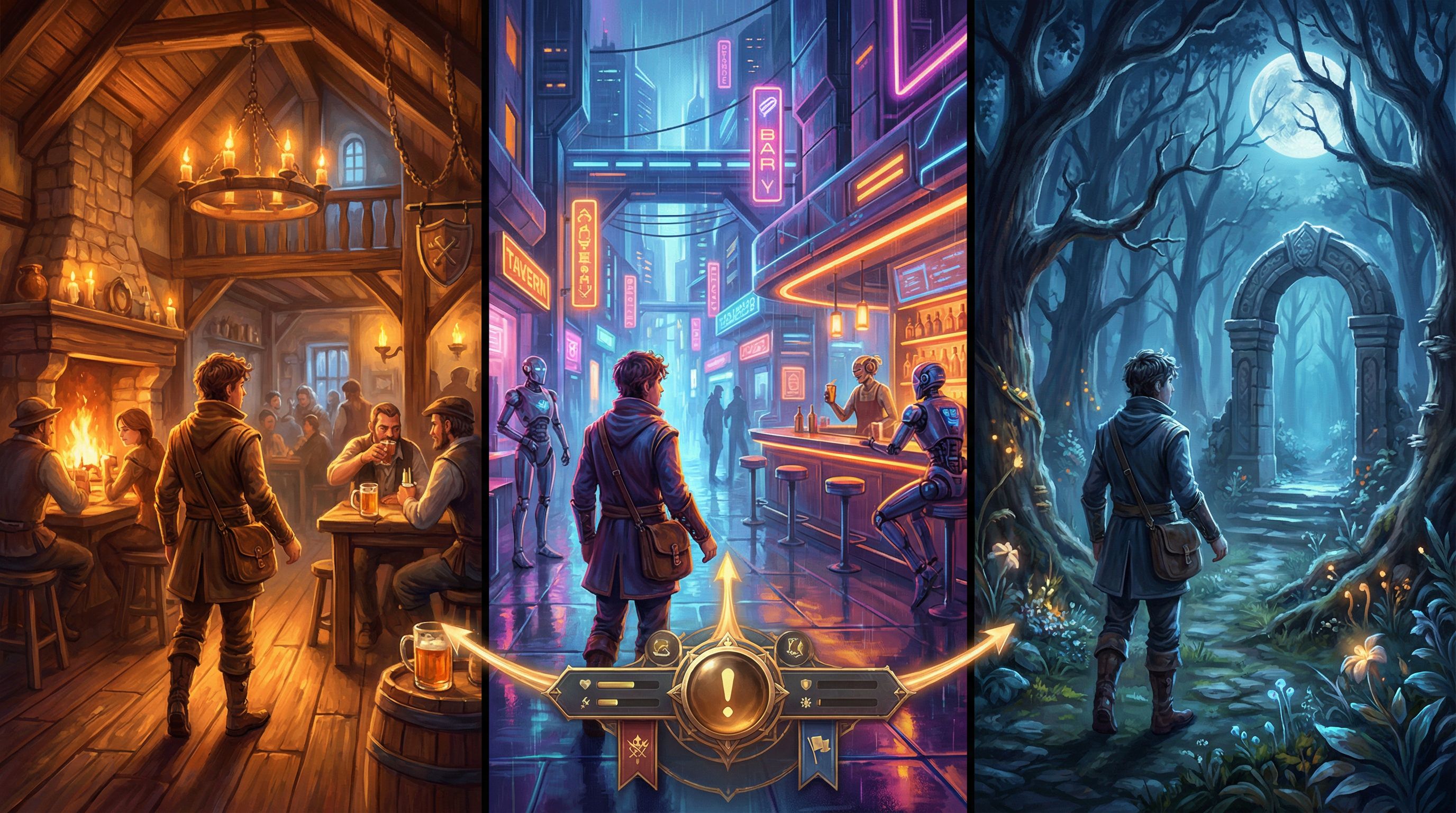
Trend #5: Data-Driven Iteration and Live Stories
Interactive stories are no longer “write once, ship, and forget.” They’re becoming living projects that evolve based on player behavior.
Creators are increasingly looking at:
- Which choices players pick most
- Where they drop off
- Which endings they reach (or never see)
- How long they spend in each scene
Then they rewrite accordingly:
- Strengthening underused branches
- Cutting or compressing dull sections
- Adding new endings or secret routes
On platforms like Questas, analytics and feedback loops are built-in or easy to layer on, so you can treat your story like a service, not a static artifact.
A simple iteration loop you can adopt:
-
Ship a minimum playable route.
Don’t wait until every branch is perfect. Publish a version where:- At least one full path runs from intro to credits
- Key branches exist, even if lightly written
-
Observe real players.
- Run small playtests and watch where people hesitate or skim.
- Our guide Playtesting Your Questas Like a Game Designer: Scripts, Checklists, and What to Watch For gives you scripts and checklists you can reuse.
-
Use analytics to prioritize edits.
Focus on:- Scenes with high exit rates
- Choices that players ignore
- Endings almost nobody reaches
-
Iterate in small, trackable passes.
- Pass 1: Clarify confusing choices
- Pass 2: Tighten pacing and cut filler
- Pass 3: Add one new branch or secret path
-
Communicate updates to your audience.
Treat your story like a live game:- Patch notes
- Seasonal events
- Limited-time branches
Pair this with the ideas in Beyond the Branch: Using Player Feedback and Analytics to Iteratively Rewrite Your Questas Narrative and Analytics for Adventure: Using Player Data to Improve Your Questas Stories Over Time for a more advanced practice.
Trend #6: Branching Beyond Entertainment
Choice-based storytelling is expanding far beyond fantasy epics and sci‑fi sagas. Organizations are using branching narratives to:
- Train employees on compliance and ethics
- Simulate customer conversations
- Teach critical thinking and media literacy
- Prototype marketing campaigns and product journeys
Interactive scenarios are especially effective because they:
- Let people practice decisions instead of just reading about them
- Reveal how learners think, not just what they remember
- Make abstract content concrete and emotional
With tools like Questas, non-technical teams can spin up prototypes quickly—sometimes in a single afternoon. If you’re working with clients or stakeholders, you might enjoy No-Code, Pro-Grade: Turning Client Briefs into Interactive Questas Prototypes in a Single Afternoon.
Ideas you can try right now:
- A branching onboarding tour where new hires choose which department to explore first.
- A customer journey simulation where marketers test different messaging paths.
- A case-study adventure where students or clients navigate a real project from your portfolio. (See Build an Interactive Portfolio: Using Questas to Showcase Your Skills, Case Studies, and Client Work for inspiration.)
How to Start Building Future-Proof Branching Narratives
You don’t need a huge team or a massive budget to align with these trends. Here’s a pragmatic way to begin.
Step 1: Define the core loop of your experience
Ask yourself:
- Who is the player? (Student, fan, trainee, prospect?)
- What are they trying to do? (Survive, learn, decide, explore?)
- What’s the repeatable loop?
Example loops:- Explore → Discover → Decide → Consequence
- Briefing → Choice → Feedback → Reflection
Design everything around making that loop satisfying.
Step 2: Sketch a small but meaningful branch map
Aim for something like:
- 1 opening scene
- 2–3 mid-path branches
- 3–5 endings (including at least one “partial success” and one “bad” outcome)
Use a whiteboard, sticky notes, or jump straight into the visual editor in Questas to lay it out.
Step 3: Decide where visuals and audio really matter
Highlight scenes where you want to invest more media:
- First reveal of a new location
- Big emotional turning points
- Climactic confrontations or discoveries
Generate AI images and micro-videos for those beats; keep others lighter to save time and focus.
Step 4: Add one system-like element
To future-proof your story, add one mechanic that treats it more like a system than a linear script. For example:
- A relationship meter with a companion that changes dialogue
- A resource (time, money, morale) that gates certain choices
- A knowledge flag that unlocks hidden options if the player learned something earlier
You can track this with variables or simple logic in your tool of choice.
Step 5: Playtest early, iterate often
Don’t wait for perfection.
- Get 3–5 people to play your first version.
- Ask them to “think aloud” as they read and choose.
- Fix the biggest friction points first.
Over time, you can grow this into a full pipeline like the one described in Building Your Questas Pipeline: A Workflow for Drafting, Testing, and Publishing Interactive Stories at Scale.
Bringing It All Together
Branching narratives in 2026 are:
- AI-assisted but still guided by human taste and ethics
- Visual and multimedia-rich, with images, video, and audio carrying as much weight as text
- Safer and more structured for younger audiences and sensitive topics
- Systemic, treating stories as living worlds with states, rules, and feedback loops
- Everywhere, from games and fiction to training, marketing, and education
The common thread is empowerment. With platforms like Questas, the power to build immersive, branching experiences is no longer limited to studios with custom engines—it’s available to anyone with a browser and a story to tell.
Your Next Step
If you’ve read this far, you’re already thinking like a systems storyteller. The best way to internalize these trends is to build something small and real.
Here’s a simple challenge:
- Open Questas.
- Create a 5–10 scene micro-adventure with at least three endings.
- Use AI images or video in two key scenes to emphasize turning points.
- Share it with one friend, student, or colleague and watch them play.
You’ll learn more from that one experiment than from any trend report.
Adventure awaits—your branching story is the next path to explore.