Replay Value by Design: How to Plan Secrets, Unlockables, and Hidden Paths in Questas

Most interactive stories are built to be played once.
Great interactive stories are built to be replayed.
Replay value is what turns a neat experiment into an experience people talk about, share with friends, and come back to weeks later to see what they missed. When you’re building in a visual, no‑code platform like Questas, you have a rare opportunity: you can design secrets, unlockables, and hidden paths right into the structure of your story—without needing a dev team.
This post is all about doing that on purpose.
We’ll walk through how to:
- Plan for replayability from the first sketch of your story map
- Layer secrets and unlockables so they feel fair, earned, and surprising
- Use AI-generated images and video in Questas to signal hidden content without spoiling it
- Test and refine your hidden paths so players actually find (and love) them
Why Replay Value Matters for Interactive Stories
Replay value isn’t just a nice bonus. It changes how your audience experiences your work—and how far it spreads.
1. More time spent in your world
If players know there are multiple endings, secret scenes, or unlockable routes, they:
- Spend more time exploring
- Pay closer attention to clues
- Develop a deeper attachment to your characters and setting
That’s especially powerful if you’re building a series. Replayable Episode 1 is the best trailer you’ll ever have for Episode 2. If you’re thinking about long-term arcs, you may also want to pair this with the ideas in From One-Shots to Series: Planning Episodic Questas Stories That Keep Players Coming Back.
2. Stronger word-of-mouth
People don’t just say, “I played this cool story.” They say:
“Did you find the hidden bunker?”
“Wait, you can save that character?”
Secrets create social fuel—perfect for classrooms, communities, or marketing campaigns where you want players comparing notes.
3. Better learning and engagement (beyond entertainment)
If you’re using Questas for:
- Training simulations
- Onboarding journeys
- Marketing funnels
…replay value means people revisit scenarios, try different decisions, and see more consequences. That repetition deepens learning and makes your content stick. For more non-fiction applications, see Beyond Fantasy: 10 Unexpected Use Cases for Questas in Business, Training, and Marketing.
4. More value from every asset you create
Every AI-generated image, video loop, and scene you build has more impact when it supports multiple routes, endings, or reveals. Replayable design lets you:
- Reuse environments across different branches
- Turn one character into the key that unlocks multiple secrets
- Justify spending extra time polishing your most important scenes
Start with a Replayable Story Skeleton
Before you hide anything, you need a structure that can support secrets.
Pick a branching pattern that invites replays
Some narrative patterns are naturally more replayable than others. In Level Up Your Plots: 7 Branching Narrative Patterns to Try in Questas, we break down several. For secrets and unlockables, three patterns shine:
-
Hub-and-spoke
- A central hub (the safehouse, the classroom, the command center) branches into multiple missions or scenes.
- Players can return to the hub and choose different spokes on replays.
- Perfect for hiding “late-game” spokes that only appear once certain conditions are met.
-
Gated routes
- Certain paths are locked behind earlier choices.
- Example: You only get the “infiltration” route if you befriended the guard and found the fake ID.
- Great for unlockables and secret endings.
-
Converging branches with variable payoffs
- Different choices lead to the same major scene, but what you did earlier changes what’s possible.
- Example: Everyone eventually reaches the final negotiation, but only some players have the evidence that flips the outcome.
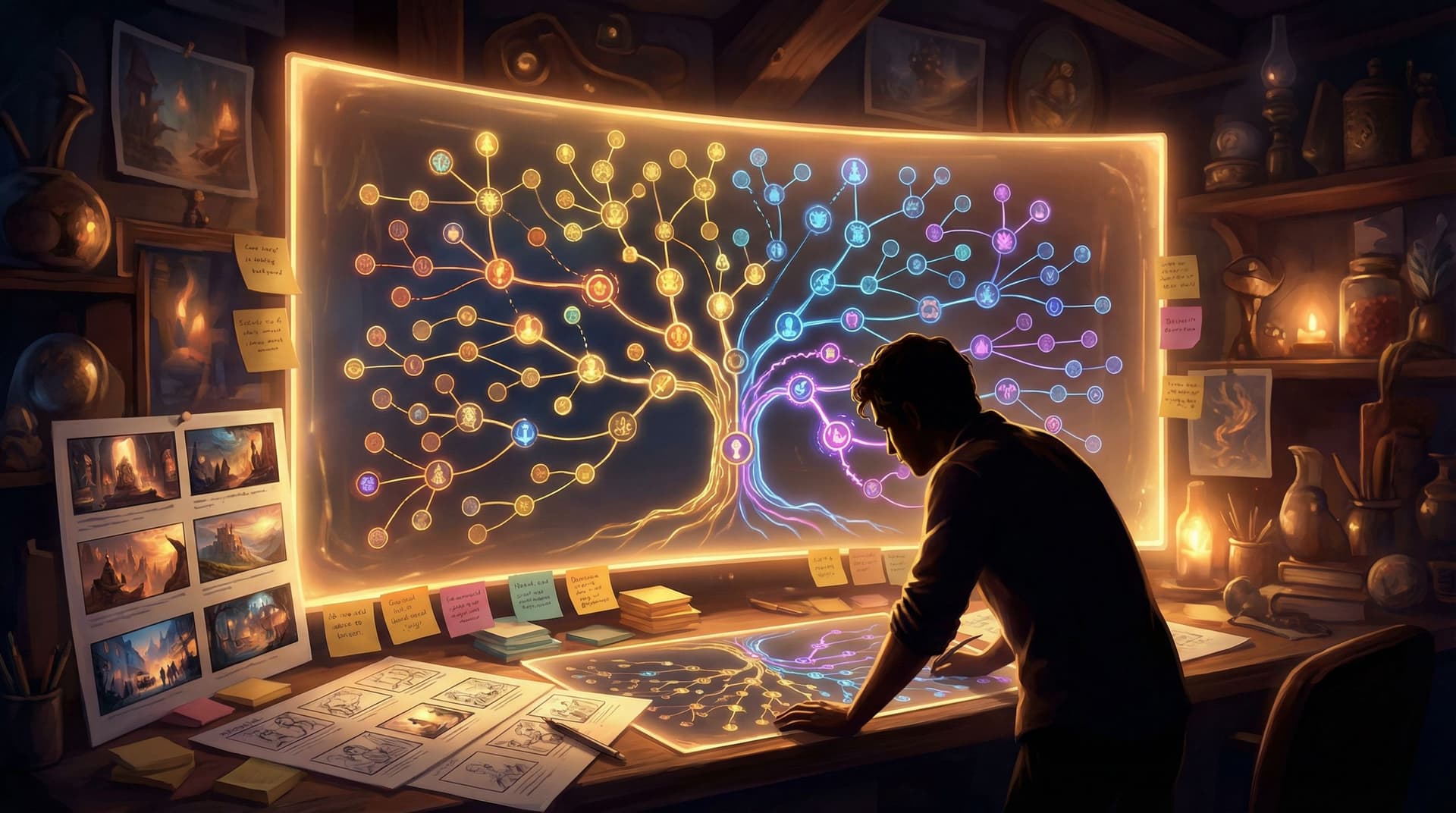
Whichever pattern you choose, sketch your core routes first—without secrets. You’re building the spine you’ll later hide surprises inside.
Map your “first-play” vs “replay” experiences
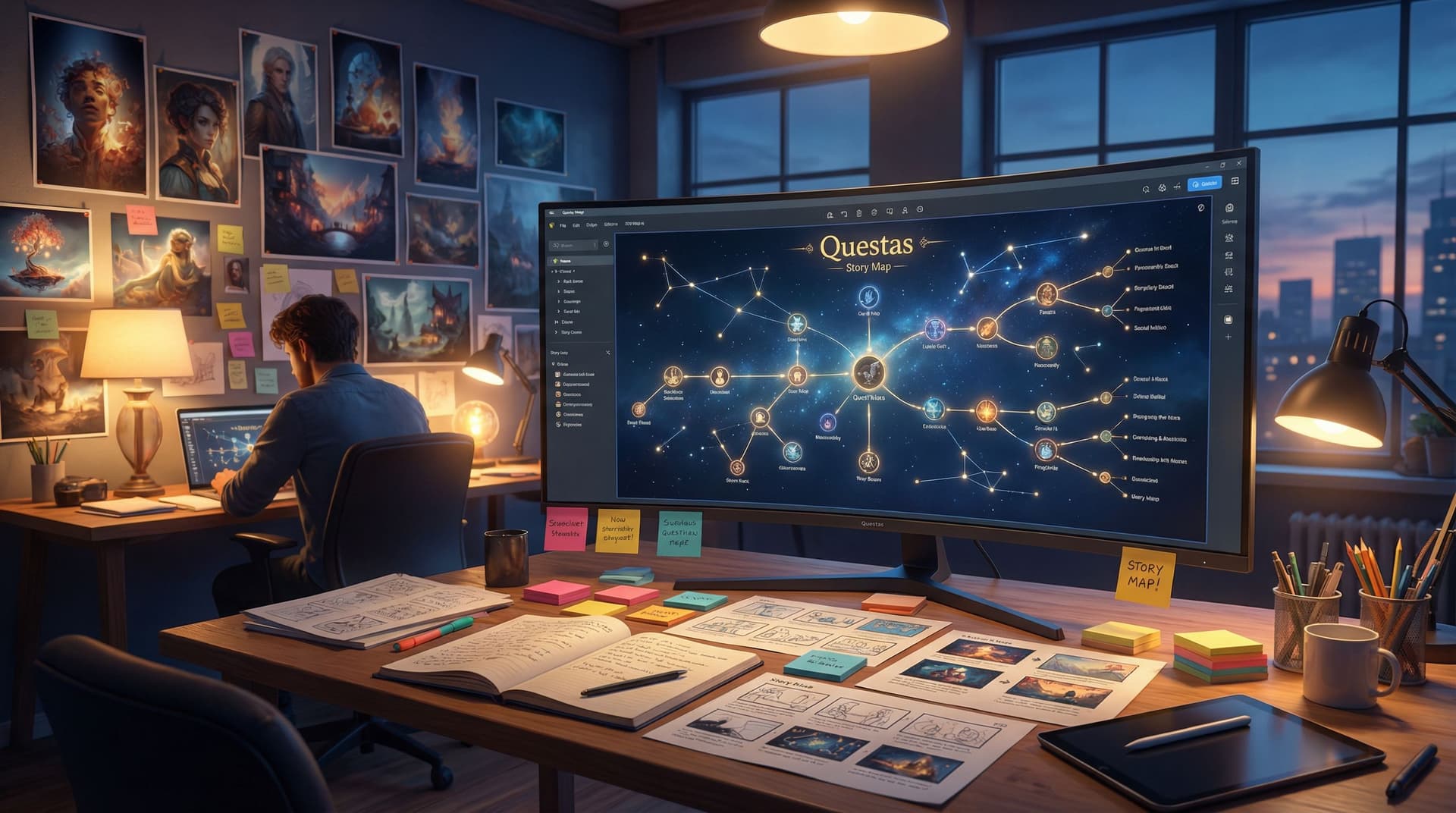
On a whiteboard or inside your Questas story map, label:
- First-play path: The most likely route a new player will take.
- Replay hooks: Points where you want players to think, “I wonder what happens if I choose differently next time.”
Look for:
- Big moral choices
- Moments with three or more options
- Scenes where a failure could lead to an interesting alternate route, not just a dead end
Those are prime spots to plant secrets later.
Define the Types of Secrets You’ll Use
Not all secrets are created equal. Mixing different types keeps players curious without overwhelming them.
Here are four reliable categories to design for in Questas:
1. Hidden scenes
What they are: Entire scenes or short branches that most players will miss on their first run.
Examples:
- A quiet rooftop conversation only available if you don’t rush into the confrontation.
- A flashback sequence unlocked if you inspect a specific object three times across the story.
How to implement in Questas:
- Create optional nodes in your visual editor that sit off the main path.
- Gate them behind conditions (choice flags, collected items, relationship scores).
2. Alternate outcomes for familiar scenes
What they are: The same scene plays differently based on earlier choices.
Examples:
- The same alley showdown, but with different allies at your side.
- A test question that has a bonus explanation if you previously explored a related topic.
How to implement:
- Duplicate the scene node and tweak dialogue, visuals, or consequences.
- Use logic to route players to version A, B, or C based on their past decisions.
3. Collectibles and meta-progress
What they are: Items, clues, or achievements that persist across replays.
Examples:
- A set of “lore fragments” that reveal the true backstory when you’ve seen all of them.
- A “perfect run” badge for finishing with every character alive.
How to implement:
- Track variables for each collectible or achievement.
- Show a progress screen or subtle UI element hinting at how many exist.
4. Secret endings and true routes
What they are: Special finales that require specific or multiple playthroughs to unlock.
Examples:
- A “true ending” that appears only if you’ve previously reached three different normal endings.
- A hidden epilogue that unlocks once you’ve seen every failure state.
How to implement:
- Use end-of-story logic to check for global conditions.
- Route to a special finale node when those conditions are met.
Seed Clues and Foreshadowing (Without Spoiling Everything)
Secrets feel best when, after the reveal, players think: “I should have seen that coming.”
That’s where your AI visuals and text work together.
Use images and video as subtle signposts
If you’ve read Show, Don’t Tell: Using AI Images and Short Video Loops to Pace Your Questas Story Beats, you know visuals are powerful pacing tools. They’re also perfect for hinting at hidden content.
Try:
- Recurring motifs: The same symbol, color, or background detail appearing in multiple scenes, hinting at a connection.
- Background characters: A mysterious figure in the crowd who later becomes central—if players choose to follow them.
- Environmental clues: A locked door, a strange poster, or a glowing artifact that suggests: “You can come back here later.”
In Questas, you can prompt AI image generation with these motifs baked in: “A neon-lit alley with a recurring red fox graffiti symbol on the wall, cinematic, moody lighting.”

Calibrate how obvious your hints are
Think in three layers:
-
Soft hints (first playthrough)
- A line of dialogue: “Most people never notice the door behind the archives.”
- A background image detail: a locked hatch with a faint glow.
-
Medium hints (after first ending)
- A post-ending message: “You escaped… but some questions remain unanswered.”
- A progress indicator: “Endings found: 1 of 5.”
-
Strong hints (for stuck players)
- A recap scene on replay that highlights missed options.
- Optional tooltips or notes: “Rumor has it there’s another way into the tower.”
You can adjust these over time using player feedback and analytics.
Design Fair Unlock Conditions
Nothing kills replay value faster than secrets that feel unfair.
A good rule of thumb: If a player is paying attention, they should have a reasonable chance of discovering your secrets—especially on their second or third run.
Principles for fair secrets
-
Clarity of cause and effect
If a secret requires a specific action, make that action feel meaningful at the time—not random. -
Multiple paths to discovery
Don’t rely on a single, easily-missed click. Let players:- Discover a route via a character hint or
- Notice a visual clue or
- Unlock it after meeting a softer condition (e.g., exploring three optional scenes).
-
Reasonable complexity
Complex multi-step secrets are fun—but limit how many you include in a single story, and clearly signal when something is “special.”
Translating this into Questas logic
When you’re wiring conditions in Questas:
- Prefer combinations of meaningful choices over obscure, one-off clicks.
- Use named variables that describe intent (e.g.,
trust_with_mentor,exploration_score) so you can reason about fairness. - Consider adding a “hint mode” branch for educators or clients who want a more guided experience.
Pacing Your Secrets Across Multiple Playthroughs
Replay value isn’t just about having secrets—it’s about when players find them.
If players discover everything on their second run, they may feel done. If they discover nothing new until their fifth, they may give up.
Aim for something like this:
-
Playthrough 1:
- Reach a satisfying “standard” ending.
- Notice a few oddities or loose threads.
- See a hint that more endings exist.
-
Playthrough 2:
- Discover at least one new scene or outcome early.
- Unlock a mid-level secret or alternate route.
-
Playthrough 3+:
- Chase specific goals: “Can I save everyone?” “Can I trigger the rebellion?”
- Start hunting for collectibles or the true ending.
You can support this pacing by:
-
Revealing new options only after certain endings:
Example: A “New Game+” style choice appears in the opening scene once you’ve seen Ending B. -
Adding meta-commentary:
A narrator or character that acknowledges repeat play: “Back again? Maybe try trusting her this time.” -
Tracking and surfacing progress:
A simple “Endings found: 2/6” counter can dramatically increase replay motivation.
Using Visuals to Make Hidden Paths Feel Special
Secrets should feel different, not just read differently.
Questas gives you AI-generated images and video at your fingertips—use them to create a distinct visual language for hidden content.
Visual strategies for secrets
-
Color shifts:
Use a specific color palette for secret routes: cooler tones for forbidden knowledge, warmer tones for hidden safe spaces. -
Framing and composition:
- Wider shots for main routes (establishing the world).
- Tighter, more intimate shots for secret scenes (you’re seeing something not everyone sees).
-
Motion and loops:
Short video loops can emphasize that a moment is special—the flicker of a hidden portal, the subtle movement of a character who usually appears only in static images.
Keep your secrets visually consistent
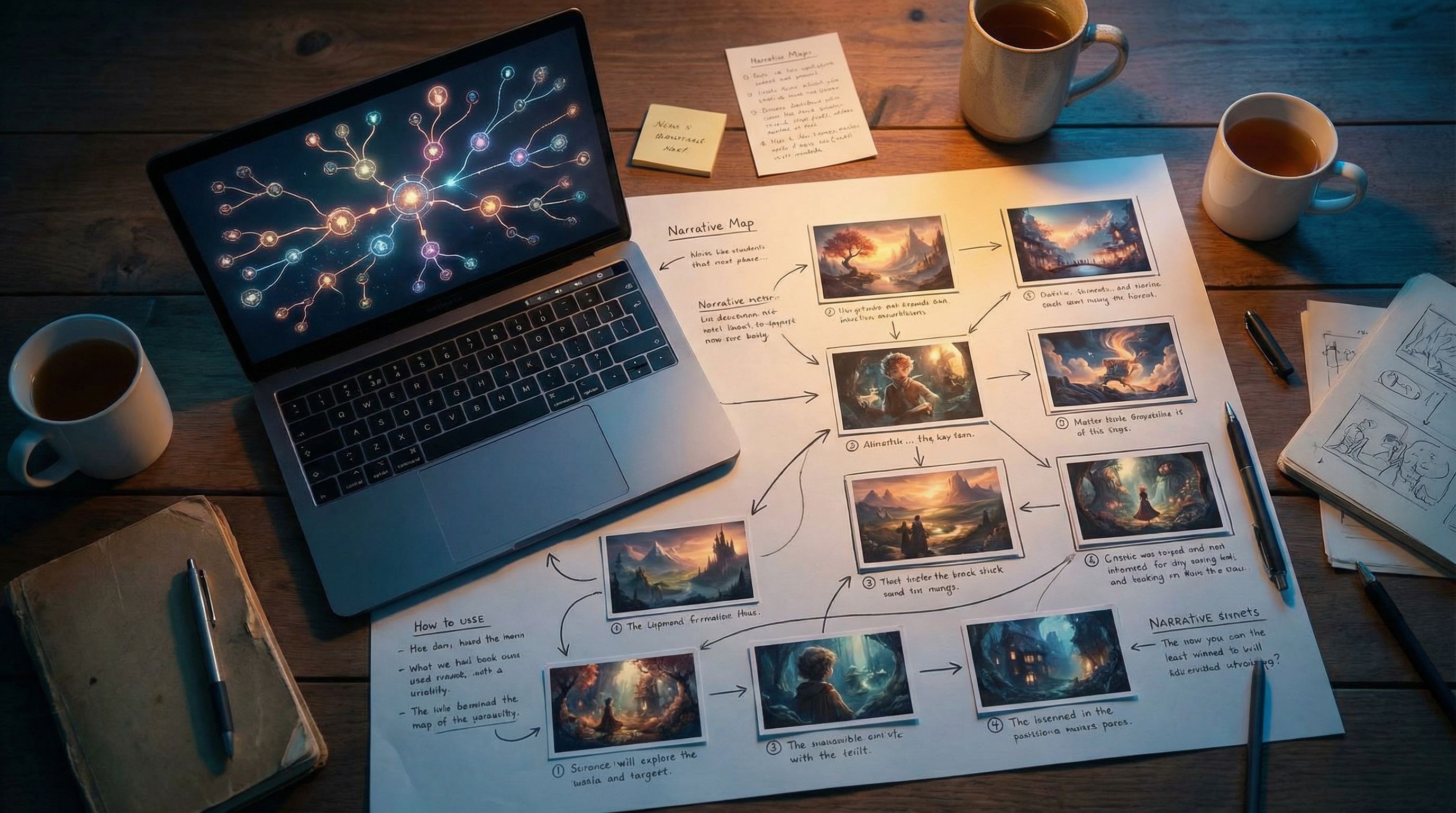
Consistency helps players recognize patterns across replays. If you’re building a world with recurring secret symbols, characters, or locations, pair this approach with the techniques in Picture This: How to Prompt AI for Consistent Characters and Worlds in Questas.
Test, Observe, and Tune Using Player Data
You won’t know if your secrets are working until real people start poking at your story.
Watch real players
Run small playtests:
- With friends or peers
- With your classroom or team
- With a small slice of your audience
Ask them to:
- Think out loud while they play
- Replay at least once
- Share what they think the story is hiding
Take notes on:
- Where they get stuck or confused
- Which choices they ignore
- How often they naturally discover your hidden content
Use analytics to find dead zones
If you’re tracking player behavior for your Questas stories (and you should), look for:
-
Nodes almost no one reaches
Maybe the secret is too well hidden—or the path to it feels uninteresting. -
Choices almost no one selects
Perhaps the option label isn’t clear, or the other choices feel obviously “correct.” -
Endings with extremely low completion rates
Your “true ending” shouldn’t be the most common, but if only 0.1% of players ever see it, you might need stronger hints.
Pair this data-driven approach with the ideas in Analytics for Adventure: Using Player Data to Improve Your Questas Stories Over Time to turn replayability into an ongoing design practice.
Iterate in small passes
You don’t have to rebuild your whole story to improve replay value. Try:
- Tweaking 1–2 choice labels to make alternate routes more tempting.
- Adding a single new hint line or visual clue to a key scene.
- Surfacing progress (“You’ve found 3 of 7 secrets”) on the end screen.
Then test again.
Putting It All Together: A Simple Replayability Checklist
When you’re building your next story in Questas, run through this list before you hit publish:
-
Structure
- Do you have at least one hub, gated route, or converging branch that supports replays?
-
Secret Types
- Have you included at least:
- 1–2 hidden scenes?
- 1–2 alternate versions of key moments?
- A clear goal for players who want to find everything (collectibles, endings, or both)?
- Have you included at least:
-
Foreshadowing
- Are there visual or textual hints that more content exists beyond the first ending?
-
Fairness
- Can an attentive player reasonably discover a secret by their second or third run?
-
Pacing Across Replays
- Does each new playthrough reward the player with something new fairly early on?
-
Visual Identity for Secrets
- Do hidden routes feel distinct in terms of color, composition, or motion?
-
Testing & Data
- Have at least a few people played, replayed, and talked about what they think is still hidden?
If you can honestly check off most of these, you’re well on your way to building adventures people can’t experience in a single sitting—and won’t want to.
Quick Summary
Replay value isn’t an afterthought; it’s a design choice.
By planning your branching structure, defining clear types of secrets, seeding fair clues, and using Questas’s AI visuals to signal hidden content, you can:
- Turn one story into many layered experiences
- Encourage players to explore, compare notes, and come back
- Get far more value from every scene, image, and ending you create
And with analytics and small, focused iterations, you can keep tuning your secrets until they’re discoverable, satisfying, and shareable.
Ready to Build Your Most Replayable Story Yet?
You don’t need a custom engine or a full dev team to create secrets, unlockables, and hidden paths. You just need a plan—and a canvas that lets you experiment.
Open Questas, sketch a small branching idea (even a 5–10 minute micro-adventure), and:
- Map a simple first-play route.
- Add one hidden scene and one alternate ending.
- Drop in a few visual hints that something more is waiting.
Ship that. Watch how people play. Then start layering in more.
Adventure awaits—and this time, your players will want to come back for seconds (and thirds).