From One Prompt to a Whole World: Worldbuilding Systems for Long-Form Questas Campaigns

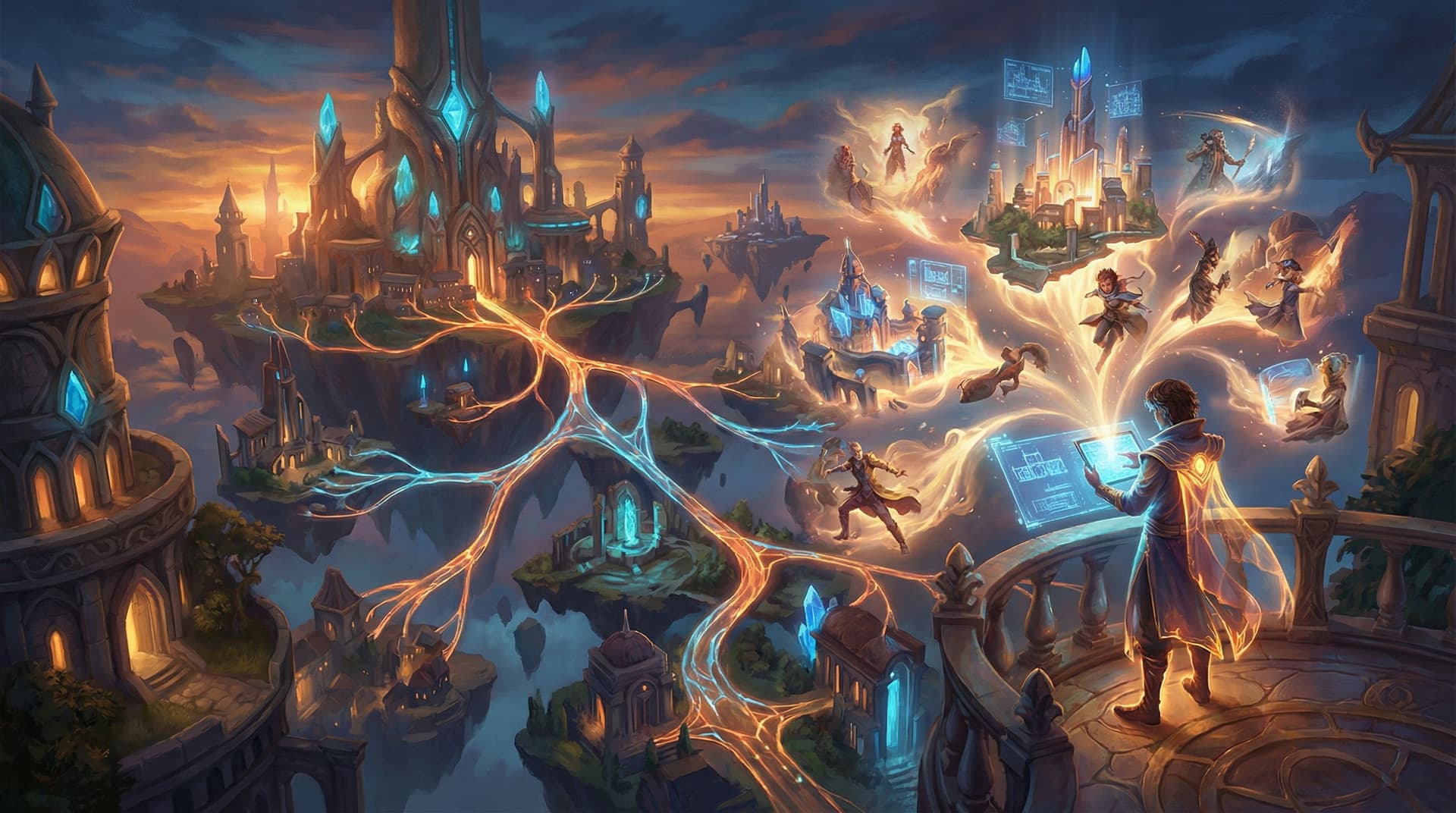
You open a new project in Questas, type a single prompt—“a drowned city of glass towers where memories wash up with the tide”—and suddenly you’re flooded with possibilities.
Who lives there?
What rules govern this place?
How do you keep it all consistent across hours of branching play?
That’s the real challenge of long-form, campaign-style interactive stories: not just inventing cool ideas, but building a system that can sustain them over dozens of scenes, routes, and endings.
This guide is all about that system. We’ll walk through how to turn one evocative prompt into a fully playable world for a long-form Questas campaign—without drowning in continuity errors, lore bloat, or visual inconsistency.
Why Worldbuilding Systems Matter for Long-Form Campaigns
Long-form Questas campaigns—stories that unfold over multiple chapters, episodes, or "seasons"—ask more from your world than a one-shot does.
Players will:
- Revisit locations from different angles
- Test the edges of your rules (“Can I do this again but with a different ally?”)
- Notice when characters or cultures behave out of character
- Share theories about how your world works
If your worldbuilding is ad hoc, you’ll feel that strain quickly:
- Continuity cracks: The city is poor in one branch and ultra-high-tech in another, with no explanation.
- Visual drift: AI-generated images slowly morph your main setting into something unrecognizable.
- Choice fatigue: You keep inventing new factions and locations instead of deepening the ones you have.
A worldbuilding system solves this by giving you:
- Reusable building blocks (factions, locations, rituals, tech rules)
- Clear constraints that make improvisation easier, not harder
- Prompt patterns that keep AI visuals and tone consistent
- A shared reference if you’re collaborating with others
If you’ve read our post on Branching Without Chaos, think of this as the world-level version: instead of just mapping choices, you’re mapping how reality itself works in your story.
Step 1: Distill Your World into a Single North Star Prompt
Start by collapsing your idea into one potent paragraph. This becomes the North Star that every scene, character, and image traces back to.
A strong North Star prompt should include:
- Genre + twist (e.g., solarpunk detective mystery, post-apocalyptic cozy town)
- Signature visuals (e.g., bioluminescent forests, rusted mechs as playgrounds)
- Core conflict (e.g., memory vs. identity, control vs. freedom)
- Tone (hopeful, tragic, satirical, eerie)
Example North Star for a Questas campaign:
A drowned glass metropolis where the rich live in sky-bridges and everyone else scavenges memories from the flooded streets. Neon reflections on water, improvised boats, hacked AR goggles. Tone: melancholic but hopeful. Themes: who owns the past, what memories are worth.
Use this paragraph everywhere:
- In your Questas project description
- At the top of your personal world wiki or doc
- As a reference block in your AI image prompts
Tip: When you feel stuck on a scene, reread this paragraph and ask, “How does this moment express these themes and visuals?”
Step 2: Define Your World’s “Rule Stack”
Instead of writing a 20-page lore doc, define a compact rule stack—a set of constraints that shape everything else.
Think in four layers:
- Physical rules – How does the environment work?
- Social rules – How do people organize power and relationships?
- Supernormal rules – Magic, tech, spirits, AI—what’s beyond the ordinary?
- Narrative rules – What kinds of stories happen here?
1. Physical Rules
Answer questions like:
- What do people eat, wear, breathe?
- How do they move around (boats, sky trams, portals)?
- What’s dangerous by default (the tide, surveillance drones, ghosts)?
Write 5–7 bullet points max. Example:
- The city floods twice a day; some streets are only walkable at low tide.
- Anything left in the water too long absorbs “memory residue.”
- Power is unreliable below the sky-bridges; candles and hand-cranked tech are common.
These bullets become quick reference notes you can keep open while building scenes in Questas.
2. Social Rules
Define how your world handles:
- Class and wealth
- Family and community
- Law and crime
- Reputation and taboo
Example bullets:
- Sky-bridge residents never touch floodwater; it’s seen as “contaminating.”
- Memory scavenging is illegal but widely tolerated.
- Neighborhoods are organized around “tide captains” who predict safe routes.
These rules pay off when designing choices. For deeper guidance on turning these into emotional decisions, pair this with Designing Meaningful Choices.
3. Supernormal Rules
If you have magic, advanced tech, spirits, or AI, define hard constraints:
- What can’t it do?
- What does it always cost?
- Who controls it?
Example bullets:
- Memory shards replay a single moment from someone’s life, but never in order.
- Using more than three shards in a day causes “echo sickness” (hallucinations).
- Only licensed “Archivists” can legally store and sell shards.
These constraints keep your story from turning into “a wizard did it” whenever you hit a plot snag.
4. Narrative Rules
Finally, decide what your world cares about narratively:
- What kinds of problems show up again and again?
- What’s considered a “big deal” vs. normal?
- What’s the default emotional temperature?
Example bullets:
- Every major choice either protects or endangers someone’s memories.
- Secrets are more valuable than money.
- Hope is fragile but persistent; small acts of kindness matter.
Keep your rule stack to one page. If you can’t remember it during a writing sprint, it’s too long.
Step 3: Build a Modular World Bible (That You’ll Actually Use)
Long-form campaigns live or die on consistency. But a 50-page lore dump no one reads doesn’t help.
Instead, build a modular world bible—small, reusable cards you can glance at while working in Questas.
Start with Five Core Modules
- Locations – 5–10 key places
- Factions – 3–5 groups with agendas
- Characters – Your recurring cast
- Artifacts/Systems – Things that drive conflict (e.g., memory shards)
- Visual Style Guide – Prompts and references for AI imagery
Each module entry should fit on half a page or less.
Example Location Card
Name: The Glass Bazaar
Function: Central trading hub for illegal memory shards
Look: Lanterns reflected in ankle-deep water, glass stalls, whispering crowds
Sounds/Smells: Murmured haggling, dripping water, incense masking mildew
Story Hooks:
- Meet a fence who sells forged memories
- Navigate a police raid
- Discover a shard that shows your own character as a child
Example Faction Card
Name: The Tidekeepers
Goal: Keep flood patterns predictable and safe—for a price
Methods: Secret tide charts, bribes, sabotaging rival predictions
Public Image: Respected but feared; everyone depends on them
Signature Visuals: Blue oilskin coats, brass tide-measuring rods
Where to Keep Your Bible
- A shared doc (Notion, Google Docs) pinned in your Questas workspace
- A second monitor or split-screen while editing scenes
- Printed cards if you like analog reference while designing
If you’re working with collaborators, pair this with the workflows from Collaborative Adventures so everyone pulls from the same source of truth.
Step 4: Design Prompt Systems for Consistent Visuals
AI-generated images and video are a huge part of what makes Questas campaigns feel like living worlds—but they’re also where inconsistency sneaks in.
Instead of writing new prompts from scratch every time, create prompt systems:
1. A Style Spine
Define a base style phrase you reuse across most prompts. For example:
“cinematic, muted teal and amber palette, soft volumetric lighting, shallow depth of field, realistic but slightly stylized”
This becomes your style spine. You’ll tweak it for specific scenes, but keep the core intact.
2. Location-Specific Prompt Blocks
For each major location card, write a reusable prompt block.
Glass Bazaar Prompt Block:
“lantern-lit market in ankle-deep water, glass stalls, reflections shimmering on the surface, crowds in patched raincoats, subtle haze of incense, cinematic, muted teal and amber palette…”
When you generate a new scene image in Questas, you combine:
- Style spine
- Location block
- Moment-specific detail (e.g., “police raid in progress,” “quiet after closing”)
This is the same logic we go deeper on in Picture This: How to Prompt AI for Consistent Characters and Worlds in Questas.
3. Character Prompt Templates
For recurring characters, lock in:
- Age range, build, hair, clothing style
- Signature props (goggles, tattoos, weapons)
- Emotional baseline (weary, bright-eyed, calculating)
Then write one canonical prompt per character and reuse it, only changing pose and expression.
Example:
“young woman, late 20s, wiry build, short curly black hair, patched orange raincoat, augmented-reality goggles around neck, small tide tattoo on wrist, wary but determined expression, cinematic, muted teal and amber palette…”
Store these prompts in your world bible under each character card.
4. Ethical and Inclusive Visual Rules
Visual systems aren’t just aesthetic—they’re ethical.
Before you lock your style spine and character prompts, run them through a quick check:
- Are you stereotyping any culture or body type?
- Are marginalized characters given depth, agency, and varied roles?
- Are you defaulting to a single skin tone, gender, or body shape?
For a deeper dive into this, see Ethical AI Worldbuilding: Guidelines for Responsible Imagery, Representation, and Choices in Questas.
Step 5: Turn Your World into Reusable Story Systems
Once your world is defined, you can start designing systems that generate story content almost on autopilot.
1. Encounter Generators
Create simple tables you can roll on (or just skim) when you’re building a new branch in Questas.
Example: Flooded Street Encounter Table
Roll a d6 or pick one:
- A child searching for a lost toy that might be a memory shard.
- A toppled sky-bridge elevator blocking the way.
- A patrol boat demanding to see shard licenses.
- A floating shrine of candles and photos for the drowned.
- A rival scavenger offering a risky partnership.
- A sudden surge in the tide, forcing a split-second choice.
Each encounter can:
- Introduce a choice node
- Reveal lore
- Test a relationship
2. Relationship Clocks or Meters
For key factions or characters, track relationship states (e.g., hostile, wary, neutral, allied, devoted).
In Questas, you can reflect these states by:
- Showing different images (e.g., same character, but posture and lighting shift)
- Unlocking or hiding certain branches
- Changing how NPCs talk to the player
Design 3–5 “relationship beats” per major NPC—moments where the player’s choices clearly move the needle.
3. Recurring Rituals and Events
Long-form campaigns feel cohesive when rituals and events keep coming back:
- Weekly market
- Seasonal festival
- Daily flood cycle
- Corporate performance reviews in a training scenario
Use these as anchors:
- Start or end each chapter around the same event
- Show how the event changes over time based on player choices
This is especially powerful if you’re planning a multi-episode arc; you can combine it with the thinking from From One-Shots to Series: Planning Episodic Questas Stories That Keep Players Coming Back.
Step 6: Map World Arcs, Not Just Plot Arcs
Most creators plan character arcs and plot arcs. For long-form Questas campaigns, add world arcs:
- How does this city/kingdom/organization change over time?
- What visible difference will players notice from Chapter 1 to Chapter 6?
Think in three snapshots:
- Status Quo – How the world is when players arrive
- Tension Peak – The moment when everything feels like it might break
- New Order(s) – 2–4 possible end states of the world
For each major ending, define:
- What everyday life looks like now
- What players would see if they revisited the same locations
- How NPCs talk about the past
This makes your endings feel like genuine alternate histories, not just different last screens.
Step 7: Keep Your World Alive with Iteration
Worldbuilding systems aren’t meant to be perfect from day one. They’re meant to be adjusted as players explore.
After you publish a first arc or season:
- Watch where players cluster. Which locations and factions attract the most attention?
- Note where confusion spikes. Are there rules players misunderstand?
- Track which endings feel “canon” to your audience. You might expand from those.
Pair your world bible with analytics and feedback tools (we explore this in Analytics for Adventure: Using Player Data to Improve Your Questas Stories Over Time) and schedule regular “world maintenance” sessions:
- Prune unused factions or locations
- Clarify or simplify confusing rules
- Promote fan-favorite NPCs into bigger roles
Your world is a living system. Let it evolve.
Quick Recap
From one prompt, you can grow an entire campaign-ready world—if you treat worldbuilding as a system, not just a burst of inspiration.
You’ve seen how to:
- Anchor everything with a North Star prompt
- Define a compact rule stack for physical, social, supernormal, and narrative layers
- Build a modular world bible you’ll actually reference
- Create prompt systems for consistent AI visuals in Questas
- Turn your setting into reusable story systems (encounters, relationships, rituals)
- Plan world arcs so endings feel like different futures of the same place
- Use iteration and player data to keep your world coherent and alive
Do this, and your long-form Questas campaigns stop feeling like a tangle of branches—and start feeling like a place players truly inhabit.
Your Next Move
You don’t need a 300-page lore bible to begin. You just need one strong prompt and one page of rules.
Here’s a simple way to start right now:
- Open a new project in Questas.
- Write your North Star paragraph in the description.
- Draft a one-page rule stack and 3–5 location cards.
- Create a style spine prompt and test 2–3 images.
- Build a short, 10–15 minute adventure set in that world.
Once that’s live, you can expand it into a full campaign, episode by episode, using the systems you’ve put in place.
Your world is waiting. Give it rules, give it visuals, give it choices—and invite players to step inside.