Designing Meaningful Choices: How to Turn Simple Branches into Emotional Turning Points in Questas

Interactive stories live and die on their choices.
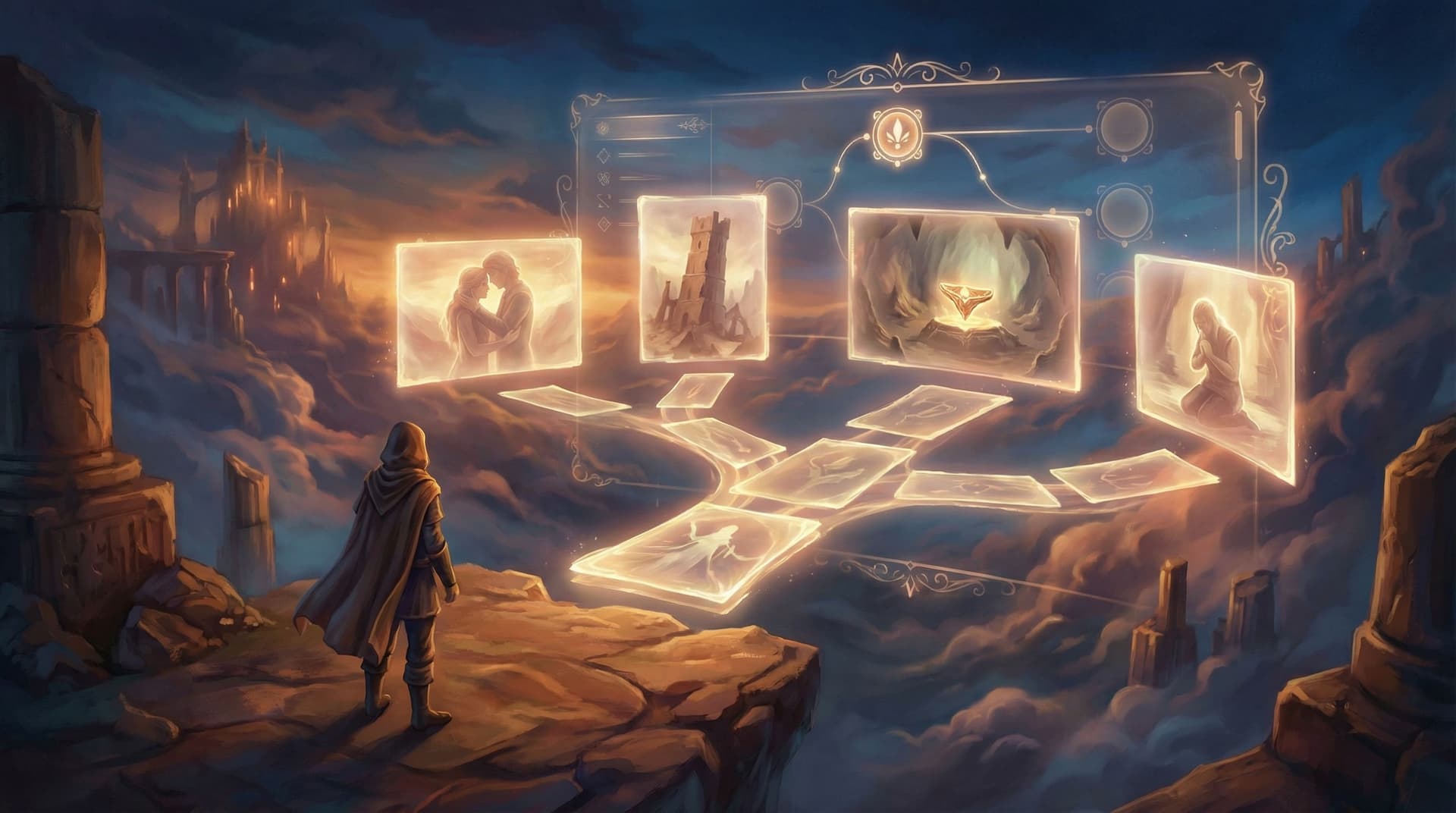
A gorgeous setting, clever dialogue, and slick AI visuals will pull people in—but it’s the moments of “Do I go left or right?” that make them lean forward, hesitate, and care. When you’re building in Questas, you can add as many branches as you like with a few clicks. The real craft isn’t adding choices—it’s making those choices matter.
This post is all about that craft: how to turn ordinary branches into emotional turning points that shape your characters, your world, and your players’ memories.
Why Meaningful Choices Matter More Than More Choices
It’s tempting to think, “More branches = more engagement.” But if each branch feels shallow or interchangeable, players quickly sense that their decisions are cosmetic.
Meaningful choices do three things:
- Change the story in a visible, memorable way (even if paths later reconverge).
- Reveal character—both the player character and the world around them.
- Create emotion: tension, regret, pride, curiosity, or even guilt.
When you get this right in Questas:
- Players slow down before clicking, because they feel the weight of the moment.
- They replay to see what they missed, supercharging engagement and shareability.
- Your story feels authored and intentional, not just a tangle of options.
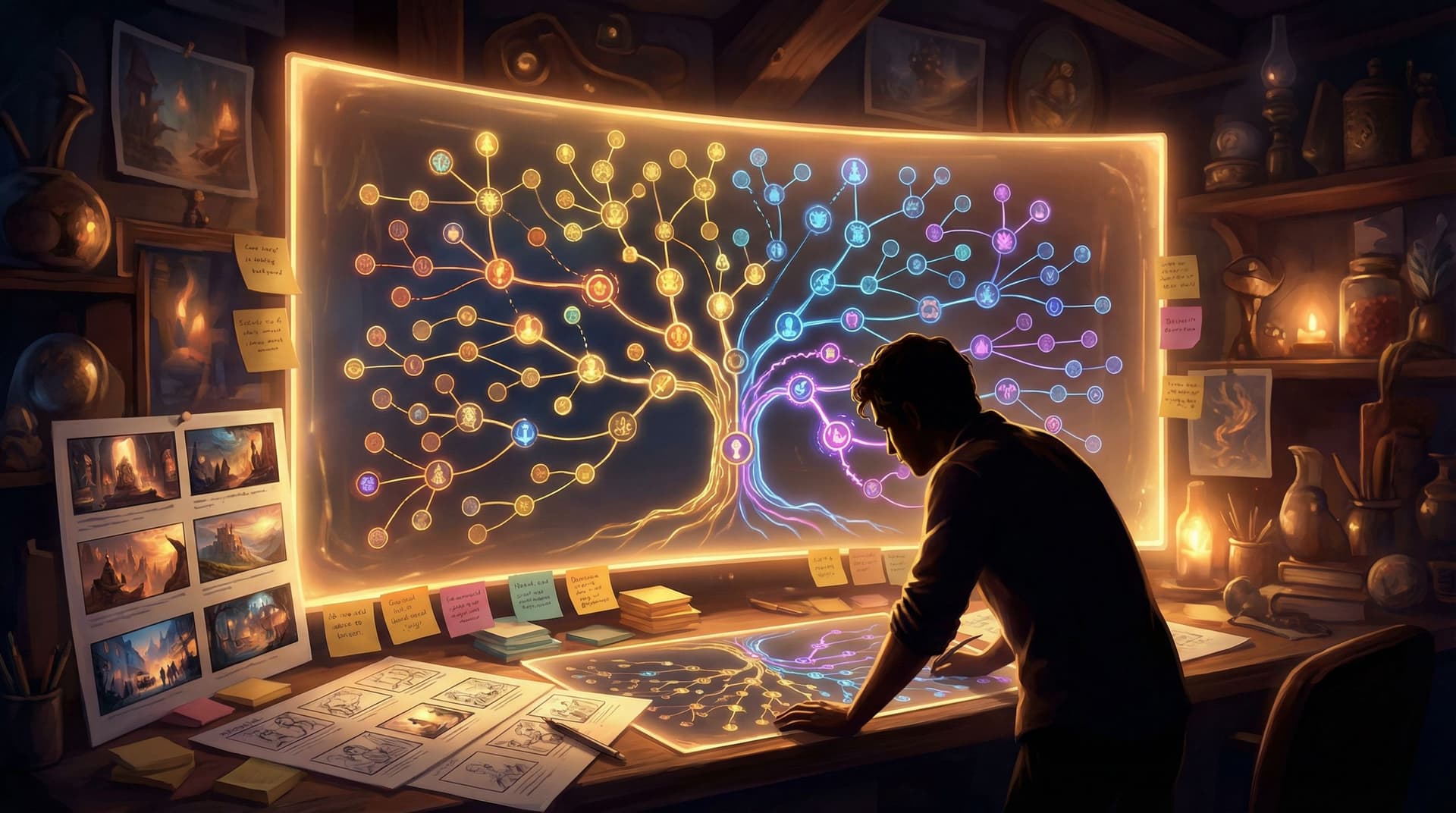
If you’re already mapping complex narratives, you may find it helpful to pair this post with Branching Without Chaos: Simple Story Mapping Techniques for Complex Questas Narratives. There, we focus on structure; here, we’re zooming in on the emotional design of individual choices.
The Anatomy of a Meaningful Choice
Before we dive into workflows, let’s define what separates a “meh” branch from a pivotal moment.
A meaningful choice usually has:
-
Clear context
The player understands what’s happening, what’s at stake, and roughly what each option represents. -
Conflicting values
It’s not just “good vs bad.” It’s safety vs loyalty, truth vs kindness, short-term gain vs long-term risk. -
Visible consequences
The outcome shows up in:- Immediate reactions (a character’s trust shifts, the environment changes)
- Future scenes (a locked path opens, a resource is missing, a relationship is strained)
-
Emotional residue
The player feels something afterward—relief, doubt, curiosity, or the sting of a mistake.
When you’re designing in Questas, you can treat each major decision node in the visual editor as a spotlight moment: a place to slow down, sharpen the stakes, and plan payoffs.
Step 1: Decide Which Choices Deserve Emotional Weight
Not every branch should be a huge moral crossroads. If everything is a big deal, nothing feels like a big deal.
Start by scanning your existing story map (or sketching a quick one if you’re just starting). Identify:
- Entrance choices: The first 1–2 decisions that define who the player is or what they want.
- Midpoint pivots: Moments where the story can tilt toward victory, tragedy, or revelation.
- Climactic decisions: The last major choice that determines the ending (or which ending family the player lands in).
Mark 3–7 of these as “emotional anchors.” These are the nodes where you’ll invest extra time in writing, visuals, and consequences.
Tip: In Questas, use naming conventions or color-coded tags in your node titles like
ANCHOR_01 – Confront the Captain?so you can spot these moments at a glance.
If you’re building for replayability, pair this exercise with the ideas in Replay Value by Design: How to Plan Secrets, Unlockables, and Hidden Paths in Questas. Emotional anchors are perfect places to hide secret branches, alternate outcomes, or unlockable scenes.
Step 2: Frame the Decision as a Question of Identity
The most powerful choices aren’t about what happens—they’re about who the player decides to be.
Instead of writing options like:
- “Open the door.”
- “Walk away.”
Reframe them as identity statements:
- “Open the door. You can’t walk away from someone who might need help.”
- “Leave it shut. You’ve learned the hard way not to invite chaos in.”
This subtle shift:
- Signals values behind each option.
- Helps players project a persona onto their character.
- Makes the eventual consequence feel like a reflection of them, not random chance.
A simple three-step workflow:
-
Write the basic options.
E.g., “Tell your friend the truth” / “Lie to protect them.” -
Ask: What value does each represent?
Truth = honesty, integrity.
Lie = protection, control, fear. -
Rewrite each as a mini-character beat.
- “Tell them everything. You owe them the truth, even if it hurts.”
- “Hold back. They’re safer not knowing what you’ve done.”
Use the choice labels in Questas not just as navigation buttons, but as micro-narration that deepens the emotional context.
Step 3: Make Stakes Concrete, Not Vague
Players can’t feel the weight of a choice if they don’t know what’s at risk.
Before a major decision, quickly clarify:
- What could be lost? (a relationship, a resource, a reputation, a secret)
- What could be gained? (trust, power, knowledge, freedom)
- What’s uncertain? (unknown dangers, hidden motives, incomplete information)
You don’t have to spell out every consequence, but you do need to:
- Show at least one likely outcome for each option.
- Hint at hidden layers so players feel intrigue, not confusion.
Example micro-scene before a big choice:
The smuggler taps the crate. “Inside is everything you need to disappear. New papers. New life. But if you take it, the rebels will call you a traitor.”
In the street below, you hear the march of armored boots. They’re getting closer.
Now the choice between taking the crate or warning the rebels isn’t abstract—it’s a clear trade-off between personal safety and collective loyalty.
In Questas, keep this text tight. If you want to slow the moment down further, you can use pacing techniques like those in Show, Don’t Tell: Using AI Images and Short Video Loops to Pace Your Questas Story Beats.
Step 4: Design Consequences That Echo, Not Just End
A choice that leads to an immediate “You died, try again” can be satisfying once, but it rarely feels emotionally rich.
Instead, think in echoes:
- Immediate echo: A reaction in the very next scene.
- Delayed echo: A callback several scenes later.
- Global echo: A shift that affects multiple future scenes (e.g., a faction’s attitude, a resource pool, an injury).
You can implement echoes in Questas with a few simple patterns:
-
Flag and recall
- Create separate branches where a variable is effectively “set” by the choice (e.g.,
ALLY_TRUST_HIGHvsALLY_TRUST_LOW). - Later, branch short reactions based on which path the player took.
- Create separate branches where a variable is effectively “set” by the choice (e.g.,
-
Visual continuity
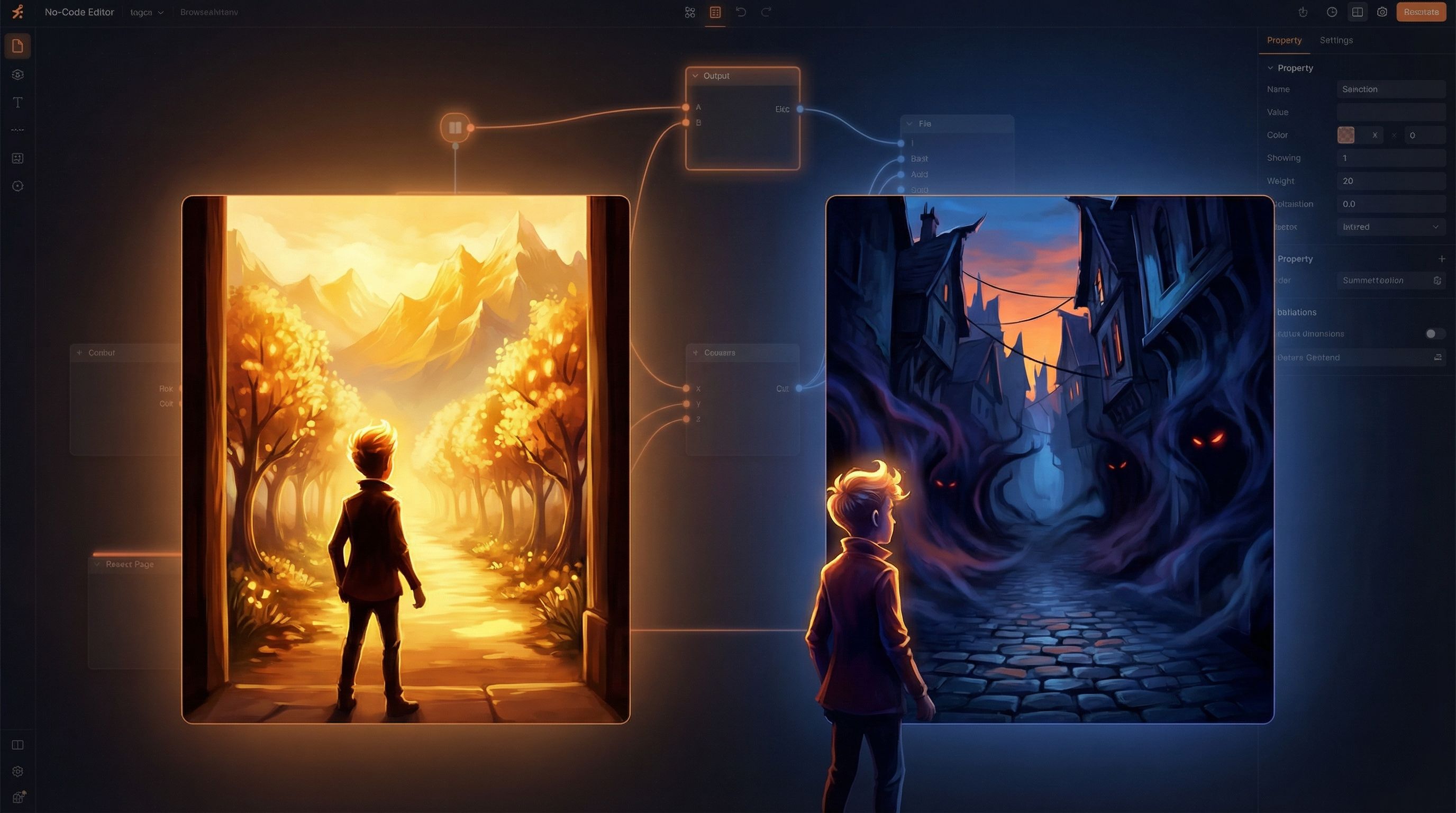
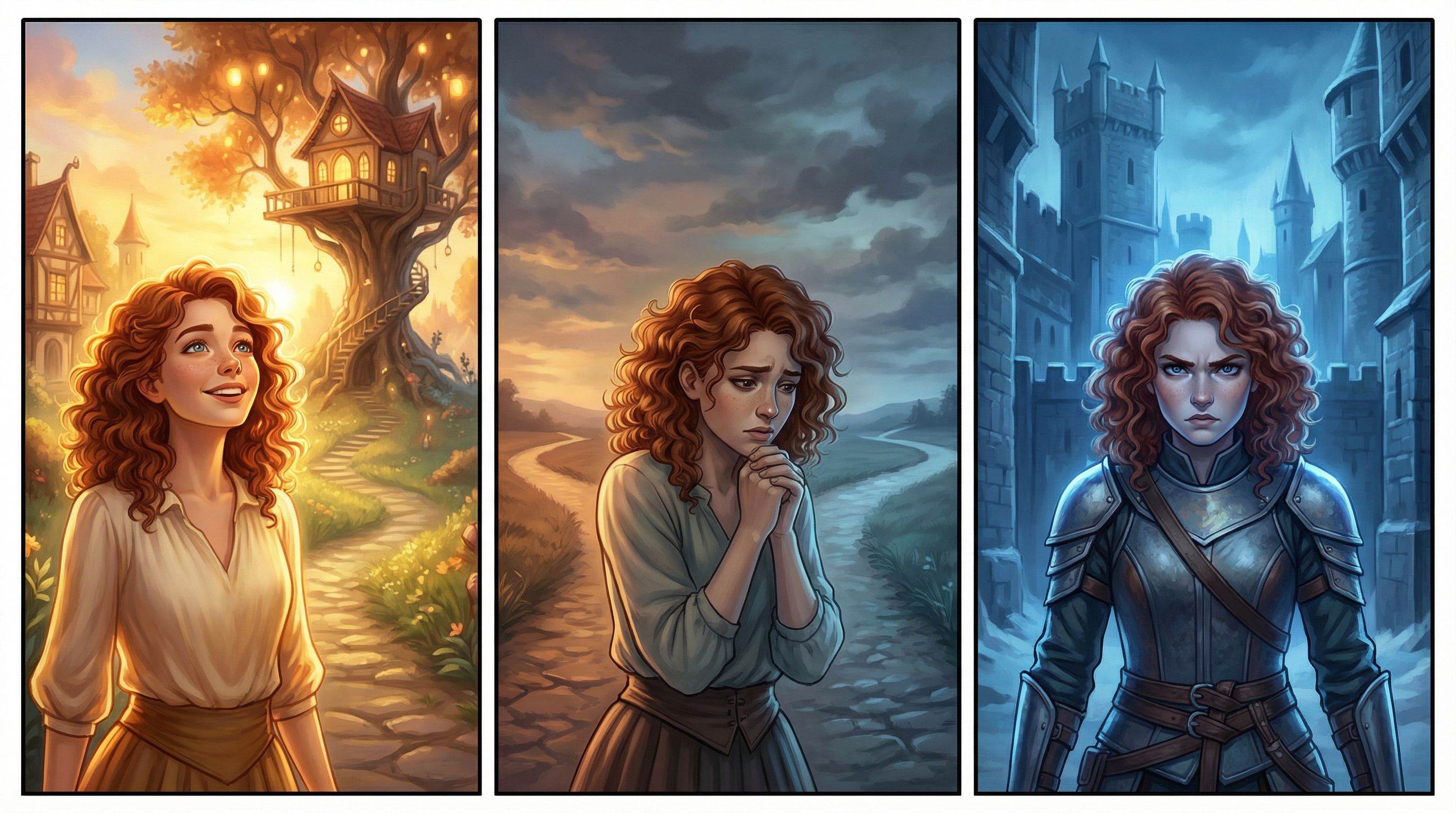
- Use AI images to show the same character or location changed by past decisions: damaged armor, a burned village, a character now avoiding eye contact.
-
Locked and unlocked content
- Certain scenes or endings are only reachable if the player made specific earlier choices.
Even small echoes can carry big weight. For example:
- A character you saved earlier reappears later with crucial information.
- A lie told in Scene 4 resurfaces in Scene 12 when evidence contradicts you.
Design rule of thumb: For every emotional anchor choice, plan at least one immediate echo and one delayed echo.
Step 5: Use AI Visuals to Heighten, Not Replace, Emotion
Because Questas lets you generate images and short video loops directly inside your story, it’s easy to over-decorate every node. Instead, use visuals surgically around emotional turning points.
Consider:
-
Before the choice:
Show a close-up of a character’s face, a looming door, a battlefield at dusk. Use composition and lighting to set tone. -
Immediately after the choice:
Use a new image that makes the consequence visible—an ally turning away, a city in flames, a healed landscape. -
On delayed echoes:
Subtly adjust the scene to reflect the past: fewer people in the market after a famine choice, graffiti praising or condemning the player.
When prompting visuals, think in terms of emotion + change:
- “A worried young mechanic standing on a starship deck, torn between two airlocks, cool blue lighting, cinematic depth of field.”
- “The same mechanic later, clothes singed, standing in front of a damaged engine, hints of regret in their expression, warm orange emergency lights.”
This kind of visual continuity reinforces that choices have shaped the world, not just shuffled text.
Step 6: Write Failure States as Story, Not Punishment
Failure is one of your richest emotional tools—if it feels like part of the narrative, not a slap on the wrist.
Instead of:
“You chose wrong. Game over.”
Try:
- Showing what the character learns from the failure.
- Hinting at alternate paths the player might explore next time.
- Giving the failure its own tone and imagery (somber, bittersweet, darkly funny).
For example:
You hesitate for a second too long. By the time you shout the warning, the fire has already swallowed the rafters. Later, when the smoke clears, you find the charred remains of the map—your only guide out of the city.
You survive. But from now on, you’ll move faster when it matters.
Then:
- Offer a branching restart from a recent anchor choice, or
- Let the failure lead to a different storyline rather than a hard stop.
Designing “beautiful failures” also increases replay value. Players may actively seek out alternate fail states just to see how you’ve written them.
Step 7: Playtest for Feelings, Not Just Logic
Once your branching is in place, it’s tempting to only test for bugs: broken links, missing nodes, inconsistent names.
But emotional design needs playtesting for feelings. Ask testers to:
- Mark moments where they hesitated before clicking.
- Note any choices that felt obvious, meaningless, or confusing.
- Share where they felt surprised, guilty, proud, or sad.
You can:
- Invite collaborators or students to co-create and test with you, using workflows like those in Collaborative Adventures: How to Co-Create Questas Stories with Teams, Students, or Communities.
- Run quick sessions where people play through a single emotional anchor and talk out loud as they decide.
In Questas, it’s easy to duplicate scenes and tweak them based on feedback. You might:
- Add one clarifying line before a confusing choice.
- Strengthen the contrast between two options.
- Insert an extra visual beat to slow the moment down.
Over a few iterations, you’ll feel your anchor choices tighten—less noise, more impact.
Example: Turning a Simple Branch into an Emotional Pivot
Let’s walk through a quick transformation.
Basic version
Scene: The hero finds an injured stranger on the road.
Choices:
- Help the stranger.
- Ignore them and keep moving.
This is functional, but thin.
Layer 1: Identity framing
- “Kneel beside them and offer your canteen. You can’t leave someone to die alone.”
- “Keep walking. You’ve seen this trick before, and you’re not falling for it again.”
Now each choice carries implied backstory and values.
Layer 2: Clear stakes
Add a few lines before the choice:
You’re already late. The rendezvous at the old watchtower is at sunset, and the sky is bleeding orange. If you miss it, the rebels march without your warning—and straight into a trap.
Now the trade-off is time vs compassion.
Layer 3: Echoes
-
If you help:
- Immediate echo: The stranger warns you about a patrol ahead, saving you from an ambush.
- Delayed echo: They reappear later as a key ally.
-
If you ignore:
- Immediate echo: You reach the tower on time and avert the trap.
- Delayed echo: You later find a wanted poster with the stranger’s face—they were the rebel leader’s sibling.
Layer 4: Visuals
- Before: A roadside at sunset, the wounded figure half in shadow.
- After (help): A close-up of bandaged hands sharing a canteen, warm light, a hint of trust.
- After (ignore): The same road, now empty, the hero’s shadow stretching long ahead.
You’ve gone from a generic moral choice to a personal, story-defining pivot that players will remember and discuss.
Bringing It All Together
When you step back, designing emotional turning points in Questas comes down to a repeatable pattern:
- Choose your anchor moments where choices truly matter.
- Frame options as identity statements, not just actions.
- Clarify stakes so players know what they’re risking.
- Plan echoes—immediate, delayed, and global.
- Use visuals intentionally to show change and emotion.
- Treat failures as story, not punishment.
- Playtest for feelings and refine.
Do this consistently, and your stories stop feeling like “click to continue” and start feeling like lived experiences—where every major decision is a small act of authorship.
Where to Go Next
If you’re itching to put this into practice:
- New to the platform? Start with From Idea to Interactive Epic: A Step‑by‑Step Beginner’s Guide to Building Your First Questas Story to get your first adventure up and running.
- Already comfortable with the basics? Use Level Up Your Plots: 7 Branching Narrative Patterns to Try in Questas to choose a structure that supports the kind of emotional moments you want to create.
Your Next Step: Build One Emotional Anchor
You don’t need to overhaul your entire story at once.
- Open your current project in Questas (or start a new one).
- Pick one decision node that feels important.
- Apply the checklist:
- Are the options framed as identity choices?
- Are the stakes clear?
- Have you planned at least one immediate echo and one delayed echo?
- Is there a visual beat before or after to heighten emotion?
- Play through that moment as if you were a new player. Notice how it feels.
Then do it again for the next anchor.
Meaningful choices aren’t an abstract theory—they’re built one decision at a time. With Questas, you already have the canvas. Now it’s your turn to turn simple branches into emotional turning points your players will carry with them long after the adventure ends.