Brand Worlds, Not Banners: Using Questas to Build Narrative Funnels for Marketing Campaigns


Most marketing funnels still feel like paperwork.
A prospect sees an ad, lands on a page, skims a few lines of copy, and either bounces or fills out a form. It’s linear, forgettable, and easy to ignore.
Meanwhile, your product, your customers, and your category are anything but linear. People arrive with different goals, objections, and levels of familiarity. They don’t want another banner. They want a world they can step into—one that responds to their choices.
That’s where narrative funnels come in.
Instead of pushing visitors through a rigid sequence of touchpoints, you invite them into an interactive story that:
- Adapts to their needs and context
- Shows consequences of different choices
- Builds emotional connection with your brand
- Quietly qualifies, segments, and educates along the way
With a platform like Questas, you can build these narrative funnels as fully visual, branching adventures—without writing a line of code.
In this post, we’ll explore what a narrative funnel is, why it outperforms traditional campaigns, and how to design one step-by-step using Questas.
From Funnels to Worlds: Why Narrative Beats Static
Traditional funnels assume everyone should move through the same steps in the same order. That’s tidy for dashboards, but it clashes with how people actually evaluate decisions.
Interactive, story-driven funnels flip that logic:
- Visitors become players, not just “traffic.” They make choices, explore scenarios, and see different outcomes.
- You earn insight while you earn attention. Each decision reveals something about their priorities, objections, and readiness.
- You can dramatize value, not just describe it. Instead of saying “our tool reduces risk,” you let them play through a risky scenario with and without your product.
Marketing studies consistently show that interactive content drives higher engagement and conversion than static formats like PDFs or one-way videos. Quizzes, calculators, and assessments outperform standard landing pages on lead quality and completion rates. Narrative funnels are the next evolution of that trend: they keep the interactivity, but add character, stakes, and emotional payoff.
A narrative funnel is essentially a choose-your-own-adventure customer journey where each branch is both:
- A meaningful story beat for the player
- A meaningful data point for your marketing and sales teams
What a Narrative Funnel Built in Questas Actually Looks Like
Imagine you’re launching a cybersecurity platform for mid-market companies.
Instead of a single “Book a Demo” page, you launch a story called “Breach in Progress.”
- The player chooses their role: CTO, Security Lead, or Founder.
- A suspicious alert pops up on their dashboard.
- They have to decide: investigate, ignore, or delegate.
- Each choice branches into consequences—some mild, some disastrous.
- At key moments, your product appears as a tool they can deploy, with clear, story-grounded benefits.
By the end of a 5–8 minute experience, they haven’t just read about your value props—they’ve felt them in a controlled crisis.
Behind the scenes, you’ve also learned:
- Which role they most identify with
- How risk-averse they are
- Which pain points resonate (compliance, downtime, reputation, etc.)
All of this can be passed into your CRM or email platform as tags or custom fields, powering highly targeted follow-ups.
This is the power of building a brand world instead of a banner. Questas gives you the tools to:
- Map branches visually in a no-code editor
- Generate AI-powered images and video loops to bring scenes to life
- Playtest and refine the experience as if it were a game
If you want more background on how brand journeys and branching structures mesh, you might enjoy our earlier piece on turning customer journeys into interactive experiences: Branching Narratives for Brands: Turning Customer Journeys into Interactive Questas Experiences.
Step 1: Start with a Moment, Not a Message
Most campaigns start with a message: “We need to tell people we’re faster/cheaper/smarter.”
Narrative funnels work better when you start with a moment of tension your audience recognizes.
Ask:
-
What’s the high-stakes situation my ideal customer dreads or obsesses over?
- A manager about to present a quarterly report with missing data
- A founder debating whether to ship a risky feature
- A marketer choosing between short-term revenue and long-term trust
-
What’s the decision at the center of that moment?
- Do they play it safe or take a bet?
- Do they handle it themselves or bring in help?
- Do they choose your category of solution or stick with the status quo?
-
What makes this decision emotionally charged?
- Fear of embarrassment
- Desire for recognition
- Pressure from a boss or client
Once you have that moment, you can wrap your product’s value around it instead of bolting it on.
In Questas, that moment becomes your opening scene:
- A short block of text setting the stakes
- One or two AI-generated images establishing the environment and tone
- 2–3 choices that feel plausible—and a little scary

Step 2: Turn Choices into Segments
A narrative funnel is only as useful as the insight it produces. The magic is that the same decisions that make a story engaging also segment your audience.
Here’s a simple pattern to follow when building in Questas:
-
Define 3–5 key dimensions you want to understand about your visitors, such as:
- Role or persona (e.g., founder, practitioner, executive)
- Primary goal (speed, cost savings, quality, safety, impact)
- Main blocker (budget, internal buy-in, complexity, uncertainty)
- Readiness (just curious vs. ready to evaluate vs. urgent need)
-
Map each dimension to at least one meaningful choice.
- Role selection is straightforward: “Who are you in this story?”
- Goals can be implied: “What do you prioritize as the crisis unfolds?”
- Blockers can surface through scenes where they must justify a decision.
-
Label branches clearly in your story map.
- Use node names or tags like
Role:CTO,Goal:Reliability,Blocker:Budget. - This makes it far easier to connect your narrative to analytics later.
- Use node names or tags like
-
Reward honesty with relevance.
- Make sure each branch genuinely responds to the choice.
- If they admit they’re budget-constrained, show them consequences and solutions tailored to that reality—not a generic pitch.
If you’d like to go deeper into the psychology behind why people choose certain options—even when they say they want something else—check out The Psychology of Choice: How Cognitive Biases Shape Player Decisions in Branching Stories.
Step 3: Structure the Narrative as a Funnel, Not a Maze
A narrative funnel still needs to move people toward a clear outcome (e.g., booking a call, starting a trial, downloading a resource). The difference is that the path flexes based on who they are and what they care about.
A simple structure that works well in Questas:
-
Onboarding Scene (Entry)
- Set the context and stakes.
- Ask 1–2 light, story-framed questions that double as segmentation.
-
Diverging Middle (Exploration)
- 2–4 scenes where choices meaningfully branch.
- Each scene highlights a different benefit or objection.
- Use AI-generated images and micro-video to emphasize key turning points.
-
Converging Climax (Decision)
- Branches start to rejoin around a pivotal decision.
- Show contrasting outcomes based on earlier choices.
- Introduce your product as a tool that changes the ending.
-
Resolution + Offer (Exit)
- Give them a satisfying narrative resolution.
- Present a contextually relevant next step: demo, checklist, template, or quiz.
Think of it as a river delta that widens, then narrows again. You’re not trying to create infinite permutations; you’re trying to make each player feel uniquely seen on the way to a focused invitation.
If you’re curious about how to maintain strong arcs while still allowing for branching, our piece on three-act structures inside interactive stories is a helpful companion: Narrative Arcs in a Nonlinear World: Structuring Three-Act Stories Inside Questas Branches.
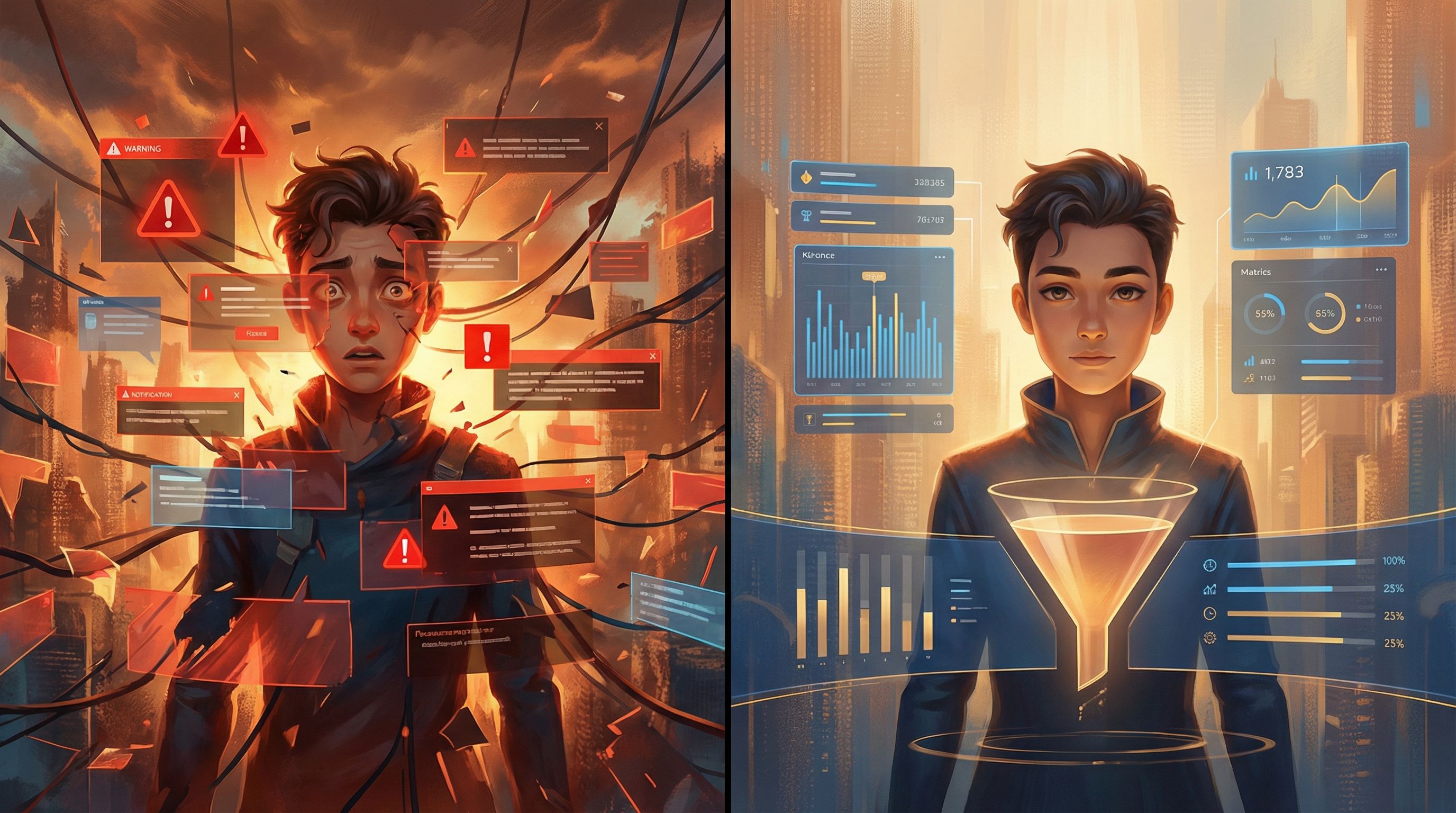
Step 4: Use Visuals to Signal Brand, Stakes, and Progress
Narrative funnels live or die on clarity. Players should always feel oriented: where they are, why it matters, and how their choices are changing things.
Questas includes AI-generated images and video loops for a reason: visuals are not decoration—they’re part of the funnel’s UX.
Use them deliberately:
-
Establish brand feel in the first scene.
- Colors, lighting, and character design should echo your brand guidelines.
- Avoid mixing radically different art styles across branches.
-
Use visual contrast to mark big decisions.
- Calm, cool palettes for low-stakes scenes.
- High-contrast, dramatic lighting when consequences hit.
-
Reinforce progress visually.
- Subtle changes in environment (from messy to orderly, from chaotic to calm) can mirror the player getting closer to a solution.
For a deeper dive on keeping your AI-generated visuals consistent and on-brand across a branching experience, you might like AI Visual Styles 101: Matching Your Questas Imagery to Genre, Tone, and Audience.
Step 5: Design “Marketing-Friendly” Outcomes (Even the Bad Ones)
A narrative funnel needs more than a single “good” ending.
You’ll likely have players who:
- Drop off early
- Make intentionally reckless choices “just to see”
- Reach an outcome where your product isn’t the right fit—yet
Instead of treating these as failures, design them as marketing opportunities:
-
Soft landings for bad choices.
- If they ignore every warning and the scenario ends badly, don’t scold.
- Offer a short debrief: what went wrong, what they might try instead.
- Then present a resource—guide, checklist, or webinar—that fits their behavior.
-
Alternative calls-to-action.
- Not everyone is ready to talk to sales.
- Offer lower-commitment options: “Get the full playbook,” “Try the risk calculator,” “See how others handled this scenario.”
-
Honest “not for you (right now)” endings.
- In some cases, your product truly isn’t the right choice yet.
- Use that outcome to build trust by pointing to educational resources instead of forcing a pitch.
Our post on writing “bad” outcomes that still teach and delight goes much deeper into this mindset: Designing Failure Safely: How to Write ‘Bad’ Outcomes in Questas That Still Teach and Delight.
Step 6: Connect Questas to Your Marketing Stack
A narrative funnel is only as powerful as the systems it feeds.
When you publish your interactive experience, plan for:
-
UTM and source tracking.
- Treat your Questas link like any other campaign asset.
- Use standard UTM parameters to see which channels drive the most engaged players.
-
Branch-level analytics.
- Track which choices are most common.
- Identify where people drop off or loop.
- Use these insights to refine both the story and your broader messaging.
-
Lead enrichment.
- Pass key choices into your CRM or marketing automation tool as fields or tags.
- Example:
ScenarioRole=CTO,RiskTolerance=High,PrimaryGoal=TimeToValue.
-
Dynamic follow-up sequences.
- Send different email sequences based on the path they took.
- Reference specific scenes or decisions: “You chose to prioritize uptime over cost—here’s how our customers do the same.”
This is where narrative funnels shine compared to static content: the same 5–8 minute experience can power dozens of nuanced follow-up paths, all grounded in what the visitor actually did—not just what they downloaded.
Step 7: Playtest Like a Game, Iterate Like a Marketer
Narrative funnels sit at the intersection of story design and performance marketing. That means you’ll want to borrow habits from both worlds:
-
Run internal playtests.
- Ask teammates from sales, support, and success to play through.
- Watch where they hesitate, skim, or get confused.
-
Check for friction in the interface.
- Are choices clearly clickable?
- Is it obvious what changed after each decision?
- Can players easily see how to continue or restart?
-
Ship, observe, refine.
- Treat your first version as a beta.
- Use analytics and qualitative feedback to tweak copy, visuals, and branching.
If you’d like a more detailed blueprint for this kind of testing, our guide on treating your interactive stories like game prototypes is a great resource: Playtesting Your Questas Like a Game Designer: Scripts, Checklists, and What to Watch For.
Putting It All Together: A Simple Starter Blueprint
Here’s a condensed blueprint you can adapt for your first narrative funnel in Questas:
- Choose a high-stakes scenario your audience cares about.
- Define 3–5 segmentation dimensions you want to learn (role, goal, blocker, readiness, etc.).
- Outline a 10–15 scene story with:
- 1–2 onboarding scenes
- 6–8 branching middle scenes
- 2–3 converging climax scenes
- 1–2 resolution scenes with tailored calls-to-action
- Design choices that double as both story beats and data points.
- Use AI-generated visuals to reinforce brand, stakes, and progress.
- Implement soft landings for every ending, including “bad” outcomes.
- Connect analytics and CRM, mapping key choices to fields or tags.
- Playtest, launch, and iterate based on real player behavior.
You don’t need a giant team or a custom engine. With Questas, a marketer and a writer can go from idea to playable narrative funnel in a matter of days.
Summary
- Traditional funnels treat people like rows in a spreadsheet; narrative funnels treat them like protagonists in a story.
- Building narrative funnels in Questas lets you:
- Turn high-stakes customer moments into interactive stories
- Use choices as both engagement and segmentation
- Show your product’s value inside a lived scenario, not just a bullet list
- A strong narrative funnel:
- Starts from a moment of tension, not a slogan
- Structures branches to diverge for relevance and converge for clear outcomes
- Uses visuals to reinforce brand, stakes, and progress
- Designs every outcome—good or bad—as a meaningful marketing touchpoint
- Connects seamlessly to your analytics and CRM for smart follow-up
Your Next Step: Build Your First Brand World
If you’ve been feeling the limits of static landing pages and one-size-fits-all nurture flows, a narrative funnel might be your next unfair advantage.
You don’t have to overhaul your entire marketing strategy. Start with one campaign, one scenario, one story:
- Pick a moment your best customers obsess over.
- Sketch a few branches around the key decisions.
- Open Questas, drop those beats into the visual editor, and generate a handful of images to bring the scenes to life.
Within a short time, you’ll have something you can share, test, and refine—a small but powerful brand world that does far more than any banner ever could.
Adventure awaits. Your funnel can be a story. Let’s build it.