Beyond the Hero’s Journey: Non-Western Story Structures for More Diverse Questas Adventures

Western storytelling has done a number on our imaginations.
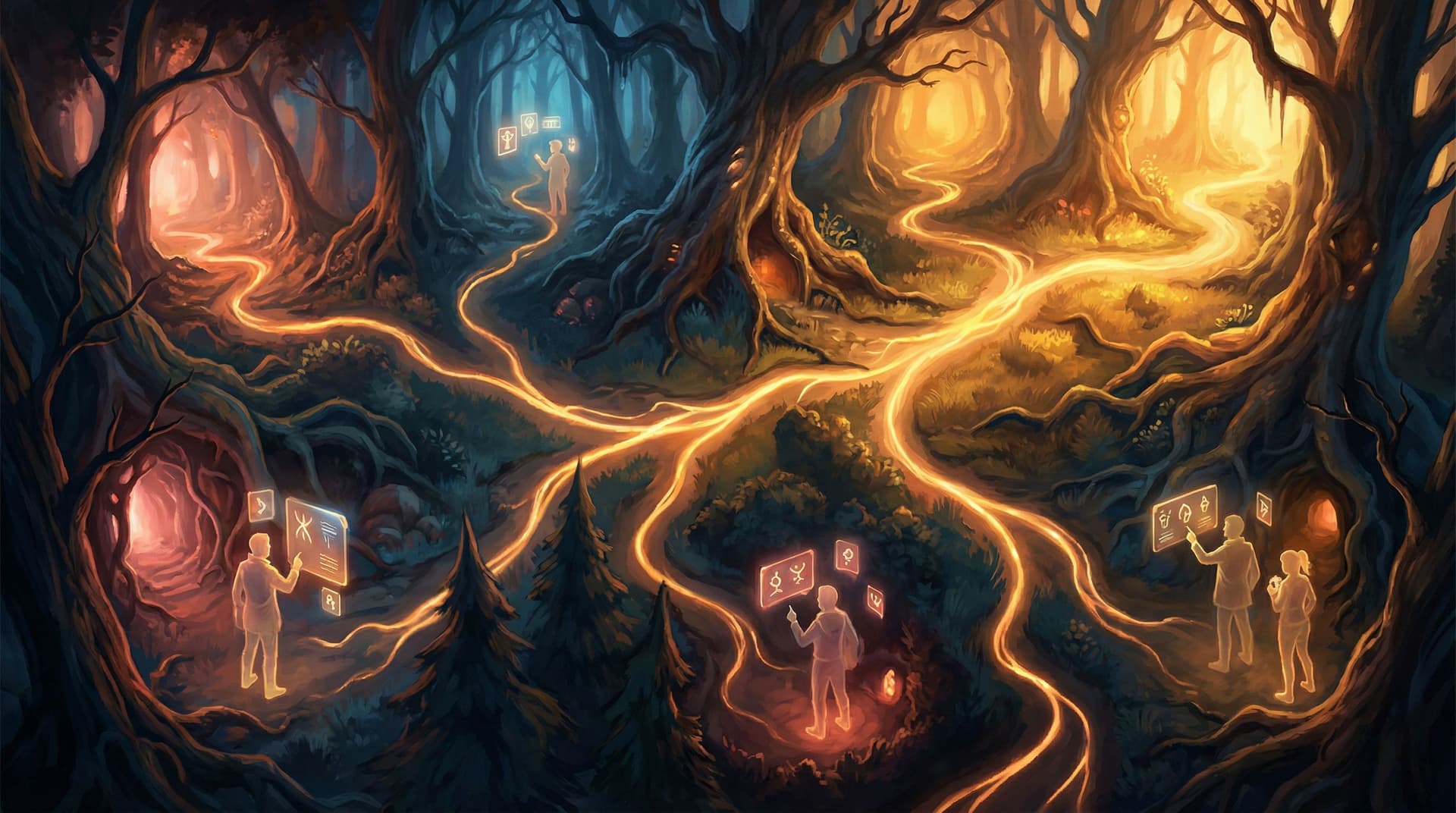
If you’ve read craft books, watched screenwriting breakdowns, or taken a writing class, you’ve probably absorbed some version of the Hero’s Journey or the three‑act structure. Those tools are useful—but they’re not the only way to tell a satisfying story. When you’re building interactive adventures on Questas, limiting yourself to a single structure can quietly limit your characters, cultures, and kinds of experiences.
This post is an invitation to widen your toolkit.
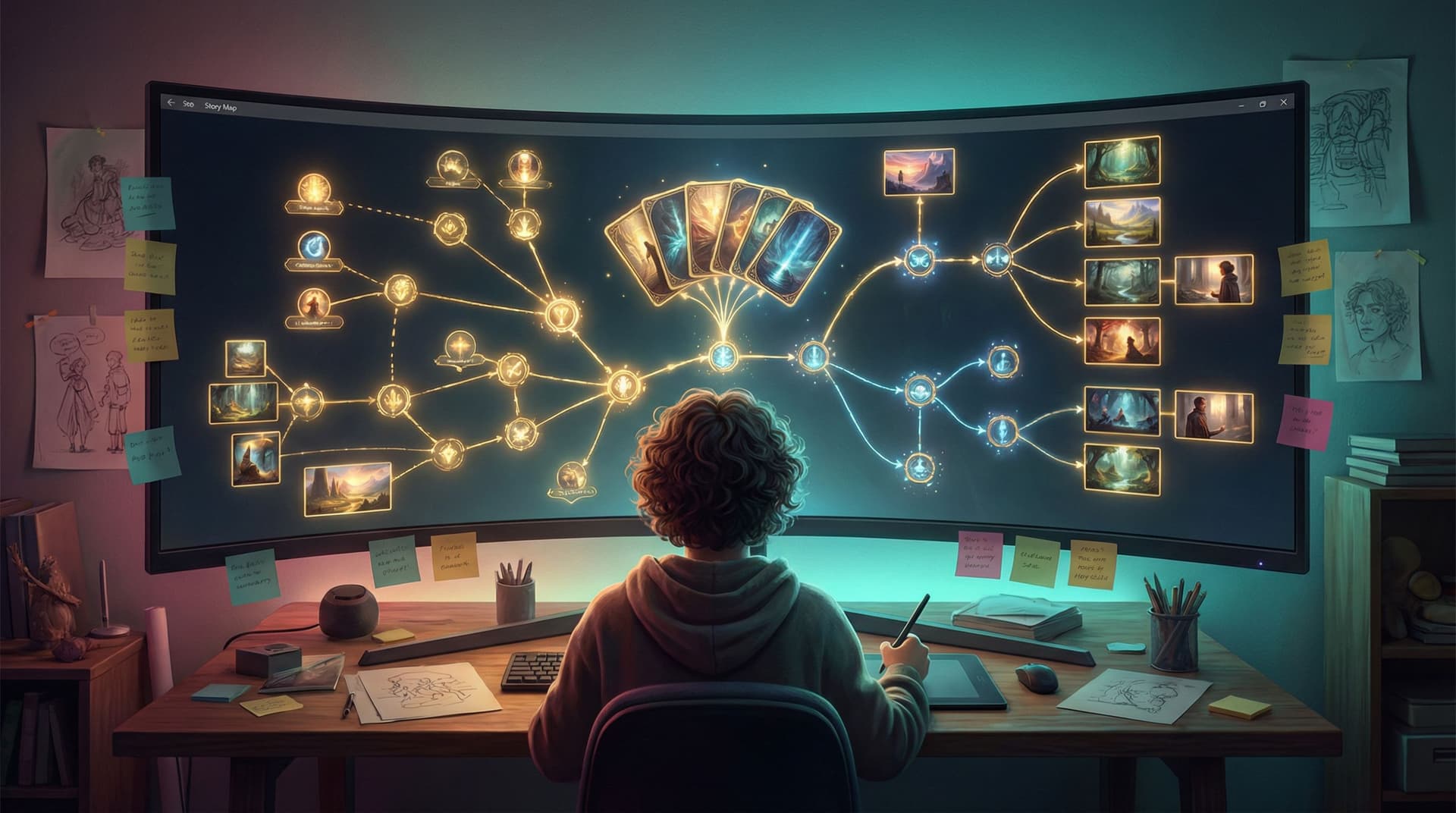
We’ll explore non‑Western story structures and show how they can power richer, more diverse branching narratives. You’ll see how to translate these patterns into nodes, choices, and AI‑generated visuals inside Questas, so your next adventure doesn’t just look different—it feels different.
Why Look Beyond the Hero’s Journey for Interactive Stories?
The Hero’s Journey is built around a single protagonist leaving home, facing trials, and returning transformed. That arc maps cleanly onto lots of Western myths and many modern films and games.
But interactive stories are already different:
- Players may not stick with one clear “hero.”
- Branches can end without a triumphant return.
- Some of your best scenes might be quiet, cyclical, or communal rather than climactic.
Leaning only on the Hero’s Journey can create hidden constraints:
- Repetitive emotional beats. Every path becomes “refusal of the call,” “dark night of the soul,” “final battle,” even when your subject might be negotiation, care work, or community healing.
- Narrow ideas of growth. Transformation is framed as individual conquest rather than shared resilience, compromise, or acceptance.
- Cultural flattening. Stories inspired by non‑Western settings end up wrapped in Western arcs, which can feel off‑key or even disrespectful.
Non‑Western structures give you new levers:
- Cyclical time instead of straight lines. Great for simulations, rituals, or recurring dilemmas.
- Ensembles instead of lone heroes. Perfect for team‑based training, political intrigue, or family sagas.
- Moments over big battles. Emphasizing mood, reflection, or moral ambiguity.
On a platform like Questas, where you can rapidly branch scenes, reuse nodes, and visualize your structure, these alternative patterns are not just interesting—they’re extremely practical.
If you’re used to three‑act arcs, you might enjoy pairing this article with our piece on structuring Western arcs in nonlinear stories: Narrative Arcs in a Nonlinear World: Structuring Three-Act Stories Inside Questas Branches.
Four Non‑Western Story Patterns to Try in Questas
We’ll look at four broad patterns that show up in many storytelling traditions and talk concretely about how they can shape your branching design.
Note: These are simplified lenses, not exhaustive definitions of any culture’s storytelling. Use them as starting points, then do deeper research when you draw from specific traditions.
1. Cyclical Journeys and Return to Balance
Many Indigenous and Eastern narratives emphasize cycles: seasons, rituals, reincarnation, return to harmony. The goal isn’t to “win” once and for all, but to restore or maintain balance.
What it feels like for players
- They revisit similar situations with new knowledge.
- Endings feel like returns, not final victories.
- Choices subtly shift how the cycle plays out, who is harmed, and who is healed.
How to build this pattern in Questas
-
Design a core loop, not a straight line.
- Create a cluster of scenes that represent a repeating situation: an annual festival, a recurring negotiation, a seasonal storm, a quarterly safety drill.
- In Questas, visually group these nodes in a ring or hub‑and‑spoke pattern.
-
Let choices echo across cycles.
- Use variables or flags to track past decisions (e.g., who you sided with last year, which safety step you skipped).
- On the next cycle, branch dialogue, risks, or opportunities based on those flags.
-
Use AI visuals to show gradual change.
- In your image prompts, keep the core location consistent but adjust details: more cracks in the temple floor, higher floodwaters, aging faces.
- For a training scenario, show equipment wear, updated signage, or new team members.
-
Offer multiple “balance points” as endings.
- Instead of one golden ending, create different states of balance: fragile peace, prosperous but unjust, just but precarious.
- Players feel the weight of tradeoffs rather than chasing a single perfect outcome.
This pattern is powerful for:
- Environmental or climate simulations.
- Community‑based stories where the town or group is the real protagonist.
- Training that repeats real‑world cycles (e.g., incident response, seasonal operations).
If you’re designing recurring crises or “bad” cycles, pair this approach with the ideas in Designing Failure Safely: How to Write ‘Bad’ Outcomes in Questas That Still Teach and Delight to keep loops meaningful instead of punishing.
2. Ensemble and Polyphonic Narratives
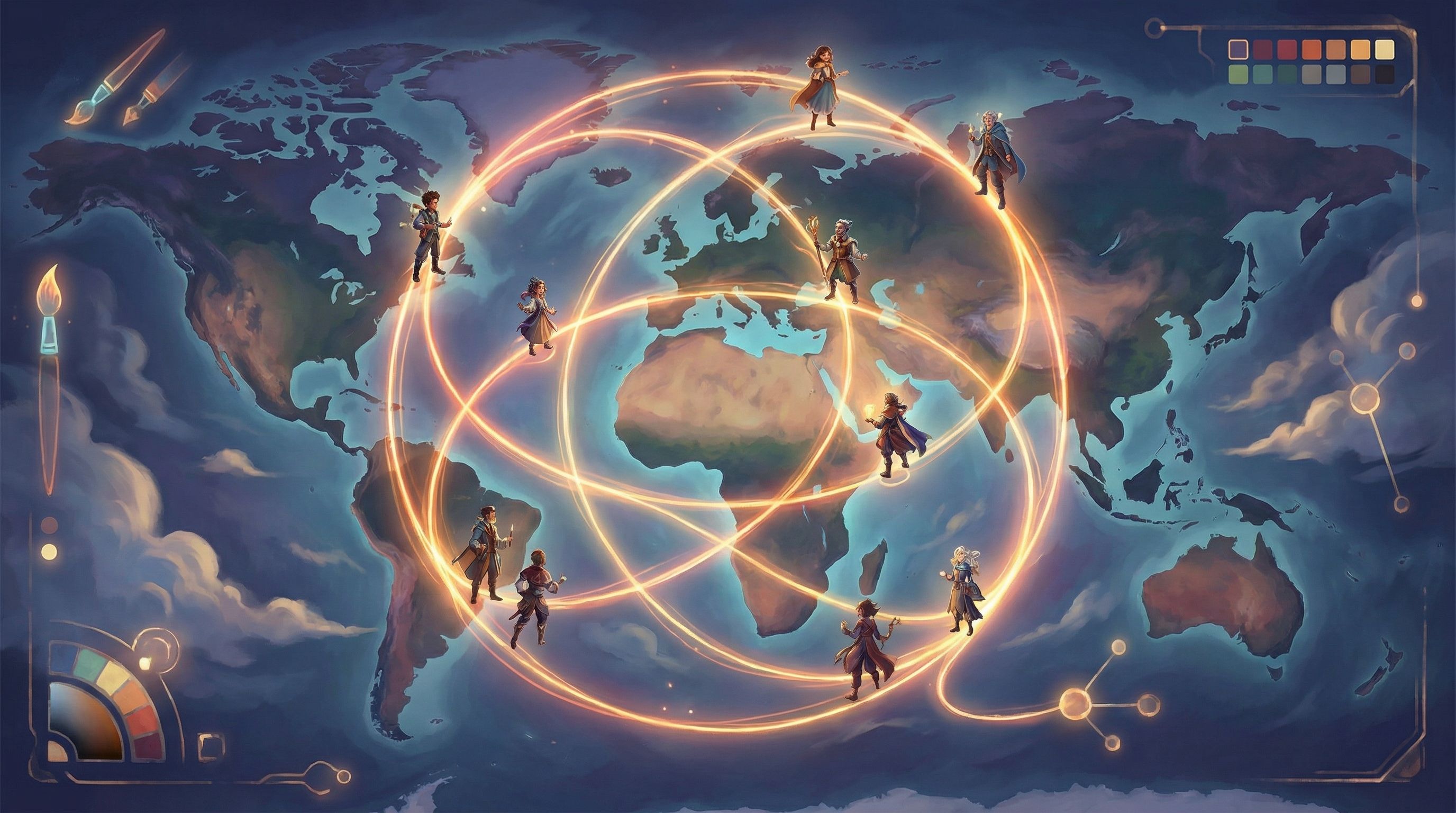
Where Western stories often center one hero, many traditions foreground families, villages, or traveling groups. Power and perspective are shared. Think of polyphonic novels, oral histories, or epics where side characters regularly take the mic.
What it feels like for players
- They step into different viewpoints across branches or chapters.
- No single character has the full truth; understanding comes from contrast.
- Moral questions feel richer because different characters value different things.
How to build this pattern in Questas
-
Start with a character web, not a single protagonist.
- Map 3–5 key characters with distinct goals, constraints, and blind spots.
- In Questas, you can give each character a color tag or label to keep their scenes visually organized.
-
Let branches swap perspective.
- Use choices to jump POV: “Follow your sister” vs. “Stay with the elders.” The next scene is told from the sister’s or elder’s perspective.
- Make it clear in UI and copy whose eyes we’re using—nameplates, first‑person narration, or distinct visual styles.
-
Use AI imagery to differentiate viewpoints.
- Adjust composition and framing per character:
- The guard sees wide shots of crowds and lines.
- The child sees close‑ups of faces and textures.
- The elder sees long, contemplative angles of the landscape.
- Consistently describe these preferences in your prompts.
- Adjust composition and framing per character:
-
Design intersecting, not isolated, arcs.
- Let a choice in one POV unlock or close branches in another.
- Example: As the village council, you deny funding for the healer. Later, playing as the healer, your available options shrink.
-
Give players a meta‑sense of the ensemble.
- Use recap scenes where characters argue about past choices.
- Consider an optional “council” node where multiple characters react to what the player has done in their shoes.
This is ideal for:
- Organizational stories (different departments, stakeholders, or roles).
- Historical or political narratives where no single hero can “fix” everything.
- Family dramas, school stories, or RPG parties.
For more on making each character visually and tonally distinct across branches, see From Prompt to Playable: Designing Your First AI-Generated Character Cast in Questas.
3. Kishōtenketsu and Conflict‑Light Structures
Kishōtenketsu, often associated with East Asian storytelling, is commonly described in four parts:
- Ki – Introduction
- Shō – Development
- Ten – Twist or turn
- Ketsu – Reconciliation or conclusion
Crucially, the “twist” doesn’t have to be a fight or a villain. It can be a surprising connection, a change in perspective, or a juxtaposition.
What it feels like for players
- They’re drawn forward by curiosity rather than combat.
- The most memorable moment is often an unexpected link between earlier elements.
- Endings feel like things “clicking into place” rather than enemies being defeated.
How to build this pattern in Questas
-
Make curiosity your main driver.
- Early choices are about what to observe, who to listen to, or which path to explore—less about winning, more about discovering.
-
Plant elements that will later connect.
- In Ki and Shō, introduce objects, stories, or minor characters that seem unrelated.
- In Questas, you can keep a simple note in your scene descriptions: “This bird motif will connect to the final twist.”
-
Design the Ten as a perspective flip.
- The branching twist might:
- Reveal that two settings are the same place at different times.
- Show that a side character was narrating all along.
- Reframe a “failure” outcome as a hidden success for someone else.
- The branching twist might:
-
Use visuals to emphasize the twist.
- Reuse compositions with altered details to show connection.
- Example: A quiet street scene from Part 1 returns in Part 3 with the same camera angle but new context—protest banners, floodwater, or a missing building.
-
Offer multiple reconciliations, not multiple boss fights.
- Branch your Ketsu into different endings that each resolve the twist in a distinct emotional register: bittersweet, serene, uncanny, hopeful.
This structure shines in:
- Reflective stories (grief, memory, migration, identity).
- Educational pieces where the “twist” is a conceptual insight.
- Brand or onboarding journeys where you want surprise without antagonism.
If you’re designing learning experiences, you can align these twists with key conceptual “aha” moments, as discussed in Beyond Gamification: What Learning Science Can Teach Us About Better Branching Stories.
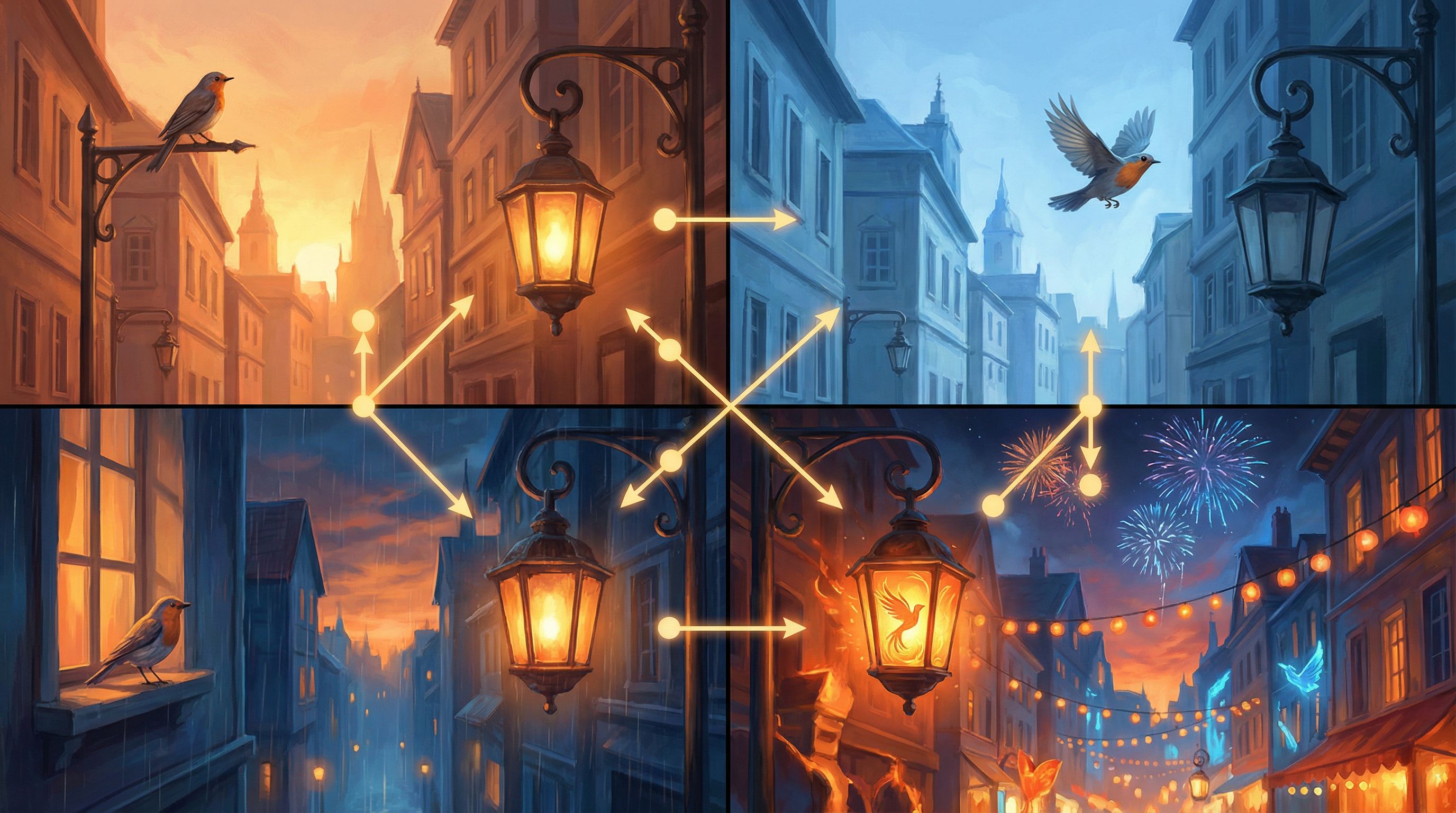
4. Moral Weaving and Story Webs
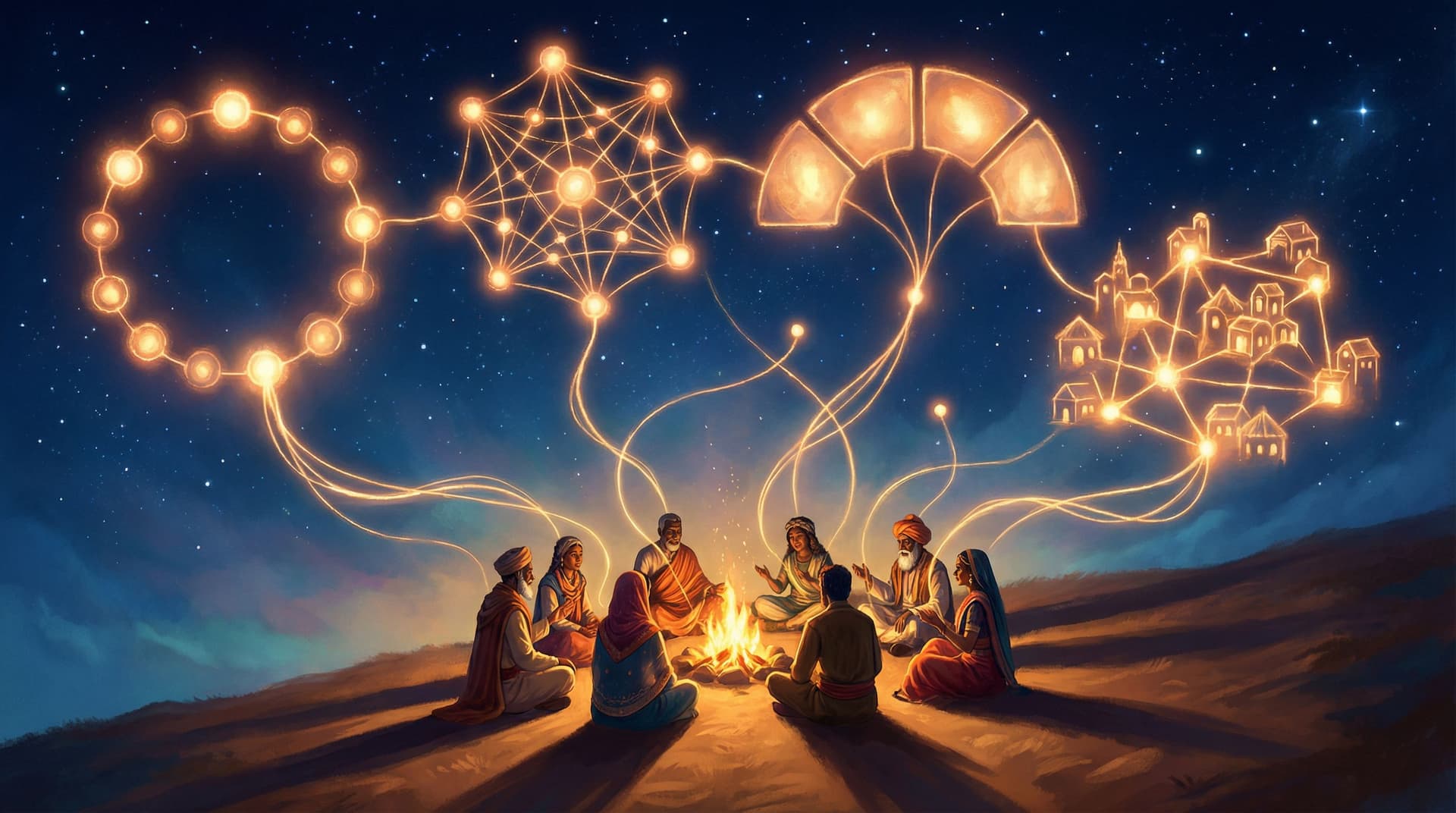
Many African, Middle Eastern, and South Asian traditions use interlocking tales: fables nested inside frame stories, moral parables that comment on each other, or storytellers who adapt episodes based on audience response.
What it feels like for players
- Each branch is a complete small tale.
- Returning to the “frame” recontextualizes what they just saw.
- Morals emerge from comparison, not a single didactic ending.
How to build this pattern in Questas
-
Create a strong frame scene.
- A storyteller around a fire, a teacher in a classroom, a grandparent with a photo album, a safety trainer starting a session.
- This frame is where players choose which embedded story to experience next.
-
Design short, self‑contained branches.
- Each “inner story” might be 5–10 scenes with its own mini‑arc.
- Give each a distinct visual style via your prompts: different palettes, aspect ratios, or levels of realism.
-
Let stories talk to each other.
- After one embedded tale, return to the frame and add new dialogue: characters debate the meaning, disagree, or connect it to a previous story.
- Use variables to track which tales the player has seen and adjust commentary.
-
Surface patterns through choice.
- Offer options like “Tell me a story about loyalty” vs. “Tell me a story about cleverness.”
- Later, present a real decision that forces the player to apply what they’ve learned.
-
End with reflection, not a scoreboard.
- Concluding scenes can recap the different tales and ask questions: “Which ending stayed with you?” or “Whose choice felt most like yours?”
- For training, you can tie this into debriefs or follow‑up resources.
This approach is especially good for:
- Ethics training, leadership development, or coaching scenarios.
- Cultural exploration and folklore‑inspired experiences.
- Any project where you want multiple short replays rather than one long run.
Translating Non‑Western Structures into Branching Diagrams
Knowing the patterns is one thing. Building them inside Questas is where the fun really starts.
Here are practical mapping tips, regardless of which structure you choose:
Think in Clusters, Not Just Paths
Instead of drawing long chains of scenes, design clusters that represent:
- A cycle (for cyclical stories).
- A character’s viewpoint (for ensemble tales).
- A structural beat like Ki/Shō/Ten/Ketsu.
- A self‑contained mini‑story inside a frame.
In the visual editor, keep these clusters tight and label them clearly. Then, draw bridges between clusters where players can cross over—change cycles, switch POVs, or jump between tales.
Use Variables to Carry Cultural and Moral Weight
Non‑Western structures often emphasize relationships, obligations, and reputations.
Track things like:
- Community trust (how much the village believes in you).
- Ancestral favor (how aligned you are with traditions).
- Collective well‑being (how many people benefit from your decisions).
Then:
- Gate certain branches behind thresholds.
- Change visual tone (weather, color, crowd expressions) based on these values.
- Adjust narration: a character might call you “outsider,” “kin,” or “protector” depending on prior choices.
Let Endings Be States, Not Just Scenes
Instead of thinking “this is the final cutscene,” think “this is the final state of the world.”
Represent that state with:
- A summary scene describing the balance you’ve reached.
- A composite image that visually encodes key variables (e.g., a city skyline with more greenery, more smoke, or more lights off).
- Optional epilogues for different characters in ensemble stories.
Because Questas makes it easy to duplicate and tweak scenes, you can quickly create multiple epilogue variants that share composition but differ in detail.
Visual and UX Choices That Support These Structures
Non‑Western structures aren’t just about plot; they’re about how players move and feel through your experience.
Support Reflection and Repetition in Your Interface
- Add “pause and think” moments where no choice is required—just a short reflection, a looping video, or ambient audio.
- Use gentle animations or micro‑videos to signal cycles starting again or perspectives shifting.
- Keep navigation clear so players never feel lost within complex webs; the patterns in The UX of Choice: Interface Patterns that Make Branching Stories Feel Effortless are especially helpful here.
Match AI Visual Style to Structure
- Cyclical stories: Reuse locations and compositions; change lighting, seasons, and small details.
- Ensemble tales: Give each POV a subtle visual signature—color grading, framing, or texture.
- Kishōtenketsu: Make the Ten visually striking—surreal elements, unexpected juxtapositions, or mirrored scenes.
- Story webs: Distinct visual modes for each embedded tale, with a consistent style in the frame narrative.
For deeper guidance on keeping these visuals cohesive across branches, check out AI Visual Styles 101: Matching Your Questas Imagery to Genre, Tone, and Audience.
Getting Started: A Simple Workflow for Your Next Adventure
If you’re excited but a bit overwhelmed, here’s a straightforward way to bring one of these patterns into your next Questas project.
-
Pick one structure to experiment with.
- Cyclical, ensemble, kishōtenketsu, or story web. Just one.
-
Write a one‑paragraph pitch that requires that structure.
- Example for cyclical: “Players manage a coastal town over four monsoon seasons, balancing safety, tradition, and tourism.”
- Example for ensemble: “A corporate whistleblowing story told through the intern, the manager, and the compliance officer.”
-
Sketch 8–12 scenes on paper before opening any tool.
- Mark which belong to which cycle, POV, or structural beat.
- Note where players can jump between them.
-
Block the structure in Questas using placeholder text.
- Create nodes with simple labels: “Season 1 Storm,” “Healer POV: Market,” “Ten: Reveal,” “Story 2 – Clever Fox.”
- Connect them according to your chosen pattern.
-
Play through the skeleton and adjust flow.
- Don’t worry about prose yet—just check pacing, clarity, and the feeling of movement.
-
Layer in writing and AI visuals with intent.
- Add dialogue and description that highlight your structural choices.
- Prompt images to reinforce cycles, contrasts, and connections.
-
Playtest with a cultural lens.
- Ask testers: “Does this feel like a story about an individual hero, or something else?”
- “Where did you feel the biggest shift or realization?”
- “Did any ending feel like a ‘wrong’ kind of closure for this world?”
For more on how to run those tests effectively, you can borrow techniques from Playtesting Your Questas Like a Game Designer: Scripts, Checklists, and What to Watch For.
Summary: Opening Up Your Story Toolkit
When you move beyond the Hero’s Journey, you don’t “abandon structure”—you trade one set of assumptions for many more options.
Non‑Western patterns can help you:
- Reflect different worldviews. Cycles, communities, and webs of stories sit alongside lone heroes.
- Design richer branches. Not every path needs a boss battle; some need a twist of insight, a shift in perspective, or a return to balance.
- Use Questas more fully. Cyclical loops, ensemble POVs, conceptual twists, and story webs all map naturally onto a visual, no‑code editor with AI‑generated imagery.
The result is not just “more diverse content,” but more truthful worlds—ones where players can inhabit different ways of understanding change, choice, and consequence.
Your Next Step
You don’t need to rewrite your entire practice overnight.
Choose one upcoming Questas project—or spin up a small experimental one—and do this:
- Commit to one non‑Western pattern for that project.
- Sketch a tiny prototype: 8–12 scenes max.
- Build it in Questas, using AI visuals to emphasize cycles, ensembles, twists, or webs.
- Share it with a friend, teammate, or community and ask what felt different from the usual “hero on a quest” arc.
The more you practice these patterns, the more natural they’ll feel—and the more your players will feel like they’re stepping into genuinely new kinds of adventures.
Adventure awaits. It doesn’t always have to be a hero’s.