Beyond Gamification: What Learning Science Can Teach Us About Better Branching Stories


Interactive stories are everywhere: training simulations, language apps, onboarding flows, museum exhibits, even marketing campaigns. But too many branching stories still lean on shallow tricks—points, badges, and “gotcha” endings—rather than real learning.
Learning science offers a richer playbook.
When you borrow from how people actually absorb, retain, and apply knowledge, your branching stories stop feeling like novelty toys and start working like memorable experiences—whether you’re designing a classroom scenario, a sales role‑play, or a narrative game built with Questas.
This post digs into what learning science can teach us about better branching design, and how to apply those ideas right away.
Why Learning Science Belongs in Your Branching Stories
Gamification isn’t useless—but it’s incomplete.
Points and progress bars can nudge people to keep clicking. Learning science explains what should happen inside those clicks so the experience actually changes how someone thinks or behaves.
A few reasons this matters:
- Attention is scarce. People have endless options. If your story doesn’t feel meaningful, they’ll leave.
- Shallow choices don’t stick. “Left door or right door?” with no stakes won’t help a learner remember or care.
- Organizations want outcomes. If you’re building for a school, team, or client, they care less about engagement metrics and more about behavior change.
Well‑designed branching stories can:
- Build decision-making skills in realistic contexts
- Strengthen memory through spaced exposure and consequences
- Increase confidence by letting people safely practice tough situations
- Boost motivation because choices feel consequential, not cosmetic
Platforms like Questas make it easy to build branches visually and layer in AI-generated images and video. Learning science helps you decide which branches to build and why.
Principle 1: Make Choices About Mental Models, Not Just Plot
At the core of learning science is the idea of mental models—the internal maps people use to predict what will happen.
In a branching story, every key choice is a chance to:
- Surface a learner’s current mental model
- Challenge it with feedback and consequences
- Help them refine it into something more accurate or useful
How to design for mental models
Instead of:
“Do you open the red door or the blue door?”
Ask:
“Do you confront the customer about the issue now, or wait until you have more data?”
The second question reveals how a player thinks about conflict, risk, and timing.
Try this pattern when authoring branches:
- Identify a misconception or key belief.
- “Students think confirmation emails don’t matter.”
- “New managers overestimate how direct they should be with feedback.”
- Design a fork that exposes that belief.
- Option A: “Skip the confirmation; it’s extra work.”
- Option B: “Send a confirmation summarizing next steps.”
- Show a believable consequence.
- A confused customer and rework later.
- Or a smoother project kickoff and fewer follow‑up emails.
- Reflect the underlying model back to the player.
- Briefly explain how their choice reflects a pattern: “You prioritized speed over clarity here—let’s see how that plays out.”
In Designing Meaningful Choices: How to Turn Simple Branches into Emotional Turning Points in Questas, we dive deeper into turning forks like this into genuine turning points. Combine that with mental-model thinking and your branches stop being arbitrary; they become diagnostic.
Principle 2: Use Desirable Difficulty (But Don’t Punish)
Learning science talks about desirable difficulty: tasks that are challenging enough to require effort, but not so hard they cause frustration and quitting.
Branching stories are perfect for this—if you avoid two traps:
- Everything is obvious. Every choice has a clearly “correct” answer, so players click through on autopilot.
- Everything is opaque. Outcomes feel random, so players stop trying to reason about them.
How to calibrate difficulty in a branching story
Use these levers:
- Ambiguous but fair options.
Provide choices where each option has trade‑offs, and the “best” one depends on context. - Partial success and partial failure.
Avoid all‑or‑nothing outcomes. Let players see what they did well and what they missed. - Preview stakes without spoiling.
A short line like, “This will shape how your team sees you,” signals importance without revealing the result.
A simple difficulty-tuning workflow
- Draft a scenario at your ideal difficulty. Don’t worry yet if it’s too hard.
- Playtest with 3–5 people similar to your target audience.
(If you’re using Questas, you can share a quick link and watch how they navigate.) - Track:
- Where they hesitate
- Where they click instantly
- Where they express confusion or annoyance
- Adjust:
- Add hints or clarifying details to over‑hard nodes.
- Add complications (time pressure, conflicting goals) to too‑easy nodes.
For more on structured testing, check out Playtesting Your Questas Like a Game Designer: Scripts, Checklists, and What to Watch For.
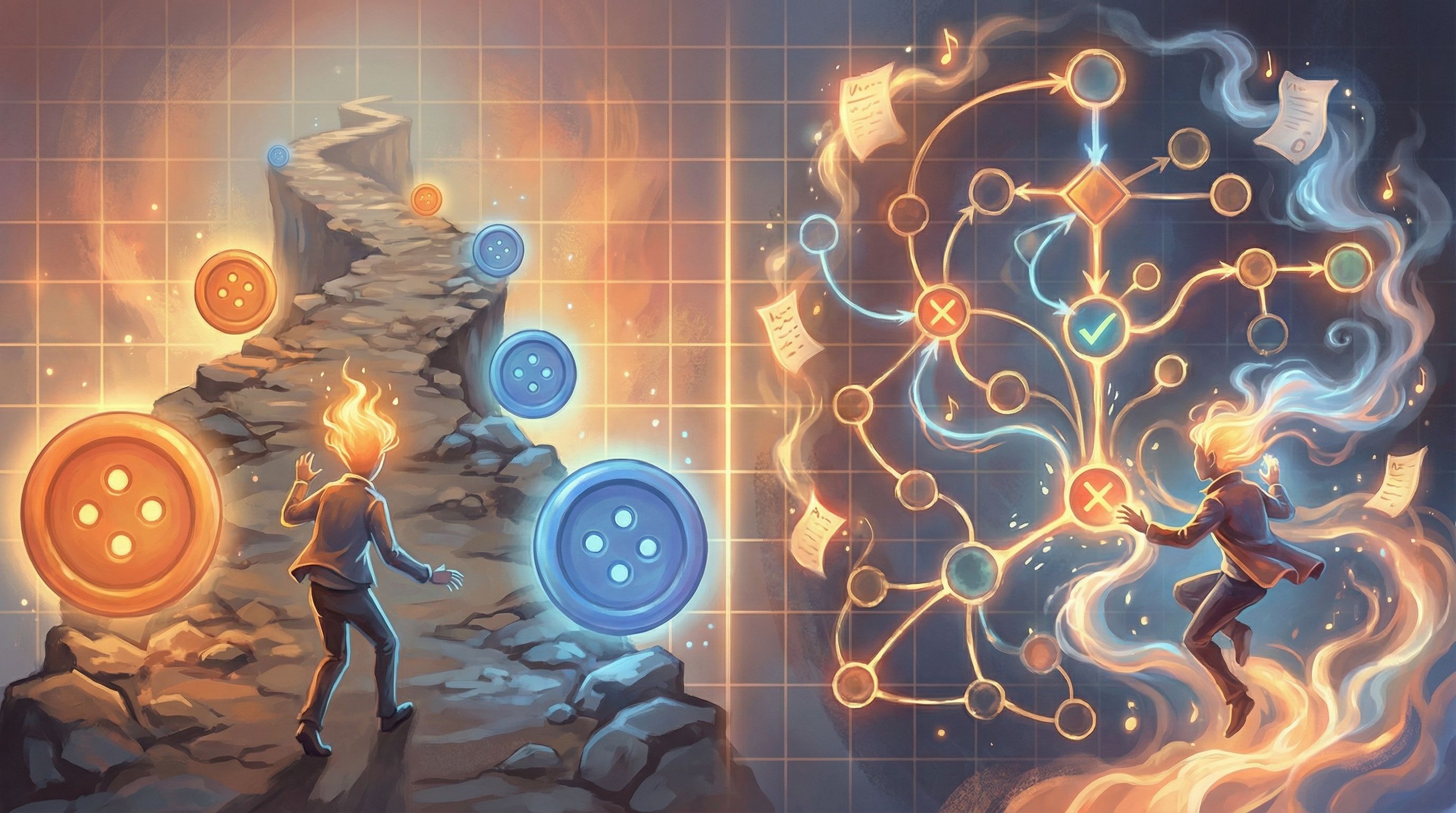
Principle 3: Feedback Beats Failure Screens
From a learning perspective, feedback is where the magic happens.
A bare “Game Over” or “You failed” screen teaches almost nothing. Effective feedback answers three questions:
- What just happened?
- Why did it happen?
- What might I try differently next time?
Types of feedback that work well in branches
-
Outcome feedback
Show the consequence clearly: “The client loses trust and asks for a different account manager.” -
Process feedback
Explain the reasoning: “By agreeing too quickly without clarifying scope, you set unrealistic expectations.” -
Feedforward
Offer guidance for next time: “Next time, try summarizing what you heard and asking one clarifying question before committing.”
Where to place feedback
You don’t need a lecture after every click. Instead:
- Add micro-feedback after key decision nodes.
One or two sentences are enough. - Use branch-specific epilogues that recap patterns.
“Across your choices, you consistently prioritized speed over safety.” - Consider optional debrief nodes.
Let players tap “Why did this happen?” for a deeper explanation if they’re curious.
In Interactive Onboarding 101: Turning User Manuals, FAQs, and Tutorials into Questas Journeys, we show how feedback like this can replace static documentation—and actually help users remember processes.
Principle 4: Space, Repeat, and Vary Key Ideas
Two well‑established learning mechanisms—spaced repetition and interleaving—can quietly supercharge your branching designs.
- Spaced repetition: Revisiting important ideas over time helps them stick.
- Interleaving: Mixing related but distinct concepts improves transfer and flexible thinking.
Applying spacing in branching narratives
Instead of teaching a concept once and moving on, design your graph so that:
- A core idea appears in multiple scenarios separated by other content.
- Later appearances raise the stakes or add nuance.
For example, if you’re teaching “obtain informed consent” in a healthcare scenario:
- Early branch: low‑risk conversation where consent is straightforward.
- Mid‑story branch: time pressure makes skipping consent tempting.
- Late branch: a complex case tests whether the learner recognizes gray areas.
Applying interleaving
Rather than a linear “module 1: empathy, module 2: policy,” mix them:
- Scene A: Empathy vs. efficiency
- Scene B: Policy vs. customer satisfaction
- Scene C: Empathy vs. policy
Your branches should force players to juggle these competing priorities, not treat them as isolated trivia.
In a visual editor like Questas, you can literally see where concepts recur. Color‑coding nodes by learning objective is a simple way to check that you’re spacing and interleaving instead of front‑loading.
Principle 5: Contextualize with Story, Not Just Skin
Learning science emphasizes contextual learning: people remember and apply ideas better when they’re embedded in realistic situations.
Branching stories are already contextual by nature—but only if you do more than wrap a quiz in dialogue.
Turn abstract rules into lived moments
Instead of telling learners: “Always verify identity before sharing sensitive information,” put them in a scene:
- A rushed caller claims to be a manager.
- They’re asking for an urgent password reset.
- The clock is ticking; there’s a backlog of other calls.
Now the choice to “verify identity” isn’t a checkbox; it’s a trade‑off between speed, service, and security. That’s how real decisions feel.
Use visuals and media to deepen context
With AI-generated images and micro‑video, you can:
- Show body language that hints at deception or discomfort
- Highlight environmental cues (a cluttered desk, a warning sign, a crowd)
- Shift lighting and color to signal risk, safety, or urgency
If you want to go deeper on using visuals intentionally, see Show, Don’t Tell: Using AI Images and Short Video Loops to Pace Your Questas Story Beats and AI Art Pitfalls and Fixes: Keeping Your Questas Visuals On-Model, On-Brand, and Not Weird.

Principle 6: Let Learners Reflect and Compare Paths
Reflection is one of the most powerful, underused learning tools. Branching stories make reflection especially potent because players can compare what might have been with what actually happened.
Simple reflection techniques to embed
-
End-of-run journal prompts
Ask 2–3 short questions at the end of a playthrough:- “Which decision felt hardest, and why?”
- “If you replayed, which moment would you handle differently?”
-
Side-by-side path summaries
Show:- “Your path: You prioritized speed over thoroughness in 3 of 4 key moments.”
- “Alternate path: Slower but more accurate, leading to fewer errors later.”
-
Unlockable commentary
After finishing, let players unlock a “designer’s notes” branch explaining the intent behind key scenes. This works especially well in education or professional training.
Tools like Questas make it easy to route players into a dedicated debrief section at the end of any run. You can even use variables (e.g., empathy_score, risk_score) to tailor that reflection to their unique path.
Principle 7: Design for Collaboration, Not Just Solo Play
Learning doesn’t have to be solitary. In fact, social learning—discussing, debating, and co‑creating—can dramatically deepen understanding.
Branching stories can support this in two ways:
- Collaborative creation.
Have teams, students, or communities build scenarios together. - Collaborative debrief.
Have people play separately, then compare paths.
If you’re curious about collaborative authoring specifically, The New Writer’s Room: Running Collaborative Story Jams and Hackathons with Questas shows how teams use a shared canvas to prototype branching scenarios in a single afternoon.
Ideas for social learning with branching stories
- Run a “choose as a team” workshop where a group votes on each branch.
- Assign different paths to different learners, then have them teach their path to others.
- Let advanced learners author new branches that explore edge cases, ethical dilemmas, or alternative strategies.
When people articulate why they made a choice—or why a different choice might be better—they’re engaging in deep processing, which learning science consistently links to better retention.
Turning Theory into Your Next Story: A Practical Checklist
Here’s a quick way to apply these principles to your next project, whether you’re building from scratch or converting existing material into a branching experience.
-
Clarify the mental models you want to shape.
- List 3–5 beliefs, habits, or misconceptions your story should surface and refine.
-
Map choices to those mental models.
- For each belief, design at least one decision point that reveals it.
-
Add meaningful, non-punitive feedback.
- Replace generic failure screens with specific outcome, process, and feedforward feedback.
-
Plan for spacing and variation.
- Revisit key ideas in at least three scenes across your graph, each with a slightly different context.
-
Enrich context with story and media.
- Use environment, character, and mood—not just text—to convey stakes and cues.
-
Bake in reflection.
- Add a short debrief path with tailored summaries and prompts.
-
Consider a collaborative layer.
- Decide how players or creators might compare paths, co‑author branches, or discuss decisions.
If you’re building on Questas, you can translate this checklist into a concrete workflow: sketch your mental models as tags, lay out branches visually, then attach feedback, media, and debrief scenes as you go.
Summary: Beyond Points and Badges
When you ground your branching stories in learning science, several shifts happen:
- Choices become windows into thinking, not just plot forks.
- Difficulty becomes purposeful challenge, not frustration or hand‑holding.
- Feedback becomes instructional, not just a score screen.
- Repetition and variation become design tools, not accidents.
- Story and media become contextual scaffolding, not decoration.
- Reflection and collaboration become core features, not afterthoughts.
The result is a new kind of interactive experience: one that’s as engaging as a game and as impactful as a well‑designed lesson.
Your Next Step
If you’re already sketching branches on sticky notes or in a notebook, this is your invitation to take the next step:
- Pick one scenario you care about—a classroom lesson, a customer interaction, a leadership challenge, a piece of fiction.
- Choose two or three principles from this article (mental models, feedback, spacing, reflection, etc.).
- Open Questas and build a small, focused branching story—5–10 scenes is enough—that puts those principles into practice.
You don’t need a full curriculum or a 3‑hour epic. You just need one well‑designed branch where every choice teaches you something about how your players think.
From there, you can iterate, expand, and—drawing on resources like From Linear Lesson Plan to Branching Scenario: A Practical Framework for Educators Using Questas—scale your approach.
The tools are here. The science is clear. The rest is your imagination.
Adventure awaits in every branch you design.