From Clicks to Conversations: Designing Questas Stories That Spark Community and Fan Theories

Interactive stories used to be a solo experience: you click through, reach an ending, close the tab.
But the most memorable Questas aren’t just “played.” They’re talked about.
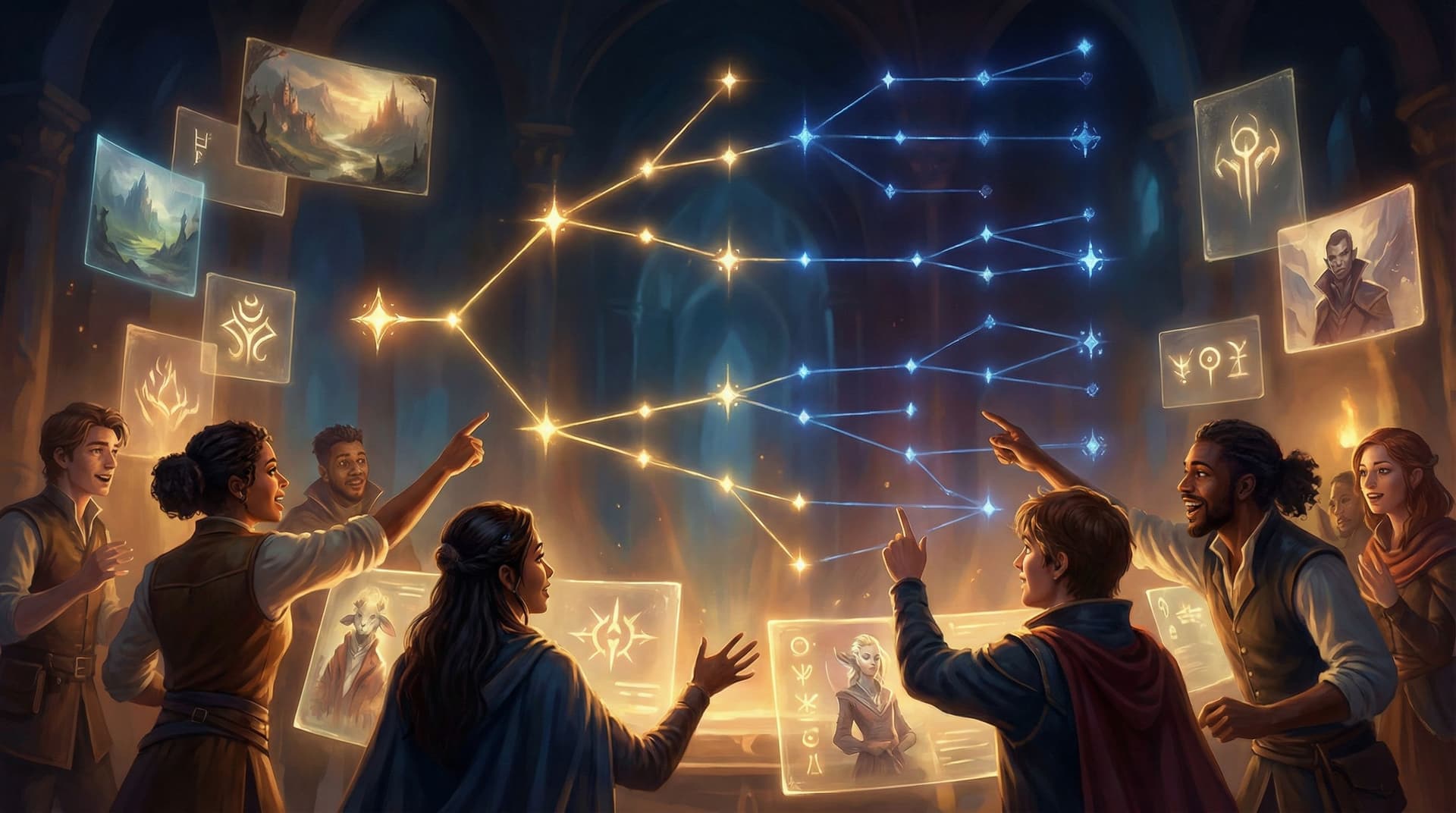
They generate Discord debates about the “true” ending, Reddit threads mapping every branch, and late‑night DMs where friends argue over which choice was morally right. That shift—from isolated clicks to shared conversations—is where your work stops being content and starts becoming a community touchstone.
This post is about how to design stories on Questas that invite that kind of energy: fan theories, headcanons, replays, and collaborative worldbuilding.
We’ll unpack narrative patterns, structural tricks, and practical workflow tips so your next project doesn’t just get played once—it becomes something people want to talk about, map, and revisit together.
Why Conversation-Ready Stories Matter
When you design for conversation—not just completion—you unlock a different tier of value:
1. Deeper engagement per player
A player who finishes once and moves on is valuable. A player who:
- Replays three times to test theories
- Screenshots scenes to share
- Argues about endings in a group chat
…is exponentially more valuable. They’re emotionally invested, not just passively entertained.
2. Organic discovery and word‑of‑mouth
Community and fan theories are free marketing. People don’t share “I clicked through 12 scenes.” They share:
- “I think the Archivist is lying in Branch C, hear me out…”
- “I found a secret scene if you choose the ‘cowardly’ option twice.”
Your story becomes a social object—something people can trade, debate, and recommend.
3. Stronger worlds, not just stronger plots
Stories that support fan theories usually have:
- Coherent rules
- Recurring motifs
- Gaps that feel intentional, not sloppy
Designing for conversation forces you to clarify your worldbuilding and character logic—which also makes the experience more satisfying for solo players.
If you’re already thinking about replay design, you’ll find this complements the techniques in Writing for Re-Reads: Narrative Techniques That Reward Players Who Replay Your Questas.
Step 1: Decide What You Want People to Talk About
Not every story needs fan theories about cosmic lore. “Conversation” can mean:
- Ethical debates – Was it right to sacrifice one character to save the village?
- Strategic breakdowns – What’s the optimal path to keep everyone alive?
- Lore speculation – Who built the underground city? What really caused the blackout?
- Meta-analysis – Is the narrator reliable? Are some choices secretly the same?
Before you open Questas, answer two questions:
-
What’s the #1 topic I hope players argue about after playing?
Examples:- “Was the AI ever actually sentient?”
- “Is the revolution justified?”
- “Is the mentor a villain, or just desperate?”
-
Where should ambiguity live?
- In character motives?
- In the history of the world?
- In the mechanics of the story (time loops, memory edits, simulations)?
Write those down. They’ll guide how you design branches, endings, and reveals.
Pro tip: If you can’t distill your “conversation hook” into one sentence, your players won’t either.
Step 2: Design Branches as Arguments, Not Just Alternatives
Most branching stories treat choices as parallel “what ifs.” For conversation, think of branches as arguments—each path embodies a worldview.
Turn each major branch into a thesis
For your key forks, define what each path is “saying” about the world. For example:
- Path A – Idealism: Trust institutions; reform from within.
- Path B – Pragmatism: Work with whoever has power, even if they’re flawed.
- Path C – Radicalism: Burn it all down; build something new.
Then:
- Make small choices along each path reinforce that thesis (dialogue tone, side quests, who helps or hinders you).
- Let each path work in some ways and fail in others. That’s where debate comes from.
Bake in “evidence” for both sides
If you want people to argue, you can’t make one path obviously correct. Give each path:
- Wins – Moments where that worldview clearly helps
- Costs – People hurt, opportunities lost, truths hidden
Players should be able to say, “My ending was better because…” and point to specific scenes.
On Questas, this is where the visual editor shines: you can see your branches side‑by‑side and sanity‑check whether each path has:
- At least one strong payoff
- At least one painful consequence
- A few unique scenes players will want to show others
If you’re curious how to keep all this structurally coherent without burning out, pair these ideas with the workflows in From Prompt Chaos to Polished Quest: A Practical Workflow for Outlining Branching Stories with AI.

Step 3: Use Visuals as Clues, Not Just Decoration
Because Questas supports AI‑generated images and video, your visuals can do more than “show the scene.” They can:
- Hide secrets in the background
- Foreshadow twists
- Signal which characters are lying or changing
Plant visual motifs that reward close viewing
Pick 2–3 recurring motifs and use them deliberately:
- A symbol (sigil, graffiti tag, constellation) that appears in different contexts
- A color palette that shifts when a hidden faction is involved
- A background object (newspaper headline, monitor readout, shrine) that evolves across branches
Players love posting screenshots with circles and arrows. Give them something to circle.
For help keeping these motifs visually consistent across dozens of scenes, check out From Style Transfer to Story Consistency: Advanced AI Visual Workflows for Questas Creators.
Turn inconsistencies into intentional mysteries
AI art sometimes introduces weirdness—faces change, props morph. Instead of fighting every quirk:
- Decide which inconsistencies you’ll embrace as in‑world glitches, memory gaps, or alternate timelines.
- Use subtle UI or narrative cues (a character’s nosebleed, a static flicker, a “Did you notice that?” line) to frame these as clues, not mistakes.
The key is consistency: if “visual glitches = simulation instability,” keep that rule across branches.
Step 4: Design Endings That Invite Debate, Not Just Closure
Endings are where fan theories either ignite or fizzle. You want players to feel:
- Emotionally satisfied (the story paid off)
- Intellectually itchy (not everything is fully explained)
Types of conversation-friendly endings
Mix and match these patterns:
-
The Incomplete Truth
Each ending reveals a different piece of the underlying mystery. No single path explains everything.- Path A reveals who sabotaged the mission.
- Path B reveals why they did it.
- Path C reveals how long it’s been happening.
Players have to compare notes to assemble the full picture.
-
The Moral Mirror
The ending reflects back the player’s values without telling them if they were right.- “You saved the colony—but at the cost of your own autonomy.”
- “You exposed the truth, and the world burned a little brighter and a little harsher.”
Great fuel for “Was it worth it?” debates.
-
The Reframed Premise
The final scenes make you reinterpret the entire story.- The narrator was biased.
- The timeline was out of order.
- The “villain” was solving a different problem than you realized.
Don’t cheapen this with a last‑second twist that invalidates choices; instead, reveal context that casts earlier decisions in a new light.
Leave deliberate gaps
Resist the urge to over‑explain. Ask yourself:
- Which questions should I never fully answer? (e.g., “Who wrote the original prophecy?”)
- Which questions should have multiple plausible answers based on different branches?
Then:
- Let characters disagree in‑story about those topics.
- Seed evidence supporting at least two interpretations.
If your endings feel a bit “open,” that’s often a feature, not a bug—especially when your goal is community discussion.
Step 5: Build for Replay and Comparison
Conversation thrives when players can compare different experiences.
To encourage that, design your Questas story so players naturally want to replay and share paths.
Make early choices matter in unexpected ways
Instead of having all the “real” branches happen near the finale, let small, early decisions echo later:
- Who you confide in during Scene 3 affects who shows up to help in Scene 10.
- Whether you pick up a seemingly trivial item unlocks a late‑game reveal.
- How politely you treat a minor NPC changes which rumor you hear later.
When players realize, “Wait, your version of the festival scene was totally different from mine,” they’ll want to replay and swap stories.
Show, don’t tell, that other paths exist
Without spoiling everything, hint that alternate routes are worth exploring:
- Use end‑cards that say, “You uncovered 3 of 7 key truths.”
- Let characters reference events you could have caused but didn’t.
- Include subtle UI signals (branch counts, unexplored nodes) in your Questas project.
Combine this with the rhythm techniques from From Branches to Beats: Using Story Rhythm to Keep Players Clicking in Long Questas so replays feel energetic, not like homework.

Step 6: Seed Community Spaces Inside and Around the Story
Design alone won’t create community; you also need invitations.
Add diegetic prompts to share and discuss
Within the story itself, you can:
- Have characters break the fourth wall at key moments:
“If you were me, would you have trusted her? Ask three friends before you decide.” - End some branches with reflective questions:
“Would you forgive someone who did what you just did?” - Include in‑world artifacts that feel like they belong on social media: maps, red‑string conspiracy boards, cryptic notes.
These act as natural screenshot moments.
Set up external hubs
Around the story, give players obvious places to gather:
- A channel in your existing Discord or Slack
- A subreddit or forum thread
- A hashtag you consistently use on X, Instagram, or TikTok
Then, from within your Questas story:
- Link to those spaces in the end‑screen or credits.
- Encourage players to share their “route” (choices taken, ending reached).
- Offer optional “theory prompts” like, “Post your best guess about who the real traitor is, and tag it with #StationEchoTheory.”
Reward co-creation, not just consumption
You don’t need a full UGC program to harness community creativity. Start small:
- Highlight one fan theory per week in your community space.
- Share alternate prompts so players can spin their own micro‑stories in the same world.
- Invite players to vote on which branch you expand in a future update.
Over time, you can even build spin‑off Questas experiences based on popular theories—a powerful way to acknowledge and incorporate your community’s imagination.
Step 7: Use Analytics to Spot Conversation Hotspots
If you’re already tracking beyond simple click‑throughs, you know that not all branches are equal. Some scenes:
- Cause players to pause longer
- Lead to more replays
- Correlate with spikes in social chatter
Pay attention to:
- Drop‑off vs. replay points – Are there scenes where people commonly restart or backtrack? Those might be key decision moments worth amplifying.
- Choice imbalance – If 90% of players pick one option, ask: is that because the other is poorly framed, or because social norms push them? Sometimes, that’s exactly the bias you want to expose.
- Ending distribution – If one ending is rarely seen but beloved by superfans, consider:
- Surfacing it more clearly in marketing
- Building a short “companion quest” that routes more people toward it
Pair your quantitative data with qualitative signals from your community spaces. Often, the branches people talk about are not the ones you expected.
For a deeper dive into measuring impact in narrative experiences, you can layer these ideas on top of the frameworks in Beyond Click-Throughs: Measuring Learning, Alignment, and Engagement in Narrative Experiences Like Questas (slugged as /beyond-click-throughs-measuring-learning-alignment-and-engageme).
Putting It All Together: A Lightweight Design Checklist
When you’re building your next story on Questas, run through this checklist before you hit publish:
Conversation Hooks
- [ ] I can name 1–2 specific questions I hope players argue about.
- [ ] At least one character or faction is genuinely debatable, not clearly right or wrong.
Branch Structure
- [ ] Major branches embody different worldviews, not just different locations.
- [ ] Each major path has at least one big win and one meaningful cost.
Visual Clues
- [ ] I’ve chosen 2–3 recurring visual motifs (symbols, colors, props).
- [ ] Some images contain details that reward close inspection or replay.
Endings
- [ ] No single ending explains everything; each reveals a different facet.
- [ ] At least one question is intentionally left open to interpretation.
Replay & Sharing
- [ ] Early choices echo later in ways players can compare.
- [ ] The story hints that other paths and secrets exist.
Community
- [ ] There’s at least one explicit invitation to share or discuss.
- [ ] I’ve set up (and linked to) a space where players can gather.
If you can check most of these boxes, you’re not just shipping a story—you’re launching a conversation engine.
Summary
Stories built on Questas have a unique advantage: they’re inherently interactive, visual, and shareable. When you design them with community in mind, they can evolve from one‑off experiences into ongoing worlds your audience returns to, debates, and helps shape.
The key moves are:
- Decide what you want people to talk about (ethics, strategy, lore, meta).
- Turn branches into arguments—each path a coherent worldview with real trade‑offs.
- Use AI‑generated visuals as clues and motifs, not just illustrations.
- Craft endings that satisfy emotionally while leaving intellectual gaps.
- Encourage replay and comparison so players bring their experiences back to each other.
- Seed spaces and prompts for discussion, and listen for emergent theories.
- Use analytics and community feedback to refine hotspots and expand your world.
Do that, and your work doesn’t end when someone reaches the credits—it begins when they start explaining their ending to a friend.
Your Next Step
If you’re ready to move from “people clicked through my story” to “people won’t stop talking about my story,” here’s a simple way to start this week:
- Open Questas and sketch a short, 10–15 scene story.
- Choose one big question you want players to debate afterward.
- Design just two main branches that answer that question differently.
- Plant 2–3 visual or narrative clues that support both interpretations.
- Publish it and invite a few friends or community members to play, then ask them what they think “really” happened.
You don’t need a massive epic to spark fan theories. You just need a world with enough coherence to feel real, and enough gaps to let your players’ imaginations rush in.
Adventure awaits—now go build the story people can’t stop dissecting together.