From Prompt Chaos to Polished Quest: A Practical Workflow for Outlining Branching Stories with AI


Interactive stories promise freedom: endless paths, surprising outcomes, personalized journeys.
But if you’ve ever opened an AI tool, fired off a few prompts, and ended up with a tangle of half-connected scenes, you know the flip side: chaos. The ideas are there, the characters are interesting, but the structure dissolves the moment you try to map it.
This post is about bridging that gap—turning raw AI prompts into a clear, replayable outline you can actually build on platforms like Questas, where a visual, no‑code editor and AI-generated visuals make it easy to bring branching stories to life.
We’ll walk through a practical, repeatable workflow you can use whether you’re creating:
- A narrative game or fiction series
- A training simulation or micro‑learning path
- An interactive brand journey or onboarding flow
By the end, you’ll have a concrete method for going from “I have 40 pages of AI rambling” to “I have a clean, testable quest map ready to build.”
Why structure matters more than more prompts
AI can give you:
- Infinite variations on a scene
- Instant character ideas and locations
- Snappy dialogue and flavor text
What it can’t do on its own is guarantee:
- Coherent cause and effect between choices
- A satisfying arc across many branches
- A consistent experience for different players
That’s where your workflow comes in. A solid outlining process:
- Prevents plot spaghetti. You know where each choice leads before you write 1,000 words you’ll throw away.
- Keeps scope sane. You decide how wide and deep your branches go instead of letting AI explode your story into 200 endings.
- Makes visuals intentional. When you later use AI images or video (for example inside Questas), you’ll know which moments deserve a big visual beat and which can stay minimal.
- Improves replay value. Thoughtful structure lets you plant callbacks, alternate paths, and hidden payoffs. If you want to lean into that, bookmark our companion guide on writing for re-reads.
The goal isn’t to tame your imagination. It’s to give it rails strong enough that players can actually enjoy the ride.
Step 1: Define the playable promise before you touch AI
Before you write a single prompt, answer three questions in plain language:
-
Who is the player?
- Role: “First‑time manager at a startup,” “rookie starship engineer,” “new customer choosing a product.”
- Perspective: first person (“I”), second person (“you”), or third person.
-
What is the core tension?
- Example: “Balance safety vs. speed,” “tell the truth vs. protect a friend,” “follow protocol vs. improvise.”
-
What is the experience in one sentence?
- Fill this in: “You play as a [role] who must [do X] while [tension], and your choices determine [stakes].”
Write this at the top of your doc or inside your Questas project notes. This becomes your north star; every branch should, in some way, test that core tension.
Pro tip: If you’re building learning or training content, tie the promise directly to a real skill or outcome. For more on that, check out how branching can transform knowledge bases into journeys in From Lore Docs to Learning Paths.
Step 2: Choose a simple backbone structure
Interactive doesn’t mean structureless. Start with a backbone that’s easy to hold in your head, then let branches hang off it.
Three reliable patterns:
-
Hub-and-spoke
- One central situation (the hub) with multiple attempts or approaches (spokes).
- Great for: sales calls, troubleshooting, investigation scenes.
- Example: You keep returning to the same negotiation, but each attempt reflects previous choices.
-
Branch-and-bottleneck
- Choices fan out, then reconverge at key moments.
- Great for: stories that must hit certain beats (e.g., a required safety briefing, a boss fight).
-
Layered three-act
- You still have a beginning, middle, and end, but each act has its own mini-branches.
- If you like this approach, pair it with the ideas in Narrative Arcs in a Nonlinear World.
At this stage, keep it extremely low‑fi:
- Draw 3–7 boxes for your main beats.
- Label them with verbs: Arrive → Choose → Confront → Resolve.
- Don’t worry about AI yet; you’re designing the skeleton.
Step 3: Use AI narrowly to explore moments, not the whole plot
This is where many creators go off the rails: they ask AI to “write a full branching story” and end up with something impossible to implement.
Instead, use AI as a moment generator:
-
Prompt for pivotal scenes only
- Take one beat from your backbone, like “Confront the saboteur in the engine room.”
- Ask AI for three distinct versions of that scene:
- One where the player is confident and prepared
- One where they’re rushed and underinformed
- One where they’re secretly compromised
-
Prompt for choice sets, not prose
- Ask: “Give me 3–5 meaningful choices the player could make in this situation, each with a short consequence summary.”
- Focus on:
- Tradeoffs (risk vs. reward)
- Revealing vs. hiding information
- Relationship impacts (who trusts you more/less)
-
Prompt for failure variants
- Don’t just ask for “good” outcomes. Ask: “How could this go wrong in interesting, non-punishing ways?”
- For guidance on designing failure that still delights, see Designing Failure Safely.
You’re not committing to anything yet. You’re mining AI for possibilities, then you’ll curate.
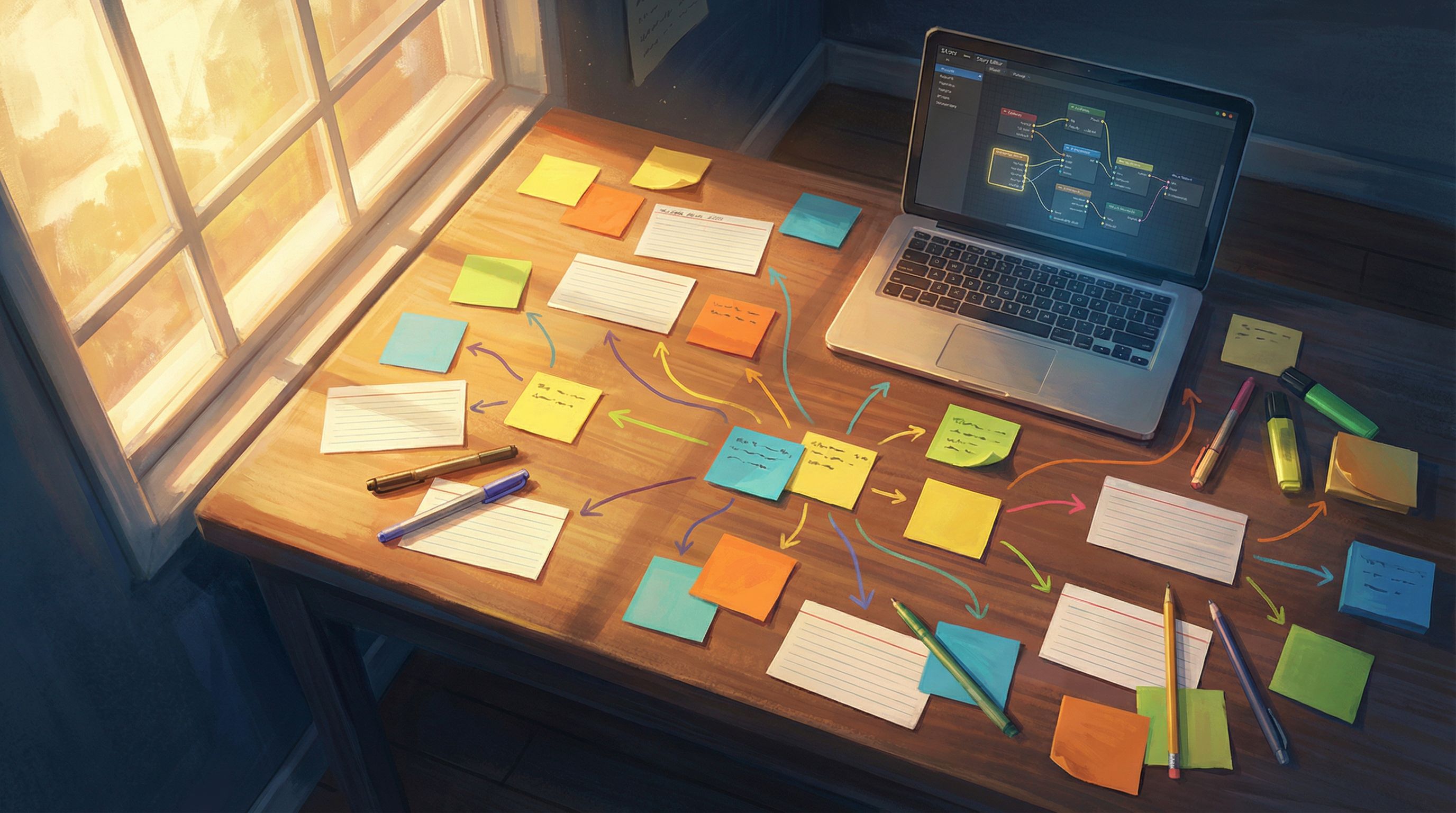
Step 4: Collapse the chaos into a clean node map
Now you likely have a bunch of AI-generated scenes, options, and consequences. Time to turn them into a map you can build.
4.1 Normalize everything into “nodes”
Think of your story as a graph of nodes (scenes) connected by edges (choices). For each potential scene:
- Give it a short, unique label:
Docking Bay Standoff,Engine Room Reveal,Quiet Debrief. - Define its purpose in one line: e.g., “Reveal who the saboteur might be and test player’s trust in authority.”
- List incoming conditions: what must be true to arrive here?
- Trust with Captain ≥ 1
- Player concealed evidence earlier
You can do this in:
- A simple spreadsheet
- A mind-mapping tool
- A visual editor like Questas, which is built around node-based branching.
4.2 Limit branch width and depth intentionally
To avoid runaway complexity, set hard constraints:
- Max choices per node: 2–3 meaningful options is usually enough.
- Max depth: Decide how many major decisions a typical playthrough should include (e.g., 6–10).
When AI suggests extra branches, ask yourself:
- Does this change the story, or just the flavor?
- Could this be a variation inside the same node instead of a whole new branch?
If it’s flavor (different lines of dialogue, slightly different tone), keep it inside the node as conditional text, not a new path.
4.3 Create “bottlenecks” on purpose
Bottlenecks are scenes most or all players hit regardless of path. Use them to:
- Re-align everyone with the core tension
- Deliver essential information
- Pay off earlier choices in a shared moment
Mark these clearly in your map so you can give them extra polish and, later, stronger visuals.
Step 5: Turn messy AI ideas into structured choice logic
Now refine each node’s internal logic. You want choices that:
- Reflect the core tension you defined
- Tie back to trackable variables (trust, time, resources, knowledge)
- Lead to distinct experiences, not just different sentences
5.1 Declare your variables
Even if you’re not coding, think like a systems designer. Common variables:
- Trust: with specific characters or factions
- Risk: how close you are to a bad outcome
- Resources: money, supplies, time remaining
- Knowledge: what the player has learned or noticed
In Questas, you can represent these as story state (flags, counters) that gate branches or modify text.
5.2 Re-prompt AI with constraints
Take a rough AI scene and refine it:
- Original prompt: “Write a scene where the player confronts the saboteur.”
- Improved prompt:
*“Write a scene where the player confronts the suspected saboteur in the engine room. The player has a TRUST score with the Captain (low/medium/high) and a KNOWLEDGE flag about a missing access card (true/false). Propose 3 choices that each:- Explicitly reference TRUST or KNOWLEDGE in how the dialogue plays out
- Lead to different emotional tones (calm, accusatory, manipulative)
- Can be mapped to follow‑up nodes that either escalate conflict or reveal a twist.”*
You’re telling AI: respect my system. It stops inventing random twists and starts working inside your design.
5.3 Make consequences legible
For each choice, jot down in plain language:
- What changes in the story state? (e.g.,
Trust_Captain +1,Risk +2) - Where does the player go next? (node label)
- What will they feel? (relief, dread, curiosity)
Later, when you build in a tool, this becomes your implementation checklist.
Step 6: Plan visuals and media as part of the outline
If you’re using AI-generated images or micro‑videos, don’t bolt them on at the end. They can clarify structure and make choices more intuitive.
6.1 Tag visual “anchor” nodes
In your map, mark 5–10 scenes that deserve strong visuals:
- First impression scenes (arrival, setting reveal)
- High-stakes decisions
- Major consequences (big success, big failure)
- Emotional turning points (betrayal, reconciliation)
For each anchor node, note:
- Mood: tense, hopeful, eerie, cozy
- Framing: close‑up on a character, wide shot of an environment, over‑the‑shoulder, etc.
- Style: realistic, painterly, comic‑book, diagrammatic
If you want a deeper dive on matching style to genre and audience, see AI Visual Styles 101.
6.2 Use AI to prototype visual prompts
For each anchor node, draft 1–2 image prompts:
- “Cinematic wide shot of a cramped starship engine room, red emergency lights, two figures facing off across a metal catwalk, steam venting from pipes, tense atmosphere, realistic style.”
You can test and refine these in your preferred image model or directly inside Questas. Keep them attached to the node in your outline so you don’t lose track of which visual belongs where.
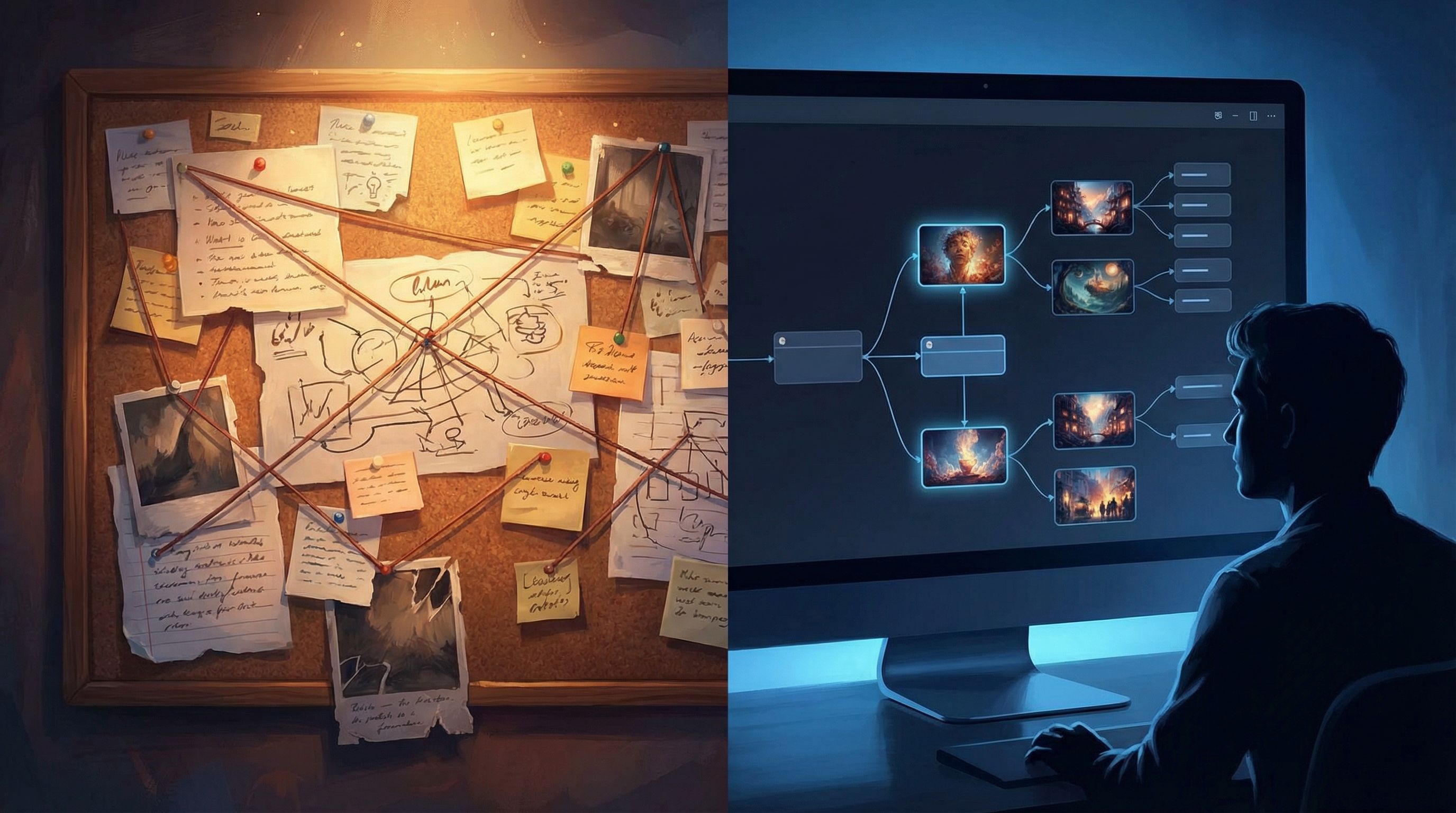
Step 7: Dry-run the story as a player before you build
Before you invest in full prose and polished visuals, “play” your outline.
7.1 Run paper playthroughs
Pick a path through your node map and narrate it quickly:
- “You arrive at the station (Node A), choose to side with the locals (Node B), which raises Suspicion with Command, leading to a tense briefing (Node D)…”
Ask yourself:
- Does this path feel like a complete experience?
- Are there weird dead ends or boring stretches?
- Are the stakes clear at each major choice?
Repeat for 3–5 different paths, especially edge cases (low trust, high risk, etc.).
7.2 Check for thematic consistency
Across different paths, your story should still feel like it’s about the same thing.
- If your core tension is “safety vs. speed,” do late‑game choices still reflect that, or have you drifted into a completely different theme?
- If not, adjust nodes or variables so the central question keeps resurfacing.
7.3 Identify missing connective tissue
During your dry runs, you’ll spot gaps:
- A character forgives the player too quickly
- A big twist appears without set‑up on some paths
- A failure outcome feels arbitrary
Mark these as bridge nodes you need to add. You can then prompt AI specifically:
- “Write a short bridging scene that explains why the Captain is willing to trust the player again after they disobeyed orders earlier. Keep it tense but not fully reconciled.”
Step 8: Build, then iterate like a game designer
Once your outline feels solid, it’s time to implement in your tool of choice.
If you’re building in Questas:
- Create nodes matching your map. Use your labels and one‑line purposes as node titles and internal notes.
- Wire choices to next nodes. Translate your paper edges into actual buttons and transitions.
- Add state logic. Implement your TRUST/RISK/KNOWLEDGE variables as flags or counters that gate branches or change text.
- Drop in draft prose and visuals. Use AI to generate first‑pass dialogue and narration, then revise by hand.
Then, treat your quest like a game:
- Playtest with a small group. Watch where they hesitate, skim, or get confused.
- Track which paths they take. If no one ever picks a certain option, ask why—unclear label, low perceived value, or hidden bias?
- Iterate on structure, not just wording. Sometimes the fix is adding a preview of consequences, not rephrasing the same dull choice.
If you want a deeper toolkit for structured testing, the checklist in Playtesting Your Questas Like a Game Designer pairs nicely with the workflow you’ve just designed.
A quick example: From messy prompt to clean mini-quest
Let’s sketch a tiny example to see the workflow in action.
Playable promise:
“You play as a junior security officer on an orbital station who must decide whether to expose a potential sabotage plot or protect your mentor, and your choices determine who controls the station when the crisis hits.”
Backbone (branch-and-bottleneck):
- Arrival on the station
- First sign of sabotage
- Confrontation in the engine room (bottleneck)
- Station-wide crisis
- Resolution (3–4 variants)
AI moment prompts:
- For step 2: ask AI for three different “first sign” scenes (data anomaly, overheard conversation, physical damage) plus 3–4 choices each.
- For step 3: ask for confrontation choices tied to TRUST_MENTOR and KNOWLEDGE_SABOTAGE.
Node map (simplified):
Dock Arrival→ choice: report to Mentor or PatrolData Anomaly/Suspicious Conversation/Damaged Relay(branch) → all funnel toEngine Room Showdown(bottleneck) → 3 major choicesCrisis Control Room→ outcomes based on accumulated trust/knowledge- 3–4 resolution nodes (
Martial Law,Shared Governance,Silent Coup)
Variables:
- TRUST_MENTOR (−1 to +2)
- TRUST_COMMAND (−1 to +2)
- KNOWLEDGE_SABOTAGE (true/false)
Visual anchors:
- First view of the station exterior
- Engine room showdown
- Control room during crisis
- Final shot reflecting who controls the station
From here, you can see exactly what to build—and where AI can help you fill in flavor without derailing structure.
Bringing it all together
Let’s recap the workflow:
- Define your playable promise so you know what experience you’re actually offering.
- Pick a simple backbone structure (hub-and-spoke, branch-and-bottleneck, or layered three-act).
- Use AI surgically to explore key moments and meaningful choice sets.
- Normalize ideas into a node map with clear purposes, limits on width/depth, and deliberate bottlenecks.
- Design choice logic with variables so consequences feel coherent and systemic.
- Plan visuals as part of the outline, tagging anchor nodes and drafting prompts.
- Dry-run multiple paths on paper to catch gaps, weak stakes, and thematic drift.
- Build and iterate in a tool like Questas, playtesting like a game designer.
Follow this loop, and “prompt chaos” stops being a blocker and becomes a creative phase you can harness.
Your next step: Turn one idea into a mapped quest
Don’t wait for the perfect epic. Pick one small story idea—a single decision point at work, a short fictional scenario, a bite‑sized learning moment—and run it through this workflow.
Here’s a simple challenge:
- Write your one‑sentence playable promise.
- Sketch 5–7 nodes on paper.
- Use AI to brainstorm choices and consequences for just one pivotal scene.
- Collapse that into a clean mini‑map with 2–3 endings.
- Open Questas and build that mini‑quest end to end.
Once you’ve done it once, you’ll have a template you can reuse for bigger, bolder adventures—whether you’re training a team, onboarding new users, or telling the sci‑fi epic that’s been living in your notes app for years.
Adventure awaits. Your job is to give it structure.