From Escape Rooms to Inbox Games: Marketing Campaigns that Feel Like Quests, Not Ads


Marketing teams have a problem: attention is expensive, and most campaigns still feel like chores.
Pop‑up. Banner. “Limited-time offer!” Close tab.
Meanwhile, the experiences people seek out—escape rooms, puzzle hunts, interactive films, cozy story games—are built around curiosity and choice. They don’t just tell you something; they invite you to play with it.
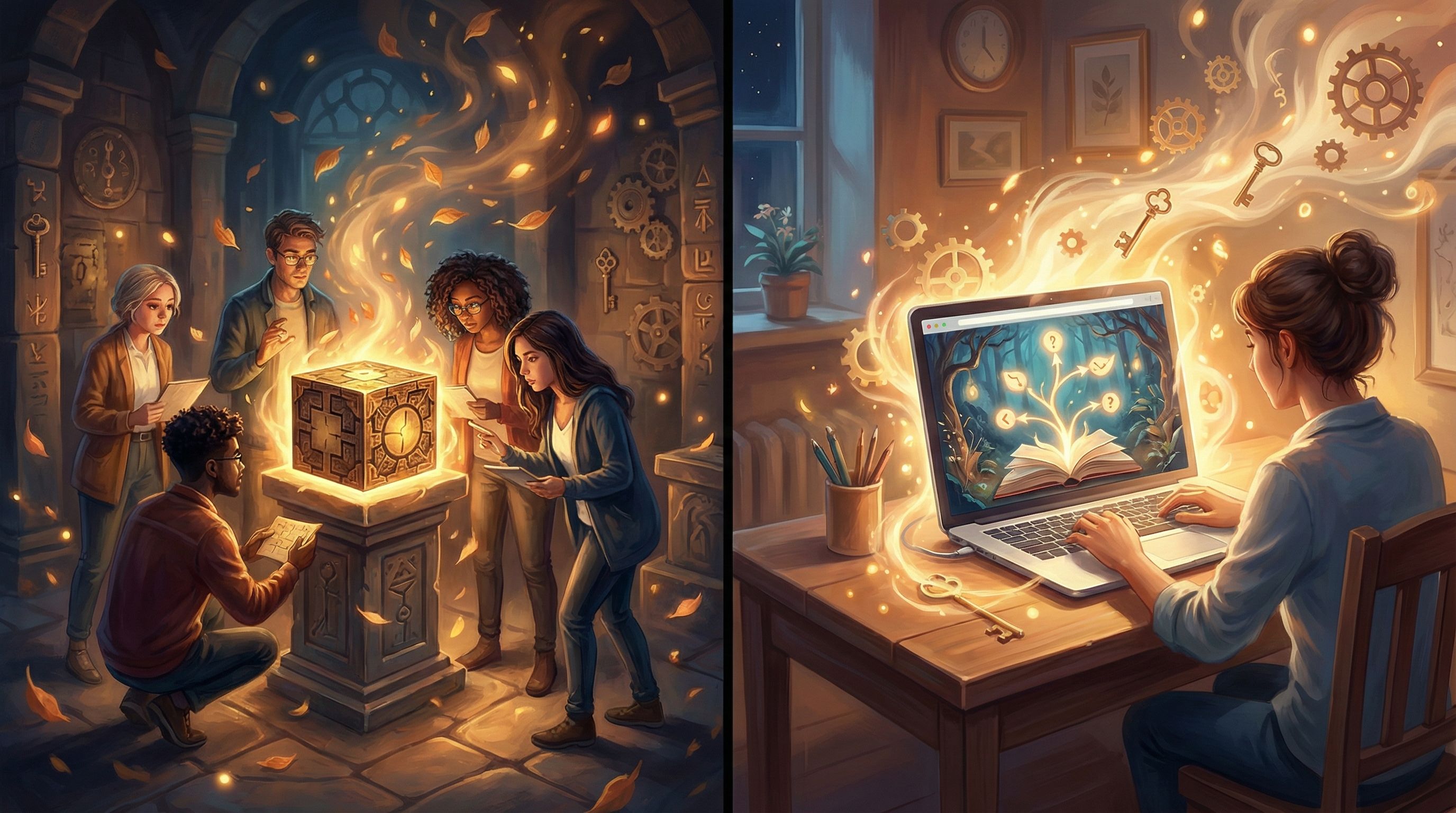
This is where quest‑shaped campaigns come in. Instead of pushing messages, you design missions. Instead of impressions, you design experiences. And with tools like Questas, you can build those experiences as branching, visual stories without touching a line of code.
In this post, we’ll explore how to borrow from escape rooms, alternate reality games, and inbox adventures to create marketing that feels like a quest—not an ad.
Why “Quest-First” Campaigns Work So Well
Before we get tactical, it helps to understand why these formats outperform traditional campaigns when they’re done well.
1. Quests give people something to do, not just something to see
Escape-room brands have leaned into this for years. Many now run ongoing mini-mysteries on social—riddles, puzzles, and codes followers can solve together—because they see dramatically higher engagement when people participate rather than just scroll by.
One escape-room chain, for example, runs monthly online mystery games with cash prizes and reports strong traction and word-of-mouth because players share the puzzles with friends who haven’t visited in person yet. The game becomes a low-friction way to sample the brand’s personality and experience.
That same principle applies to marketing:
- A static banner says, “Look at me.”
- A quest says, “Try this.”
Trying is stickier than looking.
2. Quests feel like stories, not sales copy
Interactive campaigns tap into the same appetite that drove millions of viewers to explore Netflix’s interactive film Bandersnatch—the thrill of steering what happens next.
When your brand shows up inside a story world—where the player is decoding clues, choosing allies, and uncovering secrets—you become part of their memory, not just part of their ad fatigue.
3. Quests earn organic reach
Treasure hunts, puzzle drops, and interactive quizzes are inherently shareable. A nationwide escape-room brand generated news coverage and thousands of participants when it hid cash in cities across the U.S. and released coordinates as clues on social. People didn’t share it because it was an ad; they shared it because it was a game.
Quest-shaped campaigns:
- Turn your audience into co-promoters (“Who wants to help me solve this?”)
- Generate screenshots, reaction videos, and walkthrough threads
- Create FOMO when there are limited-time puzzles or time-boxed events
4. Quests collect richer data (ethically)
Every choice a player makes in a branching story tells you something:
- Which character archetype they gravitate toward
- What problems they’re most interested in solving
- Where they drop off or replay
When you build your campaign as an interactive story in Questas, those paths can map directly to segments and follow-ups. Instead of asking, “What are you interested in?” you watch what they choose.
From Escape Rooms to Inbox Games: Key Formats to Borrow
You don’t have to build a full-blown alternate reality game to make your marketing feel like a quest. Here are a few proven formats you can adapt.
1. Real-world treasure hunts
Think: QR codes, city landmarks, physical clues.
Examples you can learn from:
- Cash and prize hunts. Some escape-room brands have hidden cash in public places and released cryptic coordinates or riddles to guide fans. Participation has reached into the thousands in some cities, with local news coverage amplifying the story.
- QR-based scavenger hunts. From cafés to museums, businesses are using QR codes to trigger clues, AR experiences, or mini-games on visitors’ phones. One museum’s AR “portals” campaign turned wall-sized codes into gateways to future-themed scenes, generating millions of impressions as visitors shared the experience.
How this translates into your campaign:
- Hide codes or clues across:
- Retail locations
- Partner stores
- Event booths
- Packaging and receipts
- Each clue unlocks a short scene in your story: a character message, a puzzle, or a choice that nudges players deeper into your brand world.
If you’re building the narrative layer in Questas, each QR can link directly to a specific node in your branching story—so players feel like they’re physically walking through your plot.
2. Interactive inbox adventures
Not everyone can trek around a city. But almost everyone checks email.
Inbox games turn a standard nurture sequence into an unfolding mission:
- Day 1: “You receive a mysterious message from Future You.”
- Day 3: “Choose which door to open next.”
- Day 5: “You’ve unlocked a hidden ending—here’s your reward.”
This format works beautifully for:
- Product launches (each email reveals a new feature via a story beat)
- Onboarding (users learn by making decisions in realistic scenarios)
- Seasonal campaigns (a 5–7 day holiday mystery with a finale offer)
You can design the full branching narrative in Questas first—complete with AI-generated images and short video loops—and then:
- Export each path as a sequence of scenes
- Map those scenes to email segments or dynamic content
- Use links or buttons in each email to send players to the next node in the live Questas experience
Now your “drip campaign” feels like a playable serial.
3. Web-based narrative funnels
If you want the entire quest to live on a single URL, a narrative funnel is your friend.
Instead of a traditional landing page with sections to scroll, you present:
- A hook scene (problem or mystery)
- A choice (“What do you want to try?”)
- A branch that adapts content based on that choice
We go much deeper into this approach in Brand Worlds, Not Banners: Using Questas to Build Narrative Funnels for Marketing Campaigns, but the high-level idea is simple:
Replace static copy blocks with scenes and choices that mirror your customer’s real decision-making.
For example, a B2B SaaS brand might:
- Open with a fictionalized story of a stressed operations lead.
- Ask the player what they’d try first (hire more staff, automate, ignore it).
- Show consequences for each path, weaving in product capabilities as tools in the story.
Because Questas is visual and no-code, marketers can prototype this kind of funnel in an afternoon and embed or link it from ads, social, and email.
Designing a Campaign that Feels Like a Quest (Step by Step)
Let’s walk through how to design your own quest-shaped campaign—without going overboard.
Step 1: Decide what “success” looks like for the player (and for you)
Most campaigns start with brand KPIs only: signups, demos, purchases.
Quest-shaped campaigns need dual goals:
- Player goal: What are they trying to achieve inside the story?
- Escape a doomed space station
- Unmask a saboteur at a product launch event
- Help a customer avatar fix a broken workflow
- Brand goal: What behavior do you want to see outside the story?
- Join a waitlist or request a demo
- Visit a store or event
- Share the quest or invite a teammate
When those two align (“help the character solve the same problem our product solves”), your campaign feels coherent instead of bolted-on.

Step 2: Choose your quest format and scope
You don’t need a 50-ending epic. In fact, for marketing, smaller is usually better.
Pick a format:
- Micro-quest on a landing page (3–7 choices, ~10 minutes to complete)
- Mini-series in email (4–6 episodes over 1–2 weeks)
- Hybrid hunt (QR clues in the real world pointing to a short online story)
Then define constraints:
- Max playtime (e.g., 5–15 minutes)
- Max number of endings (e.g., 3 main outcomes)
- Visual budget (AI images only vs. AI + short video loops)
Our post From Prompt Chaos to Polished Quest: A Practical Workflow for Outlining Branching Stories with AI walks through a concrete method for outlining within those constraints and avoiding runaway complexity.
Step 3: Build a simple story spine
Even nonlinear campaigns benefit from a clear arc. A lightweight three-act structure works well:
- Setup: Introduce the world, stakes, and the player’s role.
- Escalation: Each choice raises tension, reveals new info, or closes off an easy path.
- Resolution: The player reaches an outcome that reflects their decisions and connects to your brand offer.
For marketing quests, keep this spine tight:
- 1–2 scenes for setup
- 3–5 scenes for escalation
- 1 scene per ending
Inside Questas, you can literally see this spine in the node map, then add side branches for optional challenges, secrets, or easter eggs.
Step 4: Design choices that matter (without punishing players)
If every choice leads to the same message, players feel tricked. If one wrong click leads to a dead end, they feel punished.
Aim for meaningful but safe decisions:
- Choices should change how you reach the outcome:
- Which character you befriend
- Which problem you tackle first
- What information you uncover
- “Bad” choices should lead to interesting setbacks, not instant failure.
For a deeper dive into this philosophy, check out Designing ‘Soft Fails’: How to Let Players Backtrack, Reroute, and Recover Inside Questas Adventures. Soft fails keep people exploring instead of rage-quitting.
Practical tips for quest-like choices:
- Label options with intent, not just actions.
- Instead of: “Button A / Button B”
- Use: “Play it safe” vs. “Take the risky shortcut”
- Signal consequences visually.
- Use AI images or video loops in Questas to hint at danger or opportunity before a click.
- Offer occasional “meta” choices.
- Let the player decide whether to continue the mission now or “save progress and return later” (great for longer campaigns or inbox games).
Step 5: Weave in your product as a tool, not a billboard
The fastest way to break immersion is to drop in a hard sell that doesn’t fit the moment.
Instead:
- Let your product appear as equipment or magic item in the quest.
- A collaboration app becomes the “Control Hub” your team uses to coordinate a heist.
- A cybersecurity platform becomes the AI sidekick that helps you trace an intrusion.
- Show, don’t tell.
- Demonstrate benefits through outcomes (“Because you used X, you avoided the meltdown”) rather than feature lists.
- Reserve explicit CTAs for the epilogue.
- After the story resolves, invite players to “try this for real,” mirroring the choices they just made.
Making It Look and Feel Like a Real Quest
Visuals and UX can make or break the illusion. Fortunately, you don’t need a game studio.
1. Use consistent, story-appropriate visuals
AI-generated art lets you move fast, but it can easily drift off-model. For marketing quests, you want:
- A coherent visual style across all scenes
- Clear, readable compositions (especially on mobile)
- Brand-aligned color palettes and typography where possible
If you’re new to this, start with AI Visual Styles 101: Matching Your Questas Imagery to Genre, Tone, and Audience. It walks through how to pick and maintain a visual style that supports your story and your brand.
Inside Questas, you can:
- Generate images and short video loops directly from prompts
- Reuse characters and environments across branches
- Quickly regenerate scenes that feel off-brand
2. Make interaction effortless
If players are confused about what to click or where they are in the story, they’ll bail.
Good quest UX includes:
- Clear choice buttons with enough padding and contrast
- Progress feedback (chapters, checkpoints, or a subtle progress bar)
- Accessible design (legible fonts, good color contrast, keyboard/touch-friendly)
For more concrete interface patterns, see The UX of Choice: Interface Patterns that Make Branching Stories Feel Effortless. Many of those patterns apply directly to marketing quests built in Questas.
3. Design for replays and sharing
The best quest-shaped campaigns don’t end when someone reaches one ending.
You can:
- Tease hidden paths (“You unlocked 1 of 3 outcomes”)
- Include shareable artifacts (custom character cards, certificates, or “titles” based on choices)
- Add social prompts at the end (“Share your ending” or “Challenge a friend to beat your path”)
Our post Writing for Re-Reads: Narrative Techniques That Reward Players Who Replay Your Questas is packed with techniques you can adapt directly for campaigns—like planting secrets that only appear on a second run.
Measuring What Matters (Beyond Click-Through Rate)
Quest-shaped campaigns give you richer telemetry than standard ads. Track things like:
- Path popularity: Which branches get the most traffic?
- Choice bias: Are players consistently choosing “safe” options over risky ones? That may tell you something about your audience’s risk tolerance in real life.
- Drop-off points: Where do players quit? That may indicate:
- A confusing puzzle
- Too much text in one scene
- A moment where the brand message feels forced
- Replay rate: How many people start again to see another outcome?
Then connect these to your core metrics:
- Do players who reach certain endings convert at higher rates?
- Do replayers become better-qualified leads or more loyal customers?
- Which storylines correlate with higher average order value or faster time-to-demo?
Because Questas is built for branching narratives, it’s much easier to visualize and tweak these paths than if you were hacking everything together in a generic landing-page builder.
Bringing It All Together
Quest-shaped campaigns aren’t about slapping points and badges onto an ad. They’re about treating your marketing like a story system:
- Your audience becomes the protagonist.
- Your product becomes a tool they can wield.
- Your funnel becomes a world they can explore.
When you:
- Start with player-centric goals
- Choose a manageable format (micro-quest, inbox series, or hybrid hunt)
- Build a simple but meaningful branching narrative
- Use visuals and UX that support immersion
- Measure behavior across paths, not just clicks
…you stop shouting at people and start inviting them on an adventure.
Where to Start (Your First Small Quest)
If you’re feeling inspired but slightly overwhelmed, here’s a simple first experiment you can run in a week or less:
- Pick one moment in your funnel—a product launch teaser, an event invite, or a new lead magnet.
- Design a 5–10 minute story where the player helps a character solve a problem that mirrors your offer.
- Build it in Questas using 6–10 scenes, 2–3 endings, and AI-generated visuals.
- Send a small segment of your list to the quest instead of a standard landing page.
- Compare results on engagement, shares, and downstream actions.
You don’t need a city-wide treasure hunt or a Hollywood-sized interactive film to start. You just need one small adventure that proves to your team—and to yourself—that marketing can feel like a quest.
Your audience is already playing escape rooms, story games, and interactive shows. The question is: will your next campaign feel like another ad, or like the beginning of their next great side quest?
Ready to build your first quest-shaped campaign?
Open a blank canvas in Questas, sketch a single story moment from your customer’s journey, and give them a choice. The rest of the adventure will follow.