From Lore Dump to Living World: Turning Worldbuilding Notes into Questas Side Quests

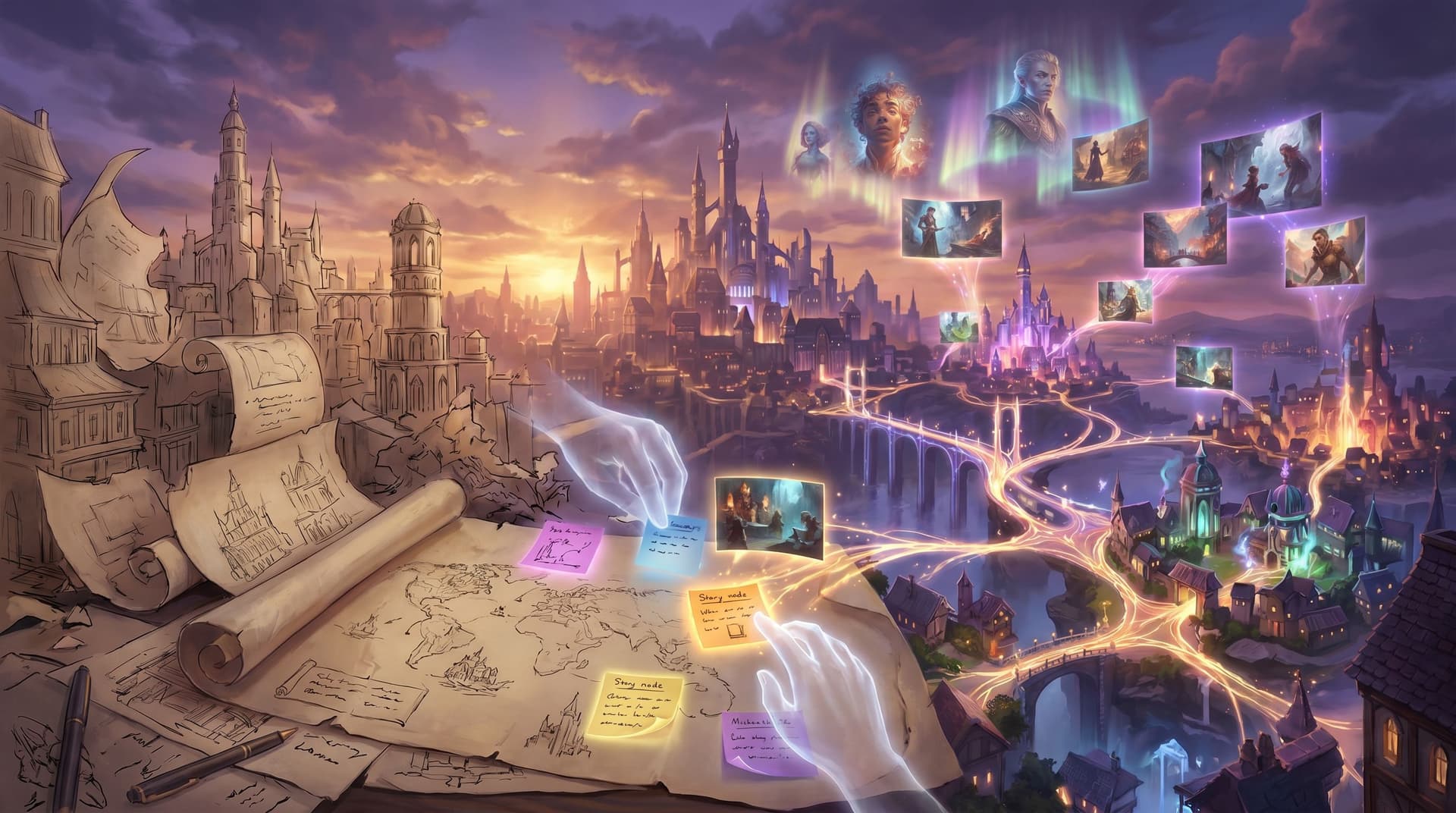
You know that 40‑page doc of worldbuilding notes you swear you’ll “use someday”? The family trees, trade routes, minor deities, and regional soup recipes that never quite make it on-screen?
Those notes are not clutter. They’re a gold mine of side quests—small, playable stories that make your world feel alive.
On a platform like Questas, you don’t need code or a team of devs to turn that lore into interactive experiences. You can spin off micro‑adventures, character vignettes, and local legends that players can explore at their own pace, all enriched with AI‑generated images and video.
This guide walks through how to transform raw worldbuilding into Questas-ready side quests that:
- Deepen your setting without overwhelming players.
- Make use of “orphaned” ideas you love but couldn’t fit in the main plot.
- Invite your audience to wander, experiment, and fall in love with your world.
Why Side Quests Are the Best Home for Your Lore
Worldbuilding is fun. Lore dumps are not.
A lore dump asks players to sit still and absorb information. A side quest asks them to do something with that information.
Side quests are powerful because they:
- Turn trivia into stakes. Instead of telling players that the river spirits hate iron, you let them decide whether to cross a warded bridge wearing metal armor.
- Show culture through action. Festivals, rituals, taboos, slang—all of these come alive when players have to navigate them.
- Give pacing relief. While your main quest handles the big arcs, side quests offer quieter, more personal stories.
- Reward curiosity. Players who poke at background details get extra scenes, items, or perspectives.
If you’ve ever felt torn between “I want to explain this cool thing” and “I don’t want to bore people,” side quests are your compromise.

Step 1: Audit Your Lore for Playable Hooks
Not every piece of lore deserves a quest. Some details are better as quiet texture in the background. Your first job is to separate read-only facts from playable hooks.
Mine your notes with three questions
Go through your docs, wikis, or notebooks and highlight anything that answers “yes” to at least one of these:
-
Can a character disagree with this?
- A law that some people ignore.
- A prophecy some factions reject.
- A tradition younger folks are rebelling against.
-
Can this cause trouble?
- A rare resource others might steal.
- A taboo that’s easy to break by accident.
- A secret only a few people know.
-
Can this be experienced in a single day?
- A festival, trial, pilgrimage, or market day.
- A storm, eclipse, or magical anomaly.
- A shift at a dangerous job.
Each “yes” is a potential side quest seed.
Classify your seeds by scale
Once you’ve highlighted candidates, group them into rough buckets:
- Micro moments (5–10 minutes of play):
Choosing how to behave at a dinner with strict etiquette; deciding whether to help a street vendor being harassed. - Compact quests (10–25 minutes):
Solving a dispute between two guilds; escorting a caravan through contested territory. - Arc-length side stories (30–60+ minutes):
Investigating a local legend; navigating a multi-day festival with shifting alliances.
On Questas, all three scales are viable. Micro moments work beautifully as little branches off your main story; longer arcs can live as standalone quests.
If you’re new to branching design, consider pairing this with the patterns in Branch Smart, Not Wide: Blueprint Patterns for Scalable Questas Stories to avoid turning every idea into a spaghetti graph.
Step 2: Choose Whose Story It Really Is
Lore is about the world. Side quests are about someone in that world.
A common mistake is to design a side quest around “explaining the history of the city” instead of “following one person’s problem in this city.” To avoid that, anchor each quest to a specific point of view.
Pick a POV lens
For each quest seed, ask:
- Who is most affected if this goes wrong?
That’s a great main character. - Who has the least power here?
That’s a great empathy-building perspective. - Who has a strong opinion about this tradition, law, or secret?
That’s a great guide or antagonist.
Examples:
- Instead of “The history of the river cult,” you follow a novice on their first night patrol.
- Instead of “How the guild elections work,” you follow a candidate deciding whether to cheat.
- Instead of “The rules of necromancy,” you follow a healer tempted to break them for a loved one.
Decide player role and distance
In Questas, you can frame the player as:
- First-person protagonist (“I sneak into the archive…”)
- Third-person director (“You advise the young prince…”)
- Multiple roles across branches (e.g., switching POVs between scenes)
For side quests, it often works best to:
- Keep the POV tight and consistent.
- Use NPCs to surface lore through conflict, not monologue.
- Let players act on beliefs about the world, then feel the consequences.
If you’re juggling several perspectives across your setting, the techniques in The Tangled Timeline: Techniques for Keeping Branching Questas Plots Coherent When Players Jump Across Perspectives can help keep your continuity straight.
Step 3: Turn Static Facts into Decisions and Consequences
A side quest lives or dies on its choices. The goal is not to quiz players on your lore, but to let them use it.
Convert lore lines into decision points
Take a line from your notes, like:
“In the city of Varyn, duels are forbidden inside temple grounds, but enforcement is lax during the Moon Festival.”
You can turn this into decisions:
- Do you accept a duel inside the temple courtyard to defend a friend’s honor?
- Do you report the duel to the temple guardians, or look the other way?
- Do you exploit the lax enforcement to stage a distraction?
Each choice reveals something about:
- The player’s values.
- The social fabric of Varyn.
- The real meaning of the rule (is it sacred, or just symbolic?).
Design at least one “quiet” branch
Not every outcome needs to be explosive. Some of the best lore moments come from:
- An awkward conversation after you break a minor taboo.
- A small favor that earns you trust with a local.
- A missed opportunity that changes how NPCs talk about you.
If you tend to only write dramatic forks, check out The Quiet Choice: Using Low-Stakes Branches to Build Empathy, Not Just Drama, in Questas for patterns that make your world feel lived-in.
Map a simple consequence loop
For each major decision, sketch:
- Immediate reaction (what happens in the next scene).
- Short-term shift (how NPCs or resources change).
- Optional long-term echo (a callback later in the main story or another side quest).
In Questas, you can:
- Use variables to track reputation, factions, or taboos broken.
- Gate future scenes or choices based on those values.
- Reuse the same side quest across multiple entry points, with different outcomes depending on past decisions.
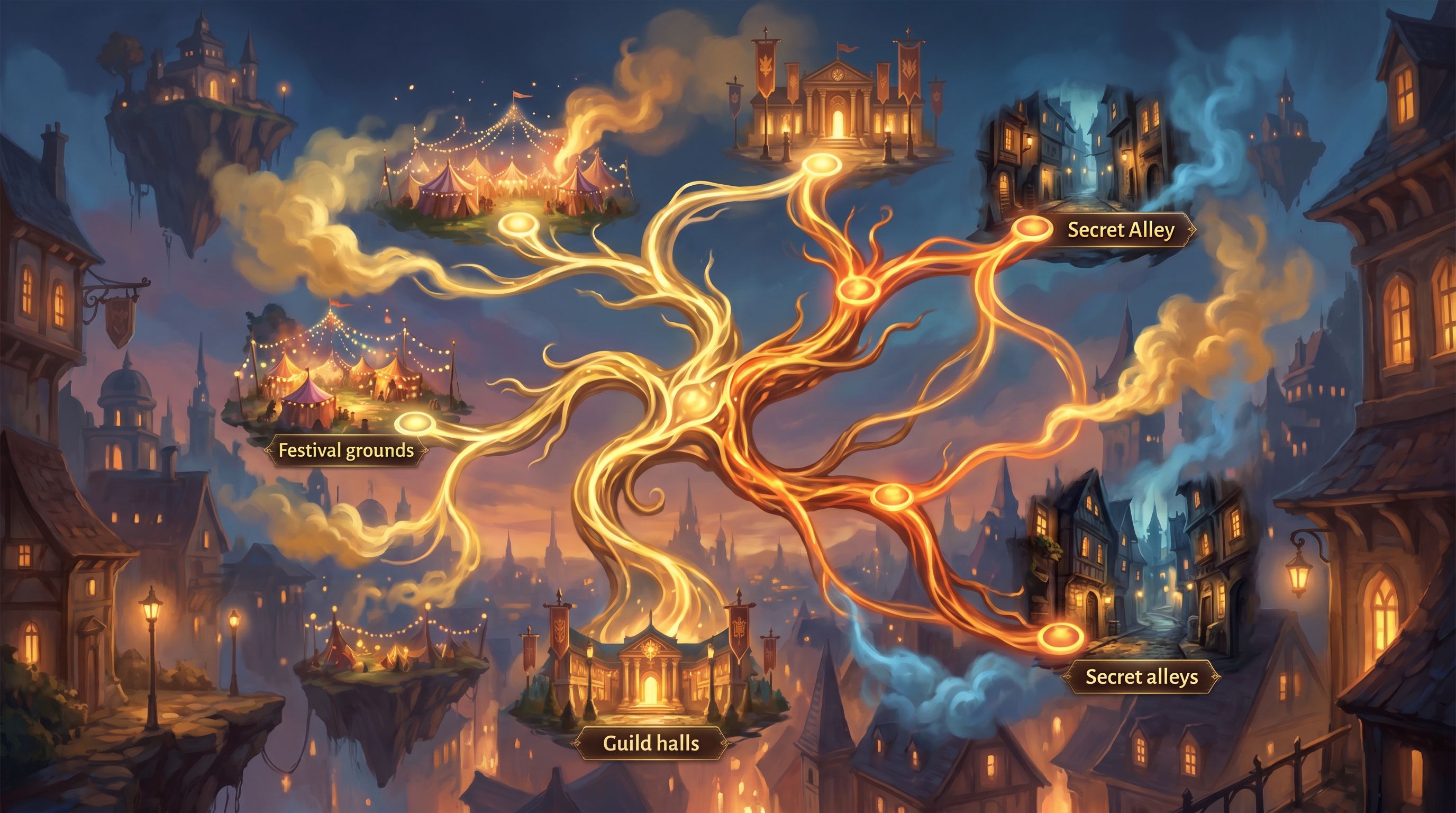
Step 4: Right-Size the Structure for a Side Quest
It’s tempting to let every side quest balloon into its own epic. Resist.
A strong side quest usually has:
- One core dilemma (what this is really about).
- 2–3 meaningful decision points.
- 1–3 endings that feel distinct but connected.
Choose a structural pattern
Here are three simple blueprints that work beautifully in Questas:
-
The Fork and Return
- Players branch into different approaches (sneak, negotiate, confront) but return to a shared resolution scene with variations.
- Great for: showing different cultural norms or factions reacting differently to the same event.
-
The Hub and Spoke
- A central location (market, festival, tavern) with 2–4 optional mini-events. Players can choose which to visit and in what order.
- Great for: giving a sense of place without building a full open world.
-
The Escalating Ladder
- A sequence of 3–4 scenes where each choice raises the stakes or clarifies the moral cost.
- Great for: taboo-breaking, political intrigue, or spiraling disasters.
If you already have a big branch map for your main story, you can think of side quests as plug-in modules that attach to specific beats rather than new roots that double your complexity.
Step 5: Let Quests Showcase Your World’s Visual Identity
Side quests are a perfect playground for your setting’s look and feel.
Because Questas supports AI-generated images and video, you can:
- Give each region a distinct color palette and lighting style.
- Make factions recognizable by silhouettes, clothing, and props.
- Use recurring visual motifs (glyphs, plants, architecture) to tie scenes together.
If you’re experimenting with different AI prompts or art directions, the techniques in AI as Mood Mixer: Blending Multiple Image Styles into One Cohesive Questas World can help keep your side quests visually consistent with your main story.
Practical tips for visual worldbuilding in side quests
- Anchor each quest in one dominant mood.
“Smoky, crowded, golden-hour market” or “cold, sterile, fluorescent archive,” not both. - Re-use key assets.
The same shrine, alley, or tavern seen at different times of day subtly tells players, “You’re still in the same place.” - Tie NPC design to lore.
If a culture reveres birds, show feathers in jewelry, architecture, and even UI elements.
Because side quests are smaller, you can iterate quickly: tweak a prompt, swap a background, or test a new style without risking your entire main campaign.
Step 6: Decide How Players Discover These Side Quests
Even the best side quest doesn’t matter if no one finds it—or if it derails your main plot at the wrong moment.
Weave side quests into your main flow
Common entry patterns:
- Location-based hooks:
Entering a district unlocks a local dispute or festival quest. - Relationship-based hooks:
Reaching a certain trust level with an NPC unlocks their personal story. - Resource or variable triggers:
Low reputation with a faction unlocks a “redemption” quest; high reputation unlocks a “favor” quest.
In Questas, you can:
- Use conditions on nodes to show side quest options only when certain flags are set.
- Add optional choices in main story scenes that branch into side quest nodes and then return.
For more on making those early moments inviting instead of overwhelming, pair this with The First Five Screens: Onboarding New Players Smoothly into Complex Questas Worlds.
Signal optionality clearly
Players should feel like side quests are opportunities, not obligations. Use:
- Framing text: “Optional: Help the spice merchant with a problem” vs. “Next: Spice merchant quest.”
- Visual cues: Icons or labels on choices that indicate “side story,” “character moment,” or “challenge.”
- Pacing breaks: Offer side quests at natural pauses, not during peak tension in the main plot.
Step 7: Recycle and Remix Your Worldbuilding Over Time
Once you’ve built a few side quests, your worldbuilding notes stop being a static archive and start behaving like a system.
Turn recurring elements into mini-systems
- A festival can show up in multiple quests across years of in‑world time, evolving as politics change.
- A taboo can be broken in different ways by different characters, with widening consequences.
- A rumor can be heard, spread, debunked, or weaponized depending on the quest.
In Questas, you can:
- Clone quest structures and reskin them for new regions or eras.
- Reuse NPCs with updated variables to show how past events changed them.
- Chain side quests so that outcomes in one unlock or reshape another.
Use player data to refine your world
Once people start playing:
- Notice which side quests get replayed—those are where your world feels richest.
- Track which choices surprise you—those reveal interpretations of your lore you hadn’t considered.
- Let that feedback loop back into your worldbuilding notes, turning them into a living document.
Over time, your side quests become a testing ground for bigger arcs, new regions, or experimental mechanics.
Bringing It All Together
Turning lore dumps into living side quests is less about inventing new content and more about changing how you use what you already have.
You:
- Audit your notes for playable hooks instead of static facts.
- Choose a clear POV so each quest feels like someone’s story, not a history lecture.
- Translate facts into decisions with meaningful, sometimes quiet consequences.
- Right-size your structure so side quests enrich the main story without overshadowing it.
- Lean on visuals in Questas to make cultures, factions, and locations instantly recognizable.
- Integrate discovery thoughtfully, signaling optionality and respecting pacing.
- Iterate and recycle, letting player behavior shape how your world evolves.
Do that, and your worldbuilding notes stop gathering dust. They become a network of playable stories your audience can wander through, argue with, and remember.
Your Next Move
If your first instinct is, “My notes are a mess,” that’s fine. You don’t need to organize everything before you start. You just need one playable hook.
Here’s a simple way to begin this week:
- Open your favorite worldbuilding doc and highlight one rule, tradition, or secret that could cause trouble.
- Ask, “Whose day gets ruined if this goes wrong?” That’s your protagonist.
- Sketch two decisions they’ll face and one consequence for each.
- Open Questas, drop those beats into the visual editor, and generate a few images that capture the mood.
- Share the link with a friend and watch how they move through your world.
You don’t have to rebuild your entire setting at once. Start with one side quest. Let it teach you what your world actually feels like in play.
From there, every page of notes is an invitation: not “Here’s everything I made up,” but “Come see how this place lives.”